

Blog / Best Practices for HTTPS Monitoring Automation
Best Practices for HTTPS Monitoring Automation
Your HTTPS setup is critical for maintaining user trust and search engine visibility. Letting SSL/TLS certificates expire can harm your SEO, trigger browser warnings, and expose your site to security risks. Here's how to avoid these issues:
- Automate HTTPS Monitoring: Manual tracking is unreliable, especially with 90-day certificates like Let's Encrypt. Automation provides consistent checks and timely alerts (e.g., 30, 14, 7, and 1 day before expiry).
- SEO Integration: Ensure HTTPS is part of your SEO workflows, like using 301 redirects and monitoring Google's HTTPS reports.
- Proactive Alerts: Set up notifications for issues like incomplete chains, hostname mismatches, or mixed content. Critical alerts should use SMS or on-call tools for faster response.
- Measure Success: Track metrics like uptime, certificate health, and SEO performance. For UAE businesses, downtime can cost up to AED 20,560 per minute.
Automated monitoring ensures your site stays secure, reliable, and SEO-friendly, especially in competitive markets like the UAE.
Common Problems in HTTPS Monitoring
Why Manual Monitoring Falls Short
Managing HTTPS certificates manually can quickly spiral into a logistical nightmare, especially as your digital presence grows. Certificates often come with a short validity period - just 90 days in many cases. Trying to keep up with these renewals manually isn’t practical. It leaves room for errors like incomplete certificate chains, hostname mismatches, and mixed content issues to slip through. According to SSL Pulse, 34% of websites suffer from weak security due to issues like incomplete chains or outdated ciphers.
SSL Labs sums it up perfectly:
SSL/TLS is a deceptively simple technology. It is easy to deploy... except that it does not, really. It turns out that it is not easy to deploy correctly.
For businesses in the UAE, managing multiple domains across various departments and time zones only adds to the complexity. Decentralised tracking makes it even harder to stay on top of certificate renewals. These manual processes don’t just increase the risk of downtime but can also erode user trust and harm your SEO efforts.
How HTTPS Issues Affect SEO and User Experience
When HTTPS configurations are flawed, the consequences hit hard and fast. Misconfigurations lead to alarming browser warnings like "Not Secure", which can scare users away. As Sean from SSL Shopper puts it:
When an SSL/TLS certificate fails, users don't think "hmm, a certificate problem." They think: "The site is down".
This user perception is just the tip of the iceberg. HTTPS issues also wreak havoc on your SEO. Google has prioritised HTTPS as a ranking factor since 2014. If your site is plagued by HTTPS errors, Google may stop crawling your pages altogether. This results in lower rankings, reduced visibility, and a shrinking crawl budget - serious setbacks in the UAE's competitive online market, where HTTPS pages dominate, accounting for over 93% of browsing time on Google Chrome.
The problems don’t stop there. Expired or mismanaged certificates can disrupt APIs, halt automated workflows, and even slow down server handshakes. For UAE businesses reliant on e-commerce or government services, these failures don’t just hurt performance - they can lead to a sharp decline in customer trust and potential breaches of local data protection standards.
How to Automate HTTPS Monitoring
Configure Automated Alerts
Setting up automated alerts is a proactive way to prevent certificate failures. Use a tiered approach for alert notifications: send a reminder 30 days before expiry for planning, another at 14 days to confirm renewal, and an urgent alert within 7 days to escalate the issue.
Configure alerts to flag issues like incomplete certificate chains or hostname mismatches (e.g., covering "example.com" but not "www.example.com"). These errors can lead to trust issues for visitors. For UAE businesses relying on Let's Encrypt or other ACME-based systems, it's crucial to set alerts for failed renewal challenges rather than waiting for certificates to expire. Additionally, enable mixed content detection to identify secure HTTPS pages that load resources over insecure HTTP links - these can trigger browser warnings that undermine user trust.
For critical alerts (less than three days to expiry), use SMS or on-call tools instead of email to ensure immediate action. Include essential details in every notification, such as the certificate fingerprint, affected hosts, responsible team members, and steps for resolution. This reduces downtime and speeds up the response process.
Once alerts are configured, the next step is to integrate HTTPS monitoring into your SEO workflows.
Add HTTPS Monitoring to SEO Workflows
Incorporating HTTPS monitoring into SEO audits is essential. Since 2014, Google has prioritised HTTPS pages, so ensure that XML sitemaps, canonical tags, and robots.txt files all point to HTTPS versions. Use 301 redirects at the edge (via your CDN or load balancer) to redirect HTTP traffic to HTTPS, preserving SEO equity while reducing server load.
Regularly review Google Search Console's HTTPS report to identify issues preventing certain URLs from being indexed as HTTPS. Common problems include incorrect canonical tags or sitemaps pointing to insecure versions. For teams using CI/CD pipelines, integrate certificate validation into the deployment process. This approach catches near-expiry certificates before they affect search rankings or user experience, a critical measure in the UAE's competitive online market.
Using Wick's Four Pillar Framework

The Wick framework complements automated alerts and SEO integrations, embedding HTTPS monitoring into your overall digital strategy.
The Plan & Promote pillar of this framework offers a structured way to incorporate HTTPS monitoring into broader SEO efforts. For example, you can align certificate management with your digital marketing workflows to maintain site security and availability - key factors for search visibility.
Wick provides UAE businesses with data-driven insights and strategic guidance to implement automated monitoring systems tailored to their growth objectives. This includes tracking multiple domains across departments, setting up escalation paths for alerts, and embedding HTTPS checks into routine performance tracking. By fostering a unified digital ecosystem, this framework ensures HTTPS monitoring supports other efforts like content creation, paid advertising, and customer journey optimisation - without compromising security or marketing goals.
Manual vs. Automated HTTPS Monitoring
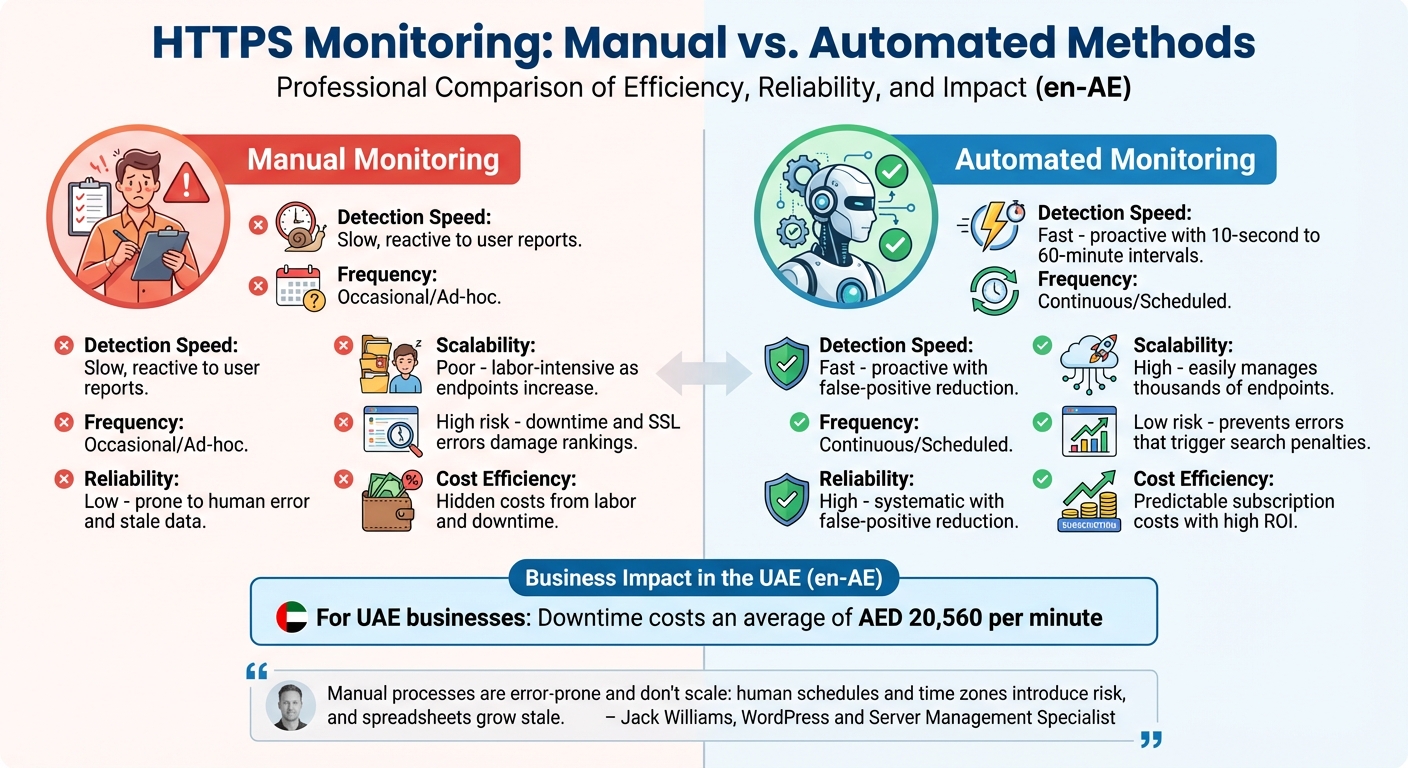
Manual vs Automated HTTPS Monitoring: Key Differences and Benefits
Relying on manual HTTPS monitoring often involves sporadic audits and individual effort, which can lead to mistakes and inefficiencies - especially as the number of endpoints increases. This method is heavily dependent on human schedules, making it prone to oversights. As Jack Williams, a WordPress and Server Management Specialist at Moss.sh, puts it:
Manual processes are error-prone and don't scale: human schedules and time zones introduce risk, and spreadsheets grow stale.
These challenges make a strong case for adopting automated monitoring solutions.
Automated HTTPS monitoring, on the other hand, leverages synthetic probes to continuously check uptime, response codes, and SSL health in near real-time, with intervals ranging from just 10 seconds to 60 minutes. This proactive approach identifies issues before users are affected. Automated tools can manage thousands of endpoints globally, bypassing the limitations of manual efforts. For businesses in the UAE juggling multiple domains across departments, this capability is particularly valuable.
Comparison Table: Manual vs. Automated Methods
| Feature | Manual Monitoring | Automated Monitoring |
|---|---|---|
| Detection Speed | Slow; reactive to user reports or scheduled audits | Fast; proactive with 10-second to 60-minute intervals |
| Frequency | Occasional/Ad-hoc | Continuous/Scheduled |
| Reliability | Low; prone to human error and stale data | High; systematic with false-positive reduction |
| Scalability | Poor; labour-intensive as endpoints increase | High; easily manages thousands of endpoints |
| SEO Impact | High risk; downtime and SSL errors damage rankings | Low risk; prevents errors that trigger search penalties |
| Cost Efficiency | Hidden costs from labour and downtime | Predictable subscription costs with high ROI |
For businesses managing critical infrastructure, it’s essential to configure automated checks from at least three different geographic locations. This strategy helps avoid false positives caused by local network issues. By employing a multi-location approach, alerts are more likely to reflect real problems rather than temporary regional disruptions - a crucial consideration for companies serving customers across the UAE and the wider GCC region.
sbb-itb-058f46d
How to Measure HTTPS Monitoring Success
Track HTTPS Performance Metrics
To evaluate the success of HTTPS automation, focus on four key areas: availability, security, performance, and SEO stability. Begin by examining certificate health metrics. Keep an eye on the number of days until certificate expiration, verify the completeness of the certificate chain, and ensure the validity of the Certificate Authority. These checks are essential, as expired SSL certificates can deter up to 70% of website visitors - a serious risk for any business.
Next, assess performance and availability metrics to understand how effectively your infrastructure serves users. Monitor probe success rates (uptime), response latency during the HTTPS handshake, and DNS lookup times. For e-commerce websites in the UAE, these metrics are directly tied to revenue, with downtime costing an average of AED 20,560 per minute. Additionally, track your team's incident management efficiency by measuring Time to Detection (TTD), Mean Time to Acknowledge (MTTA), and Mean Time to Resolution (MTTR). These metrics highlight how swiftly your team can identify and resolve certificate-related issues before they impact users.
In terms of SEO, use Google Search Console to monitor the ratio of HTTPS to HTTP URLs and flag any "HTTPS not evaluated" errors. This helps maintain both security and search rankings. Finally, ensure configuration integrity by checking redirect success rates (confirming HTTP redirects correctly to HTTPS), verifying the use of modern protocol versions like TLS 1.2 or 1.3, and validating the strength of your cipher suites. These steps not only improve security but also provide a solid foundation for refining your HTTPS monitoring automation.
Improve Your Automation Process
Once you've established these metrics, use them to fine-tune your automation process for better results. Start by creating baselines from historical data to identify any performance drifts over time. Compare HTTPS response data with server-side metrics - such as CPU usage, memory, and disk I/O - to pinpoint whether performance issues stem from application code or infrastructure. Ensure that renewed certificates are correctly deployed across all endpoints.
An integrated approach can provide deeper insights. For example, Wick's data analytics tool correlates certificate health with SEO performance, uncovering trends that might be overlooked during manual reviews. This methodology, part of Wick's Four Pillar Framework, ensures that your automation evolves based on actual performance data rather than assumptions. By continuously refining your process, you'll stay ahead of potential issues and maintain a robust HTTPS environment.
Conclusion
Automated HTTPS monitoring transforms security from a reactive measure into a proactive strategy. With Google's ranking favouring HTTPS pages, maintaining certificate health has become a critical priority. Automation helps prevent costly issues like expired certificates, mixed content warnings, and configuration errors that can disrupt Google indexing.
In the UAE's competitive landscape, where consumer trust is paramount - especially in sectors like e-commerce and fintech - automated HTTPS monitoring safeguards brand reputation and ensures compliance with data protection standards. Protocols such as TLS 1.3 and HSTS not only enhance security but also improve website performance and user experience.
"SSL monitoring is not just a best practice; it's a necessity for maintaining a secure and reliable online presence." – Farouk Ben, Author
Despite these advancements, many organisations still face challenges due to the cybersecurity skills gap and the complexity of modern infrastructures.
To address these hurdles, Wick's Four Pillar Framework integrates HTTPS monitoring into a broader digital strategy. By combining data analytics with SEO insights, Wick connects certificate health to search performance, uncovering patterns that manual reviews often overlook. This framework includes practical steps like setting up 30-day expiry alerts, implementing HSTS, auditing redirect chains, and monitoring Certificate Transparency logs. These practices ensure that your automated HTTPS monitoring adapts alongside your business, fostering a secure and high-performing online presence - essential for thriving in the UAE's dynamic market.
FAQs
How can automating HTTPS monitoring enhance your website's SEO performance?
Automating HTTPS monitoring is a smart way to keep your website secure and running smoothly. It works by routinely checking your SSL/TLS certificates, spotting mixed-content problems, and flagging any security misconfigurations. Plus, it sends timely alerts if your site experiences downtime, ensuring a seamless experience for your visitors.
Staying on top of these issues means search engines like Google can reliably index the secure version of your site. This prevents penalties for insecure or inaccessible pages, which is key to maintaining or even boosting your SEO rankings. In competitive markets like the UAE, strong SEO performance is essential for standing out and driving growth.
What are the main advantages of adding HTTPS monitoring to your SEO strategy?
Integrating HTTPS monitoring into your SEO plan is a smart way to catch potential issues early - things like expired certificates, SSL/TLS misconfigurations, or mixed-content errors. These problems can lead to alarming security warnings, erode user trust, and even hurt your search rankings.
By tackling these challenges ahead of time, HTTPS monitoring helps ensure your site stays reliable, performs well, and meets compliance standards. Plus, since Google favours HTTPS URLs, this practice boosts your site's credibility while enhancing the user experience.
Why is automated HTTPS monitoring essential for businesses in the UAE managing multiple domains?
Automated HTTPS monitoring plays a crucial role for businesses in the UAE managing multiple domains. It helps detect and address issues such as outages, expired SSL certificates, or performance lags swiftly. Ignoring these problems can result in lost revenue, diminished customer confidence, and even penalties that negatively impact SEO rankings.
With automation, businesses can keep their websites secure, dependable, and search engine-friendly. This not only protects their reputation but also ensures financial stability in an increasingly competitive online market.