

Blog / Unified Ecosystems and Compliance
Unified Ecosystems and Compliance
In the UAE, businesses face the dual challenge of integrating digital tools while adhering to strict data protection laws like the Personal Data Protection Law (PDPL). A unified digital ecosystem connects platforms such as Customer Data Platforms (CDPs), AI, and marketing tools, ensuring seamless data flow and reducing manual errors. Compliance, however, is critical - not just to avoid penalties (up to AED 5,000,000), but also to build trust and enable global operations under frameworks like GDPR.
Key Takeaways:
- Unified Ecosystems: Centralise data across systems (e.g., CRM, analytics) for efficiency and compliance.
- Compliance Risks: Penalties range from AED 10,000 to AED 28,000,000, varying by jurisdiction (e.g., DIFC, ADGM).
- Core Elements: CDPs, AI tools, and governance frameworks streamline data management while supporting UAE regulations.
- Wick's Four Pillar Framework: Ensures compliance through privacy-first design, marketing consent, secure storage, and transparent AI use.
Scaling Digital Assets with Trust: Identity and Compliance as Core Infrastructure
Core Elements of Unified Digital Ecosystems
A well-structured digital ecosystem brings together data management, process automation, and strong security measures to ensure smooth data flow and compliance with stringent regulations. Together, these elements create a solid foundation for meeting regulatory standards.
Customer Data Platforms and Data Integration
Customer Data Platforms (CDPs) act as the central hub of a digital ecosystem. They gather, consolidate, and organise data from various sources - such as digital platforms, CRMs, and offline systems - into unified customer profiles. This ensures that customer data remains consistent and up-to-date across all channels. With third-party cookies losing their effectiveness, businesses in the UAE are increasingly turning to CDPs to leverage their own first-party data for both engagement and compliance.
By linking systems like websites, email platforms, analytics tools, and customer service applications, CDPs ensure that any updates - such as changes in contact details or consent preferences - are synchronised across all channels. This is particularly important under the UAE Personal Data Protection Law, where maintaining accurate and consistent records is a regulatory requirement.
Marketing Automation and AI Tools
Once a unified data structure is in place, marketing automation and AI tools can bring the data to life, enabling personalised customer interactions. These tools allow for dynamic audience segmentation and automated workflows, both of which depend heavily on high-quality data. As Salesforce highlights:
AI and agentic AI are only as good as the underlying data.
A practical example comes from ezCater, which in 2025 deployed AI agents trained on a unified platform that combined CRM, data warehouse, and transactional data. These agents automated order management, even accounting for specific dietary preferences. For UAE businesses, automation tools reduce compliance risks by using AI to classify data automatically, tagging sensitive records to ensure they are handled appropriately. Additionally, automated governance tools monitor data movement, enforce security policies, and apply retention rules in real time.
Data Governance and Security Features
Supporting these automated systems requires a strong governance framework. This framework defines the rules, processes, and roles needed to keep data accurate, accessible, and secure throughout its lifecycle. It specifies who can access certain data, under what conditions, and how it must be protected.
Technical safeguards are a critical part of this framework. In the UAE, specific measures like AES-256 encryption for stored data, TLS 1.3 for data in transit, and multi-factor authentication paired with role-based access controls (RBAC) are mandatory. RBAC ensures that employees have the right level of access to perform their duties while restricting unauthorised access to sensitive information.
Clear governance processes are equally essential. These processes ensure that every data transfer complies with UAE regulations. For instance, maintaining a Record of Processing Activities (ROPA) is crucial. This document outlines data categories, authorised personnel, processing durations, and applied security measures. Breach notification protocols are also vital, requiring organisations to inform the UAE Data Office and affected individuals promptly in the event of a security incident. For example, in 2025, the ADGM Commissioner of Data Protection fined Okadoc Technologies Limited USD 20,000 (approximately AED 73,400) for failing to address data subject access requests within the required timeframe.
| Data Category | Examples | Protection Level | Retention Period |
|---|---|---|---|
| Personal Data | Names, contact info, ID numbers | Standard | Business necessity |
| Sensitive Data | Health records, biometric data | Enhanced | Legal minimum |
| Special Categories | Religious beliefs, genetic data | Maximum | Explicit consent duration |
| Operational Data | System logs, performance metrics | Basic | Technical requirements |
When CDPs, automation tools, and governance frameworks work together, they create an ecosystem where data flows securely, processes run efficiently, and compliance becomes a natural part of operations. This integrated system not only simplifies workflows but also provides a single source of truth, ensuring that reliable data drives sustainable business growth.
How Wick's Four Pillar Framework Supports Compliance
Wick's Four Pillar Framework weaves compliance into every phase of building a digital ecosystem, ensuring businesses in the UAE adhere to regulatory standards from the ground up. This approach aligns seamlessly with the UAE Federal Personal Data Protection Law (PDPL), which became effective on 2 January 2022. Below is a breakdown of how each pillar integrates compliance into its processes.
Pillar 1: Build & Fill
This pillar ensures Privacy by Design is at the forefront, making consent mechanisms compliant with PDPL without compromising the user experience. Privacy notices are crafted to be clear and accessible, explaining the purpose of data collection and its legal basis. Under Article 4 of the PDPL, personal data processing without consent is strictly prohibited unless it falls under specific exceptions, such as public interest or fulfilling contractual obligations. Consent mechanisms are designed to be explicit, freely given, and unambiguous, ensuring they meet the highest standards.
Pillar 2: Plan & Promote
Marketing strategies, such as SEO, paid ads, and influencer campaigns, are developed with compliance in mind, adhering to Federal Law No. 15 of 2020 (Consumer Protection Law). This law prohibits using consumer data for marketing without clear, informed consent. Additionally, promotional content undergoes thorough reviews to meet UAE Media Council standards. These standards impose penalties - ranging from AED 100,000 to AED 1 million - for violations like unauthorised use of national symbols or spreading AI-generated misinformation. Campaign performance is monitored using data tools that prioritise privacy safeguards.
Pillar 3: Capture & Store
The framework enforces strict data retention policies, ensuring minimal storage of personal data. For businesses operating across multiple jurisdictions, such as Federal UAE, DIFC, or ADGM, the framework maps data flows and incorporates safeguards like Standard Contractual Clauses for cross-border transfers. In the healthcare sector, Federal Law No. 2 of 2019 mandates that patient data cannot be transferred outside the UAE without prior regulatory approval, and health records must be retained for at least 25 years. The framework also supports data sovereignty with documented processing activities and clear retention schedules.
Pillar 4: Tailor & Automate
AI-driven personalisation and automation tools are operated with transparency and human oversight. Wick's framework ensures that automated workflows respect individual rights under PDPL Article 18. As regulations evolve, such as the UAE's launch of the world's first AI-enabled Regulatory Intelligence Office in April 2025, this pillar ensures autonomous systems remain accountable and fair. It also aligns with the UAE Charter for AI's principles. To combat "AI-washing", AI vendors are vetted through the Dubai AI Business Activity Classification System to confirm they hold the Dubai AI Seal, introduced in 2025.
| Pillar | Focus | Key UAE Regulation |
|---|---|---|
| Build & Fill | Privacy by Design, consent mechanisms | Federal Decree Law No. 45 of 2021 (PDPL) |
| Plan & Promote | Marketing consent, content standards | Federal Law No. 15 of 2020 (Consumer Protection Law) |
| Capture & Store | Data sovereignty, retention policies | Federal Law No. 2 of 2019 (Healthcare Data) |
| Tailor & Automate | AI transparency, automated decision rights | PDPL Article 18, UAE Charter for AI |
sbb-itb-058f46d
How to Build a Compliant Unified Ecosystem
Creating a compliant unified ecosystem means aligning your business objectives with regulatory requirements. This involves evaluating risks, understanding data flows, and implementing secure tools. Here's how to approach it step by step.
Step 1: Define Business Goals and Compliance Requirements
Start with a risk assessment to identify which cloud setups and data processes could pose the highest risks to your operations. For financial institutions, addressing supervisory expectations is a must before moving forward, as outlined by the Central Bank of the UAE. This approach not only ensures compliance but also improves efficiency, delivering 30% better compliance outcomes while cutting operational costs.
Next, compile a data inventory that documents what data is collected, where it is stored, how it is protected, and who has access to it. Following the UAE Smart Data Framework, classify your data into three levels: Open, Confidential, and Secret.
Develop a governance framework that clearly defines decision-making responsibilities and risk management protocols for cloud computing and outsourcing. To make well-rounded decisions about data access and its business implications, form a governance panel with representatives from legal, IT, and marketing teams.
Once your goals are defined, map out your data flows to identify weak points and assign governance roles accordingly.
Step 2: Map Data Flows and Set Governance Standards
Trace your data’s journey from its origin to its destination. This mapping exercise helps you connect data fields across different sources and spot potential security risks during transmission. Assign clear governance roles to oversee data quality and security.
"Data governance refers to a system that makes sure only authorised people can interact with specific data - while controlling what they can do, in which situation, and the methods they can use." - Fortinet
Apply the principle of least privilege, limiting access to ensure users only interact with data essential for their roles. Use standardised metadata, data formats, and schemas to make your data easy to locate and reuse across different teams or entities. For international data transfers, adopt Standard Contractual Clauses (SCCs) or Binding Corporate Rules (BCRs) to comply with global regulations.
With your data flows mapped and governance in place, you’re ready to implement tools that secure your system.
Step 3: Deploy Tools and Configure Compliance Features
Select cloud providers with UAE-based data centres to meet local data sovereignty requirements under the PDPL. For instance, the AWS Middle East (UAE) Region allows businesses to store data within the country while reducing latency.
Set up Identity and Access Management (IAM) tools with Multi-Factor Authentication (MFA) to control access to sensitive data. Encrypt your data comprehensively and use API management tools with strong cybersecurity measures. Organisations that embrace "privacy by design" principles often achieve regulatory approvals 60% faster.
"Institutions should ensure that the use, transmission and storage of Data in a Cloud Computing arrangement complies with applicable laws and regulations and is secured from unauthorised access." - Central Bank of the UAE (CBUAE)
Keep detailed audit trails and generate compliance reports to meet the Central Bank of the UAE's auditability requirements. Additionally, establish exit and resolution strategies to ensure business continuity. Regular monitoring and mature incident response systems can help resolve breaches 50% faster, significantly reducing regulatory penalties.
Compliance Challenges and Best Practices for the UAE
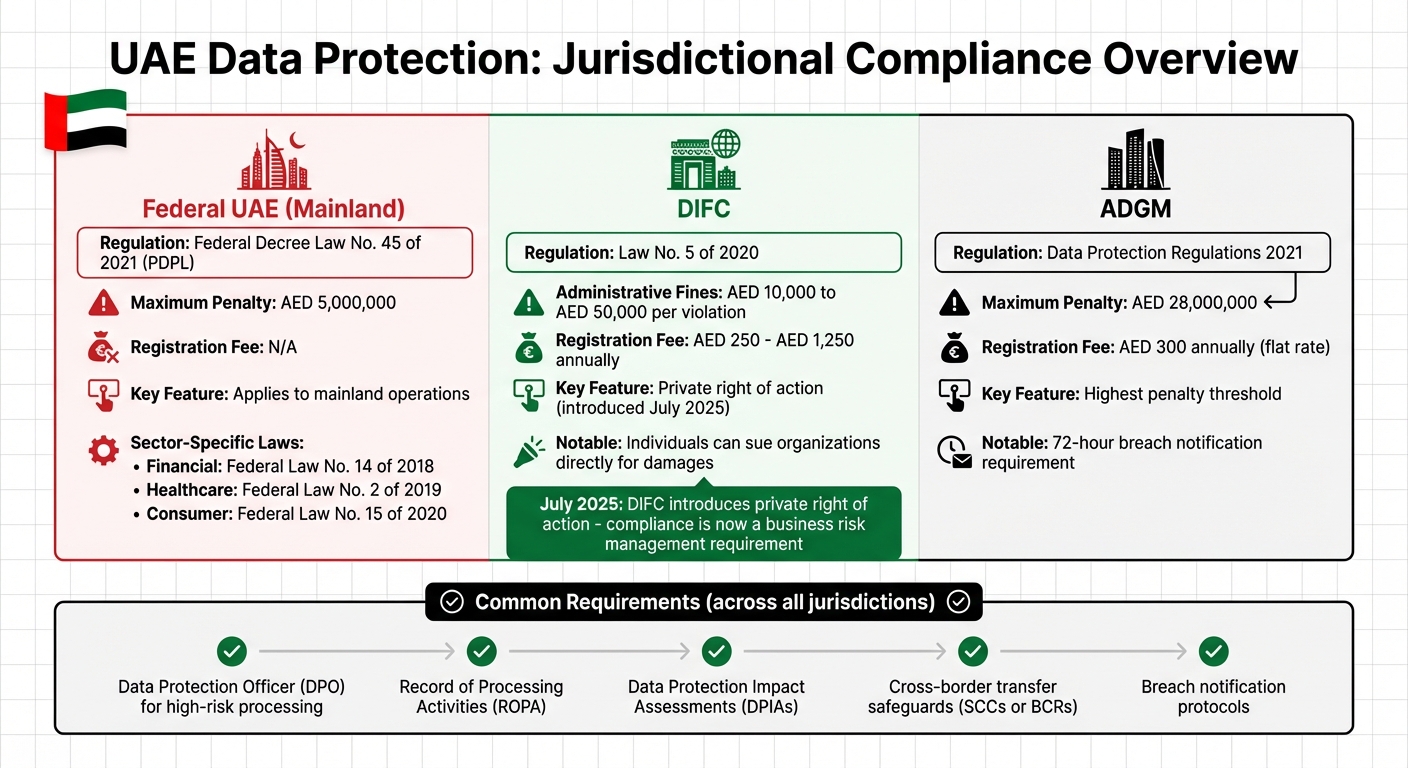
UAE Data Protection Penalties and Compliance Requirements by Jurisdiction
UAE Data Sovereignty Regulations
In the UAE, data protection regulations vary across jurisdictions. Mainland operations adhere to Federal Decree Law No. 45 of 2021, the DIFC follows Law No. 5 of 2020, and the ADGM enforces the Data Protection Regulations 2021.
Each framework imposes different penalties for non-compliance. For example, the DIFC levies administrative fines ranging from AED 10,000 to AED 50,000 per violation, while the ADGM can impose fines as high as AED 28 million. A major development occurred in July 2025, when the DIFC introduced a private right of action, empowering individuals to sue organisations directly for damages caused by non-compliance.
"The private right of action and increased maximum penalties transform compliance from administrative priority to business risk management requirement." – Abdulla Alateibi Advocates & Legal Consultancy
Sector-specific regulations add further layers of complexity. Financial institutions must comply with Federal Law No. 14 of 2018, while healthcare providers are governed by Federal Law No. 2 of 2019. Additionally, the Consumer Protection Law (Federal Law No. 15 of 2020) prohibits using consumer data for marketing purposes without explicit consent.
For cross-border data transfers, organisations must ensure that the destination country provides an "adequate" level of data protection. If not, they must adopt Standard Contractual Clauses (SCCs) or Binding Corporate Rules (BCRs) to ensure compliance. Fees for data protection registration also differ: the DIFC charges between AED 250 and AED 1,250 annually, while the ADGM imposes a flat annual fee of AED 300.
As digital ecosystems evolve, these diverse regulatory requirements add significant complexity to compliance efforts.
Maintaining Compliance as You Scale
Scaling a unified digital ecosystem while maintaining compliance is no small feat. As operations expand, organisations must remain vigilant to uphold integrated compliance standards. Research indicates that businesses with strong individual rights management systems face 75% fewer regulatory inquiries, and those with mature incident response capabilities resolve data breaches 50% faster.
To navigate these challenges, organisations should:
- Appoint a Data Protection Officer (DPO): This is essential for high-risk data processing, large-scale handling of sensitive information, or systematic monitoring.
- Maintain an updated Record of Processing Activities (ROPA): Proper documentation of data flows and roles is critical.
- Conduct Data Protection Impact Assessments (DPIAs): Before implementing automated decision-making tools or profiling systems, assess potential risks. As regulatory focus on AI and automation grows, data subjects now have the right to object to decisions made solely by automated methods.
- Develop breach response protocols: Ensure your organisation can meet the 72-hour breach notification requirement enforced by some UAE jurisdictions.
Formalising vendor relationships is another critical step. Use Data Processing Agreements (DPAs) to define security standards and breach notification procedures clearly. Automating data classification and offering user-friendly preference centres allow individuals to update or withdraw consent easily, ensuring compliance remains intact.
To address these scaling challenges, structured frameworks like Wick's Four Pillar Framework can provide a systematic approach to maintaining compliance in a growing digital landscape.
Conclusion
Creating a unified digital ecosystem in the UAE is about more than just meeting regulatory requirements - it's a cornerstone for long-term business growth. By aligning with Federal Decree Law No. 45 of 2021 and local frameworks, organisations not only sidestep penalties but also cultivate enduring customer trust. Research highlights that strong compliance practices can bring operational advantages.
The UAE's ambitious digital transformation plan, which aims for 100% digitisation of federal government services by 2025, offers businesses both opportunities and challenges. Companies that adopt frameworks like the UAE Smart Data Framework and UAE Pass position themselves to scale operations efficiently while safeguarding data sovereignty. Meanwhile, the Unified Digital Platform Policy helps transform traditional services into streamlined digital offerings, boosting efficiency and improving user experiences. These priorities are widely recognised by industry leaders.
"The digital trust imperative extends beyond mere compliance - it represents a strategic opportunity to differentiate your business, build lasting customer relationships, and position your organization for sustainable growth in the UAE's thriving digital economy." – Krystyna Sokolovska, Inlex Partners
Furthermore, organisations with advanced incident response capabilities can address breaches 50% faster and face 40% fewer regulatory hurdles by adopting cross-border data transfer frameworks. Building a resilient infrastructure involves adopting interoperability standards, appointing dedicated Data Protection Officers, and using privacy-focused technologies.
Rather than viewing compliance as a limitation, businesses should see it as a driver of innovation. Structured approaches, like Wick's Four Pillar Framework, provide scalable solutions for building compliant ecosystems. Such strategies ensure that your digital integration efforts remain both competitive and aligned with regulatory demands, reinforcing the idea that effective compliance is a key driver of sustainable growth in the UAE.
FAQs
How does a unified digital ecosystem help businesses comply with UAE data protection laws?
A unified digital ecosystem plays a key role in helping businesses across the UAE stay aligned with data protection laws. It provides a clear framework to handle data securely and responsibly, ensuring adherence to regulations like Federal Decree Law No. 45 of 2021. This law focuses on critical aspects such as secure data processing, obtaining explicit consent, and regulating cross-border data transfers.
By combining data governance, privacy safeguards, and interoperability standards, this ecosystem enables smooth and compliant data exchanges. It also reflects the UAE's Smart Data Principles, which prioritise transparency, reliability, and efficient data management while maintaining a strong focus on privacy and confidentiality.
What are the main elements of Wick's Four Pillar Framework for ensuring compliance in unified digital ecosystems?
Wick's Four Pillar Framework is all about building compliance and governance directly into the structure of unified digital ecosystems. The focus lies on four key areas: data security, regulatory adherence, transparency, and trustworthiness. Together, these elements aim to support steady growth while staying aligned with governance standards.
This framework is tailored to meet regional needs, including the UAE’s Digital Data Interoperability Principles and Unified Digital Platform Policy. These policies emphasise secure data sharing, protecting user privacy, and adhering to local regulations. By weaving these principles into its approach, Wick enables organisations to create dependable and regulation-compliant digital systems that fit seamlessly into the UAE's rapidly advancing digital environment.
How can businesses in the UAE maintain data sovereignty when using cloud services?
To ensure data sovereignty while using cloud services in the UAE, businesses must align with the country's regulatory requirements and security standards. The UAE’s National Cloud Security Policy provides guidelines on cloud governance, security measures, and risk management, enabling organisations to safeguard their data within the nation’s borders.
The Personal Data Protection Law (PDPL) mandates that businesses handle personal data with consent, uphold confidentiality, and implement strong security measures. It also governs cross-border data transfers to protect privacy and ensure compliance. By following these regulations and establishing effective governance practices, businesses can confidently utilise cloud services while retaining complete control over their data.