

Blog / UAE Mobile Shopping Insights 2025
UAE Mobile Shopping Insights 2025
Mobile shopping in the UAE reached new heights in 2025. With 67% of consumers using smartphones for their latest retail purchases - a 23% rise since 2022 - mobile commerce is now the top retail channel in the UAE. Residents spend an average of 17 days each month browsing on their phones, with 73% comparing prices or checking rewards while in-store. Millennials lead this shift, with 73% preferring mobile-first shopping.
Key takeaways:
- Mobile payments: 32% of UAE shoppers use biometric authentication, double the global average.
- Social commerce: 73% made purchases directly via platforms like Instagram and TikTok.
- Mobile transactions: Daily online transactions surged by 320% since 2020.
- Top categories: Electronics (33.3% revenue share) and fashion (30.2%) dominate mobile sales.
The UAE’s advanced 5G infrastructure and rising consumer trust have solidified its position as a global leader in mobile commerce. Retailers must focus on secure payment options, personalised shopping experiences, and seamless cross-channel integration to meet growing consumer expectations.
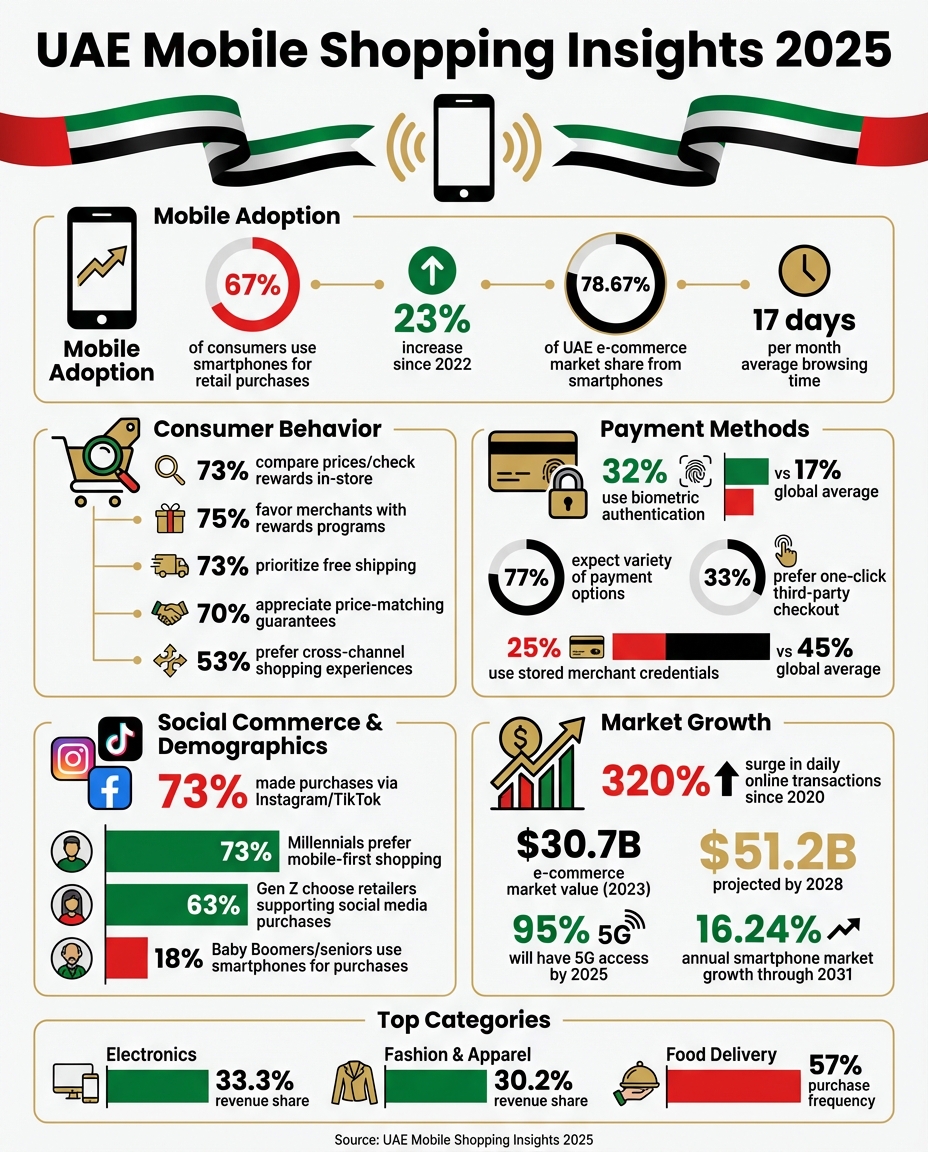
UAE Mobile Shopping Statistics 2025: Key Consumer Trends and Market Data
Inside Dubai’s new ecosystem for digital commerce growth
sbb-itb-058f46d
UAE Mobile Shopping Consumer Behavior
To understand what motivates UAE shoppers to make purchases on their mobile devices, some clear trends emerge. For instance, 75% of UAE shoppers favour merchants offering rewards programmes, while 73% prioritise free shipping, and 70% appreciate price-matching guarantees. These factors play a direct role in influencing buying decisions.
Another key aspect is cross-channel integration. 53% of UAE consumers prefer shopping experiences that merge digital and in-store options, but only 56% of retailers currently provide such features. This gap presents both a challenge and an opportunity. For example, when shoppers can check store inventory online or use loyalty points during in-person visits, they’re more likely to finalise their purchases. Below, we break down consumer expectations, generational shopping habits, and the payment methods shaping mobile commerce in the UAE.
What Consumers Want Most
Payment flexibility stands out as a major priority for UAE shoppers. 77% expect a variety of payment options, including biometric authentication, digital wallets, and one-click checkouts. These preferences underline the demand for fast, seamless transactions.
Slow payment processes often lead to abandoned carts, making speed and ease critical for mobile shopping success. Retailers who simplify their checkout systems without compromising security tend to enjoy higher conversion rates and stronger customer loyalty.
Age Group Shopping Patterns
Generational trends also reveal interesting insights into mobile shopping habits. Millennials lead the way, with 73% embracing mobile-first retail, making them the primary drivers of this trend in the UAE. Generation X also demonstrates strong mobile shopping habits, even surpassing Generation Z in some areas. In contrast, only 18% of Baby Boomers and seniors used a smartphone for their most recent purchase, highlighting a notable digital divide.
Shoppers aged 30–40 are especially prone to impulse buying, often influenced by family needs and frequent mall visits. This group is highly responsive to promotional discounts and engaging store environments, making them a key audience for retailers looking to boost mobile-driven sales.
Mobile Payment Methods
Biometric authentication has become a leading choice for UAE consumers. 32% used biometric methods like fingerprint or facial recognition for their most recent online purchase, nearly double the global average of 17%. This preference reflects the UAE’s advanced digital infrastructure and the growing demand for secure, efficient transactions.
Interestingly, only 25% of UAE shoppers relied on credentials stored with merchants for their latest purchase, compared to a global average of 45%. This suggests a stronger preference for third-party wallets or one-click solutions over storing payment data directly with retailers. Visa Click to Pay caters to this demand by using tokenisation and device-based biometric authentication, ensuring sensitive data remains protected.
| Payment Method Feature | UAE Adoption Rate | Global Average |
|---|---|---|
| Biometric Authentication | 32% | 17% |
| Stored Merchant Credentials | 25% | 45% |
| One-Click Third-Party Checkout | 33% | 17% |
Social commerce is also gaining traction. 63% of Gen Z shoppers in the UAE choose retailers that support purchases directly through social media platforms. For merchants, this means integrating secure, user-friendly payment solutions across multiple platforms is no longer optional but essential to meet consumer expectations.
UAE Mobile Infrastructure and Market Data
The UAE has firmly established itself as a leader in mobile commerce, thanks to its strategic investments in infrastructure and the customized marketing solutions that support mobile-first consumer habits. These advancements not only support but also amplify the trends driving mobile commerce, making the UAE a standout in this space.
5G Networks and Mobile Data Growth
The UAE’s robust technological framework underpins its mobile-first society. By 2025, 95% of UAE residents will have access to 5G networks, offering ultra-low latency of under 20 milliseconds. This connectivity has made advanced shopping features like augmented reality try-ons and high-definition product videos a seamless part of the online shopping experience.
Additionally, innovations like biometric authentication have streamlined mobile checkouts, cutting transaction times by 30–40% and reducing cart abandonment rates. With smartphones now accounting for 78.67% of the UAE e-commerce market share in 2025, the country’s mobile-first approach is undeniable.
Looking ahead, the smartphone market is expected to grow at an annual rate of 16.24% through 2031, outpacing all other device types. Foldable screens, predicted to reach 1 million users in the UAE by 2027, will further push businesses to optimise mobile apps for these evolving devices.
E-Commerce Market Size and Product Categories
The UAE’s e-commerce market is booming, valued at $30.7 billion in 2023 and projected to hit $51.2 billion by 2028. Mobile devices, including smartphones and tablets, play a crucial role, contributing 44% of the total e-commerce market value as of 2021 and expected to drive $4.6 billion in mobile retail sales by 2026.
Product categories show varying levels of adoption in mobile shopping. Electronics leads with a 33.3% revenue share, followed by fashion and apparel at 30.2%. However, when it comes to purchase frequency, food delivery tops the list at 57%, followed by clothing and fashion at 48%, and travel at 38%. Notably, the food and beverages category is expected to grow at a rate of 13.16% annually through 2031, while fashion and apparel currently hold a 21.59% market share.
| Product Category | Revenue Share (2023/2024) | Purchase Frequency Share |
|---|---|---|
| Electronics | 33.3% | N/A |
| Fashion & Apparel | 30.2% | 48% |
| Food Delivery | 17.0% | 57% |
| Travel | N/A | 38% |
Daily online transactions have surged by 320% since 2020, reflecting not just market growth but also increasing consumer trust in mobile commerce platforms.
Mobile-First Content Strategies for UAE E-Commerce
With the UAE’s cutting-edge 5G and digital infrastructure, mobile-first strategies have become essential to meet the growing expectations of shoppers in the region. From secure payments to personalised rewards and cross-channel experiences, these strategies cater to the unique preferences of UAE consumers.
Implementing Secure Mobile Payment Options
UAE shoppers are global leaders in using biometric authentication for mobile payments. For example, Visa partnered with UAE merchants in July 2025 to launch Visa Click to Pay, which combines tokenisation with on-device biometric authentication. This eliminates the need for manual card entry while safeguarding personal data. With 77% of UAE shoppers indicating that payment options influence their choice of where to shop, businesses must prioritise secure and convenient methods. Features like one-click checkouts and multi-factor authentication - such as SMS verification, PINs, or CVN codes - are essential to meet these expectations.
"The UAE's approach shows what is possible when all stakeholders work together to build the future of commerce."
– Salima Gutieva, Vice President and Country Manager for UAE, Visa
Beyond secure payments, businesses can strengthen customer loyalty with personalised rewards and data-driven insights.
Using Rewards Programs and Personalisation
Traditional loyalty programmes are evolving into personalised, data-driven systems. These advanced programmes use real-time analytics and predictive tools to anticipate customer needs, helping reduce churn. Interestingly, 65% of UAE shoppers expect brands to engage with them on a personal level - 9% higher than the global average. With Emirati consumers spending an average of 17 days per month "window shopping" on their mobile devices, AI-driven tools like retargeting ads and push notifications can convert browsers into buyers .
The numbers speak for themselves: in late 2025, shopping app installs grew by 38% year-on-year, while total conversions jumped by 68%. To appeal to the UAE’s diverse population, businesses should tailor their rewards. Emirati shoppers often value exclusivity and status-based perks, while expats may prefer budget-friendly rewards or options that remind them of home. By using a Customer Data Platform (CDP), companies can unify consumer touchpoints across online and offline channels, ensuring personalisation feels genuine rather than purely algorithmic.
While personalisation enhances engagement, a cross-channel strategy ensures consistency across all customer interactions.
Cross-Channel vs. Mobile-Only Approaches
Although 53% of UAE consumers seek cross-channel shopping experiences, only 56% of merchants currently provide them. Cross-channel strategies allow shoppers to move seamlessly between platforms - like browsing on a mobile device, checking in-store stock via QR codes, or redeeming loyalty points in physical stores. At the same time, mobile-only transactions remain dominant, accounting for 37% of all retail purchases in the UAE, the highest globally.
To bridge the gap, businesses can integrate mobile-first features into cross-channel experiences. For instance, in October 2025, e&, a UAE-based telecom company, partnered with Honeywell to deliver mobile-first 5G, AI, and IoT solutions tailored for SMEs. These solutions aim to boost operational efficiency and support scalable digitisation. A mobile-first design, optimised for small screens and leveraging 5G’s ultra-low latency, can include features like in-store mobile checkouts or QR code-enabled product details. This approach ensures a cohesive shopping experience without compromising mobile performance .
Key Takeaways
Actionable Insights for UAE Businesses
UAE businesses have a clear opportunity to improve mobile experiences as consumer expectations continue to rise. With 67% of shoppers now using smartphones for retail purchases - a 23% increase since 2022 - and 53% expecting seamless cross-channel integration, the gap between consumer expectations and the 56% of merchants delivering this experience is evident. Additionally, 77% of shoppers prioritise retailers that offer their preferred payment options.
Security and convenience are pivotal. 32% of UAE shoppers use biometric authentication, nearly double the global average, while 33% expect one-click checkout. Implementing solutions like Visa Click to Pay can streamline payment processes and unify loyalty programmes, offering a smoother shopping experience.
Social commerce is also booming, with 73% of consumers in the UAE and KSA making purchases through platforms like Instagram and TikTok. This shift highlights the importance of using social platforms not just for marketing but as key sales channels. As Gina Petersen-Skyrme, Country Manager for UAE & Oman at Mastercard, notes:
"These trends underpin an ongoing shift towards intentional shopping - planning earlier, spending wiser and using technology to make every dirham count".
These insights provide a roadmap for businesses aiming to stay ahead in the UAE’s evolving mobile commerce landscape.
Mobile Shopping Projections Through 2030
The UAE’s e-commerce market, currently valued at AED 40.58 billion (USD 11.05 billion), is forecasted to grow at an annual rate of 12.39% through 2030. This growth will be driven by increasing adoption of generative AI (used by 58% of consumers), expanding digital wallet usage (53% adoption, up from 41% in 2020), and the popularity of Buy-Now-Pay-Later services, which are projected to reach AED 9 billion (USD 2.45 billion) by 2024.
AI is expected to advance beyond simple chatbots, becoming a practical shopping assistant. For example, 48% of consumers want AI tools to alert them when purchases exceed gift budgets, while 49% are interested in AI that estimates product longevity. Businesses that incorporate these advanced tools, along with digital identity systems like UAE Pass, will be well-prepared to attract value-conscious shoppers who carefully plan purchases, particularly around major sale events.
FAQs
How is biometric authentication shaping mobile shopping trends in the UAE?
Biometric authentication is reshaping mobile shopping in the UAE, with an impressive 32% of consumers relying on methods like fingerprint scanning or facial recognition for their latest online purchases. This figure is nearly twice the global average, underlining the UAE’s strong inclination toward secure and efficient payment technologies.
This trend underscores a rising confidence in advanced tech, as shoppers increasingly value both ease and security in their transactions. With mobile commerce on the rise, biometric authentication is set to become an even more integral part of improving the shopping experience.
How is social commerce shaping mobile shopping trends in the UAE?
Mobile shopping is booming in the UAE, thanks to the nation's strong mobile-first culture and rapid embrace of digital technologies. A striking 67% of consumers here rely on their smartphones for recent purchases, with mobile devices now contributing to 37% of all online sales. This positions the UAE ahead of many global markets in mobile commerce adoption.
A big part of this shift comes from the UAE's young and tech-savvy population. Social media platforms are becoming central to how people shop, blending convenience with engagement. Popular features like rewards programmes, free shipping, and price matching are making the shopping experience even more appealing.
Looking ahead, social commerce in the UAE is expected to hit AED 23.5 billion by 2030. For businesses, this means one thing: creating personalised and smooth digital experiences is no longer optional - it's essential to remain competitive in this fast-changing market.
How are retailers in the UAE meeting the growing demand for seamless online and in-store shopping experiences?
Retailers across the UAE are stepping up their game with cross-channel shopping, making it easier for customers to switch between online and in-store experiences. Recent research reveals that over 50% of UAE shoppers value features like browsing online and picking up purchases in-store or enjoying loyalty perks across both platforms.
Currently, a significant number of UAE retailers offer these options, with many aiming to expand their services even further. Some of the most popular approaches include setting up in-store kiosks for placing online orders, enabling customers to compare prices digitally, and rolling out loyalty programmes that work seamlessly across channels. These advancements, combined with government backing and a tech-savvy, mobile-focused population, are shaping a shopping experience that feels effortless and perfectly aligned with modern consumer expectations in the UAE.