
Blog / How to Track Influencer ROI in UAE
How to Track Influencer ROI in UAE
Tracking influencer ROI in the UAE is critical as businesses invest heavily in marketing, with spending expected to surpass AED 1 billion by 2025. To ensure campaigns deliver measurable results, focus on metrics that directly impact business performance, like revenue, cost-per-acquisition (CPA), and conversion rates. Here's how you can do it effectively:
- Calculate Campaign Costs: Include influencer fees, production expenses, licensing, and logistics.
- Use Tracking Tools: Combine UTM links and promo codes to attribute sales accurately.
- Measure Key Metrics: Focus on ROI, CPA, conversion rates, and customer lifetime value (CLV).
- Compare Industry Benchmarks: For example, e-commerce brands in the UAE aim for a 300–500% ROI, while fashion and beauty brands target 200–400%.
- Analyse and Optimise: Identify top-performing influencers using data-driven insights and refine your strategy for better results.
The Hidden Metrics Behind High-ROI Influencer Campaigns
sbb-itb-058f46d
Step 1: Calculate Your Campaign Costs in AED
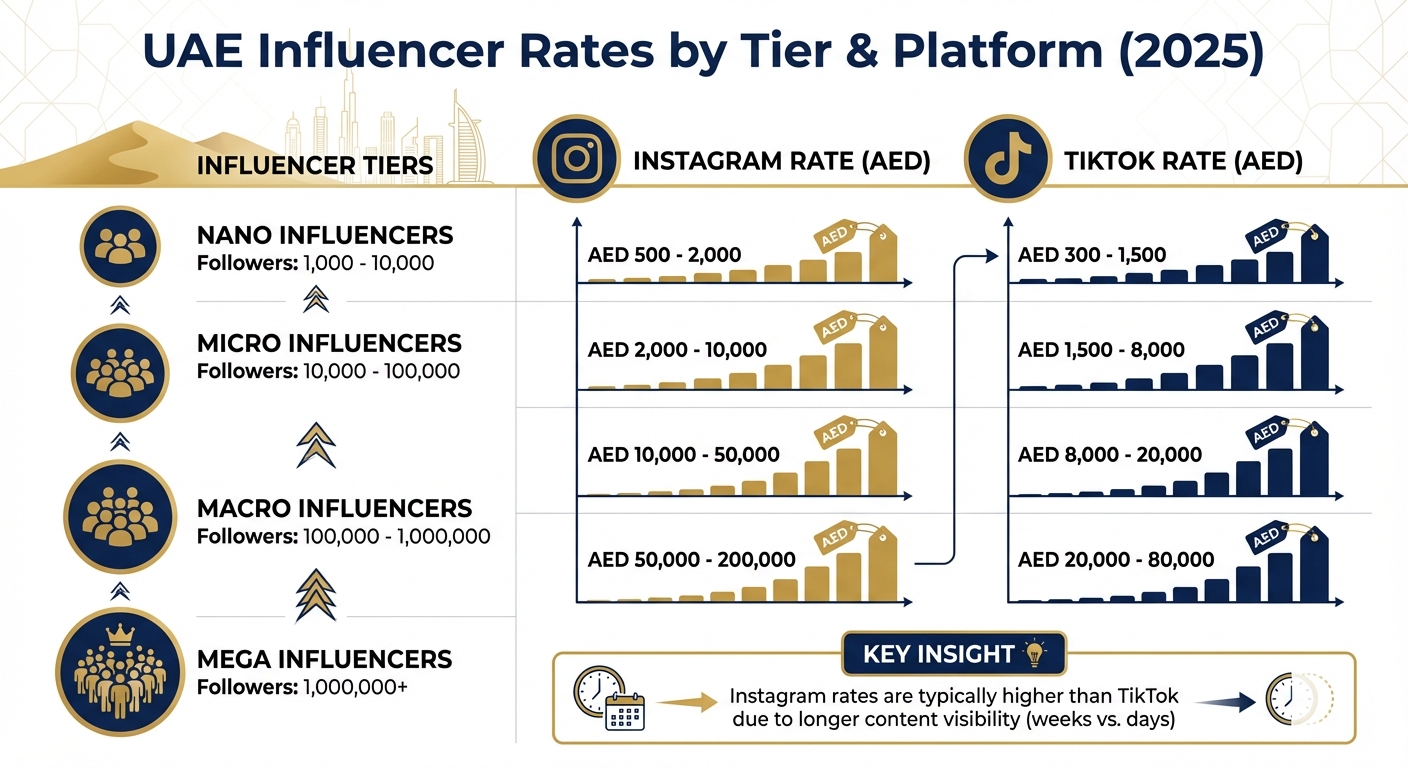
UAE Influencer Rates by Tier and Platform 2025
Before diving into ROI measurement, it’s crucial to get a clear picture of your campaign costs. A thorough cost breakdown not only helps you calculate ROI accurately but also allows you to plan future campaigns with better precision.
What to Include in Your Cost Breakdown
Start with the influencer fees. Then, factor in production costs like photography, editing, and equipment - expenses that can quickly add up, especially in Dubai's luxury market. Don’t stop there. Include usage rights for repurposed content, exclusivity clauses (which can restrict influencers from working with competitors for months), agency fees, platform subscriptions, and logistics .
Mauricio Abascal, Managing Director at Untitled Secret, highlights an important point:
"I find that folks that have management tend to have higher rates because managers have an interest to also make commission. They want to charge higher rates, obviously, to make more money".
So, if your campaign involves managed talent, remember to account for agency or management fees. Also, ensure your influencers have valid NMC licences to comply with regulations. Lastly, don’t overlook costs like logistics for product seeding, performance-based incentives (e.g., affiliate commissions), and any rush fees for expedited content creation.
Typical Influencer Rates by Tier
Influencer rates in the UAE depend on both their follower count and the platform they use. For instance, Instagram generally commands higher rates than TikTok. Why? Instagram posts often remain visible for weeks, while TikTok content typically has a shorter lifespan of just a few days, even with its viral potential .
| Influencer Tier | Follower Count | Instagram Rate (AED) | TikTok Rate (AED) |
|---|---|---|---|
| Nano | 1,000–10,000 | 500–2,000 | 300–1,500 |
| Micro | 10,000–100,000 | 2,000–10,000 | 1,500–8,000 |
| Macro | 100,000–1,000,000 | 10,000–50,000 | 8,000–20,000 |
| Mega | 1,000,000+ | 50,000–200,000 | 20,000–80,000 |
These rates are negotiable and often influenced by an influencer’s niche and engagement quality rather than just their follower count. For example, influencers specialising in areas like tech, luxury fashion, or fitness can command higher fees due to their focused and loyal audiences . Additionally, campaign costs can spike during high-demand periods such as Ramadan or the Dubai Shopping Festival, when competition for influencer partnerships intensifies.
Step 2: Set Up Your Tracking Systems
After calculating your campaign costs, the next move is to establish a robust tracking system. Without proper tracking, you risk overlooking crucial performance data. This step ensures you can effectively monitor both promo codes and UTM tracking.
How to Use Promo Codes and UTM Links
With your campaign costs in place, it's time to implement tracking tools that give you a complete view of the customer journey. In the UAE, the most reliable method for tracking influencer ROI combines UTM parameters with unique promo codes. This dual approach ensures no conversions slip through the cracks. For instance, a customer might see an influencer's post on their mobile during lunch but complete the purchase on a desktop later. While a UTM link might miss this cross-device activity, a unique promo code ensures the sale is correctly attributed.
To create effective UTM parameters for influencer links, include these components:
utm_sourceutm_mediumutm_campaignutm_contentutm_term(if necessary)
Stick to lowercase letters and use hyphens, as GA4 treats uppercase and lowercase differently. Interestingly, 73% of marketing teams use UTM parameters, but only 31% follow consistent naming conventions.
When sharing links on Instagram bios or TikTok captions, shorten UTM strings with tools like Bitly or Rebrandly. This not only keeps links professional but also improves click-through rates. Given that 95% of UAE users browse on mobile devices, clean and concise links are essential for effective tracking.
To complement UTM tracking, assign each influencer a unique discount code (e.g., "SARAH20" or "DXB15"). This redundancy is particularly useful in the UAE, where users frequently switch between apps like WhatsApp, Instagram, and e-commerce platforms. Since WhatsApp plays a major role in communication, track "Click-to-WhatsApp" campaigns with specific UTM tags to capture peer-to-peer referrals.
Analytics Tools for UAE Traffic
Beyond setting up tracking links, using powerful analytics tools is essential to make sense of the data you collect.
Google Analytics 4 (GA4) is the go-to tool for tracking UAE traffic. Its privacy-focused design aligns with the UAE's Personal Data Protection Law (PDPL) and is well-suited for the region's mobile-first audience, supported by a 97% smartphone penetration rate. Configure custom events in GA4 for key actions like whatsapp_click, generate_lead, or purchase, and mark these as conversions. GA4 also offers geographic reporting, allowing you to analyse performance by Emirate, which can help optimise future campaigns.
For influencer-specific insights, regional tools like Boomerang provide local expertise and Arabic support, making them ideal for the UAE market. Tools such as HypeAuditor verify whether an influencer's followers are genuinely based in the UAE, while Storyclash integrates with Shopify to automate ROI tracking for e-commerce brands.
Lastly, connect GA4 to your CRM - whether it’s HubSpot, Salesforce, or Zoho - to track long-term conversions. This is particularly important for B2B businesses with extended sales cycles.
Step 3: Measure Your Key Performance Metrics
Once your tracking systems are up and running, it’s time to focus on metrics that matter. While vanity metrics might look impressive, they don’t necessarily translate into profit. Instead, prioritise KPIs that directly impact business outcomes. This shift is especially relevant in the UAE, where influencer advertising spend is expected to exceed AED 1.01 billion by 2025.
Which Metrics to Track
Start with Return on Ad Spend (ROAS), which measures how much revenue you generate for every dirham spent. For instance, if you spend AED 10,000 and earn AED 35,000, your ROAS is 350%. Many UAE e-commerce brands aim for a ROAS of 300% to 400%.
Next, monitor Cost Per Acquisition (CPA) to understand the expense of gaining a new customer. Divide your total campaign cost by the number of new customers acquired. This is particularly useful in sectors like luxury and retail, where acquisition costs can vary significantly depending on the influencer tier.
Conversion Rate (CR) is another critical metric, as it ties audience interest to actual sales. Calculate it by dividing the number of conversions by total clicks and multiplying by 100. For example, if 500 users click on a link and 15 make a purchase, your conversion rate is 3%. Influencer campaigns typically achieve conversion rates between 1% and 5%.
For brand awareness, track Engagement Rate (ER). This is calculated by dividing total interactions (likes, comments, shares, etc.) by total followers or reach and multiplying by 100. In the UAE, an engagement rate of 3% or higher is considered good, with local influencers averaging 4.27%. Micro-influencers often achieve even higher rates, sometimes two to four times the average.
Finally, consider Customer Lifetime Value (CLV) for long-term planning. Use the formula: Average Purchase Value × Purchases Per Year × Customer Lifespan. For example, if a customer spends AED 500 per purchase, buys three times annually, and stays loyal for four years, their CLV is AED 6,000. This helps justify a higher CPA.
Once you’ve gathered these metrics, compare them to industry benchmarks to assess your performance.
Industry Benchmarks for UAE Sectors
Benchmarking is essential to put your metrics into perspective. For example, as of 2025, average engagement rates are 2.0% on Instagram and TikTok, and 2.8% on LinkedIn. However, these numbers vary significantly by sector.
Government and real estate accounts perform particularly well in the UAE. Government accounts see engagement rates of 3.6% on LinkedIn and 3.2% on Instagram. Real estate and professional services achieve 2.9% on Instagram. Retail and consumer goods brands average 1.8% on Instagram, though Instagram Reels can push this up to 2.1%. Meanwhile, finance and luxury sectors tend to hover between 1.8% and 1.9% on Instagram, with LinkedIn engagement for finance reaching 2.3%.
"A smaller, more engaged GCC audience is often preferable to a huge, uninterested one." - Iman Megahd, Digital Marketing & SEO Specialist
For industries like healthcare and real estate, where conversions often occur offline, track metrics like appointment bookings or property tour volumes using your CRM. In luxury retail, influencer campaigns frequently drive mall visits and in-store purchases, particularly in Dubai’s prominent shopping destinations. Around 19% of marketers report influencer marketing as a key driver of website traffic, making it crucial to measure both online and offline engagement.
One luxury fashion brand in the MENA region achieved a ×19 ROI through well-planned influencer activations. This success underscores the importance of moving beyond surface-level metrics and focusing on KPIs that reflect real business impact. While benchmarks provide helpful reference points, your results will depend on factors like choosing the right marketing partner, campaign creativity, and how well your message resonates with the UAE audience.
Step 4: Calculate and Understand Your ROI
The ROI Formula Explained
Calculating ROI for campaigns in the UAE is straightforward:
ROI = [(Total Revenue in AED - Total Costs in AED) / Total Costs in AED] × 100.
This formula provides a percentage that reflects how much profit you earned compared to the amount you spent.
Here’s an example: Let’s say you pay an influencer AED 1,000 and spend AED 200 on product samples and shipping, making your total campaign cost AED 1,200. If the campaign generates AED 4,800 in tracked revenue, your ROI would look like this:
(AED 4,800 - AED 1,200) / AED 1,200 × 100 = 300% ROI.
In simple terms, for every AED 1 spent, you earned AED 3.00 in profit.
When calculating ROI, it’s important to include all related expenses, not just the influencer’s fee. This means factoring in costs like product samples, shipping, management time, platform fees, and agency fees. To track revenue accurately, as mentioned in Step 2, use tools like unique promo codes, UTM links, and CRM data.
In the UAE, influencer marketing agencies often deliver an average ROI of 6.5:1, meaning brands typically earn AED 6.50 for every AED 1 spent. However, actual results depend on factors like the industry, the type of influencer, and how well the campaign is executed.
"ROI is not an isolated metric. True performance measurement is achievable when combined ROI with clear goals and KPIs to get the full picture." - Influencer Hero
Once you understand the basics, you can dive deeper into how ROI varies by influencer type and industry.
How ROI Differs by Influencer Type and Industry
ROI can vary significantly depending on the influencer’s follower count. Here’s how it typically breaks down:
- Nano-influencers (1,000–10,000 followers): These influencers often deliver 400–600% ROI due to their lower fees, which range between AED 300 and AED 2,000 per post.
- Micro-influencers (10,000–100,000 followers): They yield a 250–450% ROI and are about six times more cost-effective than macro-influencers.
- Macro-influencers (100,000+ followers): While their fees range from AED 10,000 to AED 50,000 per post, their ROI typically falls between 150–300%. They’re better suited for boosting brand awareness rather than driving direct conversions.
ROI also depends heavily on the industry. For example:
- E-commerce brands in the UAE usually aim for a 300–500% ROI, thanks to shorter purchase cycles.
- Fashion and beauty brands often see a 200–400% ROI due to their highly engaging, visual nature.
- SaaS and B2B companies typically achieve a 150–250% ROI since their sales cycles are longer.
- Food and hospitality sectors average a 100–200% ROI, as they rely more on experience-driven conversions.
In industries like healthcare and real estate, it’s important to account for offline metrics, such as appointment bookings or property tours, since online sales may only represent 20–30% of conversions. Promo codes might capture 20–30% of direct sales, while delayed or indirect actions can contribute 40–60% of an influencer’s overall value.
| Industry Vertical | Typical ROI Range | Key Factor |
|---|---|---|
| E-commerce | 300–500% | Fast purchase cycles |
| Fashion & Beauty | 200–400% | High visual engagement |
| Health & Wellness | 180–350% | Trust-driven purchases |
| SaaS & B2B | 150–250% | Longer sales cycles |
| Food & Hospitality | 100–200% | Experience-based products |
Step 5: Analyse Results and Improve Performance
Find Your Best-Performing Influencers
Once you've calculated ROI, the next step is to use that data to fine-tune influencer performance. Start by analysing performance at a detailed level - break it down by influencer, content type (like Reels versus static posts), and platform. This approach uncovers patterns that broader metrics might miss.
Focus on engagement rates, click-through rates, and actual conversions to identify your top performers. For the UAE market, it’s crucial to ensure that an influencer's audience is genuinely based in the region. Tools that verify authentic engagement can help, as some accounts may show signs of fraudulent activity.
In the GCC region, using tools with Arabic sentiment analysis can provide deeper insights into how local audiences perceive your brand through specific influencers. Compare each influencer's current performance with historical data and UAE benchmarks to spot those who consistently deliver excellent results.
"Collecting data is useless if you don't use it to optimise or adapt your strategies." - Boomerang
When considering long-term influencer partnerships, track the Customer Lifetime Value (CLV) of customers brought in by each creator. Some influencers may attract repeat buyers, while others might only bring in one-time customers. To balance your budget effectively, try the 70/20/10 rule: allocate 70% of your budget to influencers with proven ROI, 20% to testing new creators, and 10% to experimenting with new platforms or formats.
Once you've identified your top-performing influencers, use advanced analytics to refine your strategy further.
Use Data Analytics for Better Results
Improving your influencer campaigns requires a systematic approach to analysing data. In the UAE market, multi-touch attribution models are particularly useful because they account for influencers who contribute to early stages like awareness or consideration - not just the final conversion. Indirect conversions can make up 40–60% of an influencer's total impact.
Another effective method is incrementality testing, where you divide your audience into two groups: one exposed to influencer content and another that isn’t. This test helps you measure the actual "lift" or additional sales generated by specific influencers, giving you a clearer picture of their true impact.
Wick’s Four Pillar Framework offers an integrated system combining data analytics, marketing automation, and AI-driven personalisation. This approach allows you to customise campaigns based on real-time data, track multi-channel attribution, and identify areas for improvement across your digital ecosystem. By merging influencer insights with website analytics, SEO metrics, and content engagement data, you can build campaigns that drive consistent growth.
Additionally, keep in mind the UAE’s specific compliance rules. All influencers must hold a valid National Media Council (NMC) licence for monetised content. Include this requirement in your contracts, along with clauses to access backend data from Instagram or TikTok Insights. This ensures your partnerships are transparent and measurable. Always verify that influencers meet these licensing requirements to maintain compliance.
Conclusion: Getting the Most from Influencer Marketing in the UAE
Tracking influencer ROI in the UAE goes beyond just crunching numbers - you need a system rooted in data. The five steps covered in this guide provide a structured approach: calculate your costs in AED, implement automated marketing solutions, focus on meaningful metrics, determine ROI with precision, and continually analyse results to fine-tune your strategy. Together, these steps form a practical framework for success.
The UAE market holds plenty of potential, with Dubai-based influencer agencies reporting an average ROI of 6.5:1. However, achieving this kind of success means looking past superficial metrics like follower counts and focusing on actionable KPIs that drive real results.
Since indirect conversions account for 40–60% of the total impact, it’s crucial to use multi-touch attribution models to track the entire customer journey. This ensures you’re not missing out on the bigger picture.
When it comes to strategy, tailor your approach by influencer tier. Nano and micro-influencers often deliver ROIs of 400–600%, making them ideal for niche campaigns. On the other hand, macro-influencers are better suited for boosting overall brand awareness. Industry also plays a role - e-commerce brands typically see ROIs between 300–500%, while SaaS companies experience lower returns (150–250%) due to longer sales cycles. Aligning your expectations with these benchmarks can help you set realistic goals.
Expert opinions reinforce the importance of a robust ROI strategy:
"The brands winning in 2026 understand their influencer marketing ROI calculation methodology." – InfluenceFlow
Regularly reviewing ROI, ideally on a monthly basis, enables you to spot underperforming influencers early and shift budgets to those delivering better results. Additionally, verifying audience authenticity is essential, as around 35% of Instagram accounts show signs of fraud. In the UAE, ensure compliance by confirming that each influencer holds a valid National Media Council licence and that their audience is genuinely local, as previously discussed.
FAQs
How do I track sales if customers switch devices?
Tracking sales across multiple devices can feel like a puzzle, but with the right tools and methods, it becomes manageable. Using multi-channel attribution and advanced tracking platforms like Google Analytics 4 (GA4) is a great starting point. GA4 allows you to connect user interactions across devices, all while staying compliant with UAE privacy regulations.
Here’s how to get started:
- Set Up GA4 Properly: Define key conversions and revenue events in your GA4 account. This helps you track the actions that matter most to your business.
- Use UTM Parameters: Add UTM tags to your URLs to pinpoint where your traffic and sales are coming from.
- Leverage Influencer-Specific Codes: If you’re working with influencers, assign unique discount codes to them. This makes it easier to track which sales they drive.
By consolidating all this data into a unified analytics system, you’ll have a clearer picture of how your marketing efforts contribute to sales across devices.
How can I measure offline ROI from influencer campaigns?
To assess the offline ROI of influencer campaigns, connect offline exposure - like events or posters - to measurable actions such as sales or store visits. Use tools like unique promo codes, dedicated phone numbers, or custom landing pages to track performance. Supplement this data with surveys or customer feedback to gain a clearer understanding. The aim is to collect useful insights that help fine-tune budgets and improve offline strategies effectively.
What’s a realistic ROI target for my UAE industry?
In the UAE, a realistic ROI target for influencer marketing sits at approximately 6.5:1. What does that mean? For every AED 1 you invest, you can anticipate an average return of AED 6.50. This figure is based on industry benchmarks and serves as a general guideline. However, keep in mind that your actual results will depend heavily on how well your campaign is planned and executed.