

Blog / 5 Tips for Structuring Multilingual URLs
5 Tips for Structuring Multilingual URLs
When managing a multilingual website, structuring URLs properly makes it easier for search engines to index your content and ensures users find the correct language version. Poorly organized URLs can cause duplicate content issues, hurting your rankings. The article highlights five practical tips to improve your multilingual URL structure:
- Use Subdirectories: Organize language versions under a single domain (e.g.,
example.com/ar/for Arabic). Subdirectories consolidate SEO authority, simplify maintenance, and improve user experience. - Add Hreflang Tags: These tags guide search engines to show the correct language or regional page, avoiding duplicate content penalties and improving user targeting.
- Choose Static URL Paths: Use clear, static paths like
example.com/en-AE/instead of dynamic parameters (?lang=en). Static paths improve crawlability and user clarity. - Avoid Dynamic Parameters: URLs with parameters (e.g.,
?lang=ar) can confuse search engines and users, leading to lower rankings and poor user experience. - Set Up Canonical Tags: Canonical tags prevent duplicate content issues by consolidating ranking signals for multilingual pages.
Key Takeaway: A well-structured multilingual URL system improves SEO, avoids content duplication, and enhances user experience. For businesses in the UAE, this strategy ensures tailored content is delivered effectively, boosting engagement and conversions.
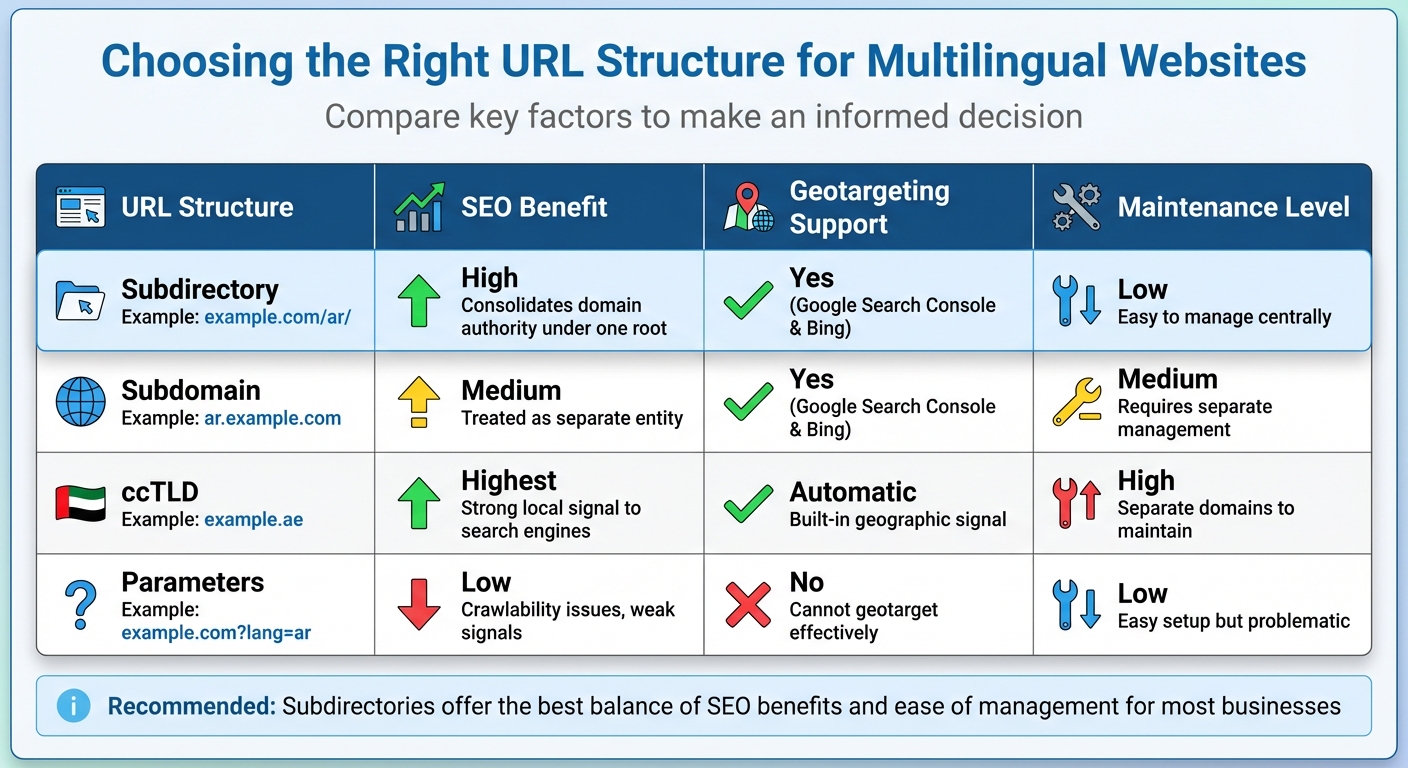
Multilingual URL Structure Comparison: Subdirectories vs Subdomains vs ccTLD vs Parameters
How Pros Handle URLs for Multilingual Sites?
1. Use Subdirectories Instead of Subdomains or Parameters
When setting up multilingual URLs, opting for subdirectories (e.g., example.com/ar/ for Arabic or example.com/en/ for English) offers distinct advantages for both search engines and users. By organising all language versions under a single domain, you ensure that backlinks and authority benefit the entire site, rather than being divided across separate entities.
SEO Optimisation
Subdirectories help consolidate domain authority, meaning any new language version benefits directly from the established strength of your main domain. As Rachel Costello, SEO & Content Manager at Lumar, explains:
"Link equity typically has a higher effect when all websites are located on the same domain."
Search engines also find it easier to crawl subdirectories compared to URLs with query parameters. For instance, Baidu - China’s leading search engine with a 70% market share - often struggles with parameter-based language indications. While Google has stated it doesn’t favour subdomains or subdirectories, evidence shows that moving content to subdirectories can lead to better rankings. Veruska Anconitano, Multilingual SEO and Localisation Consultant, highlights:
"Subdirectories are the most SEO-friendly option for most businesses. They consolidate link authority under one domain, making it easier to grow rankings sitewide."
These SEO benefits naturally extend to improving the user experience, which we’ll touch on next.
User Experience (UX)
Subdirectories don’t just boost SEO - they also enhance usability. URLs structured with subdirectories (e.g., example.com/ar/pricing/) are cleaner and more intuitive than parameter-based alternatives like example.com/?lang=ar. They make it easier for users to interpret and even manually switch languages by editing the URL. Additionally, subdirectories allow seamless cookie sharing. For example, if a user logs into the English version, they remain logged in when switching to the Arabic version.
Scalability for Multiple Languages
Subdirectories simplify the process of managing multiple languages by centralising all versions under one CMS. This setup reduces the workload compared to maintaining separate sites for each language. Paul Teddy, SEO Expert at Wpromote, shares:
"Subdirectories maximise marketing resource utilisation by consolidating all domestic and international efforts onto the same root domain. This results in much higher domain authority, and thus improved organic visibility potential for all regions."
Additionally, having a unified analytics setup allows for a comprehensive view of site performance, while still offering the flexibility to filter data by specific regions or languages.
Ease of Implementation
From a technical perspective, subdirectories are straightforward to implement. They function like folders on your hosting server, requiring only one SSL certificate and a single hosting environment, which simplifies both security and ongoing maintenance . Florian Bodelot, Co-founder of Digidop, advises:
"A subdirectory-based method organises URLs like file folders. This is the approach our agency recommends for building SEO-optimised multilingual websites."
Similarly, Kaitlin McMichael, Owner of Kate Ideas Marketing, emphasises:
"It is much safer, in my perspective, to build your international SEO strategy with [subdirectories] rather than subdomains."
2. Add Hreflang Tags to Your URL Structure
Hreflang tags help search engines display the correct language and regional version of your page to users. Without them, search engines might serve the wrong version - like showing Arabic content to English-speaking users or directing visitors in the UAE to a US-specific page with incorrect currency or shipping details.
SEO Optimisation
Hreflang tags let search engines know that pages in different languages are intentional variations, not duplicates. This avoids penalties for duplicate content and combines ranking signals across language versions. For example, if your English page performs well, search engines can show the Arabic version to Arabic-speaking users while keeping the ranking strength intact. John Mueller, Senior Search Analyst at Google, highlights the complexity of hreflang:
"Hreflang is among the most complex aspects of SEO (if not the most complex one). Feels as easy as a meta-tag, but it gets really hard quickly."
Despite their importance, over 65% of international websites have hreflang issues, such as missing return links or incorrect language codes. Fixing these not only improves SEO but also enhances user experience by ensuring the right language version is shown.
User Experience (UX)
Correct hreflang implementation ensures users get pages tailored to their language and region - featuring the correct currency (like AED for UAE users), local shipping details, and even regional dialects. This reduces bounce rates caused by mismatched content. For example, in 2026, a global SaaS company with over 50,000 pages fixed hreflang errors and saw bounce rates drop from 68% to 31% in just 90 days. During the same period, their international organic traffic increased by 75%.
Adding an x-default tag ensures a fallback page is available for users whose language-region preferences don't match any of your defined options. Merve Alsan, Creative Content Manager at Weglot, explains:
"Hreflang tags serve as signals, and not directives. In other words, they signpost to search engines how they should be serving web pages to international searchers."
Scalability for Multiple Languages
For large websites, managing hreflang tags efficiently is key. Using XML sitemaps is a better approach for large sites as it avoids adding unnecessary bulk to HTML. This method is also easier to automate. For instance, a global SaaS company switched to XML sitemaps in 2024, correcting 23,000 missing return links. This change reduced bounce rates and increased monthly organic traffic from 1.2 million to 2.1 million.
Each hreflang tag must be bidirectional: if your English page links to the Arabic version, the Arabic page must link back to the English one. Pages should also include a self-referencing tag. Use ISO 639-1 for languages and ISO 3166-1 Alpha-2 for regions (e.g., en-ae for English in the UAE, ar-ae for Arabic in the UAE), and always use absolute URLs like https://example.com/ar/ to avoid confusion.
Ease of Implementation
| Method | Best For | Complexity | Impact on Page Load |
|---|---|---|---|
| HTML Link Tags | Small sites (<100 pages) | Low | High (increases HTML size) |
| XML Sitemaps | Large sites (1,000+ pages) | Medium | None (external file) |
| HTTP Headers | Non-HTML files (PDFs) | High | None |
Ensure hreflang URLs match canonical URLs to avoid confusing search engines. While Google and Yandex use hreflang as a primary signal, Bing relies more on the content-language meta tag but still recommends hreflang as a secondary signal .
3. Choose Static URL Paths for Language and Location Targeting
Static URL paths, like example.com/ar/ or example.com/en-AE/, are far superior to dynamic parameters (e.g., ?lang=ar) when it comes to both crawlability and user clarity. They’re easier for search engines to navigate, simpler for users to understand, and essential for creating a scalable multilingual website that performs well in the UAE and other regions. Building on the earlier discussion about subdirectories, static paths are the go-to choice for targeting specific languages and locations effectively.
SEO Benefits
Search engines, especially Baidu, often struggle with URLs that contain dynamic parameters. Static paths eliminate this issue, making them far more crawlable. Unlike parameter-based URLs, static structures like subdirectories can also be geotargeted in tools like Google Search Console and Bing Webmaster Tools, giving you control over which content appears in specific regions.
Another advantage is the ability to include localised keywords in the URL. For example, Yandex, which commands roughly 42% of the Russian search market, places significant weight on keywords in the URL path. Using /ar/الأسعار/ instead of /ar/pricing/ makes your content more relevant to local audiences and can help improve rankings in regional search results.
Additionally, subdirectories (e.g., example.com/en-AE/) consolidate link equity under the root domain, boosting the authority of all language versions. Steven van Vessum, VP of Community at ContentKing, highlights the importance of localisation in URLs:
"I'd always localize URLs as well, because that leads to the best possible click-through-rate (CTR). Your potential visitors need to make a decision on Google's result page what website to go for."
Enhanced User Experience (UX)
Static paths don’t just benefit SEO - they also improve user interaction. Clear, static URLs like example.com/ar/منتجات/ immediately signal to users that the page is in Arabic and relevant to their needs. This clarity can lead to higher click-through rates and fewer instances of users leaving the page due to unmet expectations.
Static URLs also allow users to switch languages easily by editing the URL directly. For instance, changing /en-AE/ to /ar-AE/ is intuitive, whereas dynamic parameters like ?lang=en can be confusing and more prone to errors during redirects.
Localising the entire URL path - not just the language code - further builds trust. A URL like /ar/الاتصال/ (Arabic for "contact") feels more authentic than /ar/contact/. With 94.3% of web pages using UTF-8 encoding as of late 2019, it’s now the standard for displaying non-Latin characters correctly in search results.
Scalability for Multilingual Sites
Subdirectories are the most practical option for businesses expanding into multiple regions. They don’t require additional domain registrations or complex server setups, making them both cost-effective and easy to maintain. Kate Morris, Advanced SEO Specialist at Moz, explains:
"Subfolders provide a structure that's easier to build upon and develop as your site and business grows and changes."
Here’s a quick comparison of URL structures:
| URL Structure | SEO Benefit | Geotargeting Support | Maintenance Level |
|---|---|---|---|
Subdirectory (/ar/) |
High (consolidates authority) | Yes (GSC/Bing) | Low |
Subdomain (ar.) |
Medium (separate entity) | Yes (GSC/Bing) | Medium |
ccTLD (.ae) |
Highest (strong local signal) | Automatic | High |
Parameters (?lang=ar) |
Low (crawlability issues) | No | Low |
Setting It Up
Implementing static subdirectories is straightforward on most platforms. Ensure all URLs use UTF-8 encoding to support Arabic and other non-Latin scripts. Avoid query strings altogether. Dan Taylor, Agency Partner & Head of Innovation at Dan Taylor SEO, advises:
"With Baidu, you should avoid using URLs with parameters at all costs as Baidu can have issues in crawling them."
sbb-itb-058f46d
4. Keep Dynamic Parameters Out of Your Main URL Structure
Dynamic parameters (like ?lang=ar) might seem like an easy fix, but they can hurt both your SEO and user experience. Sure, they require no changes to your site's folder structure, but the long-term drawbacks far outweigh the short-term convenience. Here's why a static URL structure is a smarter choice.
SEO Optimisation
Dynamic parameters send weak signals for language and geographic targeting. This makes it harder for tools like Google Search Console and Bing Webmaster Tools to identify and prioritise the right audience for your content. Static paths, on the other hand, clearly communicate these signals, giving you an edge in geotargeting. Jamie Grant, In-house SEO, emphasises this point:
"This option is not recommended by Google for internationalisation"
Another issue with parameters is the risk of duplicate content and crawl bloat. Search engines may end up indexing multiple versions of the same page, which can dilute your rankings and waste crawl budget. Redirect problems are also more common with dynamic URLs. Rand Fishkin, Founder of Moz, offers a straightforward solution:
"If you have more than two URL parameters, it's probably worth making a serious investment to rewrite them as static, readable, text"
User Experience (UX)
From a user’s perspective, parameter-heavy URLs look messy and untrustworthy. Research shows that clean URLs tend to attract higher click-through rates. This is especially important on mobile devices, where URLs are often truncated. If the language parameter gets cut off, users might not even know if they’re on the right version of your site.
Sharing URLs is another factor. People are far more likely to share clean, straightforward links than ones cluttered with parameters. This can directly impact your organic reach and the likelihood of natural link-building.
Ease of Implementation
While dynamic parameters are easy to set up initially, they can become a nightmare to manage as your site grows and you add more languages or regions. If you’re already using parameters, tools like Apache's mod_rewrite or IIS's URL Rewrite Module can help you convert them into static paths. Instead of relying on IP-based parameter redirects, consider using JavaScript banners or user interface elements to guide visitors to the correct local version.
Switching to a static URL structure isn’t just about SEO - it’s about building a scalable, user-friendly architecture for your multilingual site.
5. Set Up Canonical Tags for Multilingual URLs
Canonical tags help search engines identify the preferred version of a page, preventing duplicate content issues and ensuring ranking signals are consolidated. When combined with subdirectories and hreflang tags, they create a cohesive structure for multilingual sites, ensuring consistent signals across different languages. This is crucial for smooth site performance and effective SEO.
SEO Optimisation
Canonical tags play a key role in consolidating ranking signals into a single preferred URL. For multilingual websites, this prevents similar content - like an Arabic and English version of the same page - from competing in search rankings. Each language version should have a self-referencing canonical tag. For example, the Arabic page should point to itself, not to the English version. Joost de Valk, Founder of Yoast, explains:
"Every language should have a rel='canonical' link pointing to itself."
However, research shows that over 65% of international websites struggle with errors in canonical and hreflang implementation. A common issue is linking hreflang tags to non-canonical URLs. As LinkGraph highlights:
"Hreflang URLs must be canonical URLs. If a page has a rel='canonical' pointing to a different URL, that page should NOT be referenced in hreflang tags."
By correctly implementing canonical tags, you ensure ranking signals are consolidated and avoid wasting your crawl budget [13, 30]. This makes canonical tags a key tool for optimising multilingual site performance.
User Experience (UX)
Canonicalisation also enhances user experience by ensuring visitors land on the most relevant version of your site. When canonical tags are properly aligned with hreflang tags, users are directed to pages tailored to their language and location. For example, UAE visitors would see content with AED pricing, local shipping options, and other region-specific details [31, 3]. A case study revealed that resolving inconsistencies in canonical and hreflang tags significantly reduced bounce rates and increased international organic traffic.
Ease of Implementation
On top of SEO and UX benefits, implementing canonical tags is relatively simple. Always use absolute URLs (e.g., https://example.com/ar/page) instead of relative paths (e.g., /ar/page) in your canonical tags [13, 30, 32]. For smaller sites with fewer than 100 pages, HTML link tags work well. Larger sites, on the other hand, benefit from managing canonical and hreflang signals through XML sitemaps. This approach keeps page weight low and simplifies ongoing management. Regardless of the method, consistency across all implementations is key to maintaining accurate canonical information [13, 30].
Conclusion
Crafting a strong URL structure is essential for achieving high search rankings and ensuring a smooth user experience. The five strategies discussed - using subdirectories, implementing hreflang tags, opting for static URL paths, separating dynamic parameters, and setting up canonical tags - work in harmony to create a system that search engines can navigate effectively, while building trust with users.
Real-world examples back this up. UNIQLO's international SEO improvements and Saxo Bank's focus on region-specific optimisation led to impressive increases in both organic traffic and revenue. These cases highlight how a well-thought-out URL structure can directly fuel business growth, particularly when localisation is a priority.
For businesses targeting the Gulf region, especially in the UAE, having a multilingual and localised URL structure is even more critical. Research shows that users in these markets are far more inclined to complete purchases when websites are tailored to their preferences. As Aleyda Solis, an International SEO Consultant at Orainti, advises:
"The first thing you should choose is a proper web structure that will better connect and target your desired audience, and the more granular the geolocalisation is, the better"
Implementing these practices requires attention to detail, especially when managing complex hreflang tags or ensuring canonical consistency across various language versions. This is where Wick's Four Pillar Framework comes into play. By combining website development, advanced SEO techniques, and data analytics, Wick helps businesses build scalable, efficient multilingual sites that strengthen domain authority and expand reach into new markets.
FAQs
Why is it better to use subdirectories instead of subdomains for multilingual websites?
Using subdirectories for multilingual websites tends to be more effective for SEO because they allow your domain’s authority to remain unified. Search engines view subdirectories as part of the main website, which helps strengthen and grow your site’s overall ranking.
On the other hand, subdomains are often seen as separate entities by search engines. This separation can weaken your SEO efforts, as it becomes harder to link them back to your primary site. Subdirectories also create a more streamlined and cohesive site structure, making it easier for users to switch between languages and navigate your site seamlessly.
What are hreflang tags, and how do they enhance user experience on multilingual websites?
Hreflang tags play a key role in enhancing user experience on multilingual websites. They signal to search engines which language and regional version of a webpage should be shown to users. This ensures visitors are directed to content that aligns with their language preferences and geographic location.
By steering users to the most suitable version of your site, hreflang tags help reduce confusion, lower bounce rates, and avoid issues related to duplicate content. The result? A smoother and more intuitive browsing experience for audiences across various regions and languages.
Why are static URLs better than dynamic ones for multilingual websites?
Static URLs work well for multilingual websites because they’re straightforward, easy to read, and user-friendly. They help search engines interpret content more effectively, which can boost your SEO performance. Plus, static URLs are easier for users to remember and share, improving their overall experience on your site.
On the other hand, dynamic URLs with parameters often look messy and can confuse both users and search engines. Opting for clean, static URL structures ensures your website stays organised and accessible, aligning with best practices for multilingual optimisation.