
Blog / Technical Safeguards for GCC Data Transfers
Technical Safeguards for GCC Data Transfers
Transferring data across borders in the GCC is complex. Companies must juggle local laws like UAE Federal Decree-Law No. 45 of 2021, Free Zone rules (DIFC, ADGM), and global standards like GDPR. Non-compliance risks fines and loss of trust, especially since 73% of consumers prioritise data privacy when making purchases.
Key safeguards include:
- Encryption: Mandatory for data security, but requirements differ by country and sector (e.g., healthcare and finance).
- Standard Contractual Clauses (SCCs): Useful for cross-border transfers but require jurisdiction-specific adjustments.
- Binding Corporate Rules (BCRs): Ideal for multinationals but involve high costs and regulatory approvals.
GCC regulations vary widely. For instance, DIFC and ADGM align closely with GDPR, while Saudi Arabia and UAE mainland impose stricter, sector-specific rules. Businesses must tailor safeguards to each jurisdiction, balancing compliance with operational needs.
Takeaway: Understand local rules, use encryption and legal tools like SCCs or BCRs, and stay updated on evolving regulations to ensure compliance and secure cross-border data transfers.
Healthcare Privacy & Cyber Across GCC, India & EU | Tsaaro Real Series Ep 2 (Part 1)
1. Encryption and Data Security Standards
Encryption plays a central role in safeguarding data across borders within the GCC, with specific requirements varying by country and industry. For example, the UAE National Cloud Security Policy enforces encryption at all stages - whether data is in transit, at rest, or being processed. It also emphasises robust key management practices throughout the data's entire lifecycle. This ensures that data remains protected no matter where or how it is handled.
Jurisdictional Variations
Regulations around encryption differ significantly between jurisdictions. In the UAE, the Federal Decree-Law No. 45 of 2021 excludes certain types of data - such as government, healthcare, and banking information - which are governed by their own specialised regulations. Financial free zones like DIFC and ADGM have adopted frameworks that are more aligned with GDPR-like data protection standards.
In Saudi Arabia, the Personal Data Protection Law (PDPL) serves as the main regulatory framework, but additional encryption standards are enforced by sector-specific bodies like SAMA and the Capital Market Authority. These regional differences mean that encryption strategies must be tailored to meet the unique requirements of each jurisdiction, often requiring highly sector-specific approaches.
Sector-Specific Requirements
Different industries face unique encryption mandates. In the financial sector, for instance, the UAE Central Bank requires customer and transaction data to be stored locally, with explicit approval needed for any cross-border transfers. Similarly, SAMA mandates approval for using cloud services hosted outside Saudi Arabia.
Healthcare providers in the UAE must comply with the Healthcare ICT Law (Federal Law No. 2 of 2019), which requires all electronic health data to remain within the country. Additionally, the IoT Regulatory Policy stipulates that "secret" or "sensitive" data must either stay within the UAE or only be transferred to countries with equivalent security measures. These sector-specific rules add another layer of complexity to encryption practices.
Implementation Complexity
Implementing encryption is not just about deploying technical solutions - it also involves adhering to regulatory and operational expectations. For example, the UAE's National Cloud Security Policy requires Cloud Service Providers to align their processes with national cybersecurity initiatives and disclose where data is processed. Organisations must also conduct transfer impact assessments to ensure that destination countries' laws uphold encryption standards.
In Saudi Arabia, recent updates like the Essential Cybersecurity Controls 2024 (ECC-2) have eased some local storage requirements for government entities, moving towards a risk-based approach for data transfers. However, this shift does not apply across the board - sectors like banking, insurance, and critical infrastructure still face strict localisation rules. These nuances highlight the intricate balance between regulatory compliance and operational flexibility.
2. Standard Contractual Clauses (SCCs)
Standard Contractual Clauses (SCCs) provide businesses across the GCC with a consistent legal framework for transferring personal data to countries that lack "adequacy" status. These clauses impose binding obligations on both data exporters and importers, simplifying the process by eliminating the need for individual agreements with every international partner. For GCC organisations, SCCs have become a key compliance tool, especially in situations where encryption alone doesn’t meet regulatory standards. Let’s dive into how SCCs vary by jurisdiction and the practical challenges they bring.
Jurisdictional Variations
The application of SCCs differs significantly across GCC jurisdictions. In the Dubai International Financial Centre (DIFC), regulators have adopted SCCs influenced by EU and UK standards, ensuring compatibility with multiple jurisdictions. The DIFC also recognises several countries as "adequate", including EU/EEA nations, the UK, Singapore, and other GCC areas like ADGM and QFC. For these destinations, SCCs are not required for data transfers.
However, outside these frameworks, organisations often face additional hurdles. These may include obtaining regulatory approval or securing explicit written consent from data subjects for each transfer.
Implementation Complexity
Using SCCs effectively involves a thorough and detailed process. For example, the DIFC mandates a Data Export Assessment to evaluate whether the destination jurisdiction meets adequacy standards before SCCs can be used as a transfer mechanism. Businesses are also required to use tools like the Ethical Data Management Risk Index (EDMRI+) to assess the data importer’s compliance readiness and document any gaps in protection.
For straightforward transfers, the DIFC offers Abbreviated SCCs, which aim to reduce the administrative burden while still meeting the requirements under Articles 2410(i) and 2410(x) of the DP Law 2020. However, organisations must carefully determine whether their specific transfer scenario qualifies for this simplified option.
The complexity of SCC implementation often varies by industry, as explained below.
Sector-Specific Requirements
Certain industries, such as financial services and healthcare, face unique challenges when applying SCCs. Financial entities regulated by the DFSA in the DIFC, for instance, must comply with specific obligations under Article 28 of the DP Law 2020 when transferring data to public authorities or law enforcement. These transfers often require written assurances or self-assessments of risk and necessity, adding an extra layer of compliance beyond standard SCCs. Similarly, healthcare providers and critical infrastructure operators frequently encounter additional requirements that either supplement or override general SCC provisions.
Here’s a comparison of how different GCC regimes approach SCCs:
| Feature | Fragmented Regimes (Kuwait, Oman, UAE Mainland) | Comprehensive Regimes (DIFC, ADGM, QFC) |
|---|---|---|
| Regulatory Basis | Sector-specific laws and general legal principles | Structured frameworks aligned with EU GDPR |
| SCC Alignment | Often requires custom drafting to meet local sector requirements | SCCs pre-aligned with EU/UK international standards |
| Approval Process | May require prior regulatory approval in sensitive sectors | Generally allowed if using approved SCCs or transferring to "adequate" countries |
| Primary Safeguard | Heavy reliance on written consent from data subjects | Relies on adequacy decisions, SCCs, or Binding Corporate Rules (BCRs) |
sbb-itb-058f46d
3. Binding Corporate Rules (BCRs)
Alongside encryption and SCCs, Binding Corporate Rules (BCRs) provide an additional safeguard for secure data transfers within organisations.
BCRs regulate the flow of data within a business group, unlike Standard Contractual Clauses (SCCs), which address transfers between separate parties. For businesses operating in the GCC, particularly in Saudi Arabia, Kuwait, and Qatar, BCRs offer a structured way to manage both employee and customer data across borders. However, these rules must align with the diverse regulatory frameworks in the region.
In the GCC, BCRs are recognised in jurisdictions like the DIFC and the ADGM. The DIFC Data Protection Law 2020 (Article 27) and the ADGM Data Protection Regulations 2021 (Article 42) provide the legal foundation for BCRs as a safeguard for international data transfers. Regulatory approval, however, is a prerequisite. For example, as of early 2025, companies like Cisco Capital (Dubai) Limited (Registered Number 779) and RGA Reinsurance Company Middle East Limited (Registered Number 221) have received approval for their BCRs within the DIFC jurisdiction.
Jurisdictional Variations
The requirements for BCRs differ significantly across the GCC. In Saudi Arabia, the framework refers to "binding common rules" for entities involved in joint economic activities when transferring data to countries without adequate protection. Bahrain, on the other hand, requires case-by-case approval from the Personal Data Protection Authority for such transfers. Both the DIFC and ADGM have established structured approval processes.
"Seeking to develop a 'one size fits all' strategy for data protection in the GCC heightens the risk of non-compliance in a particular dominion." – Justin Whelan, Partner, HFW
Implementation Complexity
Given the varied regulatory standards, implementing BCRs can be a complex process. For instance, the ADGM offers a detailed "How-to Guide" for submitting BCRs through its Registry 2.0 platform, while the DIFC requires thorough vetting periods. Organisations often need to conduct a Data Export Assessment to ensure compliance. Furthermore, sector-specific localisation laws can restrict the use of BCRs. For example, the UAE Central Bank requires licensed financial institutions to store customer and transaction data within the UAE, which can limit the applicability of BCRs for these types of data.
Sector-Specific Requirements
BCRs are commonly adopted in industries like finance, healthcare, and legal services within the GCC, as these sectors handle large volumes of sensitive data and must meet strict compliance requirements. However, local laws can impose additional restrictions. For example, the UAE Healthcare ICT Law (Federal Law No. 2 of 2019) mandates that electronic health data remain within the UAE, potentially overriding general cross-border transfer permissions. Similarly, insurance companies in Saudi Arabia must store customer data within the Kingdom. These sector-specific regulations highlight the importance of customising BCRs to meet the unique compliance needs of each industry within the GCC.
Advantages and Disadvantages
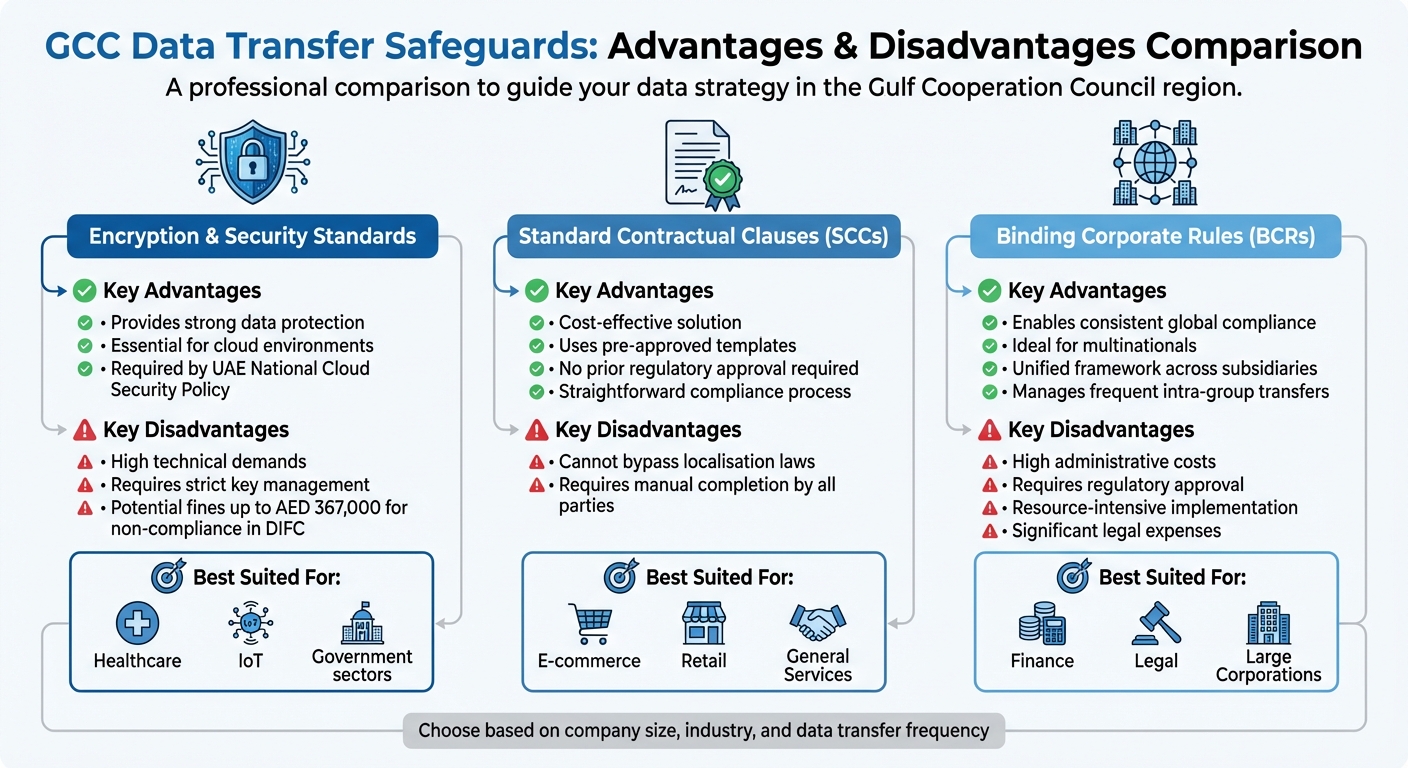
Comparison of GCC Data Transfer Safeguards: Encryption, SCCs, and BCRs
Following the earlier discussion on encryption, Standard Contractual Clauses (SCCs), and Binding Corporate Rules (BCRs), let’s examine the tradeoffs these safeguards present for businesses in the GCC. Choosing the right approach requires balancing strong data protection with operational flexibility.
Encryption and data security standards offer exceptional protection for data, whether it's being transferred or stored. These measures are crucial for compliance with the UAE National Cloud Security Policy and are especially important for businesses operating in cloud environments. However, they come with challenges. Implementing encryption requires technical expertise and diligent key management, which can strain smaller organisations. Additionally, non-compliance can be costly - violations within the Dubai International Financial Centre (DIFC) can lead to fines of up to AED 367,000.
Standard Contractual Clauses (SCCs) provide a straightforward compliance option. They rely on pre-approved templates from bodies like the Abu Dhabi Global Market (ADGM) and DIFC, which simplifies the process by avoiding lengthy regulatory reviews. Sami Mohammed, ADGM Commissioner of Data Protection, highlights their importance:
"The adoption of the SCCs provides an option for exporting personal data lawfully outside of ADGM".
However, SCCs are not without their drawbacks. They require manual completion by all involved parties and cannot override specific localisation laws.
Binding Corporate Rules (BCRs) are ideal for large multinational organisations with frequent intra-group data transfers. They create a unified compliance framework across subsidiaries, ensuring consistency. Yet, they are resource-intensive, requiring formal approval from regulators and often incurring significant legal expenses.
Below is a summary of the key benefits and challenges associated with each safeguard:
| Safeguard | Key Advantages | Key Disadvantages | Best Suited For |
|---|---|---|---|
| Encryption & Security Standards | Provides strong data protection | High technical demands; requires strict key management | Healthcare, IoT, Government sectors |
| Standard Contractual Clauses | Cost-effective; uses pre-approved templates; no prior approval required | Cannot bypass localisation laws; manual completion needed | E-commerce, Retail, General Services |
| Binding Corporate Rules | Enables consistent global compliance; ideal for multinationals | High administrative costs; regulatory approval needed | Finance, Legal, Large Corporations |
The choice of safeguard ultimately depends on factors like company size, industry, and how often data is transferred. Small and medium enterprises often find SCCs practical due to their simplicity and lower cost. On the other hand, large multinational corporations with complex data operations might find the investment in BCRs worthwhile, despite the associated challenges.
Conclusion
Choosing the right technical safeguards for cross-border data transfers in the GCC starts with understanding the regulatory landscape. Some jurisdictions, like DIFC, ADGM, and QFC, follow comprehensive frameworks that align with GDPR principles. Others, including UAE mainland, Saudi Arabia, Kuwait, and Oman, operate under fragmented systems with sector-specific laws and unique consent requirements. As Justin Whelan, Partner at HFW, explains:
"Ultimately, seeking to develop a 'one size fits all' strategy for data protection in the GCC heightens the risk of non-compliance in a particular dominion."
Start by confirming data localisation requirements. Standard Contractual Clauses (SCCs) are a practical solution where adequacy decisions are absent, while Binding Corporate Rules (BCRs) are better suited for multinational corporations managing frequent intra-group transfers. However, BCRs come with higher administrative demands and require regulatory approval. These steps help establish a solid framework for managing cross-border data.
Encryption is another key safeguard, especially for sensitive industries. Tools like DIFC's EDMRI+ can assist with due diligence on data importer compliance, ensuring alignment with broader compliance strategies across the GCC. In jurisdictions with fragmented regulations, securing explicit, documented consent from data subjects adds an extra layer of legal protection.
Maintaining a transfer log is also crucial. Documenting the legal basis for each data transfer is now a necessity, as regulatory bodies like the UAE Data Office and Saudi Arabia's SDAIA adopt more proactive enforcement measures. For organisations operating in the UAE mainland, keeping an eye on upcoming executive regulations under Federal Decree-Law No. 45 of 2021 is essential. These regulations will outline final compliance deadlines and requirements.
FAQs
What are the main differences in data transfer regulations across GCC countries?
Data transfer rules across GCC countries differ significantly due to variations in their legal systems and the progression of their data protection laws. Nations such as the UAE, Saudi Arabia, Bahrain, Oman, and Qatar have all introduced personal data protection laws, each setting unique requirements for transferring data across borders. For instance, in the UAE, both the DIFC and ADGM mandate that data transfers occur only to jurisdictions with sufficient data protection measures in place. These standards are often upheld through contractual agreements or adequacy decisions. In contrast, Saudi Arabia's Personal Data Protection Law (PDPL) focuses on lawful processing and disclosure but does not require pre-approval for data transfers.
Some GCC nations emphasise sector-specific regulations or broader principles like consent, transparency, and security, rather than establishing detailed, overarching frameworks. This results in a fragmented regulatory landscape, making it essential for businesses operating in the region to tailor their compliance strategies to meet each country's specific rules. Key considerations often include securing regulatory approvals, implementing adequate safeguards, and adhering to local consent and security requirements.
What factors should businesses in the GCC consider when choosing between SCCs and BCRs for data transfers?
When choosing between Standard Contractual Clauses (SCCs) and Binding Corporate Rules (BCRs) for cross-border data transfers, businesses in the GCC need to weigh their operational requirements and compliance priorities.
SCCs work well for organisations handling specific data-sharing agreements with external partners. They offer a straightforward way to ensure compliance across multiple jurisdictions without requiring extensive internal adjustments. In contrast, BCRs are designed for multinational companies, providing a consistent compliance framework across an entire corporate group, making them ideal for businesses with complex global operations.
For companies in the GCC, it’s essential to factor in local data protection laws, regional regulatory standards, and the nature of international collaborations. While SCCs are simpler to implement and manage, BCRs offer a more structured, long-term approach to compliance - particularly for organisations with extensive international reach.
What are the key challenges for businesses in the GCC when using encryption for cross-border data transfers?
Businesses in the GCC encounter a range of obstacles when it comes to using encryption for cross-border data transfers. A major challenge lies in dealing with diverse and constantly changing data protection regulations across the region. Since each GCC country has its own legal requirements, achieving compliance can be a daunting and intricate process.
Another critical aspect is ensuring that encryption methods comply with the legal grounds for data transfers and satisfy adequacy standards outlined by both regional and global regulatory bodies. This demands a thorough grasp of local regulations and the flexibility to adjust swiftly to shifts in the legal landscape, which can differ widely from one jurisdiction to another.
To overcome these hurdles, businesses often need to establish strong compliance systems and remain vigilant about the latest legal updates. This approach helps ensure that data transfers are not only secure but also adhere to all applicable laws.