

Blog / How Single-Touch Attribution Impacts ROI
How Single-Touch Attribution Impacts ROI
Single-touch attribution is a simple method for assigning 100% of the credit for a conversion to either the first or last customer interaction. While it’s easy to implement and works well with tools like CRM systems, it often misrepresents how marketing channels contribute to sales. This can lead to skewed ROI metrics and poor budget decisions, especially in markets like the UAE, where customer journeys are complex and span multiple online and offline touchpoints.
Key Takeaways:
- First-Touch Attribution: Credits the first interaction (e.g., an Instagram ad) for the entire sale.
- Last-Touch Attribution: Credits the final interaction (e.g., a retargeting ad) before conversion.
- Main Issue: Ignores mid-funnel activities like influencer campaigns or email nurturing, undervaluing their role in driving conversions.
- ROI Distortion: Channels like branded search or retargeting ads often appear more profitable than they really are, leading to overinvestment.
- UAE Market Challenges: High-value sectors like luxury retail, property, and automotive are heavily impacted due to offline interactions and extended decision-making cycles.
Switching to multi-touch attribution or using experimental methods like incrementality testing can fix these gaps. Multi-touch models distribute credit across all touchpoints, providing a clearer picture of what drives conversions. For UAE marketers, integrating online and offline data and accounting for local behaviours (e.g., Ramadan spending) can improve ROI measurement by 10–20%.
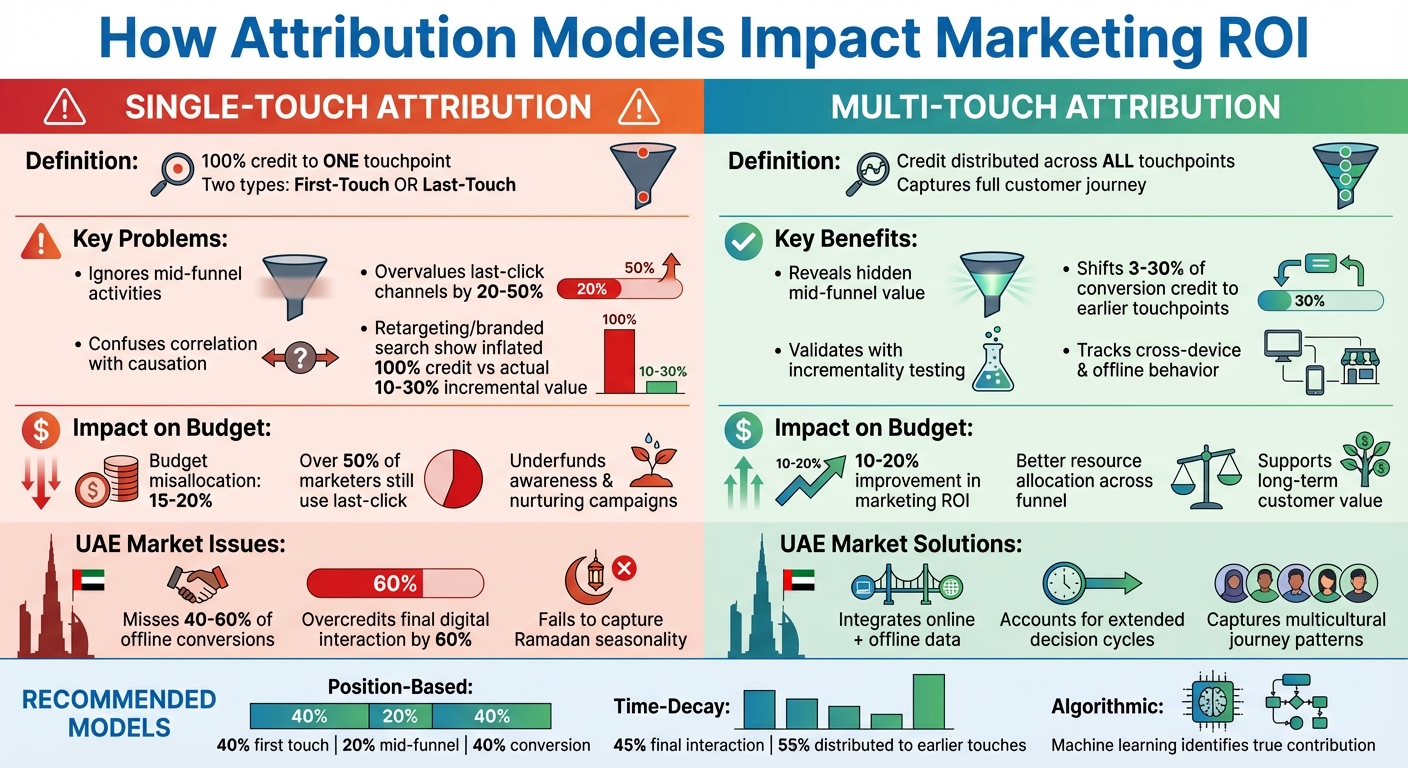
Single-Touch vs Multi-Touch Attribution: Impact on ROI and Budget Allocation
How Single-Touch Attribution Distorts ROI
Effects on Multi-Channel Campaigns
Single-touch attribution gives an incomplete picture of how different channels contribute to conversions. By crediting either the first or last interaction, it completely ignores the role of intermediary touchpoints. This creates a bias, where some channels are overvalued, while others are left out of the equation, distorting the overall ROI.
For example, last-touch attribution assigns full credit to the final action, such as a branded search click, even though earlier interactions - like display ads or social media - played a crucial role in building awareness. On the other hand, first-touch models often exaggerate the impact of channels like paid social by as much as 20–50%, disregarding the importance of follow-up interactions. Research shows that top-of-funnel channels often receive little to no credit under last-touch models, even though they’re critical for initiating customer interest and intent.
This flawed approach can lead to poor budget decisions. When inflated ROI figures favour certain channels, marketers may shift resources away from upper-funnel strategies like display ads, influencer campaigns, or video content - activities essential for creating demand. Shockingly, over half of marketers still rely on last-click attribution, even though it fails to account for the complexity of the customer journey.
Problems Measuring Incrementality
Another major flaw of single-touch attribution is that it confuses correlation with causation. It credits a channel simply because it was involved in the conversion, without considering its actual incremental contribution - the extra value it provides beyond what would have happened naturally.
Controlled experiments measuring incrementality reveal some surprising insights. Retargeting ads and branded search, which are often credited with 100% of conversions in single-touch models, actually deliver only 10–30% incremental value. Meanwhile, mid-funnel activities, like email campaigns or content marketing, often contribute an additional 15–25% lift, but this impact usually goes unnoticed.
This misrepresentation is particularly problematic for campaigns aimed at capturing existing demand. Channels like coupon sites, affiliates, or branded search often appear more profitable than they really are, leading to overinvestment in tactics that add minimal incremental value. These issues become even more pronounced in markets where online and offline behaviours are deeply intertwined.
Specific Challenges in the UAE Market
In the UAE, where customer journeys often blend digital and offline touchpoints, the limitations of single-touch attribution are even more noticeable. Consumers here frequently navigate a mix of online interactions and offline experiences, such as in-store visits, phone consultations, and live events.
Industries like luxury retail, automotive, and property are particularly affected. In these sectors, 40–60% of conversions involve offline touchpoints, and decisions are often influenced by factors like family discussions, word-of-mouth referrals, and seasonal events like Ramadan. Single-touch models fail to capture these nuances, leading to significant distortions in performance reporting. For instance, last-touch attribution can overcredit the final digital interaction by as much as 60%, while underestimating the impact of offline engagement. This misrepresentation can result in budget misallocations of 15–20%, ultimately hindering strategic decision-making.
Impact on Budget Allocation and Decision-Making
Evidence of Poor Budget Distribution
Single-touch attribution often leads to misguided budget allocation. By giving 100% of the revenue credit to just one touchpoint, marketers risk over-investing in channels that seem effective on the surface while neglecting the earlier interactions that contribute significantly to the customer journey.
For instance, last-touch attribution gives all the credit to the final interaction - like a branded search or consultation request - favouring bottom-funnel tactics. On the other hand, first-touch attribution shifts the focus entirely to top-of-funnel activities, such as paid social campaigns, ignoring the mid-funnel efforts that ultimately drive conversions. Both approaches leave marketers with an incomplete picture, leading to resources being diverted away from the touchpoints that genuinely influence purchasing decisions.
Over-reliance on last-touch attribution often results in an overemphasis on short-term gains, such as immediate offers, while neglecting mid-funnel nurturing efforts. This imbalance can create temporary spikes in performance but ultimately weakens the long-term sales pipeline. These missteps in budget allocation not only skew immediate ROI but also undermine the potential for sustained customer engagement and value.
Effects on Customer Lifetime Value
One of the biggest flaws of single-touch attribution is its inability to consider customer lifetime value. By treating all customers and touchpoints as equally important, it focuses on immediate conversions while ignoring opportunities for future purchases, retention, and upselling. This approach often overlooks the value of email campaigns that nurture relationships, service interactions that encourage repeat business, and content strategies that build loyalty over time. As a result, retention-oriented initiatives remain chronically underfunded.
In contrast, multi-touch algorithmic models that use machine learning can identify which interactions contribute most to long-term customer value. These insights allow marketers to allocate resources more wisely. Without such models, businesses relying on single-touch attribution risk falling into a cycle of constantly chasing new customers while losing existing ones to churn.
What This Means for UAE Marketing Strategies
For marketers in the UAE, the challenges of misallocated budgets and overlooked long-term value are amplified by the region's unique consumer behaviours and extended decision-making processes. These issues are particularly problematic in markets with complex customer journeys, such as the UAE.
Decision cycles in the UAE often extend over longer periods, influenced by preferences for relationship-building, family consultations, and multiple evaluations before a purchase is made. If all credit is given to the final digital interaction, budgets are shifted away from the upper-funnel awareness activities that are critical for supporting these longer journeys.
Additionally, UAE consumers frequently transition between digital research and physical experiences - visiting stores, engaging in phone consultations, or attending in-person meetings. Single-touch attribution, which typically focuses on either the first or last digital interaction, fails to account for these offline touchpoints. This oversight leads to underfunding of integrated online-offline strategies that are essential for building trust in this market.
In high-value sectors like luxury retail, automotive, or property, these dynamics can result in budget misallocations of 15–20%. Resources are disproportionately directed toward bottom-funnel tactics, leaving relationship-building efforts underfunded. A more balanced approach, such as time-decay attribution - which assigns approximately 45% of the credit to the final interaction - can help mitigate this issue. This model ensures that last-touch channels like paid search receive appropriate funding without overshadowing the importance of earlier touchpoints.
Single-Touch vs Multi-Touch and Experimental Methods
Why Multi-Touch Models Are More Accurate
Multi-touch attribution takes a broader view by distributing credit across all touchpoints in a customer’s journey, rather than focusing on just one. For instance, imagine a customer who first spots your product on LinkedIn, later attends a webinar, and finally converts through a retargeting ad. Instead of crediting only the final action, multi-touch models assign value to every step along the way, giving a clearer picture of what influenced the decision.
Google has found that moving beyond last-click attribution can shift conversion credit by 3–30%, highlighting the hidden importance of mid- and upper-funnel channels. Other studies reveal that time-decay and position-based models can reallocate 20–40% of conversion credit from last-click actions to earlier touchpoints. This shift fundamentally changes how marketers evaluate the performance of different channels. Additionally, multi-touch models excel at tracking cross-device behaviour - capturing customer interactions that might start with mobile browsing, move to desktop purchases, and even include offline activities. These are areas where single-touch models often fall short. Such insights make it clear that attribution accuracy improves significantly when validated with controlled experiments.
The Role of Incrementality Testing in Validation
To confirm the advantages of multi-touch attribution, controlled experiments like incrementality testing are indispensable. These tests isolate the true impact of marketing efforts by comparing outcomes between exposed and unexposed groups. For example, A/B testing splits audiences to measure conversion differences, while geo-holdout tests compare results in regions with active campaigns to those without, providing a clearer view of a campaign’s real impact.
Meta’s conversion lift experiments have demonstrated how last-click models can undervalue Facebook ads by as much as 47% on average. Similarly, incrementality tests have shown that retargeting ads, often given high credit in single-touch models, might only drive 10% actual lift compared to the 50% credit they typically receive. When validated through experimental methods, multi-touch attribution can lead to a 10–20% boost in marketing ROI. This makes incrementality testing not just a nice-to-have but a critical step in understanding the true value of marketing strategies.
Insights for UAE Marketers
In the UAE, consumer journeys are often complex, reflecting a blend of digital and offline interactions influenced by the country’s multicultural environment. These patterns align with findings that single-touch attribution struggles to capture the full scope of omnichannel paths. This limitation can distort ROI calculations, especially in high-value industries like retail, automotive, and real estate.
To address this, UAE marketers can use multi-touch models that integrate both online and offline data sources, such as call tracking, QR codes, and POS identifiers, to get a more accurate picture of ROI. Geo-holdout tests are particularly useful for refining attribution in the UAE, as they can account for seasonal trends like the surge in spending during Ramadan.
Starting with simpler multi-touch approaches like position-based or time-decay models is a practical way to introduce these concepts to stakeholders. These models are easier to explain than more complex algorithmic ones but still reduce the inherent bias found in first- or last-click methods. UAE marketers should also ensure their tracking systems cover mobile apps, bilingual websites, and offline interactions. Pairing these efforts with A/B tests and geo-holdout experiments can help fine-tune attribution models, potentially leading to a 10–20% improvement in marketing ROI.
sbb-itb-058f46d
Recommendations for UAE Marketers
Better Data and Tracking Practices
To improve campaign tracking, use UTM tagging on every campaign link to capture details like source, medium, and campaign parameters. Sync your CRM with marketing platforms to combine online interactions with sales outcomes, reducing attribution errors.
For offline data, use tools like unique phone numbers, QR codes, or geofencing. This is especially relevant in the UAE, where online browsing often leads to in-store purchases. Machine learning can help merge offline and online data, creating a clearer picture of customer journeys. Regularly audit your data pipelines and ensure CRM customer IDs are synced to track all touchpoints effectively.
By adopting these practices, marketers can build a more unified approach to data and attribution, as demonstrated by Wick's Four Pillar Framework.
How Wick's Four Pillar Framework Helps

Wick's Four Pillar Framework simplifies the process of gathering and analysing customer data. The "Capture & Store" pillar focuses on behavioural tracking, journey mapping, and analytics. This includes implementing a Customer Data Platform (CDP), performing data analytics, segmenting audiences, and tracking performance - all of which are critical for creating accurate, data-driven attribution models.
The framework also incorporates AI-powered strategies for advanced data processing. For example, Wick's work with Forex UAE relied on detailed tracking and analytics to inform strategic decisions. Similarly, their collaboration with Hanro Gulf used integrated analytics and performance optimisation to drive digital growth in the UAE market.
Once solid data insights are established, the next step is tailoring attribution models to fit the local market.
Adapting Attribution Models for UAE Business Needs
With cohesive data in place, it's important to customise attribution models to reflect the unique dynamics of the UAE market.
When reporting ROI, present figures in AED (e.g., AED 1,234,567.89) and account for the 5% VAT by subtracting it from costs to calculate accurate net figures. Use this formula for ROI: (Revenue in AED – VAT-adjusted costs) / Costs × 100.
Adjust attribution models to reflect regional seasonality, such as Ramadan or the Dubai Shopping Festival, by applying time-decay or custom weighting to highlight seasonal conversion peaks. Start with straightforward multi-touch models like linear attribution (equal credit across all touchpoints) or position-based attribution (40% credit to the first and lead conversion points, 20% to others). Once comfortable, you can shift to machine learning-based models for more precision.
Additionally, consider the UAE's mobile-first audience and its diverse expat population. Segment your CRM data for tailored messaging that resonates with different cultural preferences.
7 types of marketing attribution explained (and how to choose the right one)
Conclusion
Single-touch attribution paints a far too simplistic picture of how customers make purchasing decisions. By giving 100% credit to either the first or last interaction, it overlooks the other touchpoints that play a crucial role in influencing the buyer's journey. This approach skews ROI calculations, making channels that close conversions seem disproportionately effective while underestimating the value of upper-funnel activities.
For marketers in the UAE, this misrepresentation often leads to misguided budget allocations. Teams tend to overinvest in last-click channels like branded search or retargeting while pulling back on Arabic content, social media campaigns, and awareness-building efforts that are instrumental in shaping customer consideration. This creates a short-sighted strategy that prioritises immediate results over long-term brand growth and customer loyalty.
Shifting to multi-touch attribution and experimental approaches is key to addressing the UAE market's unique dynamics, which often involve multi-device, multilingual customer journeys. These methods allocate credit across all relevant touchpoints, revealing which channels truly drive incremental conversions. This evolution is particularly vital in the UAE, where customer journeys frequently span online and offline interactions in multiple languages.
By adopting better tracking practices, unified data systems, and models that consider local seasonality, marketing teams can make smarter, data-driven decisions. Tools like Wick's Four Pillar Framework, which integrates data from websites, ads, CRM systems, and offline sources, offer a clear path to optimised budget allocation and sustainable growth.
In the UAE's rapidly changing digital environment, sticking to single-touch attribution is no longer enough to safeguard and grow marketing ROI. The best time to start building a more accurate and comprehensive measurement strategy is right now.
FAQs
What is the impact of single-touch attribution on marketing ROI in the UAE?
Single-touch attribution can paint an incomplete picture of marketing ROI because it focuses only on the first or last interaction in a customer’s journey. This narrow view often overlooks the importance of other touchpoints - especially in the UAE, where the market thrives on digital connectivity and multi-channel interactions.
When businesses rely solely on single-touch attribution, they risk misallocating their budgets. Channels that play a significant role in driving conversions may be undervalued or ignored entirely. Adopting a broader approach, like the one promoted by Wick, allows businesses to measure ROI across all touchpoints. This ensures smarter decision-making and supports long-term growth in the UAE's dynamic market.
Why does single-touch attribution fall short for analysing complex customer journeys?
Single-touch attribution doesn’t quite capture the intricate nature of today’s customer journeys. By giving credit to just one interaction - often the first or last - it overlooks the influence of other important touchpoints. This can skew ROI evaluations, leaving businesses blind to the value of earlier or supporting interactions that play a role in a customer’s decision-making process.
In the UAE, where customers frequently move between social media platforms, search engines, and even physical stores, this method falls short of representing the complete customer experience. The result? Businesses might base their marketing strategies on incomplete data, leading to decisions that don’t truly reflect how customers engage or what drives their choices.
Why is multi-touch attribution better for evaluating marketing performance?
Multi-touch attribution provides a comprehensive understanding of the customer journey by acknowledging the role of every interaction, rather than focusing solely on the first or last touchpoint. This method paints a clearer picture of how various channels and strategies work together to drive conversions.
Using multi-touch attribution allows businesses to make informed decisions, allocate marketing budgets more effectively, and enhance ROI. It highlights which campaigns and tactics deliver the best results, enabling a smarter use of resources and paving the way for stronger, more sustainable outcomes.