

Blog / SEO for Localized Gulf Healthcare Content

Wick
December 25, 2025SEO for Localized Gulf Healthcare Content
Want more patients to find your clinic online? Here’s the reality: In the UAE, 70% of patients start their healthcare search on Google, but most clinics fail to rank on the first page. With 92% of users never clicking past page one, this is a missed opportunity. Add in the bilingual nature of the UAE (English and Arabic) and mobile-first search habits, and the challenge grows.
The solution? Localized SEO strategies tailored for the Gulf region. Wick’s Four Pillar Framework focuses on bilingual keyword research, Arabic-specific technical SEO, and culturally relevant content to help healthcare providers stand out. Clinics like Novalift Aesthetic Clinics saw a 72% jump in bookings by implementing these strategies.
Here’s what works:
- Bilingual Keyword Targeting: Use Gulf Arabic dialects and informal spellings alongside English.
- Localized Content: Address topics like Ramadan wellness and UAE-specific health concerns.
- Technical SEO: Optimize for Arabic RTL formatting, hreflang tags, and fast mobile performance.
- Data Analysis: Track Arabic and English user behaviour separately for better personalization.
Why it matters: With the UAE healthcare market projected to exceed AED 110 billion by 2030, and Google dominating 96% of the search market, clinics that invest in localized SEO can see an ROI of 12.2x, turning a monthly spend of AED 5,000–15,000 into long-term patient growth.
1. Wick's Four Pillar Framework
Wick's Four Pillar Framework brings together bilingual optimisation, cultural adaptation, mobile-first infrastructure, and data-driven personalisation to address Gulf healthcare SEO challenges. It moves beyond treating Arabic content as an afterthought, acknowledging the common practice among UAE users of switching between languages during healthcare searches. Each pillar tackles a specific SEO challenge, as outlined below.
Keyword Targeting
Keyword research in the Gulf region demands a dual-language approach that considers local dialects and informal spellings. In the UAE, users often favour Gulf Arabic over Modern Standard Arabic and may skip formal spelling rules, like the hamza in "alef", which results in higher search volumes for less formal terms. The framework emphasises long-tail, high-intent keywords such as "cardiology services in Dubai" and conversational voice search queries like "من هو أفضل طبيب أسنان قريب مني؟". This strategy ensures that keyword targeting aligns with both cultural nuances and technical SEO needs.
Content Localisation
Localisation goes far beyond simple translation - it involves tailoring content to reflect regional customs and priorities. For instance, referencing key events like Ramadan and Eid or addressing local health issues such as common allergies adds relevance. Gulf-specific content should highlight themes and health concerns unique to the region [13, 11]. For healthcare providers, aligning with Google's E-E-A-T standards and showcasing patient reviews as social proof builds credibility and trust in the Gulf market. This culturally relevant content strengthens the overall SEO strategy.
Technical SEO Adaptations
The framework emphasises a mobile-first approach and ensures compatibility with Right-to-Left (RTL) formatting for Arabic. Smooth navigation between English and Arabic content is achieved through optimised CSS styling. Key technical elements include using subdirectories (e.g., domain.com/ar/), implementing hreflang tags, and incorporating Arabic schema markup to boost SEO authority [6, 11, 7]. Additionally, page speed is optimised by utilising regional AWS data centres located in Dubai, Manama, and Fujairah. These technical measures create a strong foundation for analytics and personalisation.
Analytics and Personalisation
The framework measures success by analysing data separately for Arabic and English users, allowing for tailored strategies for each audience. It tracks local citations in regional directories like Yellow Pages UAE and the Dubai Chamber, while also monitoring Google Business Profile performance to ensure consistent Name, Address, and Phone (NAP) details. Personalisation efforts adapt to trends such as voice search and seasonal cultural events, like increased wellness-related searches during Ramadan. This focus on local user behaviour enables continuous improvements to the strategy.
2. Standard Non-Localized SEO Methods
Standard SEO practices often rely on a one-size-fits-all approach, failing to account for the unique challenges and nuances of the Gulf region. These generic tactics fall short in addressing the Gulf's bilingual environment and cultural intricacies. Unlike Wick's tailored framework, which focuses on regional specifics, these methods overlook critical elements like local dialects, cultural events, and technical requirements.
Keyword Targeting
Generic SEO methods typically involve translating English keywords into Arabic using tools like Google Translate. For example, translating "best cardiologist" directly into Modern Standard Arabic doesn’t consider that Gulf users often search using dialect-specific terms. A local user might search for "مركز القلب دبي" instead. Additionally, these strategies fail to address bilingual search habits, treating English and Arabic searches as entirely separate, which misses the interplay between the two languages.
Content Localisation
True localisation goes beyond mere translation - it requires cultural adaptation. Standard SEO methods often treat localisation as a word-for-word conversion from English to Arabic, ignoring regional health concerns, local regulations, and the significance of events like Ramadan or UAE National Day. This approach lacks the cultural understanding needed to resonate with Gulf audiences. For instance, content that doesn’t reference local healthcare providers, insurance options, or region-specific health issues feels disconnected and fails to build trust. Without this cultural depth, such content struggles to engage local users effectively.
Technical SEO Adaptations
Traditional SEO strategies often neglect the technical needs of Arabic content. For instance, they fail to account for Right-to-Left (RTL) formatting, leading to broken navigation menus, misaligned forms, and confusing layouts for Arabic-speaking users. Another common oversight is the lack of hreflang tags, such as 'ar-ae' and 'en-ae', which are crucial for directing UAE users to the appropriate language version of a website. Without these technical adjustments, even well-translated content may not perform well in local search rankings.
Analytics and Personalisation
Standard analytics approaches often overlook the differences between Arabic and English-speaking users. Without segmenting data by language, it’s nearly impossible to identify which audience is driving conversions or where users are dropping off. Non-localised strategies also miss out on leveraging local trust signals, such as citations in the Dubai Chamber or Yellow Pages UAE, which are highly valued in Gulf healthcare searches. Ignoring these regional metrics limits the ability to optimise effectively for UAE-specific user behaviours.
Pros and Cons
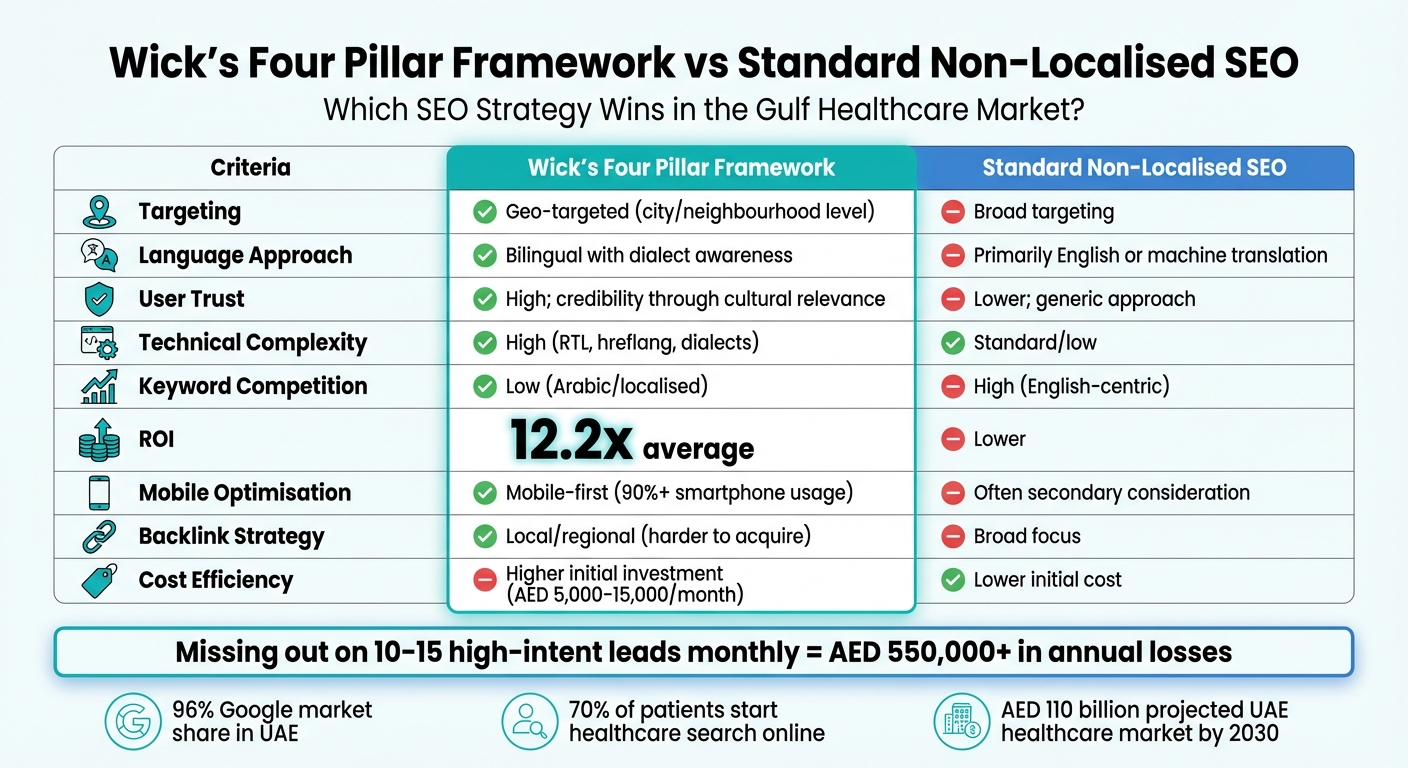
Wick's Four Pillar Framework vs Standard SEO for Gulf Healthcare
When deciding between Wick's Four Pillar Framework and a more generic SEO approach, it's essential to weigh their benefits and challenges, especially in terms of deliverables and cost.
Wick's framework delivers an impressive ROI (averaging 12.2x), focusing on intent-driven traffic at the city and neighbourhood level. It builds credibility by incorporating culturally relevant content and bilingual optimisation, which is critical when 75% of users don’t venture beyond the first page of search results. This method ensures proper RTL formatting, accurate hreflang tags (ar-ae and en-ae), and a mobile-first design - key in a country where over 90% of the population uses smartphones. However, implementing this approach requires deep regional expertise and faces hurdles like acquiring high-authority local Arabic backlinks, as many regional websites are hesitant to link to competitors.
On the other hand, standard non-localised SEO involves a lower upfront investment and uses simpler technical strategies. Its faster deployment skips over time-intensive tasks like dialect research and RTL formatting. However, it struggles with intense competition for English-centric keywords and often overlooks subtle linguistic nuances, such as differences between formal and informal Arabic spellings, which significantly impact search behaviour. Without aligning culturally, this approach falls short of earning the trust Gulf patients need when choosing healthcare providers.
"Arabic SEO isn't just a language change. It requires structure, semantic alignment, and localisation."
– Collab Lab Marketing
The comparison below highlights the key differences between these approaches:
| Criteria | Wick's Four Pillar Framework | Standard Non‑Localised SEO |
|---|---|---|
| Targeting | Geo-targeted (city/neighbourhood level) | Broad targeting |
| Language Approach | Bilingual with dialect awareness | Primarily English or machine translation |
| User Trust | High; credibility through cultural relevance | Lower; generic approach |
| Technical Complexity | High (RTL, hreflang, dialects) | Standard/low |
| Keyword Competition | Low (Arabic/localised) | High (English-centric) |
| ROI | High (12.2x average) | Lower |
| Mobile Optimisation | Mobile-first (90%+ smartphone usage) | Often secondary consideration |
| Backlink Strategy | Local/regional (harder to acquire) | Broad focus |
| Cost Efficiency | Higher initial investment (AED 5,000–15,000/month) | Lower initial cost |
Missing out on 10–15 high-intent leads each month could result in losses exceeding AED 550,000 annually. With Google holding 96% of the UAE search market and 70% of patients starting their journey online, localisation becomes a critical factor for success.
Conclusion
In the Gulf region, healthcare providers face a unique challenge: generic SEO simply doesn’t cut it when 70% of patients start their healthcare journey on Google. The bilingual nature of the region - where searches happen in both Arabic and English, often influenced by local dialects - demands a more personalised, culturally aware SEO strategy.
This is where Wick's Four Pillar Framework becomes a game-changer. For healthcare organisations aiming to go beyond basic brand visibility, this approach enables active, data-driven patient engagement. It's particularly effective for clinics and hospitals that are ready to invest in proper RTL (right-to-left) formatting and precise hreflang tags, such as "ar-ae" and "en-ae." By focusing on geo-targeted content down to city and neighbourhood levels, and aligning with E-E-A-T principles, the framework helps build the trust Gulf patients need when choosing healthcare providers.
The success of Novalift Aesthetic Clinics illustrates the potential of this strategy. After implementing a multilingual SEO plan rooted in localisation, their bookings tripled within just six months. With the UAE healthcare market expected to surpass AED 110 billion by 2030 and SEO already accounting for 60% of bookings in premium healthcare, it’s no longer a matter of if localised SEO will become the norm - it’s when.
For healthcare providers looking to expand across Gulf markets or compete in high-demand specialties, Wick’s framework offers a clear advantage. With a demonstrated ROI of 12.2x, even an initial monthly investment of AED 5,000–15,000 becomes a compelling case for long-term growth.
FAQs
How can clinics in the Gulf region optimise their SEO for bilingual audiences?
Clinics in the Gulf can strengthen their online presence by adopting bilingual SEO strategies that cater to both English and Arabic-speaking audiences. Start by conducting separate keyword research for each language, taking into account regional preferences and the subtleties of each language. For instance, while "Dubai cosmetic clinic" may attract English-speaking users, "عيادة تجميل دبي" could appeal to Arabic speakers - and their search behaviours and intent might vary. Use precise hreflang tags to help search engines direct users to the correct language version of your site, and make sure Arabic pages are formatted for smooth right-to-left (RTL) reading.
Another essential step is updating your Google Business Profile in both English and Arabic. Include key details like your clinic's name, address, and phone number, and integrate relevant keywords into your descriptions and services to improve your local search rankings. To connect with UAE-based users, ensure your content reflects local preferences - this means showing prices in AED, using the dd/mm/yyyy date format, and crafting content that aligns with cultural norms and expectations. For a comprehensive and effective plan, partnering with a consultancy like Wick can help you create a data-driven SEO strategy that combines technical improvements with tailored content.
What are the essential technical SEO tips for Arabic content in the UAE?
To effectively optimise Arabic content for search engines, start by configuring the language and direction settings in your HTML code. Use lang="ar" to specify Arabic as the language and dir="rtl" to support the right-to-left (RTL) text layout. Additionally, ensure all pages use UTF-8 encoding to display Arabic characters properly. Since more than 80% of searches in the UAE happen on smartphones, adopting a mobile-first design and ensuring fast-loading pages is essential.
When creating URLs, keep them clear and simple. You can use either encoded Arabic or Latin transliteration, but avoid including special characters. To prevent duplicate content issues, implement canonical tags, and improve indexing by including a sitemap that supports Arabic links. For local targeting, use hreflang tags with ar-AE to focus on UAE-specific audiences, and consider using a .ae domain to strengthen localisation. Hosting your website within the Gulf region can also help reduce response times and improve the overall user experience.
Don’t forget to integrate structured data (schema.org) in Arabic to enhance your content's visibility in search results. Optimise meta titles and descriptions with relevant Arabic keywords, and pay attention to regional dialects to ensure your content connects with the local audience effectively.
Why is localized SEO important for healthcare providers in the UAE?
Localized SEO plays a crucial role for healthcare providers in the UAE, especially since over 60–70% of patients in the region begin their search for medical services online. By focusing on local search optimisation, healthcare facilities can secure prominent visibility in search results, making it easier for patients to locate and choose their services. This approach not only helps retain patients who might otherwise turn to competitors but also fosters trust and strengthens their reputation within the community.
Moreover, local SEO allows healthcare providers to align their content with the preferences and behaviours of UAE residents. This includes incorporating region-specific keywords, addressing cultural considerations, and ensuring accurate information like working hours and locations. These details significantly improve the patient experience, encouraging more visits and engagement with healthcare facilities.