

Blog / SEO vs. Localization for Gulf Oil & Gas Content
SEO vs. Localization for Gulf Oil & Gas Content
When it comes to Gulf oil and gas content, SEO and localization are two critical strategies that work together to drive online success. Here’s the difference:
- SEO: Focuses on making your content visible on search engines like Google. It’s about ranking high for terms like "ADNOC suppliers" or "offshore engineering Abu Dhabi." In the UAE, where 96% of searches happen on Google, bilingual optimization (English and Arabic) is key. Arabic content is underutilized online, despite 54% of MENA searches being in Arabic.
- Localization: Goes beyond translation. It ensures your content aligns with local language, regulations, and expectations. For instance, using Gulf Arabic (Khaleeji), adhering to UAE labor laws, and designing for right-to-left (RTL) text are essential for trust and compliance.
Key takeaway: SEO gets your content found, while localization ensures it connects with Gulf audiences. Together, they help businesses rank on Google, build trust, and comply with local norms.
Quick Comparison
| Feature | SEO | Localization |
|---|---|---|
| Goal | Boost visibility on search engines | Make content relevant and compliant |
| Focus | Keywords, backlinks, mobile optimization | Language, dialect, RTL design |
| Target Audience | Search engines and global users | Local stakeholders and regulators |
| Technical Elements | Hreflang tags, .ae domains | RTL formatting, local laws |
| Language Approach | Bilingual (English and Arabic) | Gulf Arabic (Khaleeji) |
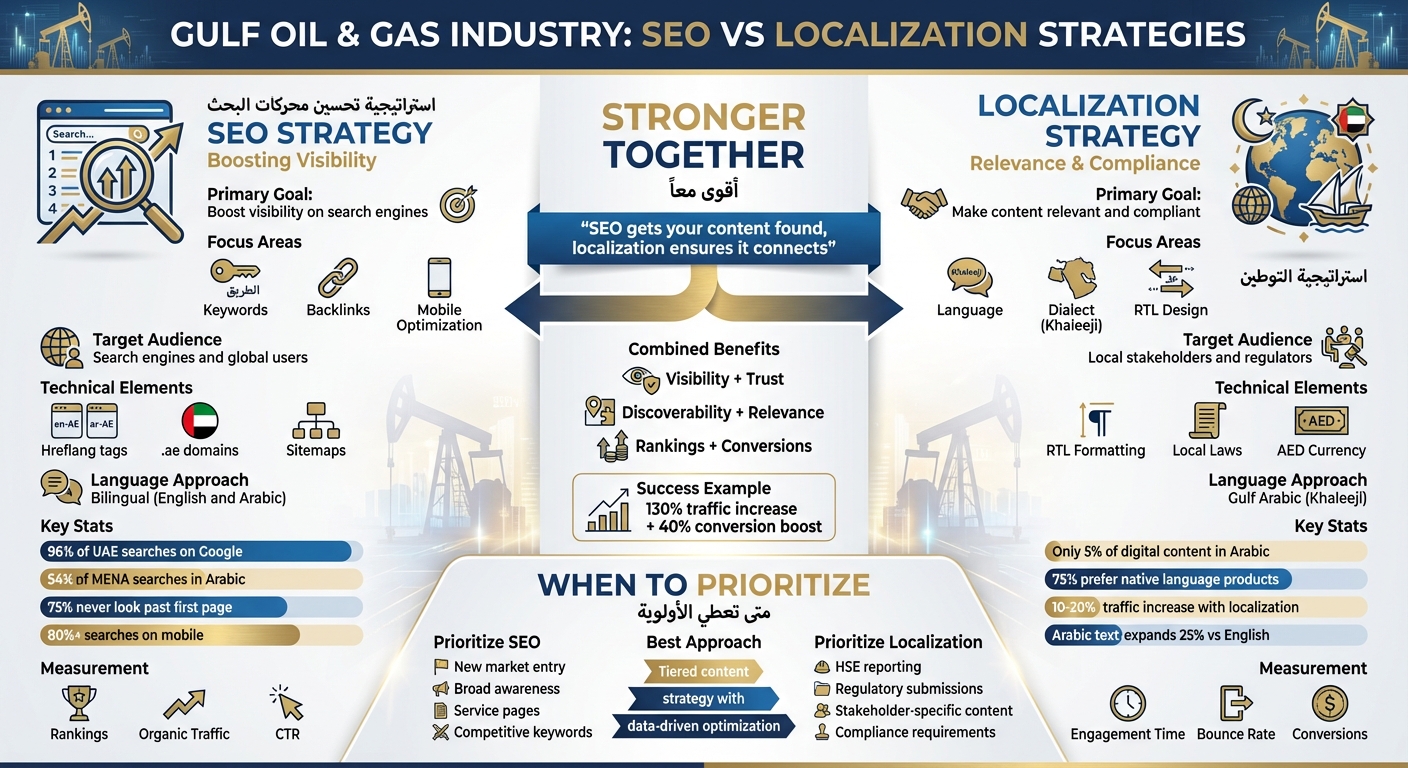
SEO vs Localization for Gulf Oil and Gas: Key Differences and Integration Strategy
BHGE regional president on the secrets to successful localisation
What is SEO for Gulf Oil and Gas Content
SEO (Search Engine Optimisation) is all about making your company’s content easy to find when procurement teams, investors, and business partners search for energy services online. In the Gulf, this means showing up on Google - which dominates 96% of the UAE's search market. Think searches like "ADNOC suppliers", "LNG services", or "offshore engineering Abu Dhabi."
For oil and gas companies operating in the UAE and GCC, SEO acts as a digital doorway to vendor shortlists and partnership opportunities. With 92% of consumers in the UAE turning to Google to find local businesses, your ranking determines whether decision-makers can even find your services. And here’s the kicker: 75% of users never look past the first page of search results. If you’re not there, you’re essentially invisible.
The Gulf market has its own SEO challenges and opportunities. While English dominates international business, 54% of Google searches in the MENA region are in Arabic. This bilingual reality means companies need to optimise for both languages, yet many ignore Arabic entirely. Here’s the opportunity: Arabic content makes up only about 5% of the digital landscape. That’s a huge chance for early movers to target industry-specific Arabic search terms with far less competition than in English.
"In the Arab world, SEO is one of the prominent ways to obtain traffic... there is a fair amount of competition for the English language, but SEO in Gulf for the Arabic language is at a primitive stage." – GTECH
Mobile optimisation is non-negotiable. With over 80% of searches in the UAE happening on smartphones and 78% of local mobile searches leading to an offline conversion within 24 hours, your website needs to load fast and navigate smoothly. If your site takes more than three seconds to load, you risk losing potential partners.
These insights lay the groundwork for technical strategies tailored to the Gulf’s energy sector.
SEO Methods for the Gulf Energy Market
SEO for Gulf oil and gas companies requires precise technical adjustments. For instance, Hreflang tags ensure search engines display the right language version - English for global investors, Arabic for regional procurement teams. At the same time, Right-to-Left (RTL) formatting is crucial for proper Arabic content display. Using a .ae domain signals local relevance to Google, boosting your visibility in UAE search results.
Keyword research needs to account for the nuances of each language. English queries like "LNG services" tend to be transactional and technical, whereas Arabic searches often emphasise trust and brand reputation. The UAE’s growing SEO software market - estimated at AED 4.4 billion and expected to reach AED 8.8 billion by 2030 - reflects the increasing sophistication and demand for these tailored strategies.
Local signals also play a big role in B2B visibility. Keeping a verified Google Business Profile with consistent Name, Address, and Phone (NAP) details across platforms like Dubai Chamber and Yellow Pages UAE helps establish authority. For businesses based in industrial areas like Musaffah or Jebel Ali, appearing in "near me" searches can directly influence whether you make it onto vendor shortlists.
Voice search is another game changer. With the rising use of Google Assistant and Siri in the region, optimisation should favour conversational, question-based Arabic phrases rather than rigid keywords. This aligns with the shift towards entity-based search, where topic clusters take precedence over isolated keywords.
These strategies not only improve search rankings but also help build the trust necessary for long-term success in the Gulf energy market.
Why SEO Matters for UAE and GCC Oil and Gas Companies
In a market where reputation is everything, high search rankings act as trust signals. UAE stakeholders tend to favour well-established, authoritative brands, and showing up at the top of search results conveys credibility before any direct interaction takes place. For procurement teams evaluating potential suppliers, strong search visibility can make or break your chances of being considered.
SEO budgets vary widely. Entry-level SEO typically costs AED 1,500–3,000 per month, covering basic keyword research and on-page optimisation. Mid-tier strategies range from AED 3,000–7,500 monthly and include more comprehensive content development. At the top end, enterprise-level campaigns often exceed AED 15,000 per month.
"SEO is a long game in the UAE; patience and consistency yield the best returns." – Grassroots Creative Agency
The benefits go beyond immediate results. By optimising for industry-specific terms, your company becomes more discoverable during critical procurement phases. Whether it’s international investors searching for Gulf energy partners or local procurement officers looking for service providers, effective SEO bridges the language and cultural gaps that define the Gulf’s business environment.
What is Localization for Gulf Oil and Gas Content
Localization tailors content - language, design, visuals, and messaging - to fit the UAE and GCC's cultural, technical, and regulatory landscapes. Unlike translation, which focuses solely on linguistic accuracy, localization ensures content resonates with local audiences and meets specific regional requirements.
In the Gulf oil and gas industry, this distinction is especially important. While a translated safety manual may convey instructions, a localized version ensures compliance with UAE Federal Decree Law 33/2021, incorporates the Gulf Arabic (Khaleeji) dialect, and follows proper right-to-left (RTL) formatting.
"Gulf Arabic localisation isn't just another regional dialect adaptation, it's the linguistic gateway to the world's wealthiest per-capita markets." – Wordminds
Although only 5% of digital content is in Arabic, 54% of MENA searches are conducted in the language, highlighting a massive untapped opportunity. Thoughtful localization can increase monthly web traffic by 10% to 20%, helping businesses connect with procurement teams, regulators, and local partners more effectively.
This understanding of localization lays the groundwork for implementing key strategies tailored to the Gulf market.
Main Components of Localization for the UAE and GCC
Successful localization in the UAE and GCC requires attention to several key areas, including language, regulations, technical adjustments, and cultural nuances.
Language Choice
Modern Standard Arabic (MSA) works well for formal documents and contracts. However, Gulf Arabic (Khaleeji), spoken by about 11 million people across the GCC, creates a stronger connection with local technical teams.
Regulatory Compliance
UAE Federal Decree Law 33/2021 mandates that employment contracts, instructions, and circulars must be issued in Arabic. For Health, Safety, and Environmental (HSE) standards, Article 22 requires fire prevention and hazard instructions to be provided in Arabic and another language workers understand. Failing to comply can result in fines ranging from AED 5,000 to AED 1,000,000.
"The employer shall use the Arabic language in concluding contracts with the workers, in writing and publishing instructions and circulars which it shall issue, provided that the text in the other language matches the Arabic text. In case of divergence, the Arabic text shall prevail." – UAE Federal Decree Law 33/2021, Article 66.2
Technical Adaptation
Localization involves reworking digital platforms to accommodate RTL orientation. This includes mirroring website layouts, navigation menus, and forms to suit Arabic reading patterns, as well as implementing hreflang tags (like ar-AE) to ensure search engines display the correct version. Arabic text typically expands by 25% compared to English, and given that 90–95% of traffic from Arab regions comes via mobile devices, responsive RTL-compatible designs are essential.
Cultural Sensitivity
Adapting to local customs is just as important. Gulf business culture often revolves around "wasta", a system rooted in trust and reciprocity, which differs from Western transactional approaches. Localized content should use imagery that aligns with regional values, schedule campaigns around key periods like Ramadan and National Days, and respect Islamic principles in messaging. For instance, this approach is critical for Environmental, Social, and Governance (ESG) efforts, as 58% of young GCC Arabs are willing to boycott companies that neglect environmental responsibilities.
| Feature | Translation | Localization |
|---|---|---|
| Primary Focus | Accurate meaning | Cultural relevance and user experience |
| Design Impact | Minimal (text only) | Significant (RTL layout and UI/UX adjustments) |
| Search Impact | May overlook local intent | Matches regional dialects and search habits |
| Compliance | General understanding | Adheres to local laws (e.g., HSE, Labour Law) |
Benefits of Localization in the Gulf Energy Sector
Localization fosters trust with regulators and stakeholders by aligning with cultural and technical expectations. For example, presenting HSE reports, environmental impact assessments, and site safety signage in Gulf Arabic while complying with laws like Federal Law 24/1999 demonstrates respect for local standards.
For engineering teams and site managers, localized materials that use familiar Khaleeji terms and properly adjusted RTL designs minimise misunderstandings and improve safety compliance. Interestingly, 75% of consumers prefer buying products marketed in their native language, a principle that also strengthens business-to-business relationships.
Localization also supports In-Country Value (ICV) initiatives, such as ADNOC's program, by promoting local manufacturing and ensuring business continuity. This not only enhances your ICV score but also aligns your operations with broader goals like Saudi Arabia's Vision 2030.
Additionally, localized content improves ESG and stakeholder communication. Sustainability reports and community engagement materials that reflect local values and use culturally appropriate visuals resonate more with government officials, investors, and the public. This thoughtful approach transforms basic compliance into meaningful connections, paving the way for long-term success in the Gulf energy sector.
sbb-itb-058f46d
SEO vs. Localization for Gulf Oil and Gas
How SEO and Localization Differ and Work Together
In the Gulf energy sector, SEO and localization play distinct yet complementary roles in crafting effective content strategies. While SEO is all about making your content visible - helping search engines like Google find, index, and rank it - localization ensures that the content feels relevant and relatable by adapting it to the linguistic, cultural, and regional nuances of the UAE and GCC. Together, they create a powerful combination that builds both visibility and trust.
Think of it this way: SEO gets your content noticed, while localization ensures it connects with the audience. Without SEO, even the most thoughtfully localized Arabic content might never surface in search results. On the other hand, without localization, SEO-driven traffic may fall flat if the content feels out of place or disconnected from the local context.
"Translation makes content understandable. SEO localization makes it discoverable." – Mia Comic, Writer, Lokalise
This balance is especially crucial in the Gulf oil and gas industry. For example, SEO might ensure that Arabic-language HSE documentation ranks well in search results, but localization ensures the content is tailored to the region’s dialects and standards. Together, these strategies not only attract stakeholders but also encourage genuine engagement.
One challenge to keep in mind is Google’s increasing reliance on AI to auto-translate English content into local languages. If you don’t create your own localized version, you risk losing both traffic and credibility as automated translations can misinterpret context and reduce link equity.
"If you don't localise your content, Google might do it for you - and take the traffic." – Erik Sarissky, Head of International Marketing, Ahrefs
Comparison Table: SEO vs. Localization
Here’s a breakdown of how SEO and localization differ while working hand-in-hand to achieve content success in the Gulf region:
| Feature | SEO | Localization |
|---|---|---|
| Primary Goal | Boost rankings and drive organic traffic | Enhance user experience, build trust, and improve conversions |
| Target Audience | Search engine algorithms and global searchers | Specific linguistic and cultural groups within the GCC |
| Core Activities | Keyword research, backlinking, hreflang tags, audits | Cultural adaptation, dialect alignment, RTL design, and regulatory adherence |
| Technical Signal | Sitemaps, URL structure, metadata optimisation | RTL formatting, AED currency, and DD/MM/YYYY date formats |
| Language Approach | Focus on high-volume global keywords | Use regionally adapted Gulf Arabic phrasing |
| Consequence of Neglect | Content becomes invisible to potential leads | Content feels disconnected, foreign, or irrelevant |
| Measurement | Rankings, organic traffic, click-through rates | Engagement time, bounce rate, and conversion rates |
When combined, SEO and localization ensure your content not only ranks high but also resonates deeply with Gulf audiences, creating a strategy that drives both visibility and meaningful engagement.
How to Combine SEO and Localisation
When to Prioritise SEO
SEO should take the lead when your primary objective is to increase visibility and expand market reach. For instance, if you're introducing new services across multiple GCC markets or aiming to create broad awareness for your oil and gas operations, being easily discoverable is key. High-intent service pages such as "upstream drilling services UAE" or "offshore maintenance Abu Dhabi" must be built on a strong SEO foundation to rank effectively in search results.
This approach is especially crucial when establishing your brand presence in competitive markets, where English keywords face tough competition or when targeting the 54% of MENA region searches conducted in Arabic. Technical elements like .ae domains, hreflang tags, and mobile-first optimisation are essential, particularly since most users rely on smartphones. Start by mapping targeted keywords with reliable tools to identify what Gulf stakeholders are actively searching for - steering clear of simply translating English terms.
Once you’ve achieved visibility, it’s time to align your content with local nuances to deepen engagement.
When to Prioritise Localisation
While SEO helps attract an audience, localisation ensures that your content resonates and builds trust. Localisation should take precedence when precision, credibility, and regulatory compliance are vital. For example, in contexts like HSE (Health, Safety, and Environment) reporting, regulatory submissions to ADNOC or Saudi Aramco, and detailed operational manuals, the focus must be on accuracy and cultural understanding rather than search rankings.
Localisation becomes critical when addressing specific stakeholders - such as Emirati engineers, Saudi contractors, or Kuwaiti regulators - who expect materials tailored to their cultural and professional norms. Research shows that 75% of consumers are more likely to prefer products marketed in their native language. In high-stakes energy operations, it’s essential to collaborate with native copywriters who understand technical energy terminology and can incorporate regional expressions that go beyond basic translation.
Combining SEO and localisation effectively requires a phased, strategic approach.
Steps to Combine SEO and Localisation
To successfully merge the strengths of SEO and localisation, follow a structured plan. Start with a tiered content hierarchy: global content for your brand narrative, regional messaging for GCC markets in both Arabic and English, and localised materials for market-specific regulations. Launch a couple of high-priority localised landing pages - such as for key services in Abu Dhabi or Riyadh - and monitor their performance before scaling up.
Rely on data to guide your decisions. Use tools like Google Search Console and Analytics to track metrics such as click-through rates, bounce rates, and conversion rates across different locales. This data can highlight areas where content ranks well but fails to engage audiences. Companies that integrate bilingual SEO and localisation strategies have reported impressive results. For example, one Dubai-based business saw a 130% increase in website traffic and a 40% rise in conversions from Arabic-speaking users, while another achieved a 318% boost in local blog traffic.
Pay attention to technical details. Use hreflang tags to avoid duplicate content issues, ensure Arabic pages are formatted for Right-to-Left (RTL) reading, and conduct regular crawl audits. Tools like Wick’s analytics can help identify localised pages that generate impressions but suffer from low click-through rates, signalling areas where meta-description localisation may need improvement.
It’s worth noting that effective Arabic content localisation can increase monthly traffic by 10% to 20% compared to straightforward translation. To achieve this, SEO and localisation must work hand in hand as part of a unified strategy.
Conclusion
The strategies outlined earlier highlight an essential truth for Gulf oil and gas companies: SEO and localisation are not opposing forces. Instead, they complement each other, working in tandem to ensure your content not only ranks well in search results but also connects meaningfully with your audience.
Consider this: a large portion of online activity in the MENA region happens in Arabic, and 76% of online shoppers prefer products with information in their native language. This makes a strong case for merging SEO with localisation.
The potential here is immense. While Arabic speakers number around 422 million globally, Arabic content makes up only about 5% of the digital space. This gap represents an underserved market, where effective localisation could increase monthly traffic by 10% to 20%, far outperforming simple translations. By adopting a tiered, data-driven content strategy that balances global messaging with regional optimisation, companies can unlock this opportunity. Key technical elements like hreflang tags, RTL formatting, and mobile-first design ensure search engines deliver the right content to the right users.
But success demands precision. Dialects matter - a simple term like "mobile phone" varies between Saudi Arabia ("جوال") and Jordan ("موبايل"). To build sustainable visibility, companies should implement advanced techniques like entity-based clustering, Arabic schema markup, and geotargeted landing pages tailored to cities like Abu Dhabi or Riyadh. Tools like Google Analytics and Search Console are invaluable for identifying where your content performs well in rankings but falls short in engagement, enabling continuous improvement.
Managing these complexities - whether it's RTL design, linguistic subtleties, or technical SEO - requires specialised expertise. Companies in the Gulf energy sector can benefit from integrated frameworks that combine SEO, content creation, and analytics into a cohesive strategy. Consultancies like Wick offer tailored, data-driven solutions that address the unique challenges of this region. Whether your audience includes Emirati engineers, Saudi contractors, or Kuwaiti regulators, blending discoverability with cultural relevance creates a long-term competitive edge.
Start by focusing on high-priority localised landing pages, monitor their performance, and scale your efforts from there. This integrated approach not only meets the technical demands of search engines but also aligns with the cultural expectations of your audience - a winning formula for sustained success in the Gulf energy market.
FAQs
How can Gulf oil and gas companies balance SEO and localisation effectively?
To effectively balance SEO with localisation for Gulf oil and gas content, businesses must optimise their digital presence for search engines while crafting content that aligns with the cultural and technical expectations of users in the UAE. On one hand, SEO involves structural elements like keyword-rich titles, fast-loading pages, and clean URLs. On the other hand, localisation ensures the content feels authentic by incorporating elements like Arabic search terms, UAE-specific units such as AED, kilometres, and °C, and British spelling conventions like "optimise" and "organisation."
Here are some key strategies to make this work:
- Bilingual keyword research: Pinpoint industry-relevant keywords in both English and Arabic, keeping regional language variations in mind.
- Domain strategy: Opt for a
.aedomain or create sub-directories (like/ar/) to enhance visibility specifically for UAE-based searches. - Localised content: Adjust meta descriptions, headings, and visuals to fit the UAE context; use metric measurements; display prices in AED (e.g., AED 1,250.00); and format dates as 19 Dec 2025 for consistency.
- Technical optimisation: Prioritise mobile-first design, add hreflang tags for en-AE and ar-AE, and host the website on servers located in the Gulf region to minimise loading times.
By combining these approaches, businesses can improve their search rankings while creating content that genuinely connects with Emirati audiences, setting the stage for growth in the Gulf market.
Why is Arabic content essential for businesses in the Gulf region?
Arabic is the heart of communication across the Gulf, including the UAE, where millions of internet users prefer to search, browse, and shop in their native language. Ignoring Arabic content isn’t just a missed opportunity - it could mean losing out on valuable website traffic and the trust of the local audience.
Creating Arabic content isn’t only about climbing the SEO ladder. It’s about aligning with local values, enhancing the user experience, and avoiding cultural missteps. Tailoring content to include Arabic keywords, the local currency (AED), proper number formatting, and messages that resonate with the region can dramatically increase visibility and conversions, particularly in industries like the Gulf’s oil and gas sector. Companies such as Wick specialise in merging SEO strategies with Arabic localisation, helping businesses establish a strong, region-focused digital presence.
What challenges arise when implementing SEO and localisation for the UAE market?
Implementing SEO in the UAE comes with its own set of challenges, largely due to the country's bilingual audience and mobile-first habits. To succeed, keywords need to be optimised in both Arabic and English. Using a local domain like .ae also signals relevance to search engines, which can boost visibility. With over 80% of searches happening on smartphones, ensuring fast page-load speeds, responsive design, and mobile-friendly elements is non-negotiable. Additionally, targeting specific emirates such as Dubai, Abu Dhabi, and Sharjah through geotargeting, along with building credibility using UAE-based backlinks and reviews, adds another layer of complexity to the strategy.
Localisation, however, is more than just translating content. Arabic content must incorporate cultural nuances, regional dialects, and local terminology to truly connect with Emirati audiences. This also means adapting visuals, layouts, dates, times, currency (AED), and measurement units to match UAE-specific conventions. Proper localisation doesn’t just make the content accessible - it makes it relatable. Done right, it can significantly boost traffic and engagement. However, achieving this requires a deep understanding of both linguistic subtleties and cultural expectations, as well as adherence to local regulations. Wick’s expertise lies in blending technical SEO with precise localisation to help oil and gas firms navigate these challenges successfully.