

Blog / SEO for Gulf Banking Content: Best Practices
SEO for Gulf Banking Content: Best Practices
Gulf banks face a unique challenge: capturing mobile-first, bilingual search traffic in a region where over 90% of searches are mobile and more than 60% of users prefer Arabic content. To stay visible and competitive, banks must focus on localized SEO strategies tailored to the UAE and GCC markets. Here's the key to success:
- Prioritize Arabic content: Many users search in Arabic for terms like "قرض شخصي" (personal loan) or "حساب توفير" (savings account). Invest in Arabic keyword research and culturally relevant, bilingual content to address these preferences.
- Optimize for local and mobile search: With Google dominating the Gulf's search landscape, ensure your website is mobile-friendly, fast-loading, and aligned with local search habits. Use tools like Google Business Profiles with accurate, bilingual branch details and customer reviews.
- Leverage regional backlinks: Secure links from trusted Gulf-based financial websites, media, and industry associations to improve local search rankings.
- Focus on Core Web Vitals: Fast-loading pages (under 3 seconds), responsive design, and smooth Arabic RTL formatting are critical for a seamless user experience.
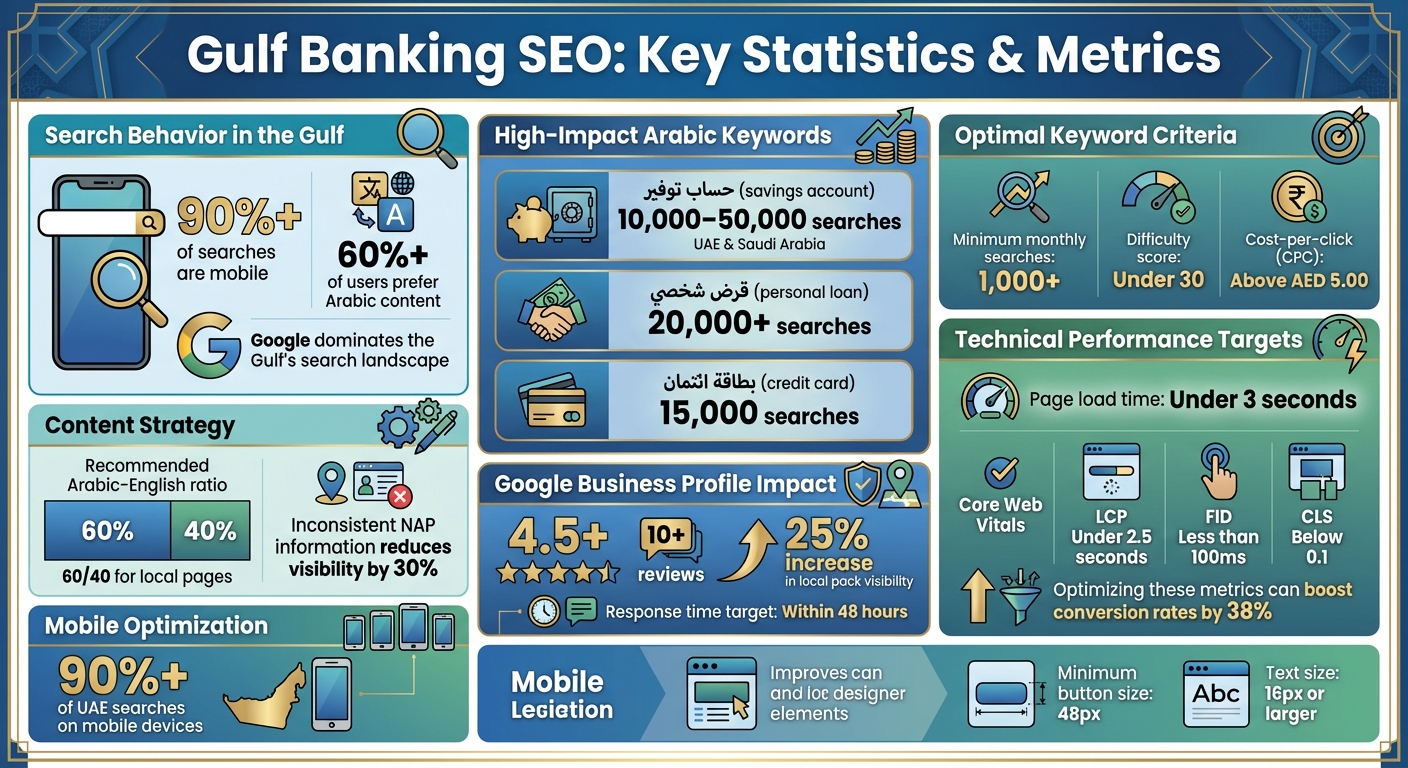
Gulf Banking SEO Statistics: Mobile Usage, Search Preferences, and Key Performance Metrics
Arabic Keyword Research for Banking Content
How to Find High-Impact Arabic Keywords
When Gulf customers search for banking services, they often use specific Arabic terms that reflect their needs and preferences. Tools like Google Keyword Planner, SEMrush, and Ahrefs can help uncover these terms by analysing search volume and competition. Start with foundational terms such as "حساب جاري" (current account) or "قروض بنكية" (bank loans). From there, expand your list by exploring Google.ae's autocomplete suggestions and examining regional trends through Google Trends, particularly when filtered for the UAE or Saudi Arabia.
Long-tail keywords are especially valuable because they often capture high intent while facing less competition. For instance, a phrase like "أفضل بنك للقروض في دبي" (best bank for loans in Dubai) is likely to attract users ready to act, unlike broader, less specific searches. Some high-performing keywords in the Gulf banking sector include "حساب توفير" (savings account, with approximately 10,000–50,000 monthly searches in the UAE and Saudi Arabia), "قرض شخصي" (personal loan, over 20,000 searches), and "بطاقة ائتمان" (credit card, around 15,000 searches).
For optimal results, focus on keywords with at least 1,000 monthly searches, a difficulty score under 30, and a cost-per-click (CPC) above AED 5.00. Transactional phrases like "تقديم طلب قرض" (apply for loan) tend to convert better than purely informational queries. Additionally, keep an eye on seasonal trends, such as increased search activity during month-end salary periods and Ramadan. A carefully curated Arabic keyword list can serve as the cornerstone of a strong bilingual content strategy.
Using Arabic and English Keywords Together
To maximise your reach, a bilingual approach is essential. Gulf audiences frequently switch between Arabic and English when searching online. While younger Emiratis and expats often prefer English, local customers - especially those seeking Islamic banking or traditional services - lean towards Arabic. The challenge is to create content that resonates with both groups without alienating either.
For locally focused pages, aim for a 60/40 Arabic-English content ratio, adjusting based on your audience's preferences. Use hreflang tags (en-AE and ar-AE) to ensure search engines serve the right language version to the right users. Additionally, integrate both languages into your titles, such as "حسابات بنكية في الإمارات | Bank Accounts in UAE", to appeal to a broader audience. Tailoring content to local intent is also crucial; for example, translating "mortgage calculator" into "حساب قسط المنزل" aligns with the everyday language used in searches. This balanced approach ensures your content connects effectively with diverse Gulf audiences.
Local SEO for Banking Websites
Setting Up Google My Business for Banks
For UAE banks, each branch needs a verified Google Business Profile to show up in local search results. Start by claiming and verifying the profile with the branch's exact name, like "Emirates NBD - Dubai Mall Branch." Use phone numbers in the +971 format and include a full address with the emirate and postcode, such as: "Dubai Mall, Financial Centre, Dubai, UAE 12345."
Create a bilingual profile that uses location-specific keywords, such as "bank near me in Abu Dhabi" or "أقرب فرع بنك في الشارقة". Add high-quality photos of the branch, list operating hours in the 24-hour format (e.g., 09:00–17:00), and update hours for Ramadan and public holidays. It's crucial to keep your Name, Address, and Phone number (NAP) consistent across all platforms, like Yello UAE. Inconsistent information can hurt your visibility, reducing it by as much as 30%.
Customer reviews play a huge role in improving local search rankings. Respond to all reviews - both positive and negative - within 48 hours, using both English and Arabic. Encourage feedback by sending SMS requests after customer visits. Banks that maintain a 4.5+ star rating with at least 10 reviews often see a 25% increase in local pack visibility. To keep your profile engaging, regularly post updates about new services, promotional rates, or branch-specific announcements.
These efforts not only strengthen your Google Business Profile but also enhance your website’s local SEO strategy.
Adding Regional Information to Your Website
Once your Google Business Profiles are set up, your website should also reflect detailed regional information. Create dedicated location pages for each branch, such as "Emirates NBD Branch - Abu Dhabi Corniche." Include embedded Google Maps, complete NAP details, and a clear list of services offered. Make sure to mention AED pricing directly, using phrases like "AED 0 account fees" or "minimum balance of AED 3,000" to help users quickly understand costs and improve relevance for local searches.
Tailor these pages further with UAE-specific details, like branch hours (e.g., Saturday–Wednesday), holiday closures for both Gregorian and Hijri calendars (e.g., Eid Al Fitr), and adjusted Ramadan timings. Use schema markup with LocalBusiness tags to help search engines better understand your branch locations, and add hreflang tags (en-AE and ar-AE) to serve the correct language version to users.
Since over 90% of searches in the UAE are conducted on mobile devices, ensure your location pages load in under three seconds and display perfectly on smartphones. Combining fast-loading pages with relevant, localised content ensures your bank captures high-intent local searches across the Gulf region.
Technical SEO for Gulf Banking Websites
Mobile Optimization for Banking Sites
For Gulf banks, mobile optimisation isn't optional - it's essential. With Google's mobile-first indexing, the mobile version of your site is what primarily determines your search ranking. This makes having a responsive design absolutely critical.
Your banking website must seamlessly support both English and Arabic content on mobile devices. To achieve this, implement responsive design using fluid grids and media queries that adapt layouts to fit different screen sizes. For Arabic pages, ensure proper RTL (right-to-left) support for smooth content display. Design interactive elements like buttons to be at least 48px, and use text sizes of 16px or larger for easy navigation, especially when users are checking balances or making transactions.
Additionally, use hreflang tags (e.g., en-AE and ar-AE) to guide Google in distinguishing language versions of your site. Testing your site on real mobile devices is crucial to catch any RTL-specific layout issues that desktop testing might overlook. Features like click-to-call buttons and biometric login should work flawlessly to enhance the user experience.
Finally, don't underestimate the importance of site speed in mobile optimisation - it’s the next step to improving both performance and rankings.
Improving Website Speed and Performance
Once your site is mobile-friendly, the next priority is speed. Fast-loading pages are vital for keeping users engaged, especially on mobile. Aim for a load time of three seconds or less to reduce bounce rates. Focus on Core Web Vitals - key metrics Google uses to evaluate user experience. These include:
- Largest Contentful Paint (LCP): Under 2.5 seconds
- First Input Delay (FID): Less than 100ms
- Cumulative Layout Shift (CLS): Below 0.1
Optimising these metrics can boost conversion rates by up to 38%.
Start by compressing images into WebP format, which reduces file sizes without sacrificing quality. Minify CSS, JavaScript, and HTML to streamline code, and enable browser caching to cut down on server requests. A Content Delivery Network (CDN) tailored for Gulf audiences ensures faster load times across the UAE, Qatar, and nearby regions. For dynamic pages, like those showing account details or loan calculators, use server-side rendering and lazy-load nonessential elements to improve performance.
A faster site not only enhances mobile usability but also delivers a smoother experience for Gulf users, who expect quick and efficient digital interactions. Conduct regular technical audits using tools like Google Search Console and PageSpeed Insights to monitor Core Web Vitals and resolve indexing errors. Analyse mobile usability issues and regional traffic trends with Google Analytics, prioritising fixes for both Arabic and English versions of your site.
For instance, Forex UAE successfully implemented this strategy by focusing on detailed website maintenance, optimisation, and performance tracking. This approach helped them deliver actionable insights that shaped their strategic growth.
sbb-itb-058f46d
Building Backlinks from Gulf Sources
Working with Regional Financial Websites
Securing backlinks from Gulf-based sources can significantly enhance your local search rankings compared to international links. For instance, a backlink from a reputable UAE financial portal or a GCC business publication sends strong geo-relevance signals to Google. This is especially important for search queries like "personal loan Dubai" or "Islamic banking UAE". The goal is to focus on websites with strong financial credibility and regional influence.
Start by identifying financial news portals and business media in the Gulf that regularly cover topics such as banking, fintech, and economic trends in the UAE and the broader region. These platforms often publish expert insights and data-driven content, making them excellent collaborators for thought leadership. For example, co-authoring articles on Sharia-compliant finance or emerging digital banking trends can secure backlinks to your bank's research hub.
You can also explore opportunities with industry associations, fintech hubs, and free-zone business councils. Many of these organisations maintain member directories and resource pages, which are excellent for building trust signals. Participating in their initiatives, sponsoring events, or contributing to their publications can help earn these authoritative citations. Similarly, government or semi-government initiatives tied to Vision 2030, SME development, or financial literacy offer high-authority link opportunities when you share your bank’s expertise or resources.
When reaching out, tailor your approach to reflect Gulf business etiquette. Reference the publisher’s previous coverage in your outreach and follow up through phone or WhatsApp, as these are commonly used communication channels in the region. Offering content in both English and Modern Standard Arabic is essential, as many Gulf platforms cater to diverse audiences. Timing your pitches around key local events - like Ramadan, UAE National Day, or budget announcements - can increase the likelihood of success for finance-related topics tied to seasonal interests. Always highlight mutual benefits and ensure compliance with UAE Central Bank regulations to address potential concerns. These strategies lay the groundwork for creating content that naturally attracts backlinks.
Creating Content That Gets Shared
Once your outreach is in place, developing engaging content is the next step to drive organic backlinks. By aligning your content with local needs and cultural expectations, you strengthen your overall SEO strategy. Educational guides and explainers - such as "How to get a home loan in Dubai" or "Introduction to Islamic banking for expatriates" - are particularly effective when optimised in both English and Arabic. These resources address real challenges faced by UAE residents, making them frequently cited by personal finance blogs, comparison sites, and regional media.
Original data reports also generate strong interest. Publishing quarterly insights on topics like UAE household savings, SME financing gaps, or digital payments growth - complete with charts and downloadable PDFs - provides journalists and bloggers with valuable material to reference. Breaking down the data by emirate or sector adds further appeal, while bilingual summaries and Arabic-labeled visuals ensure accessibility for Arabic-speaking audiences.
Interactive tools are another excellent way to earn backlinks. Tools such as AED-based mortgage calculators, VAT calculators, or Zakat estimators naturally attract links as other sites recommend them as useful resources. Additionally, case studies featuring real UAE SMEs or individuals - highlighting specific AED figures and regionally formatted dates - resonate well with local audiences and are often republished by business outlets. Content that focuses on culturally relevant themes, such as family budgeting in AED, preparing for school fees, or planning for Hajj expenses, aligns with the values of community support and financial responsibility.
It’s crucial to avoid overt product promotion. Instead, integrate your banking products subtly within educational content to build trust with both publishers and readers. Use visuals and examples that respect local cultural norms, such as modest imagery and recognisable UAE settings. For regulated industries like banking, digital PR through data-driven stories and expert commentary is a safer and more effective approach than traditional link exchanges. Collaborating with a consultancy like Wick can help streamline digital PR efforts across Gulf media, ensuring quality backlinks while maintaining regulatory compliance.
Conclusion and Key Takeaways
Main Points Recap
To wrap things up, let’s revisit the core strategies for effective SEO in Gulf banking. Success in this space hinges on five essential pillars:
- Bilingual keyword research: Address both Modern Standard Arabic and English search behaviours.
- Local SEO: Optimise Google Business Profiles, ensure consistent NAP (Name, Address, Phone) details, and create geo-targeted landing pages for each emirate.
- Technical optimisation: Prioritise mobile-first design with sub-3-second load times and improved Core Web Vitals for seamless customer experiences.
- High-quality content: Focus on topics like fees, eligibility, and product details while adhering to UAE regulatory standards.
- Authoritative backlinks: Secure links from trusted Gulf financial publishers and industry organisations.
These pillars collectively reduce reliance on paid media and lower customer acquisition costs in AED over time.
The Gulf’s digital environment requires both technical precision and cultural understanding. Arabic right-to-left layouts, AED-specific tools like calculators, and content tailored to local concerns (e.g., school fees or Hajj planning) resonate far more than generic material. Tracking key metrics - such as organic sessions segmented by language and emirate, keyword rankings across Arabic and English, and conversion actions from Google Business Profiles - helps identify what’s working and where tweaks are needed. By building on these foundational elements, you’ll strengthen and broaden your SEO efforts.
Next Steps for Your Banking SEO
Here’s where to begin: conduct a comprehensive audit of your current SEO standing. This includes assessing technical performance, identifying content gaps, and evaluating local visibility for your branches. Within the first 90 days, focus on these priorities:
- Refine your bilingual keyword strategy.
- Standardise all Google Business Profiles.
- Optimise mobile performance for key landing pages.
- Launch a content sprint targeting high-intent queries like “how to open a business account in Dubai” in both Arabic and English.
- Start a pilot backlink outreach programme, focusing on five to ten regional financial publishers.
To keep momentum, make these practices part of a continuous SEO strategy. Develop a rolling content calendar tied to product launches and local events. Conduct quarterly technical reviews to stay aligned with Google updates and Core Web Vitals benchmarks. Moreover, ongoing conversion rate optimisation will boost application completions and lower acquisition costs in AED.
For those looking to accelerate results, partnering with a consultancy like Wick can be a game-changer. With a Four Pillar Framework that integrates SEO with user experience, content strategy, marketing automation, and analytics, Wick helps transform fragmented efforts into a cohesive, AI-powered digital ecosystem. Backed by over 27 years of experience and access to more than 1,000,000 first-party data points, their approach connects organic performance to measurable business outcomes. This ensures budget alignment, stakeholder buy-in, and sustained growth across the Gulf’s banking sector.
FAQs
How can Gulf banks optimise SEO with bilingual content?
Gulf banks have a unique opportunity to enhance their SEO by crafting bilingual content that incorporates Arabic keywords alongside English terms. This approach aligns with local search habits, making it easier for users to find relevant information in both languages.
To make this strategy more impactful, content should be carefully tailored to local standards. For example, use the UAE dirham (AED) for currency, adopt the DD/MM/YYYY date format, and stick to the metric system for measurements. These small but crucial details resonate with local audiences and help build a stronger connection.
Another key element is addressing regional trends and understanding cultural subtleties. By weaving these aspects into the content, banks can create a sense of familiarity and trust, which not only engages users but also improves search engine rankings in the Gulf region.
How can I optimize a banking website for mobile users in the Gulf region?
To make a banking website more user-friendly for mobile users in the Gulf, prioritise a fast-loading, mobile-responsive layout that adjusts smoothly to various screen sizes. Keep the navigation straightforward so users can quickly access essential features like account login or loan calculators.
Add a touch of localisation by including Arabic keywords and imagery that aligns with the region's culture. Ensure the website accommodates UAE-specific formats, such as currency displayed as AED 1,000.00, dates in DD/MM/YYYY format, and numbers with commas as thousand separators. Use clear calls-to-action to guide users effectively, and integrate AI-powered personalisation tools to create customised experiences that align with the preferences of Gulf customers.
Why are local backlinks important for improving Gulf banking SEO?
Local backlinks are a crucial part of boosting SEO for Gulf banking websites. They help establish regional authority while improving visibility in location-specific search results. Essentially, these links tell search engines that your content is relevant and reliable within the Gulf region, making it easier to connect with local audiences.
Moreover, regional backlinks align your website with the preferences of Gulf users, whether they’re searching in Arabic or English, particularly in the UAE. This doesn’t just improve your rankings - it also enhances your credibility and fosters trust among potential customers in the region.