
Blog / SEO for GCC Real Estate: Localization Strategies
SEO for GCC Real Estate: Localization Strategies
If you’re targeting the GCC real estate market, generic SEO won’t work. Here’s why:
- 54% of searches in MENA are in Arabic, but many websites only cater to English-speaking audiences.
- Users in the UAE and GCC search with hyperlocal intent, such as "villas near Dubai Mall" or "apartments in JLT."
- Mobile dominates: 80% of UAE searches happen on smartphones, and "near me" searches have surged by 900%.
To succeed, you need localised SEO that reflects the region’s unique search habits, bilingual preferences, and cultural nuances. This includes:
- Arabic and English content tailored to Gulf dialects and search intent.
- Right-to-left (RTL) formatting for Arabic pages.
- Geotargeting with specific subdirectories (e.g.,
/ae/,/sa/) andhreflangtags. - Google Business Profile optimisation with local details, photos, and reviews.
Without these strategies, you risk losing visibility and trust. Localised SEO isn’t just an option - it’s the key to connecting with Emiratis, expats, and investors in the GCC real estate market.
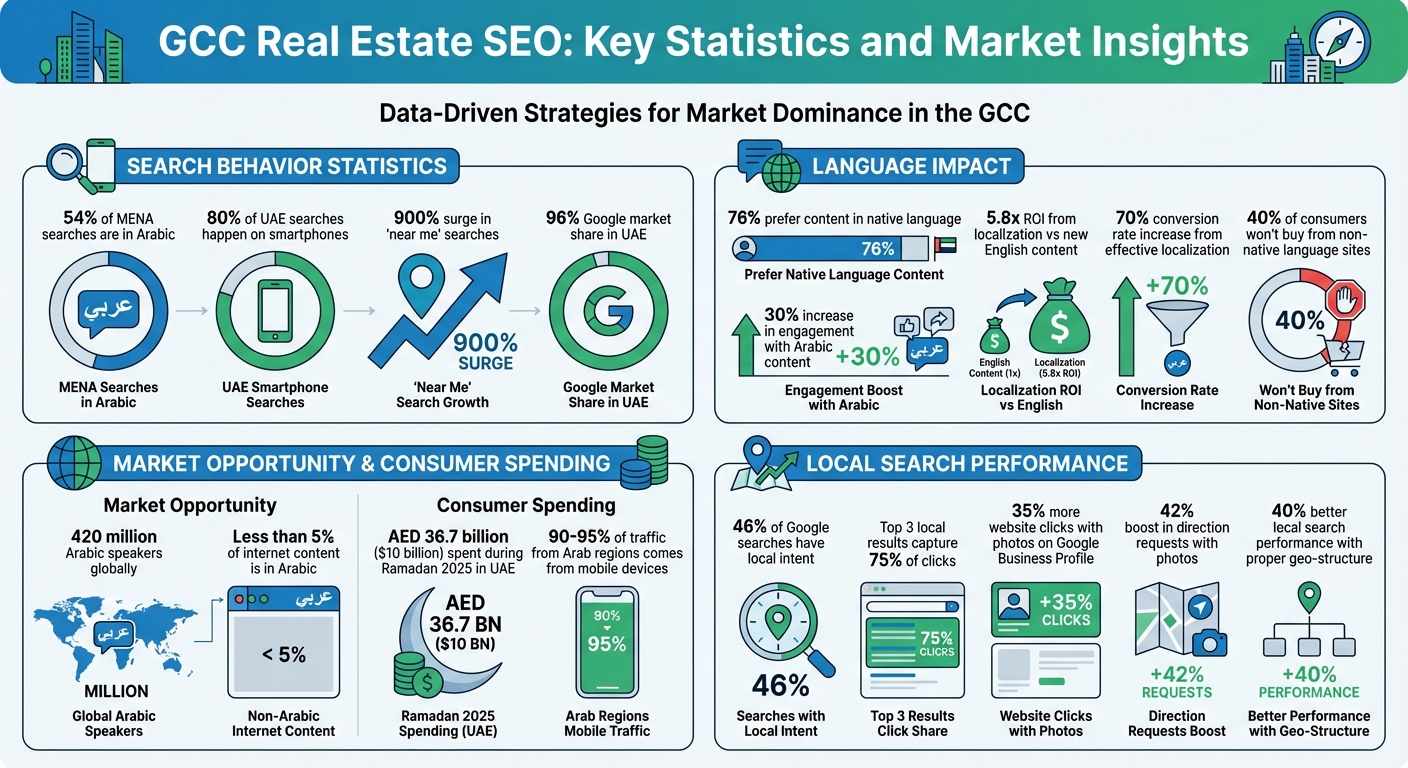
GCC Real Estate SEO: Key Statistics and Market Insights
How GCC Audiences Search for Real Estate
In the GCC, property searches reflect a mix of bilingual preferences, hyperlocal focus, and culturally specific trust indicators. Let’s dive into how these elements influence search behaviours and the importance of precise location cues.
Location-Specific Search Queries
GCC users often focus their searches on specific neighbourhoods, streets, or landmarks. For example, queries like "villas in Abu Dhabi Al Nahyan" or "luxury apartments near Downtown Dubai" are highly popular. This highlights the need for precision - broad terms like "Dubai property" might miss the mark for users with clear intent. Instead, searchers combine real estate terms with detailed geographic modifiers, such as Business Bay, Jumeirah Village Circle, or Dubai Marina. They may also include references to nearby schools or mosques, which serve as key decision-making factors.
Landmarks are particularly influential in these searches. Terms like "apartments near Dubai Mall" not only reflect user intent but also provide opportunities for content creators to align their listings with these high-traffic queries, capturing users ready to take action.
Arabic and English Search Preferences
Language plays a pivotal role in shaping search behaviour across the GCC. Approximately 54% of MENA Google searches are conducted in Arabic, compared to 34% in English. However, the difference isn’t just in numbers - it’s also about how users phrase their searches.
Arabic queries tend to be more conversational and question-driven, often starting with phrases like "كيف" (how) or "ما هو" (what is). These searches typically begin with informational intent, as users seek to build trust before transitioning to transactional stages.
English queries, on the other hand, are shorter and more direct, often including commercial modifiers such as "best" or "near me". Interestingly, a high-performing English keyword may not translate effectively into Arabic due to differences in phrasing and intent. While Modern Standard Arabic (MSA) is suitable for formal contexts, Gulf Arabic (Khaleeji) resonates more with conversational and voice-driven searches.
"Arabic search queries in the UAE often lean toward conversational and question-based formats. Users commonly type full questions starting with words like 'كيف' (how) or 'ما هو' (what is)." – Panamedia
| Feature | Arabic Search Behaviour | English Search Behaviour |
|---|---|---|
| Query Format | Conversational, long-tail queries | Short, direct keywords |
| Intent | Informational, trust-building | Transactional, commercial |
| Modifiers | Dialect-specific terms | "Best", "near me", service-related terms |
| UX Requirement | Right-to-Left (RTL) alignment | Left-to-Right (LTR) alignment |
Regional Trust Signals
Building trust is crucial when targeting GCC audiences. Localised signals, such as pricing in AED instead of USD, references to local regulations, and imagery that reflects regional norms, help establish credibility.
"Arabic is still a language that brings trust, connection, and cultural significance in the United Arab Emirates (UAE) market." – GTECH
Seasonal trends also shape search behaviours. For instance, user interest spikes around Ramadan, Eid, and the Dubai Shopping Festival. Acknowledging these periods in content can demonstrate local awareness, appealing to both Emirati nationals and the expatriate community.
These unique search patterns and trust factors highlight the importance of tailoring SEO strategies to the GCC real estate market. By addressing linguistic nuances, hyperlocal intent, and cultural preferences, businesses can better connect with their audience and drive meaningful engagement.
sbb-itb-058f46d
Regional Keyword Research for GCC Real Estate
Moving from Generic to Local Keywords
In the GCC market, generic phrases like "real estate services" or "Dubai property" don’t cut it. People searching for property here tend to combine specific property types with neighbourhood or landmark details. So instead of targeting broad terms like "villas in Dubai", it’s better to aim for phrases such as "villas for sale in Jumeirah Village Circle" or "luxury apartments near Business Bay." These geo-specific keywords attract users who already have a clear idea of where they want to live.
The approach is simple: dedicate a landing page to each main keyword. For example, have one page for "Dubai Marina rentals" and another for "JLT properties for sale." Then, add 2–3 long-tail variations to support each page. This keeps your content focused and helps establish authority for specific locations. Tools like Google Keyword Planner, Ahrefs, or SEMrush are great for this. Just remember to set location filters to specific UAE cities to get accurate search data.
Arabic Keyword Research
Translating English keywords directly into Arabic doesn’t work. A keyword that performs well in English might have no search value when translated word-for-word. Arabic searches tend to be more conversational, often starting with "كيف" (how) or "ما هو" (what is), while English searches are typically shorter and more action-oriented. You’ll also need to consider dialect differences - Modern Standard Arabic (MSA) is fine for general information, but Gulf Arabic (Khaleeji) is much better for local service-related queries.
"Arabic keyword research isn't simply about identifying words; it is about knowing the context, search intent, and regional differences." – GTECH
It’s essential to validate Arabic keywords with native speakers to catch regional nuances and spelling differences. For example, a term that works in Dubai might need tweaking for Sharjah or Abu Dhabi. Implementing hreflang="ar-AE" and hreflang="en-AE" tags is also crucial to target the right audience and avoid duplicate content issues.
Understanding these language subtleties helps refine your keyword strategy even further, especially when incorporating long-tail keywords.
Long-Tail Keywords and Voice Search
Long-tail keywords are a must for attracting high-quality leads. Instead of competing for generic terms like "buy apartment Dubai", focus on specific phrases like "best community to buy a villa in Dubai" or "affordable family properties in Sharjah." These detailed searches often come from users who are closer to making a decision.
Another important factor is voice search, which plays a big role in the GCC market. With mobile devices accounting for over 80% of UAE searches, tailoring your content for voice queries is essential. Voice searches are often phrased as questions, like "What is the best area for families in Dubai?". To optimise for these, structure your content with clear, concise answers that can appear in featured snippets.
For Arabic voice searches, prioritise Gulf dialect terms that reflect how people naturally speak. For instance, someone might search for "تقسيط" (instalment plans) instead of using a more formal MSA equivalent. Combine conversational terms with location-specific modifiers and intent-driven words like "near me", "affordable", or "24/7" to cover the full range of voice-driven property searches.
Technical SEO Setup for GCC Markets
Regional Site Structure and Geotargeting
How you structure your website plays a big role in helping search engines deliver the right content to users in different GCC countries. For real estate agencies working across multiple markets, using subdirectories is a smart approach - like /ae/ for UAE or /sa/ for Saudi Arabia. This method keeps your domain authority under one umbrella while organising content for each market separately.
To make this work, implement hreflang tags with specific language-region codes, such as en-ae for English targeting UAE audiences and ar-ae for Arabic content in the same region. Ensure every localised page references all its counterparts, including itself, so search engines can understand the relationships between versions. Add an x-default tag as a fallback option for users from unassigned regions or those relying on AI search tools.
"Hreflang is mandatory for UAE & MENA SEO... Region-specific tags outperform generic setups." – Creative Digital
If you're using IP-based geo-redirection to guide visitors to their local site, that's acceptable - just make sure Googlebot gets the same treatment as a regular user to avoid cloaking penalties. Additionally, set the target country for each subdirectory through Google Search Console's "International Targeting" feature. Websites with properly structured geographic URLs can achieve 40% better local search performance compared to those without this setup.
Once your site is structured and geotargeted, strengthening local signals will further enhance your visibility.
Google Business Profile Setup
Beyond your website, optimising local business profiles and automated marketing solutions are game-changers for building trust with GCC audiences. Claim and verify a Google Business Profile (GBP) for each of your offices to increase your local reach. A well-optimised GBP can lead to four times more walk-in appointments and deliver impressive ROI.
Start by listing "Real Estate Agency" as your primary category, then add secondary categories like "Leasing Service" or "Commercial Real Estate" to broaden your visibility. Ensure your Name, Address, and Phone number (NAP) are consistent across your GBP, website, and regional directories such as Yellow Pages UAE or Dubizzle. Include specific neighbourhoods - like Dubai Marina, Business Bay, or Jumeirah - and landmarks like the Burj Khalifa to attract high-intent local searches.
Upload high-quality, geotagged images and immersive 360° videos showcasing properties and their surroundings. Profiles with photos see 35% more website clicks and a 42% boost in direction requests on Google Maps. Regularly post updates about new listings, market trends, or community events, and respond to all reviews within 48 hours. It takes 30 to 33 positive reviews to offset the damage of one negative review. Use UTM parameters on your website links to track leads generated from local search results.
Property Schema Markup
Schema markup helps search engines understand your property listings better, making them eligible for rich snippets in search results. Use RealEstateListing schema with JSON-LD to highlight key details like property type, location, number of bedrooms, availability, "priceCurrency": "AED", and GeoCoordinates (latitude and longitude) for precise map placement.
"Always use currency tags like 'priceCurrency': 'AED' to align with local expectations." – Trout Digital
Format phone numbers with the +971 code and specify the country as "AE" for clarity. If your agency has physical offices, add LocalBusiness schema to boost visibility in Google Maps and "near me" searches. After implementation, validate your schema using Google's Rich Results Test to ensure it's error-free and ready for enhanced SERP features.
For bilingual sites, make sure to implement schema for both Arabic and English pages. Arabic pages should also support Right-to-Left (RTL) layouts to maintain usability and design consistency. Adding BreadcrumbList schema can further enhance search engines' understanding of your site's structure - like Country > City > Neighbourhood - improving local search relevance.
Adapting Content for GCC Audiences
Regional Content and Imagery
To connect with GCC audiences, tailoring your content to reflect local culture is essential. Research shows that 76% of online shoppers are more likely to make a purchase when information is presented in their native language. Additionally, creating Arabic-language content can increase engagement by up to 30%.
For instance, neighbourhood guides focusing on areas like Dubai Marina, Business Bay, or Al Nahyan can attract high-intent local searches. Use geo-specific keywords and cover topics like property values, market trends, and amenities that resonate with the audience. Highlight features such as prayer rooms, separate majlis areas, or proximity to international schools to address local preferences. When choosing visuals, include images of traditional clothing like the Kandura or Abaya, and incorporate iconic landmarks to foster a sense of familiarity and trust. Pay attention to colour symbolism too - green often represents prosperity, while blue conveys trust.
For Arabic content, ensure your website supports right-to-left (RTL) layouts, uses Arabic-friendly fonts, and incorporates design elements like calligraphy for authenticity. While Modern Standard Arabic is suitable for formal contexts, using Gulf Arabic (Khaleeji) in social media posts or voiceovers can make your content more relatable. It’s also crucial to ensure your content complies with local regulations, which enhances credibility and demonstrates respect for regional standards.
Local Regulations and Standards
Adhering to local regulations is a non-negotiable step in building trust with GCC audiences. Always display property prices in AED and include VAT calculations to ensure transparency. Mentioning local licensing requirements and regulatory frameworks in your content can further establish authority and market expertise.
Cultural sensitivities also play a significant role. Be mindful of religious references, gender representation, and modesty standards, especially in more conservative markets like Saudi Arabia. During key periods such as Ramadan and Eid, adjust your messaging to align with seasonal trends. For example, during Ramadan 2025, consumer spending in the UAE reached AED 36.7 billion (around $10 billion). By respecting these cultural and seasonal nuances, you strengthen the connection with your audience and build long-term trust.
User Experience for GCC Visitors
Beyond localisation and compliance, delivering a smooth user experience is crucial. With over 80% of searches in the UAE happening on smartphones and 90–95% of traffic from Arab regions coming from mobile devices, your site must be mobile-friendly. Optimise images for quick loading and compress files without compromising quality to ensure your site performs well on 4G and 5G networks.
Incorporate WhatsApp CTAs prominently, as this is a preferred communication tool for users in the GCC. Keep your NAP (Name, Address, Phone) details consistent across platforms, including your website, Google Business Profile, and local directories like Yellow Pages UAE or Dubizzle. Regularly test both Arabic and English versions of your site to ensure they function seamlessly, providing a reliable and accessible experience for all users.
Building Trust in GCC Real Estate Markets
Establishing trust in the GCC real estate market hinges on leveraging local reviews, forming strategic partnerships, and ensuring strong technical signals. These elements are essential for boosting SEO performance and building credibility in the region.
Local Reviews and Client Testimonials
Your Google Business Profile reviews can significantly improve your visibility in local search results. For instance, businesses with higher ratings (e.g., 4.7 from 150 reviews compared to 3.2 from 12) tend to rank better, especially for location-specific searches like "Dubai Marina" or "Al Barsha". These reviews often include keywords tied to these areas, which strengthens your rankings for long-tail and voice search queries.
To further enhance your online presence, embed review schema markup on your website. This creates rich snippets that stand out in search results. When responding to reviews, include specific details about your service - such as helping a client find a villa in Sharjah - to reinforce keyword relevance. Additionally, encourage clients to share photos of their new properties along with their feedback. This not only boosts engagement but also adds credibility to your profile.
Timely feedback is crucial. Use automated SMS or email requests immediately after closing transactions to encourage clients to leave reviews. Offering reviews in both Arabic and English ensures you cater to the region's multilingual audience.
Regional Partnerships and Media Mentions
Beyond client testimonials, forming local partnerships can solidify your market position. Being featured in respected publications like Gulf News, The National, or Khaleej Times serves as a strong trust signal for both search engines and potential buyers. Backlinks from trustworthy UAE-based sources and collaborations with organisations like the Dubai Chamber of Commerce enhance your domain authority and legitimacy.
Maintaining active profiles on regional directories such as Bayut, Dubizzle, and Yellow Pages UAE can also strengthen your local presence. These platforms create a consistent citation trail, which is essential for local SEO. Additionally, submitting press releases to local media outlets and participating in forums like ExpatWoman helps you engage with the community. Collaborating with local influencers and bloggers further bridges cultural gaps and fosters trust within the community.
Search Engine Trust Signals
Technical SEO elements are equally important for building trust in the GCC market. With Google holding a 96% market share in the UAE, having a verified Google Business Profile (GBP) with consistent NAP (Name, Address, Phone) details and a .ae domain is vital for establishing local authority.
Using Property Schema markup on your website can highlight key details such as prices, locations, and ratings directly in search results. Additionally, registering your business on official government websites and with the Dubai Chamber of Commerce adds a layer of legitimacy. Given that 46% of Google searches have local intent and the top three local search results capture 75% of clicks, these technical improvements can have a direct impact on your business performance.
| Trust Signal Type | Key Platforms/Actions | Impact on Authority |
|---|---|---|
| Local Citations | Bayut, Dubizzle, Yellow Pages UAE, Dubai Chamber | High: Validates business presence in the region |
| Technical SEO | .ae domain, Property Schema, Mobile-first design | High: Confirms geographic and industry relevance |
| Reputation | Google Reviews, Trustpilot, Facebook UAE | Very High: Influences Local Pack rankings and CTR |
| Digital PR | Gulf News, Khaleej Times, local industry blogs | Medium-High: Builds high-quality backlink profile |
| Content | Bilingual (Arabic/English) landing pages | Medium: Enhances user engagement and E-E-A-T |
Providing high-quality, bilingual content in Arabic and English not only demonstrates expertise but also respects regional norms. This dual-language approach aligns with Google’s E-E-A-T (Experience, Expertise, Authoritativeness, Trustworthiness) guidelines. By tailoring content to local dialects and cultural preferences, you can increase user engagement and strengthen your search engine trust.
Conclusion
Localised SEO plays a crucial role in boosting both visibility and trust within the GCC real estate market. Consider this: over half of all MENA Google searches are conducted in Arabic, and the majority of consumers prefer content in their native language. By localising existing content instead of creating new English-only material, businesses can see a 5.8x return on investment. Even more compelling, effective localisation strategies can drive conversion rates up by as much as 70%.
But localisation isn’t just about translation. It’s about adapting content to reflect cultural nuances, meeting technical SEO standards, and establishing credibility in the region. As Louis Pretorius, Brand Marketing and Creative Consultant, aptly puts it:
"Tackling local SEO for Arabic & English audiences is more than a technical task. It's a brand decision - one that helps you meet people where they are, in the language they prefer."
This approach opens up a significant market opportunity. Despite there being over 420 million Arabic speakers globally, Arabic content accounts for less than 5% of the internet. For businesses, this gap is a chance to establish authority. By focusing on essentials like mobile-first design (critical in the UAE, where 80% of searches are conducted via smartphones), optimising Google Business Profiles, and implementing property schema markup, you lay the groundwork for sustainable growth.
Building regional credibility is equally important. Local reviews, media mentions, and consistent NAP citations can transform your business from an outsider into a trusted local leader. And in a region where 40% of consumers won’t even consider purchasing from websites that aren’t in their native language, localisation becomes a powerful competitive edge - one that global competitors often struggle to replicate.
The takeaway? Invest in localisation, honour cultural expectations, and prioritise technical excellence. Companies that embrace these strategies won’t just climb the rankings - they’ll earn the trust and loyalty that drive long-term success in the GCC real estate market.
FAQs
Do I need separate pages for each UAE area?
Absolutely! Crafting individual pages for each area in the UAE is a smart move for boosting local SEO. Why? It allows you to target geo-specific keywords effectively, making your website more visible in local searches.
By tailoring content to each specific area, you can align better with the local search intent of users. This means you’re not just driving traffic to your site - you’re attracting the right kind of traffic. People searching for services or products in their area are more likely to find your page relevant, which can lead to higher engagement and conversions.
So, if you want to connect with audiences across different parts of the UAE, creating dedicated pages for each location is a strategy worth considering.
How do I choose Arabic keywords for Dubai searches?
To choose Arabic keywords for Dubai, start by focusing on Gulf Arabic dialects, as these connect better with local users. Incorporate location-specific terms like Dubai Marina to target searches with local intent. Adding bilingual keywords (a mix of Arabic and English) can help reach a broader audience. Utilise AI tools and testing to fine-tune your selections. Emphasising locally relevant and intent-driven phrases will align your strategy with Dubai’s multilingual search habits.
What should I add to property schema for UAE SEO?
If you're targeting SEO in the UAE, using schema markup can make a big difference in how your business appears in search results. Adding structured data like LocalBusiness, Organization, or RealEstateListing schema helps search engines better understand your website’s content. This can enhance your local visibility and even generate rich snippets that stand out.
Here’s what to include in your schema markup:
- Business name: Ensure your official name is displayed.
- Address: Include the full address, specifying the Emirate and neighbourhood for precise localisation.
- Phone number: Add a contact number that customers can easily use.
- Operating hours: Clearly define your business hours, including any specific timings for weekends or holidays.
- Property details (for real estate): Highlight key information like prices in AED, property location, and whether it’s for sale or rent.
By incorporating these details, you not only improve your search rankings but also make it easier for potential customers in the UAE to find and trust your business.