
Blog / SEO Frameworks for Addressing Pain Points
SEO Frameworks for Addressing Pain Points
Most businesses focus on high-volume keywords but ignore their audience's actual needs. This leads to low conversions because 80% of searches are problem-driven, not keyword-based.
Addressing problems directly with SEO frameworks like PAS, AIDA, or JTBD helps align content with what users truly want, boosting trust, engagement, and rankings. By targeting low-competition, high-intent keywords, businesses can attract the right audience and improve conversions, especially in regions like the UAE where mobile-first browsing and bilingual content are key.
Key takeaways:
- Why focus on pain points? Problem-solving content converts up to 143x better than generic posts.
- What are SEO frameworks? Structured strategies like PAS (Problem, Agitation, Solution) and AIDA (Attention, Interest, Desire, Action) guide content creation to match user needs.
- UAE-specific insights: Mobile optimization, bilingual content (Arabic/English), and local SEO are crucial for success.
- How to get started: Use tools like Google Search Console and customer feedback to identify pain points, then map them to content types (e.g., blogs, guides, case studies).
SEO is a long-term investment. By solving customer problems, you create content that ranks, resonates, and drives conversions.
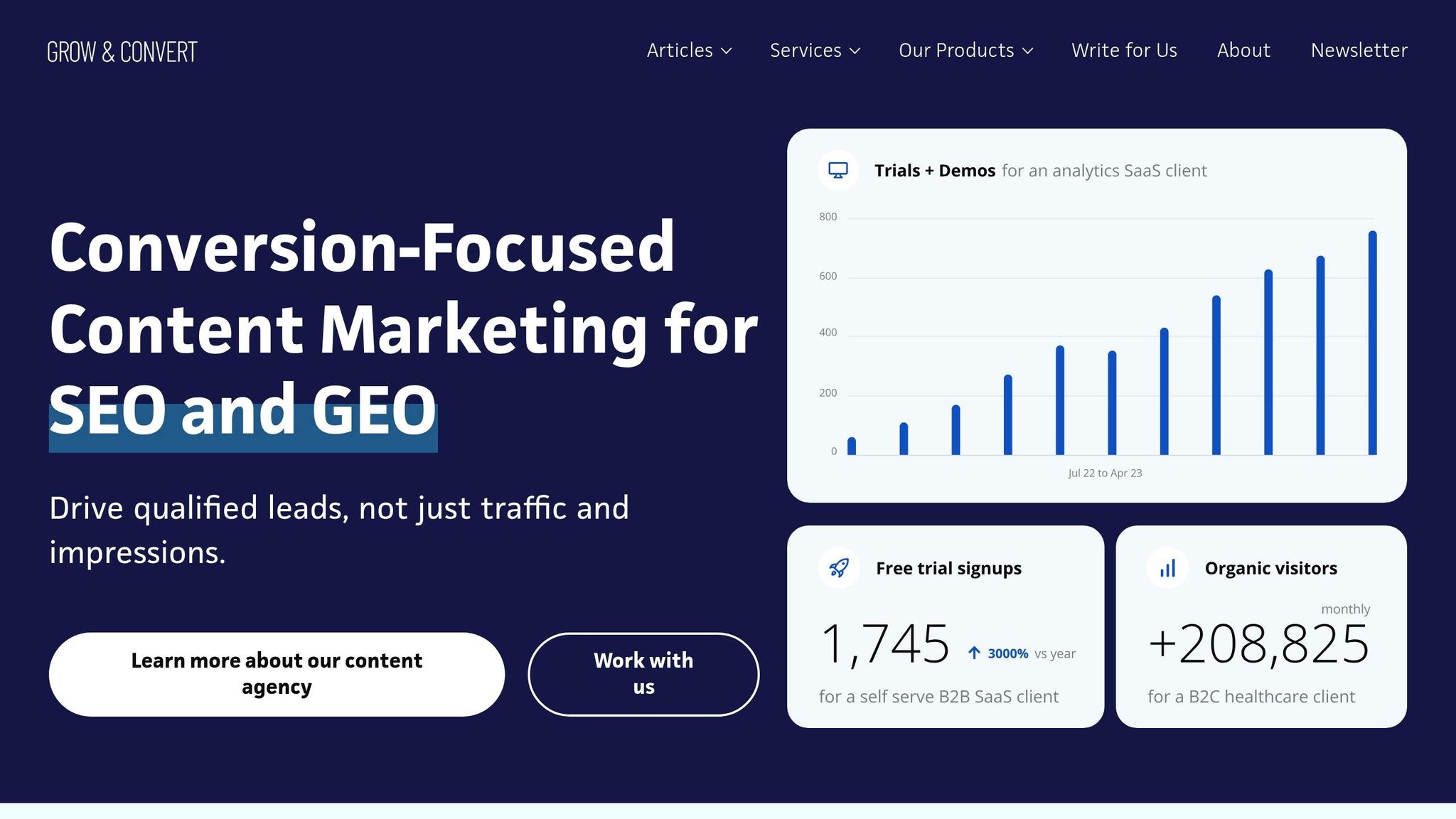
Pain Point SEO: What is it? Examples, Objections and How to Get Started- Grow and Convert Deep Dives
How to Identify Audience Pain Points
Pinpointing what frustrates your audience requires more than just guesswork. A mix of data analysis, direct customer feedback, and studying competitors can help uncover the exact challenges your users face.
Using Data-Driven Insights
Search behaviour often reveals what users are struggling with. For instance, when someone searches for "how to prevent deadlines from slipping in remote teams", it highlights a specific issue - far more actionable than a generic search like "task management software".
Start by using tools like Google Search Console to identify the pain points already drawing traffic to your site. You can take it further by using regex filters to find post-sale issues. Searching for terms like "broken", "doesn't work", or "manual" can highlight problems your customers face after purchasing your product - problems you might not be addressing in your content.
For UAE-specific insights, narrow your focus to particular cities like Dubai or Abu Dhabi in tools like Google Trends or Keyword Planner. This approach can uncover local trends that broader national data might miss.
"People Also Ask" boxes are another goldmine for understanding your audience. These questions reflect how users describe their problems. For the UAE, analysing these in both English and Arabic is key. But keep in mind: avoid direct translations. Regional nuances matter, such as how "hair stylist" might mean different things in Dubai versus Sharjah.
Here's a real-world example: In March 2022, Danish insurance company Købstædernes Forsikring used Google Search Console and Moz Keyword Explorer to map search intents. This strategy led to a 100% increase in organic traffic for their salary insurance category within 10 months.
Don’t ignore AI-driven search results. If competitors appear in AI-generated summaries and you don’t, you could be missing out. Since 26% of users stop their search after reading such summaries, this gap could cost you traffic.
Using Customer Feedback
Your sales and customer support teams are often the first to hear about customer pain points. They deal with complaints and objections daily, making them a valuable source of unfiltered insights. Compile their feedback to identify recurring frustrations that keyword research might not reveal.
Online reviews, whether for your business or competitors, are another treasure trove. They can highlight common complaints that you can address in your content. For example, look at reviews on Google Business Profiles for location-specific issues. A business in Dubai Marina might face entirely different challenges compared to one in another neighbourhood.
Social listening adds another layer. Platforms like Reddit and LinkedIn provide general insights, but UAE-specific forums like Dubai Local and YallaBanana can reveal regional frustrations that global platforms might overlook. For a deeper dive, you can even export comments from popular UAE-based influencers on platforms like YouTube and use tools like ChatGPT to categorise recurring complaints.
"80% of search queries are problem-based... yet most businesses still approach SEO by starting with keywords instead of the actual problems their customers face." – Njualem ATM
Once you’ve gathered internal feedback, competitor analysis can help refine these pain points even further.
Analysing Competitor Gaps
After identifying your audience's frustrations, compare them against what your competitors are doing. This can reveal untapped opportunities. Tools like SEMrush or Ahrefs can help you perform a "keyword gap" analysis. Focus on keywords where competitors rank between positions 4–20 with low difficulty scores (below 40). These represent easier opportunities to capture traffic.
For UAE markets, refine your analysis by filtering results for cities like Dubai or Abu Dhabi. This helps you uncover sub-regional opportunities that might otherwise go unnoticed.
Dive deeper into competitor content. Look at their H2 and H3 headings, visuals, and the level of detail they provide. This can show you what’s needed to meet user expectations. Also, check out "People Also Ask" sections on competitor pages. These often highlight specific frustrations users have and the tasks they’re trying to accomplish.
A great example of this strategy is Zendesk. In March 2025, they analysed market needs and created a content hub with guides, templates, and best practices. Their report on how AI developments are shaping customer expectations earned over 15,000 backlinks, outperforming their typical how-to guides, which usually earned under 1,000 links. This approach helped them capture high-intent traffic that competitors missed.
Technical factors matter too. In the UAE, where over 80% of searches happen on smartphones, slow page speeds or poor mobile optimisation can hurt your rankings - even if your content is relevant. Also, check competitors’ Google Business Profiles to see if they’re winning "near me" searches with better reviews or more consistent business information (Name, Address, Phone).
| Analysis Type | What to Look For | UAE-Specific Application |
|---|---|---|
| Keyword Gap | Terms competitors rank for that you don’t | Filter by Dubai or Abu Dhabi for local insights |
| Content Depth | H2/H3 structure, visuals, and E-E-A-T signals | Spot poorly covered or outdated topics |
| Review Mining | Recurring complaints in reviews and social media | Identify overlooked pain points |
| Technical Benchmarking | Page speed, Core Web Vitals, and mobile UX | Critical for UAE’s mobile-first audience |
Timing matters too. In the UAE, search intent shifts during Ramadan, Eid, or events like the Dubai Shopping Festival. For example, searches for "Eid gift boxes" spike two to three weeks before the holiday. Aligning your content with these seasonal trends ensures you address pain points when they’re most relevant.
SEO Frameworks for Addressing Pain Points
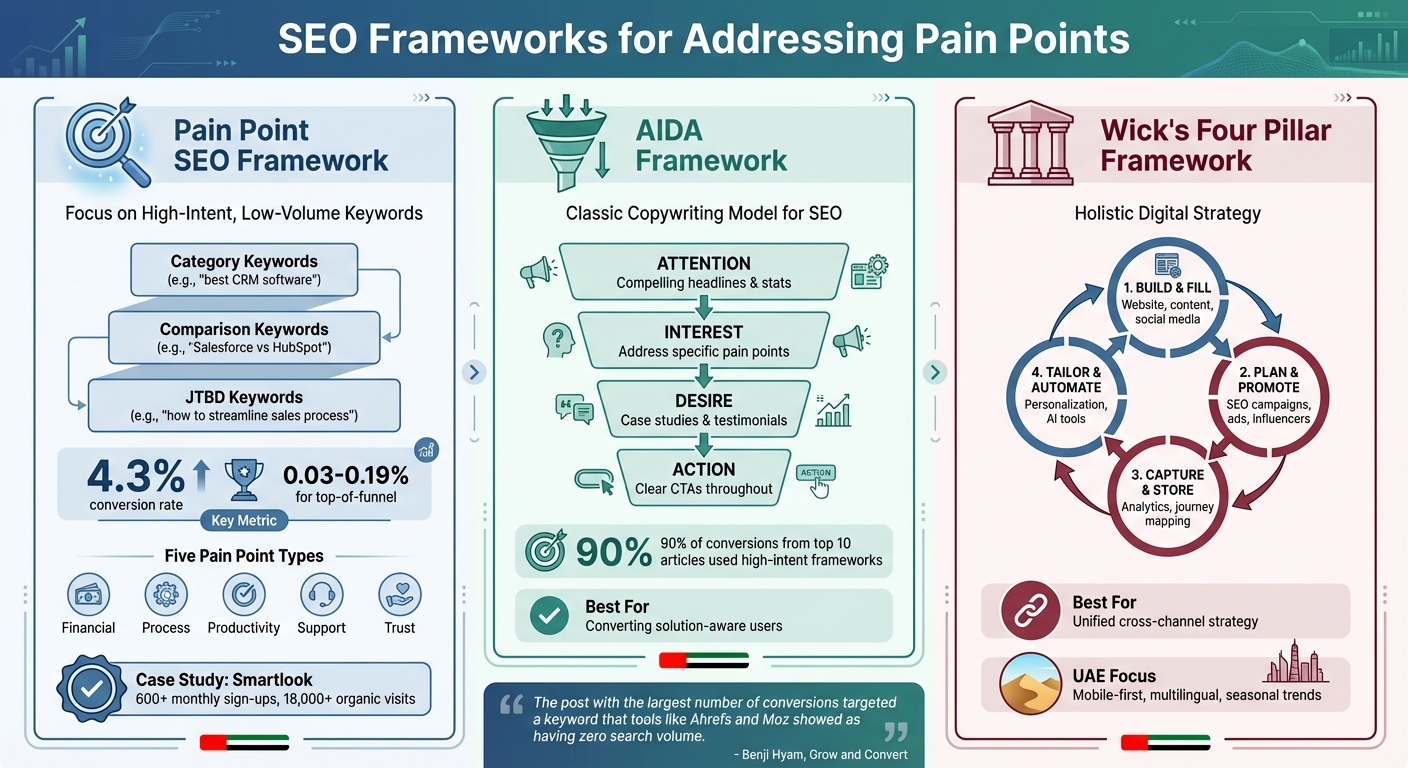
SEO Frameworks Comparison: Pain Point, AIDA, and Four Pillar Approaches
Once you’ve pinpointed what frustrates your audience, the next step is to choose a framework that turns those insights into content that not only ranks but also drives conversions. Your choice will depend on your specific goals - whether you're targeting buyers ready to make a decision, guiding users through their options, or creating a comprehensive online presence.
The Pain Point SEO Framework
This framework shifts the focus away from high-volume keywords and instead prioritises low-volume terms with high buying intent. For example, someone searching for "how to prevent deadlines from slipping in remote teams" is far more likely to take action than someone typing "task management software".
The strategy is divided into three tiers:
- Category keywords for informed users (e.g., "best CRM software")
- Comparison keywords for those evaluating options (e.g., "Salesforce vs HubSpot")
- JTBD (Jobs to Be Done) keywords for task-specific queries (e.g., "how to streamline sales process")
This approach delivers much stronger conversion rates - up to 4.3%, compared to the 0.03% to 0.19% seen with top-of-funnel content.
A real-world example? Smartlook, an analytics platform, partnered with Grow and Convert in 2021 to adopt this framework. By targeting JTBD keywords like "tracking user activity on website" and creating content around alternatives, they achieved 600+ sign-ups and demo requests per month over 16 months. This also brought in 18,000+ organic visits and secured top-three rankings for key terms.
"The post with the largest number of conversions... targeted a keyword that tools like Ahrefs and Moz showed as having zero search volume." – Benji Hyam, Co-Founder, Grow and Convert
The framework also categorises pain points into five types:
- Financial: Concerns about cost
- Process: Inefficiencies in workflows
- Productivity: Time management issues
- Support: Post-purchase assistance
- Trust: Reliability and credibility concerns
For UAE businesses, this strategy can address specific challenges like price sensitivity or the high expectations for customer service, especially during periods of economic change.
The AIDA Framework in SEO
The AIDA framework - Attention, Interest, Desire, Action - is a classic copywriting model that pairs well with SEO when addressing user pain points.
- Attention: Start with headlines or statistics that grab attention. For instance, "Is Your AC Costing You AED 500 Extra Per Month?" could immediately resonate with Dubai homeowners.
- Interest: Show empathy by delving into the specifics of their problem instead of offering generic advice.
- Desire: Use case studies or testimonials to demonstrate how your solution works, helping users picture the results.
- Action: Include clear calls-to-action (CTAs) throughout the content, making it easy for users to convert even if they don’t read the entire page.
An analysis of 95 blog posts revealed that 90% of conversions from the top 10 articles came from high-intent frameworks like AIDA, rather than generic content aimed at awareness.
| AIDA Stage | SEO Application for Pain Points | Goal |
|---|---|---|
| Attention | Use compelling headlines and stats | Capture attention and spark curiosity |
| Interest | Address the specific pain point | Build a connection with the audience |
| Desire | Showcase case studies and success stories | Turn interest into an intent to act |
| Action | Add clear, noticeable CTAs | Drive conversions, such as sign-ups or purchases |
Wick's Four Pillar Framework

Wick, a data-driven marketing consultancy, offers a Four Pillar Framework that incorporates pain point resolution into a holistic digital strategy. It creates a streamlined system to gather, analyse, and act on customer data.
- Build & Fill: This focuses on building a strong online presence through website creation, content, and social media. For pain point SEO, this involves creating pages that address user frustrations, such as blog posts on "how to reduce operating costs" or landing pages for "AC repair in Dubai Marina."
- Plan & Promote: This includes SEO campaigns, paid ads, and influencer partnerships. For UAE businesses, this could mean geo-targeted campaigns for cities like Abu Dhabi or Sharjah, or seasonal content tied to events like Ramadan or the Dubai Shopping Festival.
- Capture & Store: This pillar emphasises analytics and customer journey mapping. For instance, if reviews highlight "slow support" as a common issue, you can create content to address this concern and track its effectiveness over time.
- Tailor & Automate: Using tools like marketing automation and AI, this step personalises messaging. For example, if a user visits your "Salesforce vs HubSpot" page but doesn’t convert, you could retarget them with an email focusing on cost savings or integration benefits.
These pillars work together in a feedback loop. Insights from Capture & Store guide the content created in Build & Fill, which is then promoted through Plan & Promote and refined using Tailor & Automate. For UAE businesses, this approach aligns with local habits like mobile-first browsing, multilingual content needs, and seasonal search trends, creating a unified strategy that works across all channels.
sbb-itb-058f46d
How to Implement SEO Frameworks for Pain Point Content
Mapping Pain Points to Content Types
To effectively use an SEO framework, align each pain point with the right type of content. For example, users just starting to recognize a problem - like someone searching "why is my AC bill so high in Dubai" - may not be ready to make a purchase. At this stage, educational blog posts, how-to videos, or infographics breaking down energy consumption can grab their attention without overwhelming them.
For users in the consideration phase, focus on more detailed content. Resources like comparison guides (e.g., "Salesforce vs HubSpot for UAE SMEs") or whitepapers on workflow automation can help these solution-aware users weigh their options. When targeting decision-ready users, case studies can demonstrate success, while landing pages with clear pricing in AED and free trial offers can nudge them toward action.
| Customer Journey Stage | User Intent | Effective Content Types |
|---|---|---|
| Awareness | Identifying a problem | Educational blogs, how-to guides, videos, infographics |
| Consideration | Researching solutions | Comparison guides, "Best of" lists, whitepapers, webinars |
| Decision | Ready to purchase | Case studies, landing pages, pricing sheets, free trials |
| Post-Purchase | Seeking support | FAQs, tutorials, knowledge base articles, community forums |
Once you’ve mapped pain points to content types, the next step is to ensure your content reaches the right audience.
Content Distribution and Promotion
Creating great content is only half the battle - getting it in front of your audience is just as important. In the UAE, where mobile usage dominates and social media is a key communication channel, your distribution strategy should reflect these habits. Repurpose a single blog post into Instagram carousels, YouTube Shorts, or LinkedIn posts to extend its reach.
With YouTube reaching 90% of the UAE's population each month, it’s a fantastic platform for product education and storytelling. For B2B audiences, LinkedIn and email campaigns are highly effective, especially when addressing industry-specific challenges like cutting operational costs or ensuring compliance. Timing is also crucial - link your promotions to local events like Ramadan, Eid, or the Dubai Shopping Festival to take advantage of seasonal search trends.
"Where you find your audience and what types of content they want to engage with will almost certainly change over the next few years. So, try to figure out who your audience is, where you can find them, and what kind of content they are consuming." – Stefan Somborac, Marketing Metrology
To boost visibility among high-intent users, collaborate with micro-influencers, share content through industry publications, or partner with relevant organisations.
Finally, tailor your content to meet the UAE’s bilingual and localised needs.
Localising Content for the UAE Market
Both Arabic and English keywords are essential when optimising content for the UAE. By 2025, over half of UAE businesses are expected to prioritise Arabic content, yet many still rely on basic translations that fail to capture local nuances. For example, "AC repair" might translate to "إصلاح المكيفات" in Arabic, but natural phrasing can vary depending on the emirate.
Geo-modifiers also play a big role. Users often include specific locations in searches, such as "dentist in Abu Dhabi Al Nahyan" or "plumber in Dubai Marina." Combining service terms with these geo-modifiers can help attract high-intent local traffic. On the technical side, using subdirectories like example.com/ar/ instead of separate domains consolidates authority, while hreflang tags (e.g., ar-AE for Arabic and en-AE for English) ensure search engines deliver the right version.
For Arabic content, it’s important to fully support right-to-left (RTL) layouts, including mirrored navigation menus, form fields, and call-to-action buttons. Additionally, optimise your Google Business Profile in both languages, using bilingual business names and unique descriptions instead of direct translations. To increase visibility on social platforms, incorporate local hashtags like #MyDubai or #Ramadan2025.
How to Measure SEO Framework Performance
Once you've implemented a pain point SEO framework, tracking its performance is crucial to ensure you're making the right adjustments. To gauge success, focus on metrics tied to visibility, engagement, and conversion. Start by examining visibility indicators like organic impressions and keyword rankings, especially for long-tail, problem-solving queries that resonate with your audience. If you're missing out on SERP features, it could signal an opportunity to expand visibility.
Key Metrics to Track
Engagement metrics tell you if your content is solving users' problems. Metrics like average engagement duration and scroll depth are often more insightful than bounce rates. For instance, if users scroll through 75% of your page, it shows they're finding value in your content. In GA4, an "engaged session" is defined as one lasting over 10 seconds, involving a conversion event, or including at least two pageviews. Combine this with metrics like pages per session to measure how well your content holds user interest.
To measure business impact, look at metrics like organic conversion rates, lead generation (e.g., form submissions or demo signups), and organic growth in conversions. For example, a 20% month-over-month rise in organic traffic after launching a new content series is a strong indicator of audience engagement. To calculate SEO ROI, use the formula:
(Revenue from SEO - Cost of SEO) / Cost of SEO × 100.
A practical example: In 2024, Fluentica, a marketing agency, helped ABA Matrix grow to over 34,000 monthly organic visits by focusing on "how-to" guides and time management content, expanding their lead generation reach beyond Florida.
| Metric Category | Key KPIs | Purpose |
|---|---|---|
| Visibility | Impressions, Keyword Rankings, Share of Voice | Tracks reach and brand awareness |
| Engagement | Bounce Rate, Dwell Time, Scroll Depth | Assesses content relevance |
| Conversion | Leads, Revenue, ROI, CPA | Evaluates business outcomes |
| Authority | Backlinks, Referring Domains, DA/PA | Measures site credibility |
Advanced analytics can take these metrics further by offering deeper insights into user behaviour and conversion patterns.
The Role of Data Analytics
Data analytics tools like GA4 and Adobe Analytics help you track how users arrive via organic search and whether they complete high-value tasks. Site search data is especially useful for identifying gaps - if users search for "pricing" on your site and leave immediately, you've uncovered a critical issue. By analysing site search data and exit rates, you can quickly identify and address content weaknesses.
Adopting multi-touch attribution lets you better understand SEO's role in the customer journey, moving beyond outdated "last-click" models that often undervalue organic traffic. In 2023, 55.15% of large enterprises used advanced SEO analytics tools to link organic search efforts directly to revenue. Tools like Google Tag Manager can track scroll depth at intervals of 25%, 50%, and 75%, helping you see if users reach your calls-to-action. Additionally, tracking clicks on FAQ sections can reveal which questions attract the most attention, giving you ideas for new content.
"Content without data is like a property without a foundation - it lacks stability." – Abby Webb, Head of Search & Content, Base Creative
Achieving Long-Term Growth
SEO is a long game, with results typically appearing three to six months after consistent optimisation efforts. Set SMART goals (Specific, Measurable, Achievable, Relevant, Time-bound), such as "Increase organic leads by 15% within 90 days." Conduct detailed SEO audits at least twice a year to spot technical issues, content gaps, or declining rankings.
Distinguish between leading indicators (like impressions and backlinks) and lagging outcomes (like revenue). Use leading indicators for early insights and reserve lagging indicators for quarterly reviews. A/B testing can refine headlines, CTAs, or content layouts to better address user needs. Segment your organic traffic to separate branded from non-branded searches - this helps determine whether you're attracting new audiences or just engaging existing ones.
As AI search tools grow in popularity, monitor metrics like LLM mentions (how often your brand appears in AI-generated responses) and AI Overview visibility. For instance, Wikipedia saw an 8% traffic drop in 2024 due to AI tools delivering direct answers. Adjust your strategy to ensure your content remains visible on both traditional search engines and emerging AI platforms.
Conclusion: Using SEO Frameworks for Business Growth
SEO frameworks that address real audience pain points can transform your online presence into a self-sustaining asset. Unlike paid advertising, which halts the moment the budget dries up, SEO generates momentum that grows over time, offering long-term benefits. By focusing on solving customer problems rather than chasing high-volume keywords, businesses attract leads that are not only relevant but also ready to convert.
A well-rounded approach is key - one that combines technical precision, a clear content strategy, and actionable data. Wick's Four Pillar Framework serves as a great example, integrating Technical Foundation (like Core Web Vitals and mobile-first indexing), Content Strategy (including search intent mapping and E-E-A-T optimisation), User Experience (performance and journey mapping), and Advanced Analytics (such as GA4 implementation and ROI tracking). This structure ensures that all elements of your digital strategy work in harmony to meet customer needs while delivering measurable results.
"Unlike paid channels, SEO doesn't reset when your budget does. It's an always-on, compounding asset." - Passionfruit
This approach is especially effective in markets like the UAE. By aligning content with key pain points - such as financial concerns, trust, and process-related challenges - you position your business as a trusted solution provider, not just another source of information. The benefits? Lower customer acquisition costs, stronger domain authority, and greater visibility across both traditional search engines and emerging AI-driven platforms like ChatGPT and Gemini. As AI continues to shape search behaviour, this strategy ensures your business remains visible and relevant.
Keep your site fast and easily crawlable, and focus on creating content that directly addresses customer challenges. Monitor early indicators like impressions and backlinks to gauge progress, while using metrics like revenue for quarterly evaluations. With consistent effort, the results will snowball, delivering returns that far outlast your initial investment.
FAQs
How can businesses in the UAE use SEO frameworks to identify and solve customer pain points?
Businesses in the UAE can tap into SEO frameworks to better understand and address customer pain points. By analysing feedback from sources like surveys, social media platforms, and customer support interactions, companies can pinpoint recurring issues their audience faces. Collaboration with internal teams, such as sales and support, can further uncover patterns and challenges that customers frequently encounter.
Once these pain points are clear, businesses can craft targeted content that offers real solutions. Think how-to guides, detailed case studies, or troubleshooting articles - content designed to address specific needs. To ensure this content reaches the right audience, incorporating high-intent, long-tail keywords that match customer search behaviour is key.
Tracking performance metrics such as engagement rates, conversions, and ongoing customer feedback is also essential. Regular analysis allows businesses to fine-tune their strategy, ensuring their SEO efforts remain aligned with solving actual problems. This not only boosts search visibility but also enhances overall customer satisfaction.
How can I optimize SEO content for the UAE audience?
To improve SEO content for a UAE audience, it's essential to include bilingual keywords in both Arabic and English. This approach ensures your content connects with the region's diverse cultural and linguistic landscape. Pay attention to local dialects and preferences, as they can make your content feel more relatable. Also, focus on creating mobile-friendly content with fast-loading pages, as mobile devices dominate internet usage in the UAE.
Boost your local presence by optimising your Google My Business profile with accurate, UAE-specific details. Adding Arabic keywords can further increase your content's relevance for Arabic-speaking users, helping it perform better in local search rankings.
How can SEO frameworks like PAS and AIDA help boost conversion rates?
Frameworks like PAS (Problem-Agitate-Solution) and AIDA (Attention-Interest-Desire-Action) are powerful for boosting conversion rates. They work by addressing audience challenges and steering them toward taking action.
Here's how they function:
- PAS: This framework starts by identifying a problem your audience faces, then amplifies its emotional or practical impact to make it feel urgent. Finally, it presents a clear and actionable solution, showing how your product or service resolves the issue.
- AIDA: This method grabs attention first, then builds interest by highlighting benefits or unique aspects. It stirs up desire by showcasing how the solution fits their needs and finishes with a strong call to action, encouraging immediate steps.
Both frameworks help craft messages that connect with your audience on a deeper level, driving engagement and achieving better outcomes.