
Blog / How Search Intent Shapes Arabic SEO
How Search Intent Shapes Arabic SEO
54% of Google searches in the MENA region are in Arabic, yet Arabic content accounts for only 5% of the web. This gap is an opportunity for businesses in the UAE to connect with Arabic-speaking users by focusing on search intent - the "why" behind every search.
Key takeaways:
- Search intent types: Informational (e.g., "how to start a blog"), Navigational (e.g., "Facebook login"), Commercial (e.g., "best restaurants in Dubai"), and Transactional (e.g., "buy iPhone 15 online").
- Arabic-specific SEO challenges: Literal translations miss intent; dialects (like Gulf Arabic) and "Arabizi" (mixing Arabic and English) are key.
- Mobile-first focus: 85–95% of Arabic searches happen on smartphones.
- Localisation matters: Use dialect-aware keywords, AED pricing, and UAE-specific visuals.
Search Intent Explained | The Most Important SEO Concept | SEO Course (Part 05)
How to Identify Arabic Search Intent
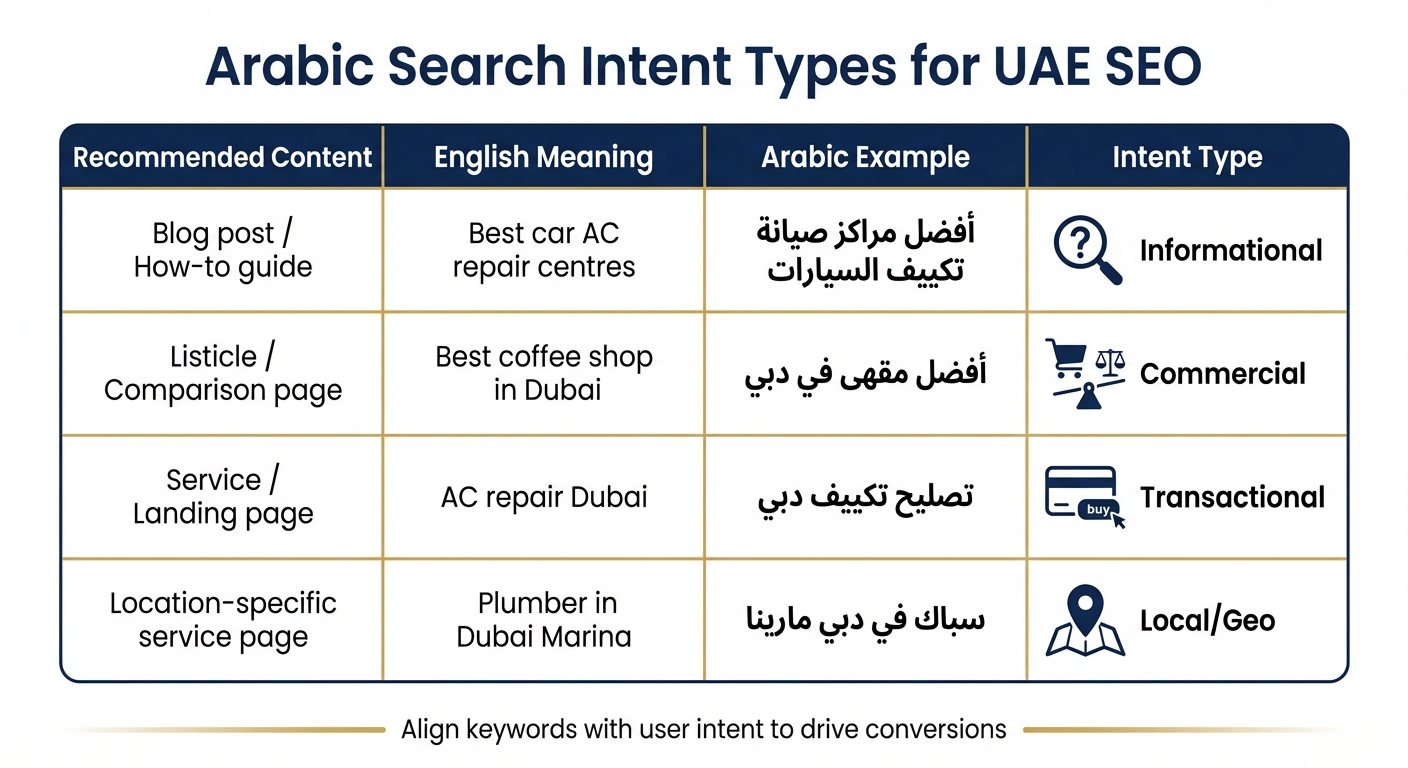
Arabic Search Intent Types and Content Strategy Guide for UAE SEO
Understanding Arabic search intent requires more than just translating English keywords. It’s about recognising how users in the UAE search and categorising their queries based on intent.
Researching Dialect-Specific Keywords
Arabic dialects play a huge role in search behaviour. Modern Standard Arabic (MSA) is ideal for formal content like policies or technical pages, while Gulf Arabic (Khaleeji) captures the conversational tone often used in voice searches and social media across the UAE. Keep in mind, a keyword popular in Egypt or Morocco may not resonate with Emirati audiences, as the region has over 30 distinct Arabic dialects.
Instead of directly translating English keywords, adapt them to reflect local speech patterns. SEO tools like Google Keyword Planner, SEMrush (AED 440/month), or Ahrefs (AED 363/month) can help identify high-volume terms when filtered for 'UAE' and 'Arabic'. Don’t overlook "Arabizi", the mix of Arabic and English in queries, such as أفضل iPhone في دبي (best iPhone in Dubai). To ensure accuracy, have a native UAE Arabic speaker review your keyword lists to catch local nuances and synonyms that tools might miss.
Once you’ve gathered dialect-specific keywords, the next step is to organise them by intent.
Categorising Keywords by Intent Type
After compiling your keywords, group them by intent type. For instance, transactional keywords often include terms like سعر (price), عرض (offer), حجز (book), or قريب مني (near me). A query like تصليح تكييف دبي (AC repair Dubai) signals readiness to book a service, whereas أفضل مراكز صيانة تكييف السيارات (best car AC repair centres) reflects someone still exploring options.
| Intent Type | Arabic Example | English Meaning | Recommended Content |
|---|---|---|---|
| Informational | أفضل مراكز صيانة تكييف السيارات | Best car AC repair centres | Blog post / How-to guide |
| Commercial | أفضل مقهى في دبي | Best coffee shop in Dubai | Listicle / Comparison page |
| Transactional | تصليح تكييف دبي | AC repair Dubai | Service / Landing page |
| Local/Geo | سباك في دبي مارينا | Plumber in Dubai Marina | Location-specific service page |
High-intent keywords in the UAE often include specific locations like 'Dubai Marina' or 'Business Bay'. For example, a Dubai-based retailer revamped its Arabic category pages in 2025, using dialect-aware long-tail keywords. This led to a 45% increase in organic sessions and higher add-to-cart rates within a quarter. This shows how aligning keywords with user intent and content type can drive results.
Next, let’s explore how local culture influences search patterns.
Understanding Cultural Search Patterns
Cultural factors heavily influence how people in the UAE search. Arabic queries tend to be longer and more question-based, often starting with كيف (how) or ما هو (what is), unlike the shorter, direct queries in English. In industries like healthcare, education, and professional services, users often perform detailed informational searches to build trust before making a decision.
The rise of voice search has also encouraged more conversational queries in the MENA region. Beyond Google, platforms like YouTube and Instagram are widely used for searches in sectors like retail, travel, and education. For instance, a tourism operator in Abu Dhabi launched Arabic landing pages in 2025, focusing on family-friendly activities and seasonal updates. This approach, tailored to cultural events, resulted in a 30% increase in inquiries as it aligned with local question formats.
Search trends also shift significantly during major cultural and religious events like Ramadan, Eid, and UAE National Day. Aligning your content calendar with these periods can help capture peak search interest effectively.
Creating Content for Different Search Intents
By understanding search intent and categorising keywords effectively, you can craft content that resonates with Arabic-speaking audiences. This approach not only engages users but also drives higher conversions by addressing their specific needs.
Content Formats for Each Intent Type
Each search intent demands a unique content strategy. For informational searches like ما هو التسويق الرقمي (what is digital marketing), focus on creating FAQs, how-to guides, and glossaries. Use short paragraphs, definition boxes, and structured data to increase the chances of appearing in featured snippets.
For commercial investigation queries such as أفضل مقهى في دبي (best coffee shop in Dubai), opt for content like product comparisons, listicles, or reviews. Include details like pros and cons, AED pricing, and location-specific information, such as proximity to popular areas like Dubai Marina or Business Bay.
For transactional searches like حجز فندق في دبي (book a hotel in Dubai) or سعر iPhone 15 (price of iPhone 15), create service-oriented pages. These should feature localised calls-to-action, booking forms, AED pricing tables, and clear contact details. High-intent keywords such as سعر (price), حجز (book), and عرض (offer) should be prioritised.
After tailoring content to intent, ensure your site design aligns with Arabic-speaking users' expectations.
Adapting Content for Arabic Layouts
Arabic content requires attention to right-to-left (RTL) formatting. This means mirroring the layout, including navigation menus, forms, tables, and images. Align text to the right, and reposition elements that are typically on the left in English to the right for Arabic.
Arabic text tends to expand by 10%–20% compared to English, so use flexible containers to prevent layout issues. Test RTL designs on mobile devices to ensure font sizes are legible, pages load quickly, and buttons or links are easy to tap.
Incorporate visuals that reflect the UAE's identity. Images of Dubai's skyline, Emirati attire, or local settings resonate far more than generic, international visuals.
Localising Content for UAE Audiences
Local relevance is key to connecting with your audience. Use AED for prices, DD/MM/YYYY for dates, and visuals that reflect UAE-specific settings. Refer to local landmarks and align content with major events like Ramadan, Eid, UAE National Day (2nd December), and the Dubai Shopping Festival.
Ensure bilingual consistency for your NAP (Name, Address, Phone number) across Google Business Profile listings in both English and Arabic. This consistency builds trust and improves visibility for location-based searches like سباك في دبي مارينا (plumber in Dubai Marina).
"Arabic keywords lift relevance signals for UAE searchers, improving impressions, rankings, and click-through rates when implemented in on-page content, metadata, and internal linking." - Act Local
Research shows that 75% of consumers prefer buying products marketed in their native language. By focusing on Arabic localisation instead of simple translation, you could boost your monthly traffic by 10%–20%.
sbb-itb-058f46d
Technical SEO for Arabic Search Intent
After localising and structuring your content for Arabic search intent, technical SEO ensures that search engines can properly crawl and rank your pages. This step is critical for making your Arabic content discoverable and effective.
On-Page SEO for Arabic Content
Start by including your main keyword in the title tag and weaving secondary keywords naturally into the meta descriptions. Arabic calls-to-action (CTAs) like اكتشف المزيد (discover more) or احجز الآن (book now) can significantly improve click-through rates.
Pay attention to Arabic spelling variations. For instance, omitting the Hamza from Alef (writing ا instead of أ) often aligns better with how users type and can drive higher search volumes. Tailor your content to both Modern Standard Arabic (MSA) for formal business communication and Gulf Arabic for conversational queries. For example, use صيانة السيارات (car maintenance) for formal pages, but incorporate تقسيط سيارات (instalment plans) when targeting transactional intent for UAE users.
Your site’s technical setup must support right-to-left (RTL) CSS styling to ensure proper readability and user experience. For bilingual sites in the UAE, it's better to use subfolders like example.com/ar/ rather than subdomains. This approach consolidates domain authority across language versions. Additionally, internal links with Arabic anchor text strengthen topical clusters, helping search engines better understand your site’s structure.
"In 2025, a Dubai-based retail brand restructured category pages with dialect-aware long-tail Arabic terms, resulting in a 45% increase in organic sessions and improved add-to-cart rates within three months."
Using Schema Markup for Arabic Content
Schema markup adds clarity by specifying whether a term refers to a product, service, event, or organisation. This is especially helpful in Arabic, where words often carry multiple meanings depending on dialect or context.
Use the JSON-LD format for schema implementation, as it’s Google’s preferred method and offers the best compatibility. When using Product or LocalBusiness schema, include "priceCurrency": "AED" and "addressCountry": "AE", and ensure phone numbers use the +971 country code. To avoid penalties, make sure the data in your schema matches the visible Arabic text exactly.
For industries like real estate, healthcare, or fintech, apply FAQPage schema. This can help your content appear in "People Also Ask" boxes, increasing visibility and occupying more space in search results. Structured data can boost organic traffic by 20% to 30% and improve click-through rates by as much as 43%.
"A restaurant in Dubai implemented Arabic schema markup and localised FAQs to target 'near me' searches, achieving a 30% growth in reservations over three months in 2025."
Validate your schema using tools like Google’s Rich Results Test or the Schema.org Markup Validator to ensure there are no syntax errors in your Arabic scripts.
Setting Up Hreflang for Bilingual Sites
Hreflang tags are essential for ensuring users see the correct language version of your site based on their location and browser settings. For UAE-targeted sites, use hreflang="ar-ae" for Arabic content and hreflang="en-ae" for English content to maximise local relevance.
These tags not only prevent duplicate content issues but also align with distinct user behaviours. For instance, Arabic-speaking users in the UAE often type conversational queries like كيف (how) or ما هو (what is), while English-speaking users lean towards shorter, transactional phrases. Always include a self-referencing hreflang tag on each page to confirm the intentional relationship between language versions.
Avoid forced IP-based redirects, as these can interfere with search engine indexing. Instead, let hreflang tags guide search engines to display the appropriate version in results. Use an x-default tag for users whose language preferences don’t align with any specific version - this typically points to a global landing page or your most common language version.
Keep your Name, Address, and Phone number (NAP) details consistent across both Arabic and English versions, even if the script changes. This consistency builds trust with search engines and enhances visibility for location-based searches.
"Hreflang tags are often overlooked aspects of web optimization, holding immense power, ensuring search engines correctly understand linguistic and regional variations of your content." – Jen Cornwell, VP of SEO, Ignite Visibility
Add hreflang tags either in the <head> of your pages or through your XML sitemap to consolidate authority across language versions.
Measuring and Improving Intent-Based SEO
To ensure your content aligns with search intent, it's crucial to track key metrics. For Arabic queries, tools like Google Search Console can help monitor impressions, clicks, and click-through rate (CTR). If your page gets high impressions but a low CTR, it could mean your meta titles or descriptions aren't resonating with your audience. For instance, a page ranking well for أفضل مطاعم دبي (best restaurants in Dubai) might see low clicks if the snippet doesn't meet the expectations or preferences of UAE users.
Another important step is segmenting keywords by intent. Divide them into informational, commercial, and transactional categories to identify gaps in your content. For example, a retail site might perform well for informational queries like كيف أختار الهاتف (how to choose a phone) but struggle with transactional terms such as شراء هاتف بالتقسيط (buy phone on instalments). This could highlight the need for a product page tailored to Gulf Arabic customers' purchasing behaviour.
Beyond clicks, engagement metrics like session duration, scroll depth, and bounce rates provide deeper insights. If a page has high traffic but low conversions, it might mean the content isn't fully addressing local preferences. Using Google Analytics 4, you can isolate Arabic sessions and compare their performance to English ones. This helps measure the impact of localisation efforts and ensures your adjustments align with user intent.
Metrics to Track for Search Intent
Start with visibility metrics to see how often your Arabic pages appear in search results and whether users are clicking on them. Since over 85% of searches in Arabic-speaking markets happen on smartphones, optimising for mobile usability and fast load times is essential.
Next, focus on conversion metrics. Track goal completions, lead quality, and assisted conversions to gauge the business impact of your SEO efforts. For bilingual sites in the UAE, ensure your analytics differentiate between ar-ae and en-ae traffic so you can accurately attribute revenue to each language version.
"SEO analytics turns organic search from a 'hope it works' channel into a measurable, improvable growth system." – Maram Nuuman, SEO Content Writer, Lucidly
Using Analytics to Adjust Your Strategy
Before making any changes, establish a 30-day baseline of Arabic-specific clicks, impressions, and conversions. This gives you a clear benchmark to measure the impact of your updates. Use Search Console to identify queries with high impressions but low clicks, as these often signal a mismatch between user intent and your page’s meta information. Revise Arabic titles and descriptions to emphasise benefits or include numbers that align with commercial intent.
Revisit your target Arabic keywords every quarter, particularly in response to shifting search trends during events like Ramadan or the Dubai Shopping Festival. For example, a UAE tourism site achieved a top-three ranking for "Dubai travel rules 2026" by creating timely, intent-based landing pages for seasonal queries.
Separating brand from non-brand queries is another effective strategy. This distinction helps you decide whether to focus on navigational content for users already familiar with your brand or informational content for those exploring general topics. Advanced tools can automate this process, providing deeper insights into user behaviour.
How AI Improves Search Intent Analysis
AI tools can take your analysis to the next level by decoding the complexities of Arabic syntax, which traditional keyword tools often overlook. For instance, Python scripts with Pandas can classify thousands of Arabic keywords by intent, revealing gaps in your content strategy. If traffic data shows a disconnect between user intent and page purpose, AI can help refine your content focus.
AI also plays a key role in optimising for voice and conversational search, which is increasingly popular in Arabic markets. Incorporating long-tail keywords that reflect Gulf Arabic speech patterns can make your content more relevant. With nearly 50% of searches having local intent, AI tools that analyse user behaviour and trends can help you create content that answers specific, complex questions often featured in Google's AI Overviews.
Platforms like Wick use AI-driven personalisation and data analytics to refine Arabic search intent analysis. These tools can forecast ranking potential, suggest internal linking strategies, and optimise Arabic pages. However, native speakers remain essential for validating cultural nuances. When analysing metrics like time-on-site or conversions, prioritise these "quality" indicators over raw click numbers as search continues to evolve beyond traditional results.
"Focus on your visitors and provide them with unique, satisfying content. Then you should be well positioned as Google Search evolves, as our core goal remains the same: to help people find outstanding, original content that adds unique value." – John Mueller, Google Search Relations
Conclusion
Arabic SEO is about more than just translating content - it’s about building trust and connecting with UAE audiences in meaningful ways. By aligning your strategy with how locals search - whether through voice commands, Gulf Arabic expressions, or question-based queries - you can boost visibility, engagement, and conversions.
Despite Arabic being one of the most widely used languages online, there’s still a noticeable gap in high-quality Arabic content. This gap presents a unique opportunity, especially in the UAE, where 54% of Google searches are in Arabic, and 90% to 95% of traffic comes from mobile devices.
"Arabic SEO in 2026 is about semantic depth, cultural relevance, and technical structure." – Conquerra Digital
To succeed in Arabic SEO, it’s essential to combine technical accuracy with a deep understanding of local preferences. Use hreflang tags like ar-ae to target Arabic-speaking audiences in the UAE, and ensure your site employs RTL (right-to-left) layouts for a natural reading experience. Craft content that focuses on entities rather than isolated keywords, and incorporate dialect-specific phrases - using Modern Standard Arabic for formal topics and Gulf Arabic for casual or conversational searches. Tracking metrics like session duration and scroll depth will help you gauge how well your content resonates with users.
With AI-driven search and voice assistants now prioritising topical authority over keyword density, search engines are rewarding websites that demonstrate expertise and clarity. Staying ahead means refining your strategy with quarterly keyword reviews and aligning content with seasonal events like Ramadan or the Dubai Shopping Festival. These steps will help you adapt to shifting search trends and maintain a strong online presence in the UAE’s competitive digital market.
FAQs
How can businesses identify search intent in Arabic markets?
To understand Arabic search intent effectively, businesses need to merge local knowledge with data-driven tools. Search habits in Arabic can differ significantly depending on the region - whether it's Gulf, Levantine, or Egyptian dialects. Recognising these regional variations is crucial. Adjust your keyword research to account for these distinctions and remember that Arabic queries are often conversational and framed as questions.
Tools like Google Search Console or AI-based analytics can be invaluable for sorting keywords into categories such as informational, transactional, or navigational. Consistently testing and analysing user behaviour can further sharpen these insights, helping ensure your content matches what users in the UAE and other Arabic-speaking regions are actively searching for. By combining local expertise with technical precision, businesses can fine-tune their Arabic SEO strategies for better results.
What challenges arise when optimizing Arabic SEO for different dialects?
Navigating Arabic SEO can be tricky, mainly because of the dialect variations across the Arabic-speaking world. Regions like the Gulf, Levant, and Egypt each have their own unique vocabulary and expressions. This means that search terms - and even user intent - can differ greatly from one area to another. A keyword that works well in one dialect might completely miss the mark in another. That’s why precise keyword research and targeting are absolutely crucial.
On top of that, cultural and linguistic nuances play a big role. It’s not enough to simply translate content into Arabic. To truly engage users, the content needs to reflect local customs, idioms, and preferences. This makes the content feel natural and relatable. And let’s not forget the technical details - like ensuring proper right-to-left (RTL) formatting and making sure the Arabic script displays correctly. These elements are essential for a smooth and user-friendly experience.
Then there’s the challenge of semantic ambiguity. In Arabic, a single word can mean different things depending on the region. This adds another layer of complexity. To tackle these issues, a tailored approach is key. Combining accurate keyword research, careful localisation, and technical fine-tuning is the best way to connect with the diverse Arabic-speaking audience.
How does cultural context impact Arabic search behaviour?
In regions like the UAE, cultural context heavily influences how people search online. With Arabic being a diverse language, regional dialects such as Gulf Arabic and Levantine Arabic play a big role in shaping search habits. People often use long-tail, conversational queries or sprinkle in idioms that are deeply tied to their daily lives and traditions.
There’s also a technical side to this. Arabic’s right-to-left (RTL) formatting demands specific design and technical tweaks to ensure content aligns with user expectations. But it’s not just about the language - cultural norms and traditions also shape what people search for and how they phrase their queries.
For businesses, this means creating localised content and keyword strategies that reflect these cultural and linguistic nuances. Doing so not only improves user engagement but also strengthens SEO performance in Arabic-speaking markets.