

Blog / Regional Link-Building Trends in Arabic Markets 2025
Regional Link-Building Trends in Arabic Markets 2025
Arabic link-building in 2025 is about quality over quantity. With fewer high-authority Arabic publishers compared to English markets, securing backlinks from trusted, region-specific domains is critical for businesses in the UAE and GCC. Here's what you need to know:
- Localised Backlinks Matter: Links from UAE-hosted domains like
.aeor regionally trusted sources significantly boost rankings for Arabic and bilingual queries. - Mobile and Voice Search Dominate: With most Arabic searches coming from smartphones and voice search gaining traction, optimising for mobile and conversational queries is essential.
- Regional Differences: GCC markets thrive on high-authority directories and news portals, the Levant focuses on community-driven links, and North Africa leans on volume from entertainment and news platforms.
- AI in Link Prospecting: AI tools help identify and evaluate Arabic-language link opportunities, but human expertise ensures relevance and effectiveness.
For UAE businesses, focusing on localised, mobile-friendly, and voice-search-optimised strategies is key. These efforts not only improve search visibility but also drive tangible business outcomes like traffic and conversions.
Why SEO in Other Languages Is So Much Easier (and How to Do It Right)
Data Insights: Link-Building Across Arabic-Speaking Regions
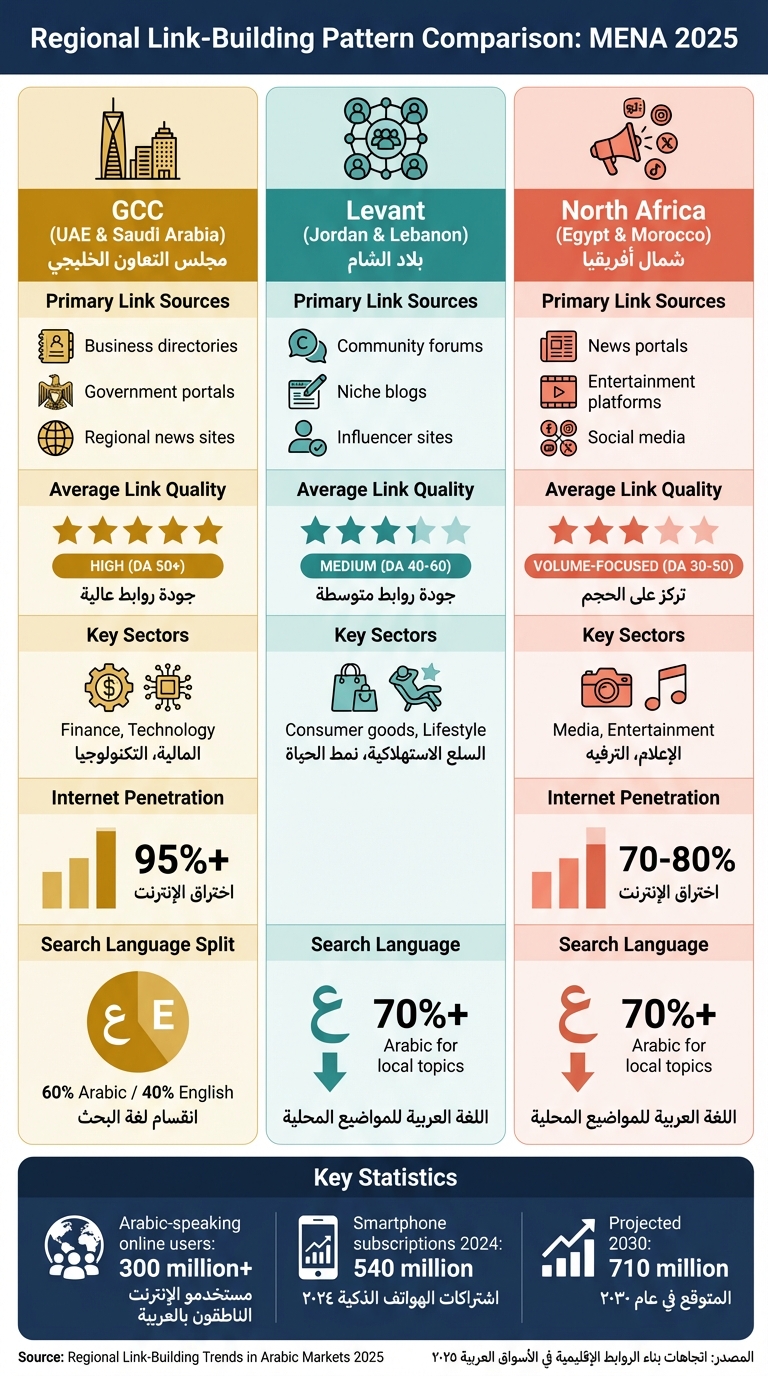
Arabic Link-Building Strategies by MENA Subregion 2025
Arabic Internet Usage and Search Patterns
The Arabic-speaking online audience has surpassed 300 million users, with smartphone subscriptions expected to rise from 540 million in 2024 to 710 million by 2030. Since most users in the region access the internet through smartphones, it's critical to ensure that link sources and landing pages are mobile-friendly.
Internet penetration rates vary significantly across the region. In the GCC countries like the UAE and Saudi Arabia, penetration exceeds 95%, while in North Africa, it ranges between 70% and 80%. These differences in access influence search behaviours. For example, in North Africa and the Levant, Arabic dominates over 70% of searches for local topics, while in the GCC, the split is closer to 60% Arabic and 40% English. Additionally, the growing popularity of voice search is reshaping how users phrase their queries. This shift highlights the importance of optimising anchor text and incorporating long-tail keywords into backlink strategies. These insights lay the groundwork for crafting regionally tailored link-building approaches.
Primary Link Sources by Region
The types of referring domains that drive results vary across MENA subregions. In the GCC, business directories such as Mawqi3 Sifr, Yellow Pages Arabia, and Google My Business are key players. Regional news portals, government websites, and guest posts on authoritative Arabic blogs also contribute significantly to local link-building efforts. Partnerships with local brands and ensuring consistent Arabic and English listings across directories help signal credibility to search engines. These elements form the backbone of successful link-building strategies in the Gulf.
In the Levant, countries like Jordan and Lebanon rely heavily on niche community forums, local blogs, and entertainment platforms. Collaborating with influencers and engaging in active online communities generate backlinks that align with local search intent. These links often carry medium domain authority (DA 40–60), making them valuable for contextual relevance.
For North Africa, news portals, entertainment sites, and regional directories dominate the link-building landscape. Strategies here focus on creating engaging Arabic content that resonates on social platforms like Facebook groups. While high-traffic sites provide relevant backlinks, the average domain authority tends to be lower (DA 30–50). However, the trade-off is volume - brands can secure more placements, even if individual links carry less weight.
Regional Link-Building Pattern Comparison
The table below highlights the differences in link-building strategies across subregions, focusing on the types of sources, average link quality, and key industries.
| Subregion | Primary Link Sources | Average Link Quality (DA) | Key Sectors |
|---|---|---|---|
| GCC | Business directories, government portals, regional news | High (50+) | Finance, technology |
| Levant | Community forums, niche blogs, influencer sites | Medium (40–60) | Consumer goods, lifestyle |
| North Africa | News portals, entertainment platforms, social media | Volume-focused (30–50) | Media, entertainment |
This comparison underscores the importance of tailoring link-building strategies to each region. For GCC campaigns, prioritising high-authority links builds trust with both search engines and business audiences. In the Levant, deeper engagement with local communities and influencers is key to earning relevant placements. Meanwhile, North African strategies thrive on content virality and broad media coverage, leveraging volume to achieve results. With Google's 2025 updates placing more emphasis on cultural relevance and traffic metrics, region-specific targeting is becoming increasingly critical.
New Link-Building Trends for 2025
As we move into 2025, link-building strategies are evolving to reflect shifts in Arabic search behaviour and technology. These changes are redefining how businesses approach link-building in Arabic-speaking markets.
Language-Specific and Localised Backlinks
Securing Arabic backlinks from high-authority, region-specific websites is becoming increasingly important for boosting local SEO. With Google's 2025 updates placing more emphasis on localised results and Arabic dialects, a backlink from a trusted Egyptian news site, for instance, is far more effective for reaching native Arabic audiences than a generic English link. Region-specific domain extensions like .ae for the UAE, .sa for Saudi Arabia, and .eg for Egypt send strong signals of local relevance to search engines, directly improving rankings in Arabic search results.
To acquire these valuable links, it’s essential to go beyond simple translations and truly adapt content for local audiences. Strategies include guest blogging on influential Arabic platforms, submitting content to regional directories such as Mawqi3 Sifr and Yellow Pages Arabia, and creating shareable Arabic-language infographics. The secret lies in cultural adaptation - adjusting tone, idioms, and examples to resonate with specific audiences, whether in the Gulf, Levant, or North Africa.
Additionally, the rise of voice search is reshaping how content should be crafted and linked.
Voice Search and Conversational Content
Voice search is changing the way Arabic users interact with online content. Natural, conversational queries in Arabic dialects are becoming more common. To tap into this trend, businesses need to focus on FAQ-style content that addresses common voice-search queries. For example, answering questions like "ما هي أفضل استراتيجيات بناء الروابط في الإمارات؟" (What are the best link-building strategies in the UAE?) can make your content more link-worthy. When authoritative websites link to such answers, it not only drives traffic but also aligns perfectly with voice search intent.
Content formats like FAQ sections, how-to guides, and dialogue-based posts in Modern Standard Arabic or regional dialects (like Gulf Arabic) are particularly effective. Even podcasts or videos with detailed show notes written in a conversational style can attract backlinks from host sites, bolstering credibility and SEO impact.
On top of these trends, AI is now playing a key role in making link prospecting more efficient.
AI-Powered Link Prospecting
AI tools are transforming link prospecting by quickly analysing Arabic-language link profiles and identifying high-quality opportunities. According to industry surveys, backlinks remain a critical factor in AI-driven search rankings.
For Arabic markets, AI offers specific advantages, such as understanding regional dialects and enabling scalable outreach to publishers. The typical workflow involves AI tools scanning directories like Google My Business or Arabic forums to identify potential links, followed by personalised pitches crafted with human oversight. Agencies that combine AI-driven research with native linguistic expertise report higher-quality backlinks from reputable, traffic-rich websites rather than low-value directories. Striking the right balance between automation and personal engagement is key to maximising results in AI-driven link-building.
sbb-itb-058f46d
Link-Building Strategies by Subregion
Arabic markets are far from one-size-fits-all - what resonates in Dubai might not gain traction in Beirut or Cairo. Each subregion has its own digital landscape, which calls for a customised link-building strategy. Let’s explore how these strategies adapt to the unique characteristics of each area.
GCC: UAE and Saudi Arabia
In the GCC, domains like .ae and .sa carry significant weight in SEO, and Google's upcoming 2025 update is expected to further emphasise localised results. Securing backlinks from reputable platforms such as UAE Today can make a notable difference, provided outreach efforts align with local cultural expectations.
Given the region’s diverse population, bilingual content - Arabic and English - is a must. Think mobile-friendly infographics and other assets optimised for mobile-first indexing. Additionally, maintaining consistent listings on platforms like Yellow Pages Arabia and Google My Business strengthens local authority. Mobile optimisation is non-negotiable here, as mobile usage dominates. Collaborating with local influencers for cross-promotional campaigns can also lead to natural endorsements from high-authority domains, further boosting visibility.
On the other hand, Levant markets take a more community-focused approach.
Levant: Niche Community Opportunities
In places like Jordan and Lebanon, community engagement takes centre stage. Active participation in forums, Facebook groups, and LinkedIn discussions not only builds credibility but also attracts organic, contextually relevant backlinks .
Using keyword tools to identify active forums and consistently contributing to discussions can establish your expertise, eventually leading to natural link placements. Partnering with local influencers through expert roundups or podcasts can also increase visibility within these tight-knit, community-driven networks. This approach prioritises genuine connections over transactional link-building, aligning well with the focus on Arabic search relevance.
North Africa: News and Entertainment Platforms
In North Africa, particularly in Egypt and Morocco, high-traffic news and entertainment platforms present valuable opportunities. Pitching engaging stories or creating shareable assets like infographics tailored to local trends can secure placements that drive both traffic and authority .
Reaching out to journalists at trusted Egyptian news outlets has shown strong results in boosting conversions. Meanwhile, Moroccan platforms enhance visibility through social shares that generate natural backlinks. With Google's AI updates now recognising dialects and prioritising localised sources, it’s crucial to craft content that resonates with local dialects and cultural nuances, rather than relying on direct translations. This locally adapted approach strengthens the overall strategy of creating culturally relevant link-building efforts across Arabic markets.
Measuring Success: Metrics and Integrated Methods
As link-building trends continue to evolve, measuring success accurately is key to ensuring these efforts deliver tangible results.
Evaluating Arabic Backlinks
When assessing Arabic backlinks, focus on factors like domain authority, organic traffic relevance, topical alignment, and language-specific considerations. These include the right-to-left layout, primary use of Arabic, and country-specific targeting. For GCC markets, prioritise high-authority domains like .ae and .sa, especially those with strong urban mobile traffic . In contrast, Levant markets value trust signals from niche forums and professional communities, while North African publishers are best judged by referral traffic volume and mobile engagement .
Anchor text plays a crucial role as well. Using natural Arabic phrasing that reflects how UAE users search - often a mix of Modern Standard Arabic and Gulf dialects - yields better results than generic translations . A concise scoring system can help evaluate backlinks, focusing on domain authority, organic traffic, topical relevance, proper Arabic formatting, local dialect usage, and regional trust indicators like presence in GCC news ecosystems .
Analysing Link-Building Performance
Once quality metrics are established, systematic analysis is the next step. Keep a centralised record of each backlink, noting its placement date, source domain, target URL, anchor text, and associated keyword cluster. Use analytics tools to annotate large link batches and monitor organic traffic changes over a 4–12 week period . In Google Search Console, filter data by country (United Arab Emirates) and query language (Arabic) to track improvements in rankings and clicks.
For conversion tracking, employ multi-touch attribution models to distinguish between direct referral traffic and the longer-term impact on SEO . Landing page reports filtered for organic traffic from Arabic-speaking users (ar/ar-AE with country=AE) can reveal shifts in session volume, average duration, and scroll depth after links are implemented . This data-driven approach lays the groundwork for refining strategies and achieving measurable results.
Wick's Four Pillar Framework in Action
Wick's Four Pillar Framework offers a comprehensive way to connect Arabic backlinks with broader digital performance, linking them directly to business outcomes in AED. The Capture & Store pillar integrates intelligent systems to track backlinks alongside customer journey data, while the Plan & Promote pillar ensures link-building aligns with visibility goals. This approach shifts the focus from merely counting backlinks to understanding their impact on business results.
Executive dashboards can provide a clear view of metrics such as the number of new quality Arabic backlinks, changes in Arabic keyword rankings, associated landing pages, and estimated incremental revenue over 30–90 days . By combining backlink indexers filtered for Arabic-language pages and relevant MENA ccTLDs, search tools configured for google.ae, and analytics set to Gulf Standard Time (UTC+4) with AED as the currency, teams gain a detailed understanding of how each backlink contributes to sustained growth .
Conclusion: 2025 Link-Building Priorities
As we look ahead to 2025, businesses must pivot from chasing sheer numbers in link-building to focusing on quality and localisation. Google's latest updates for Arabic markets highlight the importance of regional relevance, mobile-first strategies, and conversational content tailored to user preferences.
For brands in the UAE, this means prioritising backlinks from trusted .ae and .sa domains, creating content that uses AED pricing and incorporates Gulf dialects, and ensuring all links adhere to technical SEO best practices while offering genuine value.
While AI can streamline outreach efforts, the human touch remains irreplaceable for securing meaningful, high-quality placements. AI tools are particularly useful for identifying and evaluating Arabic publishers based on factors like domain authority, topical relevance, and regional credibility. However, crafting culturally resonant pitches requires native speakers who understand the nuances of the target audience.
The rise of voice search and conversational queries is reshaping how Arabic-speaking users, especially in the GCC, find information. With mobile devices dominating the region, creating FAQ-style content in natural spoken Arabic - such as "ما أفضل شركة استشارات تسويق رقمية في دبي؟" - can help brands earn organic backlinks from publishers referencing these authoritative answers. Combining this approach with structured data and optimising for featured snippets further boosts visibility in both traditional and voice-driven searches. These strategies demand robust tracking to measure their effectiveness.
Measuring success means connecting high-quality backlinks to broader business outcomes. Wick's Four Pillar Framework, which integrates SEO, content, analytics, and AI-driven personalisation, offers a way to transform link-building into a key growth strategy.
With over 400 million Arabic speakers and MENA smartphone subscriptions expected to hit 710 million by 2030, the region presents immense opportunities for growth. By focusing on localised and data-driven link-building strategies, brands can position themselves for success in 2025 and beyond.
FAQs
How can businesses in the GCC use local backlinks to boost their SEO rankings?
Businesses in the GCC can boost their SEO by focusing on localised backlinks that connect with the region's audience. One effective approach is teaming up with local platforms like industry-specific blogs, government websites, or organisations. By producing high-quality, regionally relevant content, you can naturally attract backlinks from trusted sources.
Another strategy involves engaging with local media, attending community events, and building partnerships with businesses in the region. These steps not only enhance credibility but also encourage organic backlinks. When integrated into a cohesive digital plan, these efforts can greatly improve search rankings and increase online visibility.
How is voice search influencing link-building strategies in Arabic markets?
Voice search is playing an increasingly important role in shaping link-building strategies across Arabic markets. As more people embrace smart devices and voice assistants, businesses are recognising the need to adapt their content to cater to voice-based queries.
To stay ahead, it's crucial to focus on natural language and local dialects, tailoring content to reflect how people actually speak and search when using their voices. This not only boosts visibility but also improves engagement, helping users find the information they need more easily through voice search.
How is AI transforming link-building strategies in Arabic markets?
AI is transforming link-building strategies in Arabic markets by simplifying the search for high-quality backlinks that resonate with local audiences. Through advanced algorithms, it examines extensive datasets to ensure that the links chosen are both strategic and culturally appropriate.
On top of that, AI takes over labor-intensive tasks like outreach and follow-ups, streamlining the process while keeping interactions personalised. This approach not only saves valuable time but also enhances online visibility and improves search engine rankings in a competitive digital space.