

Blog / Real-Time Recommendations for E-Commerce Growth

Wick
December 24, 2025Real-Time Recommendations for E-Commerce Growth
Real-time recommendation systems are reshaping how online shopping works. By analyzing live user actions like clicks and cart additions, these systems suggest products in under 100 milliseconds, boosting sales and customer satisfaction. Unlike older methods that rely on past data, these systems react instantly, offering more relevant suggestions.
Here’s why they matter:
- Higher Sales: Personalised recommendations can drive up to 31% of e-commerce revenue and increase conversion rates by 320%.
- Customer Loyalty: Tailored shopping experiences make 56% of shoppers more likely to return.
- Operational Efficiency: Businesses using real-time analytics see fewer stockouts and better inventory management, cutting costs and improving customer experience.
For UAE businesses, where the e-commerce market is expected to reach AED 29.38 billion in 2025, real-time systems are a game-changer. They help provide personalised experiences across multiple channels, meeting the expectations of 84% of shoppers who shop via various platforms. Companies like Amazon and Netflix already generate a significant portion of their revenue using these systems, proving their effectiveness.
With advanced AI, unified customer data, and lightning-fast recommendations, real-time systems are essential for staying competitive in the UAE’s growing digital economy.
Build Real-Time GenAI Product Recs that Boost Cart Size
Machine Learning Algorithms Behind Recommendations
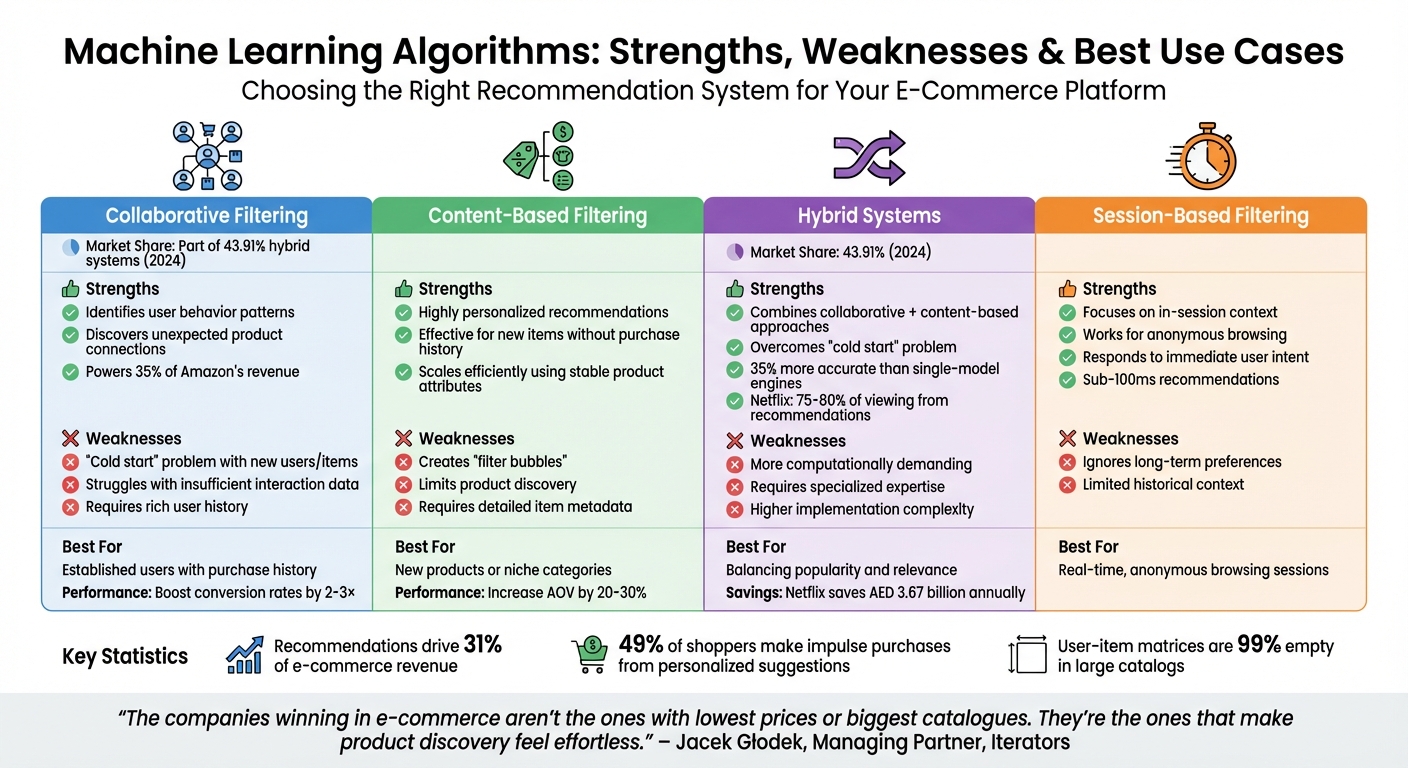
Machine Learning Algorithms for E-Commerce Recommendations Comparison
Real-time recommendation systems rely on three main machine learning techniques. Collaborative filtering focuses on analysing user behaviour to identify patterns and similarities between shoppers or products. By examining past interactions like purchases, clicks, and ratings, it predicts what a user might like next. Amazon revolutionised this approach by comparing items instead of users, creating a system that is both scalable and stable, even with millions of products.
Content-based filtering, on the other hand, uses product features - such as tags, descriptions, and categories - to align with a user’s previous preferences. This method is particularly effective for recommending niche products or new items that lack a purchase history. However, it can sometimes trap users in "filter bubbles", where they only see similar items, reducing opportunities for discovery.
To address the limitations of these methods, many companies now use hybrid filtering systems, which combine the strengths of both collaborative and content-based approaches. These systems excel in overcoming challenges like the "cold start" problem that occurs with new users or products. In 2024, hybrid systems dominated the market, capturing 43.91% of the share and outperforming single-model engines by 35% in accuracy. Companies like Amazon generate 35% of their revenue through recommendations, while Netflix attributes 75–80% of its viewing to its recommendation system, which also saves the company over AED 3.67 billion annually.
Each method comes with unique technical advantages and challenges that directly influence e-commerce performance. Collaborative filtering is excellent for discovering unexpected connections between products but struggles with items that lack sufficient interaction data. Meanwhile, content-based filtering is efficient for scaling as it relies on stable product attributes, though it may limit the element of surprise in recommendations. Hybrid systems strike a balance but require more computational power and specialised expertise to manage effectively. These nuances make a significant difference in driving sales and improving customer engagement.
"The companies winning in e-commerce aren't the ones with lowest prices or biggest catalogues. They're the ones that make product discovery feel effortless."
– Jacek Głodek, Managing Partner, Iterators
These algorithms don't just enhance user experience - they also drive business results. They can boost conversion rates by 2–3× and increase the average order value by 20–30%. However, implementing these systems comes with its own set of challenges, particularly when dealing with data sparsity. Large product catalogues often result in user–item interaction matrices that are 99% empty, making optimisation a critical task.
Next, we’ll dive into the steps for implementing these advanced recommendation systems on e-commerce platforms.
How to Implement Real-Time Systems
Data Collection and Processing
Real-time systems are designed to capture user interactions - like clicks, views, cart actions, purchases, and searches - using tools such as Apache Kafka or AWS Kinesis. Unlike traditional systems that store data for later analysis, these systems process data within milliseconds, directly influencing the current shopping session.
The tricky part is turning raw event data into something actionable. Modern approaches rely on incremental updates to refresh recommendation models with every user interaction. A great example is Tencent's system, which uses a distributed graph database and prediction engine to boost click-through rates by up to 18%.
Storage solutions play a huge role here. In-memory databases like Redis deliver lightning-fast performance, with sub-20 ms latency for vector similarity searches. Meanwhile, real-time databases like ClickHouse or Tinybird handle high-throughput data ingestion and complex queries. For instance, Redis can process a real-time recommendation query using DocArray in just 10 ms. Speed matters - a lot. Amazon found that every 100 ms of added latency could cut profits by 1%, and Google reported that a 500 ms delay in search results could reduce traffic by 20%.
"If the system's recommendations aren't returned immediately, they're irrelevant."
– Alaeddine Abdessalem, Redis
This efficient data processing forms the backbone of seamless e-commerce integration.
Integration with E-Commerce Platforms
Integrating machine learning models into an e-commerce platform involves a two-step pipeline. First, a candidate generation stage uses methods like k-nearest neighbours or metadata filters to narrow millions of products down to a few hundred. Then, a ranking stage applies models - such as Logistic Regression, XGBoost, or Neural Networks - to score these candidates based on user behaviour, item details, and contextual factors like the time of day or device type.
Serverless architectures make it easier to handle traffic surges. Tools like AWS Lambda and API Gateway automatically scale during high-demand events, such as Black Friday. For example, running an MVP that processes 1,200 queries per second could cost around AED 20,200 per month using AWS serverless solutions. Additionally, DynamoDB Accelerator (DAX) ensures product metadata retrieval happens within microseconds, even during peak loads.
A practical example of this approach is Walmart's implementation on their online grocery homepage in December 2020. Their system ranked item carousels in real time, capturing user preferences and improving product discovery. This led to a noticeable increase in add-to-cart actions per visitor. To achieve this, maintaining 200 ms latency for the recommendation API was critical.
"Real-time recommendation systems dynamically adapt to user interactions as they happen, providing low-latency recommendations within a user session."
– Joe Karlsson, Developer Advocate, Tinybird
With integration strategies in place, choosing the right algorithm can further enhance system performance.
Algorithm Comparison: Pros and Cons
| Algorithm Type | Strengths | Weaknesses | Best For |
|---|---|---|---|
| Collaborative Filtering | Identifies connections based on user behaviour patterns | Struggles with "cold start" issues for new users/items | Established users with rich histories |
| Content-Based Filtering | Offers highly personalised recommendations | Can become too narrow, needs detailed item metadata | New products or niche categories |
| Hybrid Systems | Combines user behaviour and item similarity for accuracy | More complex and computationally demanding | Balancing popularity and relevance |
| Session-Based Filtering | Focuses on in-session context effectively | Ignores long-term user preferences | Real-time, anonymous browsing |
Starting with simpler techniques, like SQL-based heuristics or basic collaborative filtering, is often a smart move. This allows teams to save data science resources while building foundational systems. For candidate generation, libraries like ScaNN or Faiss are excellent options - they trade a little precision for much faster results. Additionally, prioritising recent user interactions can better reflect a shopper's immediate intent.
Business Benefits of Real-Time Recommendations
Real-time recommendations do more than just increase sales; they also improve customer loyalty and refine inventory management, making them an essential tool for e-commerce success.
Increasing Sales and Average Order Value
Real-time recommendations play a key role in boosting sales by showcasing products that align with customer preferences at the right moment. Personalised interactions significantly improve conversions, with product recommendations accounting for an average of 31% of e-commerce revenues. Features like "Frequently Bought Together" encourage customers to add complementary items, while upselling directs them toward premium options. In fact, personalised shopping experiences can increase the average order value by nearly four times compared to non-personalised sessions.
Take Maine Lobster Now as an example. By switching to Shopify and introducing a customised checkout with a delivery date calendar, the company saw a 69% increase in overall conversions and a 97% jump in mobile conversions. Additionally, nearly half of shoppers (49%) report making extra purchases due to personalised suggestions, and recommendations can lead to a 68% rise in the number of items in a customer’s cart.
These personalised strategies not only drive revenue but also build a foundation for long-term customer loyalty.
Improving Customer Retention
Real-time personalisation helps businesses keep their customers coming back by tailoring interactions to each shopper's current behaviour. Instead of using a generic approach, these systems adapt dynamically, responding to signals like time spent on a page or recent cart activity. This matters because repeat customers typically spend 67% more than new ones, and even a small 5% improvement in retention can increase profits by 25% to 95%.
Reducing friction during key moments - like checkout - can also make a big difference. For example, reminding customers about their loyalty points or offering personalised discounts can reduce cart abandonment. Half of consumers say that personalised offers enhance their shopping experience. BPN, a performance nutrition brand, used subscription data to create win-back campaigns, achieving a 12% repurchase rate among lapsed customers. Similarly, Faherty leveraged real-time ad data through Saras Pulse to refine its marketing efforts, generating AED 4.04 million (US$1.1 million) in additional revenue. Dermalogica Canada saw a 23% boost in B2B conversion rates and a 338% increase in reorder frequency after adopting Shopify’s personalisation tools.
Better Inventory Management
Real-time recommendations don’t just boost sales and retention - they also streamline inventory management. By analysing live customer behaviour, search trends, and purchase patterns, businesses can forecast demand more accurately than with traditional methods. This enables smarter stock replenishment and helps redirect traffic to overstocked items.
The impact on operations is substantial. Inventory analytics can cut stockouts by 25% and increase retail sales by 15% in just six months. For instance, in 2025, SR Analytics helped an outdoor recreation company integrate data from Shopify, GA4, and Netsuite into a unified Snowflake warehouse. The result? A 25% reduction in stockouts and a 15% boost in online sales. Similarly, a fashion retailer used real-time analytics during peak seasons to halve stockouts and reduce excess inventory by 30%, saving costs and enhancing customer satisfaction.
Advanced systems can even deactivate recommendations for low-stock items to avoid disappointing customers. Meanwhile, they can highlight overstocked or slow-moving products in "Trending" or "Sale" sections, aligning inventory with customer demand and maximising efficiency.
Wick's Approach to Real-Time Recommendations
Wick's Four Pillar Framework addresses the unique challenges of UAE's e-commerce sector by delivering real-time recommendations. This framework not only consolidates scattered customer data but also employs AI to personalise experiences and provide recommendations in milliseconds. In a market where 92% of UAE customers value the experience as much as the products or services they purchase, Wick's approach ensures businesses can meet these high expectations by transforming data into actionable insights.
Tailor & Automate for AI-Driven Personalisation
The Tailor & Automate pillar uses AI to study customer behaviour and predict the most relevant next steps. Why does this matter? Because 74% of customers feel frustrated when content isn’t tailored to them, and personalisation can drive revenue increases of up to 40%.
Wick's system, a standout element of its framework, delivers recommendations in just 100 milliseconds, ensuring a smooth and uninterrupted user experience. But it doesn’t stop at basic product suggestions. Features like Product Finders and Subject Generators adapt in real time to user actions - whether it’s re-ranking items based on what's added to the cart or adjusting recommendations based on time spent exploring specific categories.
CDP Implementation for Unified Customer Data
In the UAE, where 84% of customers rely on multiple communication channels to complete a single transaction, a consistent experience across platforms is crucial. Wick excels in deploying Customer Data Platforms (CDPs), which centralise data from various sources like CRM systems, marketing tools, and e-commerce platforms into a unified customer profile. This eliminates data silos and enables businesses to create a Single Customer View, essential for personalised interactions.
With 85% of UAE commerce professionals already skilled in using data for personalisation, Wick’s CDP solutions empower businesses to activate first-party, consented data effectively - especially vital as traditional cookie-based tracking becomes obsolete. This unified data approach not only enhances customer experiences but also drives measurable growth, as proven by local case studies.
Case Studies and Results
As the UAE e-commerce market is projected to hit AED 29.38 billion by 2025, the ability to provide real-time, personalised recommendations represents a significant growth opportunity. Wick has helped local businesses tap into this potential by combining unified data strategies with AI-driven personalisation, leveraging both speed and data integration.
The results speak for themselves: personalised recommendations can boost conversion rates by up to 320% and account for as much as 31% of total e-commerce revenue. By focusing on rapid data unification and context-aware AI, Wick ensures businesses can deliver the most relevant options to each user, tailored to their current journey stage. This approach equips companies to stay competitive in a rapidly evolving market.
Conclusion
Real-time recommendation systems are proving to be game-changers for businesses, driving growth, increasing conversion rates, and strengthening customer loyalty. With the UAE's e-commerce market projected to reach AED 29.38 billion by 2025, these systems are becoming indispensable for delivering the personalised and seamless experiences that modern shoppers expect.
For businesses in the UAE, where 84% of customers use multiple channels to complete a single transaction, maintaining consistency across platforms is critical. Real-time systems ensure that customers receive relevant and consistent recommendations, whether they're shopping on mobile, desktop, or in-store.
"Our customer strategy is built on a commitment to relevance. Through our immersive experiences, we strive not only to meet but also to anticipate customer expectations." – Fahed Ghanim, CEO, Majid Al Futtaim Lifestyle
This focus on relevance is central to Wick's approach. Their Four Pillar Framework integrates customer data through CDP implementation, delivering AI-powered personalisation in under 100 milliseconds. By breaking down data silos and ensuring consistency across channels, Wick turns fragmented insights into actionable recommendations that achieve measurable results. As the UAE undergoes rapid digital transformation, businesses that embrace real-time recommendation systems are positioning themselves to capture higher revenues, retain customers, and provide the seamless experiences that set them apart.
Personalisation isn't just a buzzword - it's a proven strategy. Companies excelling in this area can see returns as high as AED 73 for every AED 3.67 invested. Personalised recommendations can boost conversion rates by 320% and contribute up to 31% of total e-commerce revenue. For UAE businesses looking to meet growing customer expectations and leverage market growth, real-time recommendation systems are no longer optional - they are a necessity for staying competitive and achieving long-term success.
FAQs
How can real-time recommendation systems enhance customer loyalty in e-commerce?
Real-time recommendation systems transform the shopping experience by tailoring suggestions to each customer. They analyse factors like browsing behaviour, purchase history, and even contextual details such as the shopper's device or location. Using this data, AI-driven systems provide product or offer recommendations that match the customer’s intent during their visit. This personal touch not only makes shoppers feel valued but also boosts satisfaction and encourages repeat visits.
For retailers in the UAE, adding a local touch can make these systems even more effective. Features like displaying prices in AED (د.إ), offering promotions aligned with regional events like Ramadan, and supporting the Arabic language create a more engaging and culturally relevant experience. By blending timely and meaningful recommendations with cultural awareness, businesses can strengthen customer loyalty and drive repeat purchases.
What are the main differences between collaborative, content-based, and hybrid filtering in recommendation systems?
Collaborative filtering dives into user behaviour - think purchases or clicks - to suggest products based on patterns from similar users or items. It works well when there’s a wealth of behavioural data but tends to hit a snag with new users or products, where data is scarce.
Content-based filtering, on the other hand, zeroes in on product attributes like category, brand, or colour, aligning them with a user’s preferences. While this method delivers highly tailored suggestions, it can sometimes feel a bit too focused, offering recommendations within a limited range of attributes.
Hybrid filtering blends the best of both worlds. It taps into community trends via collaborative filtering while using product details to tackle the challenges of limited data for new users or items. The result? Broader and more precise recommendations, though it does demand more advanced computational power.
Wick’s AI-powered personalisation platform takes the hybrid route, empowering UAE e-commerce brands to deliver real-time recommendations tailored to local shopping habits. This not only enhances the customer experience but also drives sales, all in AED.
How do real-time product recommendations improve inventory management for e-commerce businesses?
Real-time product recommendations do more than just improve the shopping experience - they also deliver critical insights for managing inventory. By examining customer actions like browsing habits, items added to carts, or completed purchases, these systems can quickly spot demand patterns. This allows businesses to predict which products might sell out soon, ensuring timely restocking and avoiding missed sales opportunities.
On the flip side, products that aren’t selling well can be highlighted for potential discounts or scaled-back reordering. When combined with inventory management tools, these insights create a more flexible and efficient supply chain. Features like automated restocking, dynamic adjustments to safety stock, and smarter stock distribution across fulfilment centres help maintain ideal inventory levels, reducing excess stock and boosting profits in AED. For e-commerce businesses in the UAE, this translates to smoother operations and happier customers, especially during peak shopping seasons.
Wick’s cutting-edge AI personalisation tools make it easy for UAE merchants to merge real-time recommendations with inventory systems. This unified approach provides a clear view of customer demand and stock status, paving the way for steady and sustainable growth.