
Blog / Qatar PDPPL: Impact on GCC Businesses
Qatar PDPPL: Impact on GCC Businesses
Qatar’s Personal Data Privacy Protection Law (PDPPL) is reshaping how businesses in the GCC handle personal data. If you process data from Qatari residents, you must comply - no matter where your business operates. Non-compliance can lead to steep penalties ranging from QAR 1,000,000 to QAR 5,000,000.
Here’s what you need to know:
- Scope: PDPPL applies to any organisation processing Qatari personal data, even outside Qatar.
- Key Requirements: Businesses must establish a Personal Data Management System (PDMS), conduct Data Protection Impact Assessments (DPIAs), and report breaches within 72 hours.
- Cross-Border Challenges: Transferring personal data outside Qatar requires explicit consent or legal justification.
- Sensitive Data Rules: Handling sensitive data (e.g., health, religion) requires prior approval from Qatar’s regulators.
- Financial Burden: Compliance demands investments in IT systems, employee training, and automated tools.
For GCC businesses operating across borders, PDPPL’s strict rules mean a single compliance strategy isn’t enough. Tailored solutions for each jurisdiction are critical to avoid fines, operational disruptions, and reputational damage.
Quick Tip: Start with a gap analysis, implement a robust PDMS, and ensure contracts with data processors meet PDPPL standards. Automating compliance tasks, like managing data subject requests, can save time and reduce risks.
Qatar Data Privacy: A Quick Guide to Law No. 13 of 2016 on Protecting Personal Data Privacy (PDPL)
sbb-itb-058f46d
Main Compliance Challenges for GCC Businesses
With Qatar implementing its data regulations, businesses across the GCC are encountering a mix of technical and financial challenges as they strive to meet these stringent requirements.
Core PDPPL Requirements
Qatar's PDPPL mandates organisations to adopt rigorous data management practices. A key requirement is the establishment of a Personal Data Management System (PDMS). This system must track all data processing activities, manage breach notifications, and address individual rights requests. Additionally, businesses must maintain a Record of Processing Activities (RoPA) to document every instance of data handling.
Another critical requirement is conducting Data Protection Impact Assessments (DPIAs) before initiating new processing activities or making significant system changes. Neglecting to perform a DPIA can lead to fines of up to QAR 1,000,000 (roughly USD 275,000).
The law also introduces strict guidelines for handling sensitive data, referred to as "Personal Data with Special Nature." This includes health details, religious beliefs, criminal records, and marital information. Processing such data requires prior approval from the Competent Department.
"If your organisation fails to protect personal data and comply with Law No. 13 then you are exposed to not only high financial penalties... but operational inefficiencies, intervention by regulators, and most importantly permanent loss of your consumer trust."
– PwC Middle East
These regulations create a complex environment, forcing businesses to navigate both operational and financial obstacles.
Operational and Financial Obstacles
Complying with PDPPL demands significant resources, both in terms of time and money. Beyond the risk of steep fines, businesses must invest heavily in IT infrastructure, automated tools for data discovery, and employee training. Many companies also face the challenge of overhauling outdated systems that were not designed with modern data privacy in mind.
Handling Data Subject Rights (DSR) requests - such as access, rectification, erasure, and portability - adds another layer of complexity. Without automation, managing these requests can overwhelm operational teams and drain resources.
Adding to the difficulty is the law's extraterritorial scope, which requires even businesses located outside Qatar to comply if they process data belonging to Qatari residents . For GCC organisations operating across multiple jurisdictions, this means a single compliance framework won't suffice. Instead, they must develop tailored strategies for each country.
"Although, at first blush, it may appear manageable and more cost effective for an organisation to implement a general GCC-wide personal data governance regime, this is likely to heighten the risk of non-compliance in a particular jurisdiction."
– Justin Whelan, Partner, HFW
For businesses with cross-border operations, ensuring compliance involves formalising contracts with third-party data processors and auditing data flows across various departments. These measures are essential but add to the already significant compliance burden.
Impact on Cross-Border Business Operations in the GCC
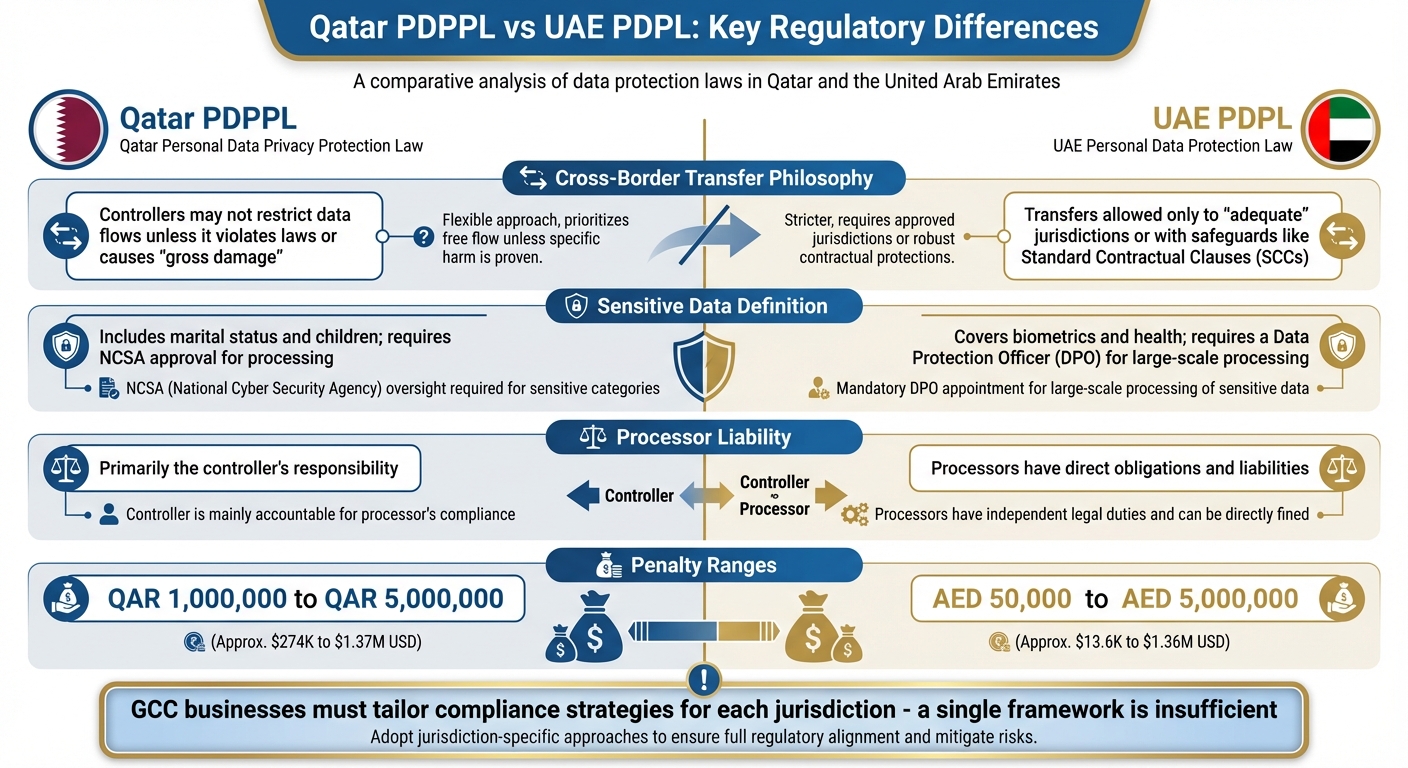
Qatar PDPPL vs UAE PDPL: Key Differences for GCC Businesses
For companies operating between Qatar and other GCC nations, particularly the UAE, managing cross-border data flows has become increasingly intricate. While regional trade relies on efficient information exchange, varying privacy regulations now compel businesses to reassess how they handle personal data across borders. These complexities highlight the need to evaluate the risks and compare Qatar's framework with broader GCC practices.
Risks in Cross-Border Data Transfers
One of the biggest hurdles is extraterritoriality. Qatar's Personal Data Privacy Protection Law (PDPPL) governs data processed within its borders, while the UAE's Federal Decree-Law No. 45 of 2021 extends its reach to any entity processing data of UAE residents, regardless of where the processing occurs. This means a company in Doha managing customer data from Dubai must comply with both Qatari and Emirati regulations simultaneously.
Data transfers from the UAE to Qatar require Qatar to be recognised as having an "adequate level of protection" or necessitate safeguards like Standard Contractual Clauses (SCCs). Failing to implement these measures could lead to hefty fines - up to QAR 5 million in Qatar and AED 5 million in the UAE. Beyond financial penalties, non-compliance can disrupt operations, as regulators may suspend data processing activities, impacting critical functions such as customer service and marketing.
"By taking proactive steps to ensure compliance, businesses are not only better prepared to avoid legal risks and penalties, but enhance their reputation as trustworthy custodians of personal data." – Victoria Woods, Partner, Hadef & Partners
The risks don't end with fines or operational halts. Reputational damage is another significant concern. Customers are more vigilant about how their data is handled, and a single breach or violation could permanently erode trust. For industries like banking - where the UAE mandates secure retention of personal data and transaction records for at least five years - the stakes are even higher.
Comparison: PDPPL vs Standard GCC Practices
To navigate these challenges, it's essential to understand how Qatar's regulations differ from those in other GCC countries. Despite their economic ties, GCC nations have distinct data protection frameworks, and these differences can significantly impact cross-border operations.
| Feature | Qatar PDPPL | UAE PDPL |
|---|---|---|
| Cross-Border Transfer Philosophy | Controllers may not restrict data flows unless it violates laws or causes "gross damage". | Transfers allowed only to "adequate" jurisdictions or with safeguards like SCCs. |
| Sensitive Data Definition | Includes marital status and children; requires NCSA approval for processing. | Covers biometrics and health; requires a Data Protection Officer (DPO) for large-scale processing. |
| Processor Liability | Primarily the controller's responsibility. | Processors have direct obligations and liabilities. |
| Fines | Ranges from QAR 1 million to QAR 5 million. | Ranges from AED 50,000 to AED 5 million. |
These differences underline the importance of tailoring compliance strategies to each jurisdiction. For example, a business operating in both Qatar and the UAE must secure NCSA approval for processing certain types of data in Qatar while ensuring SCCs are in place for UAE-related transfers.
"The data protection landscape in the UAE (and the wider GCC region) remains complex to navigate and somewhat fragmented, meaning that the application of the PDPL will need to be considered carefully." – DLA Piper
Practical Solutions for PDPPL Compliance
Step-by-Step Compliance Process
To navigate PDPPL compliance effectively, start by conducting a gap analysis. This helps map out all personal data and ensures there’s a lawful basis for processing it. Use a centralised Personal Data Management System (PDMS) to handle tasks like breach notifications, managing rights requests, and maintaining compliance. For sensitive data, make sure to obtain explicit consent and secure prior permissions.
For high-risk or significant changes in data processing, conduct Data Protection Impact Assessments (DPIAs). Additionally, maintain a Record of Processing Activities (RoPA) that details the purpose, scope, duration, and security measures of all processing operations. These measures can help reduce the risk of regulatory fines and operational issues.
When transferring data across borders, ensure compliance with PDPPL regulations to protect individuals from harm. Draft written contracts with data processors and establish breach protocols to notify regulators and affected individuals within 72 hours.
While process improvements are critical, strong technical measures are equally essential.
Investing in Data Security and Governance
Adopt tools like encryption, pseudonymisation, and anonymisation to protect data both at rest and in transit. These measures are crucial to preventing breaches, which can cost organisations up to $10 million USD on average.
"Data residency shall no longer be a requirement as data classification schemes, security and encryption technologies now secure a high level of protection controls." – Cloud Policy Framework (Qatar), June 2022
Embed "Privacy by Design and Default" into every new process. For consent management, prioritise "opt-in" mechanisms over "opt-out", particularly for cookies and direct marketing. Automate tasks like data discovery and classification using AI tools to enhance efficiency.
Appointing a Data Protection Officer (DPO) or privacy lead can significantly streamline compliance efforts. This individual can oversee regulatory communication and ensure that your team is fully aware of its responsibilities. To reinforce this, provide comprehensive PDPPL training for employees and key stakeholders as part of a broader awareness initiative.
Standardise compliance documentation with templates for privacy notices, DPIAs, and RoPAs. Update your privacy notices to clearly explain the lawful purposes of data processing and the extent of data sharing. Streamline procedures to allow individuals to exercise their rights - such as access, rectification, erasure, and consent withdrawal - within the 30-day response window required by Qatar’s regulations.
How Wick Helps Businesses Meet PDPPL Requirements
Using Wick's Capture & Store Pillar
Wick's Capture & Store Pillar lays the groundwork for PDPPL-compliant data systems by mapping personal data and maintaining a detailed Record of Processing Activities (RoPA) as mandated by Article 11. With advanced analytics and customer journey mapping, businesses gain complete visibility into all personal data.
This framework enforces purpose limitation controls, ensuring that organisations collect only the minimum personal data needed for specific and legitimate purposes. By doing so, it prevents unnecessary data collection and ensures data is not retained longer than required. Wick also employs data analytics tools to safeguard sensitive information through technical and organisational measures, protecting it from unauthorised access, modification, or destruction.
This strong foundation paves the way for more advanced automation capabilities.
Tailor & Automate for Personalisation and Compliance
Once the data capture process is secured, Wick's Tailor & Automate Pillar takes over to enhance personalised customer engagement while maintaining compliance. It simplifies challenges like cross-border data transfers and consent management, making it especially relevant for GCC businesses.
This pillar focuses on delivering tailored customer experiences while meeting PDPPL requirements. Its marketing automation tools include consent management systems that ensure explicit consent is obtained before processing personal data. The tools also make revoking consent straightforward.
Additionally, AI-driven personalisation features introduce transparency mechanisms that clarify how customer data is processed and the logic behind automated decisions. This aligns with PDPPL's stipulation that individuals have the right to object to automated decisions with legal or significant impacts. Wick’s AI tools also automate responses to requests for access, rectification, erasure, and data portability. By linking personal data directly to its owner, they reduce the risk of non-compliance penalties, which can range from QAR 1,000,000 to QAR 5,000,000 (approximately AED 1,007,000 to AED 5,035,000).
Conclusion: Adapting to PDPPL for Long-Term Success
Qatar's Personal Data Privacy Protection Law (PDPPL) marks a significant change in how businesses across the GCC region handle data protection. Its reach extends beyond Qatar's borders, requiring any organisation processing the personal data of Qatar residents to comply.
Non-compliance comes with hefty penalties ranging from QAR 1,000,000 to QAR 5,000,000 (around AED 1,007,000 to AED 5,035,000), accompanied by active enforcement across various industries.
The law mandates stringent measures, including breach notifications, obtaining explicit consent, and fulfilling operational responsibilities. Dino Wilkinson, Partner at Baker McKenzie, highlights the seriousness of this shift:
"The regulator is now prepared to enforce against organisations that fail to comply with the law".
This reinforces the idea that compliance is no longer optional - it is a critical component of staying competitive.
Organisations that embrace strong data protection practices not only build consumer trust but also streamline their operations. Automated systems for handling requests and maintaining records can make compliance more efficient. Rather than treating it as a mere regulatory obligation, businesses can integrate compliance into their core strategy.
For companies struggling with these challenges, working with expert consultancies can fill knowledge gaps. By adopting proven strategies, such as Wick's Four Pillar Framework, businesses can transform compliance into a strategic advantage. Tools like structured data capture, automated consent management, and AI-driven personalisation - while maintaining transparency - can help deliver customised customer experiences. These efforts lay the groundwork for long-term growth in the GCC region.
To get ahead, businesses should act now. Start with gap assessments for PDPPL and QFC requirements, implement Arabic-language consent platforms, review third-party contracts, and deploy AI-powered tools for data discovery. These steps will ensure that organisations are well-positioned to align with global frameworks like the GDPR and thrive in a rapidly evolving regulatory landscape.
FAQs
What challenges do GCC businesses face in complying with Qatar's Personal Data Privacy Protection Law (PDPPL)?
GCC businesses are navigating a tough landscape when it comes to meeting the requirements of Qatar's Personal Data Privacy Protection Law (PDPPL). One of the biggest obstacles lies in fully understanding and implementing the law's intricate rules. These regulations apply to any organisation handling personal data in Qatar, no matter where the business is based. To comply, companies need to adhere to stringent protocols around consent, data processing, and cross-border data transfers. This often means overhauling internal systems and workflows.
On top of that, businesses must keep pace with regulatory updates issued by Qatar’s Data Protection Office. These updates can lead to operational changes, necessitate staff training, and demand ongoing monitoring to stay compliant. For multinational companies working across the GCC, restrictions on cross-border data transfers add another layer of complexity. They must establish strong safeguards to meet these requirements, which can be both time-consuming and resource-intensive.
Effectively addressing these challenges requires a proactive stance on data governance. Businesses need to stay alert to regulatory changes and invest in continuous efforts to align their operations with Qatar's evolving privacy standards.
What is the impact of Qatar's PDPPL on cross-border data transfers within the GCC?
Qatar's Personal Data Protection Law (PDPPL) sets firm rules for transferring personal data beyond its borders, presenting challenges for businesses operating across the GCC. Under this law, data transfers are only permitted if the receiving country meets Qatar's adequacy standards or if companies adopt approved measures like Standard Contractual Clauses. However, the law does outline specific exceptions where these conditions may not apply.
This approach aligns with a growing trend in the GCC, where nations are introducing stricter data protection frameworks. For businesses, this means navigating local regulations carefully, securing required consents, and establishing strong privacy protocols. These efforts are essential for maintaining compliance and ensuring smooth cross-border operations while protecting individuals' personal data.
How can businesses in the GCC region comply with Qatar's PDPPL regulations?
To stay in line with Qatar's Personal Data Privacy Protection Law (PDPPL), businesses need to take specific measures to handle personal data responsibly.
Start by thoroughly understanding the law's requirements. One key point is obtaining clear and explicit consent from individuals before processing their personal data - unless certain exceptions apply. This ensures transparency and builds trust. Additionally, it's essential to implement strong security measures, such as encryption, and conduct regular assessments to protect sensitive information from breaches.
You’ll also need to set up processes that allow individuals to exercise their rights. This includes enabling them to access, correct, or delete their personal data. Be prepared to report any data breaches that could pose significant risks to the National Cyber Security Agency within 72 hours of discovering the incident.
For businesses involved in high-risk activities, appointing a Data Protection Officer (DPO) is a smart move. The DPO can oversee compliance efforts and act as a point of contact with regulatory authorities. Regular audits and keeping up with updates to the regulations are also essential steps to ensure your business remains compliant and avoids unnecessary risks.