

Blog / Predictive Content for GCC Businesses
Predictive Content for GCC Businesses
Predictive content is reshaping how businesses in the GCC engage with their audiences. By using AI and data analytics, companies can anticipate customer needs, deliver personalized experiences, and address long-standing challenges in the region's digital landscape. Here's why this matters:
- High Cart Abandonment: 60% of GCC shoppers leave carts due to impersonal experiences.
- Language Preferences: 75% prefer Arabic content, but poor localization drives users away.
- Cultural Disconnect: Generic strategies fail to resonate with local habits and key moments like Ramadan.
- Feedback Gaps: 85% of unhappy customers don't voice complaints, making proactive solutions critical.
The solution? Predictive analytics. This approach uses past behaviors to predict future actions, enabling businesses to optimize content, tailor and automate engagement, and increase conversions. For example, AI can adjust recommendations based on Ramadan trends or tailor offers to address price sensitivity.
Key Benefits of Predictive Content in GCC:
- Revenue Growth: Boosts revenue by 5–15% and reduces churn by 2–4%.
- Improved Engagement: Personalized strategies can increase conversion rates by 30–40%.
- Localized Solutions: AI trained for Arabic and GCC-specific behaviors ensures relevance.
Success Stories: Emirates NBD, Etisalat, and Majid Al Futtaim have all leveraged predictive tools to achieve measurable results, from higher leads to reduced churn.
To get started, businesses should audit their data, focus on high-impact use cases, and implement AI models tailored for GCC markets. Predictive content isn't just a trend - it's the future of customer engagement in the region.
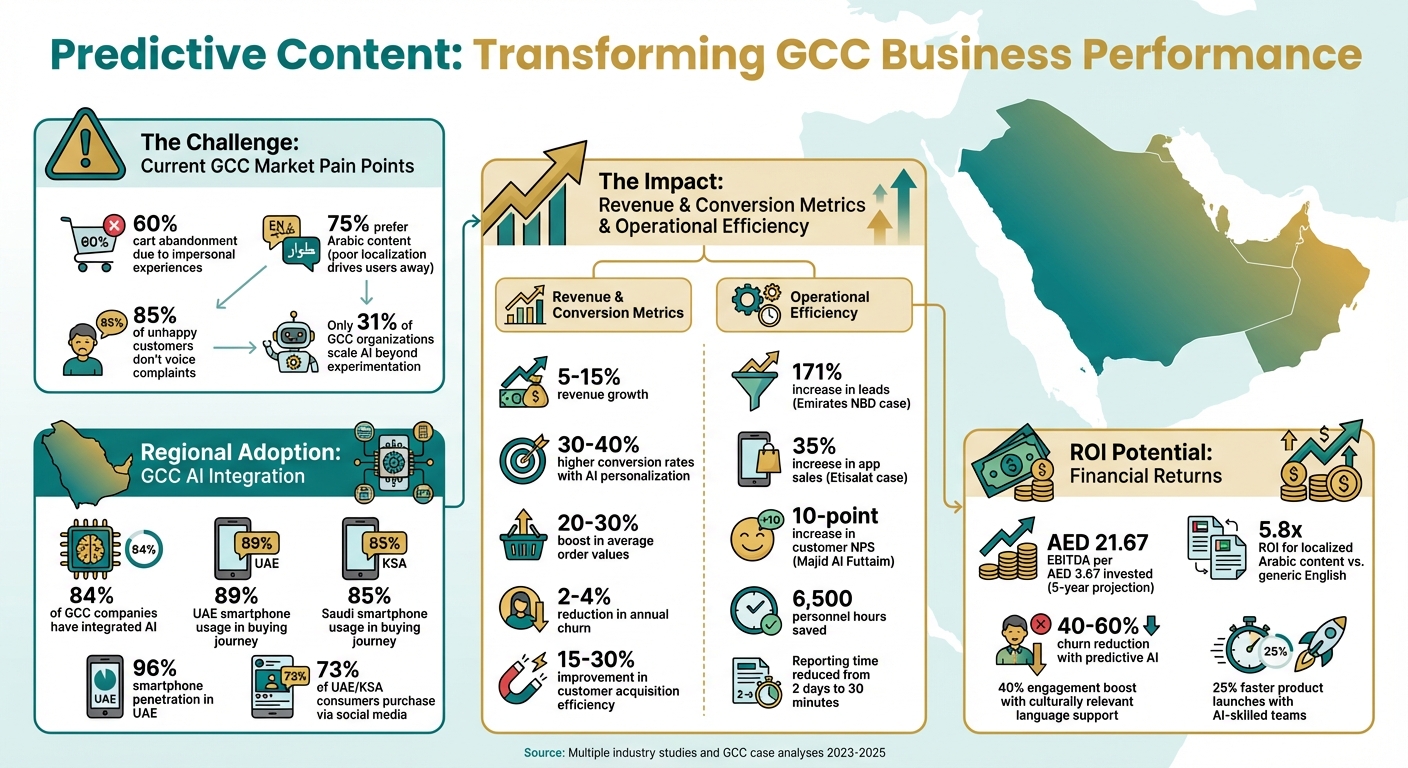
Predictive Content Impact on GCC Business Performance: Key Statistics and ROI Metrics
The Rise of Predictive Analytics in Marketing Strategy
sbb-itb-058f46d
Using Predictive Analytics to Fix Engagement Problems
Predictive analytics is transforming how businesses in the GCC approach customer engagement. Instead of relying on reactive strategies, companies can now anticipate customer behaviour using AI. By analysing browsing habits, purchase patterns, and click data, AI can predict actions like cart abandonment or customer churn. This approach not only improves engagement but also enhances customer acquisition efficiency by 15–30%. It’s a game-changer, especially when combined with deeper insights into cultural and behavioural trends.
How AI Powers Predictive Analytics
AI leverages behavioural signals to uncover customer intent. These signals might include how often someone visits a website, whether they open emails, how far they scroll on a page, how much time they spend on specific sections, or even if they switch between Arabic and English interfaces. By identifying hidden patterns, AI can suggest the most relevant next step for the customer.
For GCC markets, this requires algorithms that understand the region's cultural intricacies. AI models trained in Western contexts often miss the mark when applied here. Enhanced Arabic natural language processing (NLP) bridges this gap, handling both Modern Standard Arabic and regional dialects effectively. This ensures customer interactions are tailored and relevant.
"Stop thinking of AI as an autopilot and start treating it as your strategic co-pilot, a tool that augments your team's creativity with unparalleled data-driven precision."
– Go-Digital
AI also helps businesses focus their efforts where it counts. By scoring leads based on their likelihood to convert, AI ensures sales teams prioritise high-potential prospects. Predictive SEO adds another layer by analysing search trends and social media chatter to anticipate market changes before competitors do. This lets businesses create content and secure rankings around emerging topics while they’re still gaining traction. These targeted strategies drive tangible results.
Why Predictive Content Works for GCC Businesses
The numbers paint a clear picture. In the Gulf region, recommendation engines implemented correctly can boost average order values by 20–30%. Meanwhile, AI-driven personalisation increases conversion rates by 30–40% across GCC markets. These outcomes are achieved by delivering experiences that resonate locally rather than offering generic, one-size-fits-all solutions.
Predictive analytics closes the personalisation gap. Traditional retargeting might repeatedly show customers the same product they viewed. Predictive personalisation, on the other hand, adjusts the entire approach. It changes the message, tweaks the offer, and reworks the content based on why the customer didn’t purchase initially. For instance, AI might adapt the offer to address price sensitivity, provide social proof, or resolve localisation challenges.
"The retailers thriving in data-driven retail GCC markets are those who view personalisation not as a technical feature but as a cultural bridge, leveraging AI to deliver experiences that feel authentically local."
– Aneesh Sreedharan, CEO, 2Hats Logic Solutions
The GCC’s mobile-first environment amplifies these benefits. With 89% of UAE shoppers and 85% of Saudi shoppers using smartphones during their buying journeys, predictive systems can adjust in real time. They can tailor content based on the user’s location, time of day, or device type. This instant adaptability, combined with culturally relevant language support, can boost engagement rates by 40%, eliminating the hassle of manual language selection.
| Industry | Predictive AI Application | Key Benefit |
|---|---|---|
| Retail | Demand forecasting & personalised recommendations | 30–40% higher conversion rates |
| Travel | Dynamic pricing & seasonal surge forecasting | Optimised revenue during Eid/holidays |
| B2B | Lead scoring & CRM enrichment | 20–40% shorter deal cycles |
| F&B | Order prediction & menu personalisation | Reduced waste & increased upselling |
AI adoption in the GCC is strong, with 84% of companies already integrating it into their operations, close to the global average of 88%. But adoption alone isn’t enough. Success hinges on thoughtful implementation that respects the region’s unique needs. This includes aligning predictive models with the GCC’s commercial calendar, adhering to data sovereignty laws like Saudi Arabia’s PDPL and UAE data protection regulations, and ensuring Arabic and English support from the outset rather than as an afterthought.
Wick's Four Pillar Framework for Predictive Content
Wick's Four Pillar Framework is designed to deliver predictive content tailored to local nuances. By creating a unified digital ecosystem, the framework combines data signals, intent analysis, and culturally relevant content to offer meaningful experiences. This approach avoids generic personalisation by focusing on transcreation that resonates with specific cultural and regional contexts.
The framework acknowledges the diversity within GCC markets, where consumer behaviours in cities like Riyadh and Dubai can vary significantly, especially during key periods like Ramadan. By integrating culturally aware content creation, a robust data infrastructure, and AI-driven personalisation, each pillar addresses a unique aspect of the customer journey, ensuring a seamless blend of insights, content, and technology.
Build & Fill: Creating and Optimising Content
The first pillar centres on crafting content that authentically connects with GCC audiences. This involves using regional dialects like Khaleeji and respecting cultural norms around imagery, family values, and religious practices. Transcreation is key, ensuring that brand messages retain their emotional and cultural depth.
Wick's strategy also aligns with the Islamic calendar. For instance, Ramadan 2025 saw consumer spending in the UAE reach AED 36.7 billion, with Saudi Arabia experiencing a 35% surge. Additionally, this pillar prioritises mobile-friendly content, essential in a region where 89% of UAE shoppers rely on smartphones for their purchases.
"Marketing localisation is the process of adapting your entire marketing ecosystem to resonate authentically with local audiences."
– Contentech
A great example of this approach is Samsung's 2025 Galaxy Z Flip5 campaign. By collaborating with Saudi artist Lamia Al Malki and using bilingual advertising, the campaign reflected local values of luxury and family. This culturally aligned strategy drove higher engagement rates - up to 30% more in the GCC - compared to simple translations of global campaigns.
Capture & Store: Collecting and Analysing Data
Predictive content relies on clean, unified data. The second pillar addresses the challenge of fragmented data, which is often spread across e-commerce platforms, in-store systems, call centres, and social media. Wick uses Customer Data Platforms (CDPs) to create a comprehensive Customer 360 view, aggregating behavioural signals like clickstreams, payment habits, and language preferences across Arabic and English interfaces.
This pillar also considers data sovereignty requirements. With regulations like Saudi Arabia's PDPL and UAE data protection laws mandating local data storage, Wick integrates composable CDPs with existing cloud infrastructure to ensure compliance without duplicating data. These systems analyse live signals to predict customer satisfaction and churn risk, crucial in a market where 85% of dissatisfied customers switch brands without providing feedback.
Majid Al Futtaim exemplifies this approach by analysing footfall data and shopping behaviours across its malls and supermarkets. This helps forecast demand, reduce overstocking, and deliver personalised promotions in real time, enhancing customer satisfaction. By moving from broad demographics to detailed micro-segments, businesses can better meet customer needs as they arise.
Tailor & Automate: AI-Driven Personalisation
The final pillar focuses on bringing predictive insights to life through AI-driven personalisation. Instead of repeatedly targeting customers with the same product, it identifies why they didn’t convert and adjusts the strategy - whether through new messaging, refined offers, or better localisation.
This pillar also supports conversational commerce, such as using WhatsApp Business API to enable transactions directly within the app - a format particularly popular in the UAE and Saudi Arabia. Emirates Airlines leverages similar predictive models to analyse past purchases and market trends, dynamically adjusting ticket prices and recommending personalised upgrades or hotel packages.
Rather than replacing human decision-making, Wick's automation complements it. For example, it might suggest a how-to video when engagement drops or offer a discount when price sensitivity is detected. This moment-focused strategy can increase revenue by 5–15% and reduce annual churn by 2–4 percentage points, making predictive personalisation a powerful tool for businesses in the region.
Predictive Content Success Stories in GCC
Case Studies: Predictive Content in Practice
Let’s look at how businesses in the GCC are combining data-driven insights with local understanding to deliver personalised customer experiences. These examples show how predictive analytics is being used to achieve measurable results, highlighting the powerful intersection of technology and regional nuances.
Emirates NBD teamed up with Persado from 2021 to 2023 to enhance their digital marketing campaigns using AI-powered natural language processing. Through 29 experiments, primarily on Facebook ads, they discovered which emotions - Encouragement, Safety, and Fascination - resonated most with their audience. The results were impressive: a 171% increase in leads, 31% lower cost per click, and 39% lower cost per lead. Thanks to predictive analytics, they were able to launch successful campaigns in days rather than weeks.
"The engagement allowed Emirates NBD to scale its digital marketing efforts and produce as much as a 171% increase in leads in any given campaign."
– Persado
Etisalat UAE leveraged data-driven strategies in June 2019 with their Smiles app campaign, developed in collaboration with Google's BrandLab. By segmenting their audience into five personas and using six-second "bumper" ads triggered by real-time data, they tailored promotions like cinema deals for Thursdays, when movie searches spiked. This approach delivered a 35% increase in app sales, a 24% rise in monthly active users, and a 10.7% boost in purchase intent.
Majid Al Futtaim Retail took a forward-thinking approach in June 2023 by adopting the Microsoft Intelligent Data Platform to forecast customer shopping behaviours across Carrefour outlets. Led by CFO Rahul Bhandari and Director of FP&A Mohamed Tawfiq, the initiative streamlined performance tracking with a real-time KPI dashboard. The results? A 10-point increase in customer Net Promoter Score, 6,500 personnel hours redirected from manual tasks to insights, and a reduction in reporting time from two days to 30 minutes. Later, in November 2024, they launched "Precision Media", introducing AI-powered LED smart screens in stores to display personalised ads based on real-time demographic data for their 600 million annual visitors.
These examples clearly illustrate how predictive content can drive both engagement and revenue. A study by Strategy& Middle East revealed that GCC telecom operators could generate up to AED 21.67 in EBITDA for every AED 3.67 invested in an AI-powered marketing personalisation engine over five years. One telecom operator used predictive AI to offer personalised resolutions after network outages, reducing potential churn by 40% to 60%. These advancements represent a shift in how businesses across the GCC connect with their audiences, blending innovation with local expertise.
How to Start with Wick's Predictive Content Solutions
Implementation Steps for GCC Businesses
Transitioning from small-scale trials to fully integrated predictive content systems requires more than just automating existing processes - it demands a complete rethinking of workflows. A McKinsey survey from 2025 highlights that while 84% of GCC organisations have adopted AI in at least one function, only 31% have successfully scaled their efforts beyond experimentation. The real challenge isn't the technology itself but aligning your strategy and preparing the infrastructure to support it. This alignment lays the groundwork for effective implementation.
The first step is to audit your data architecture. To build a strong foundation, you'll need first-party data collected with consent from both online and offline sources. This could include browsing history, purchase patterns, email engagement, clickstreams, and even call-centre transcripts. Why is this important? Because 85% of dissatisfied GCC customers don’t voice their complaints - they simply stop engaging. Predictive models can help identify and address these risks in real time, but only when your data systems are designed to support machine learning and real-time analytics.
Next, focus on defining high-impact use cases before attempting a full-scale rollout. Start with areas that deliver quick wins, like demand forecasting, churn prediction, or dynamic pricing. For instance, Majid Al Futtaim uses predictive analytics to understand footfall data and optimise inventory planning, while Emirates Airlines adjusts ticket prices dynamically based on travel patterns and market demand. A 90-day pilot targeting a specific customer journey, such as onboarding or prepaid recharge, can quickly demonstrate measurable ROI.
Adapting to local nuances is equally critical. AI models must reflect the specific needs of GCC markets, such as Arabic language subtleties, religious observances like Ramadan and Eid, and preferred payment methods like mada, KNET, and Benefit. Aneesh Sreedharan, CEO of 2Hats Logic Solutions, explains:
"A recommendation engine trained on Western shopping behaviours will never understand why a Saudi shopper browses differently during Ramadan".
To address these nuances, integrate AI models specifically designed for Arabic fluency, such as Jais or Falcon 40B. Ensure your cloud infrastructure supports local data storage, utilising regional providers like AWS Bahrain, Azure UAE, or Google Cloud KSA to comply with data protection laws.
Lastly, invest in upskilling your teams and incorporate human-in-the-loop validation. Cross-functional teams skilled in AI/ML, data storytelling, and agile workflows can evaluate AI outputs effectively, improving efficiency and accelerating product launches by as much as 25%. Treat AI as a collaborative tool rather than a fully autonomous system.
Wick's Plans for Predictive Solutions
Once these foundational steps are in place, you can choose from Wick's three-tiered framework for predictive content solutions. Each tier is tailored to match your organisation's AI maturity level:
| Plan Tier | Target Business Stage | Key Features | Data Depth |
|---|---|---|---|
| Basic | Experimentation/Piloting | Recommendation engines, WhatsApp Business API, basic Arabic localisation. | Browsing and purchase history. |
| Advanced | Scaling Operations | Predictive churn models, dynamic pricing, bilingual AI chatbots, lead scoring. | Behavioural clickstreams and CRM data. |
| Enterprise | AI-Native Transformation | Omnichannel orchestration, sovereign-grade compute, generative AI, real-time inventory forecasting. | Unified first-party data (online and offline). |
The Basic plan is ideal for SMEs and startups testing recommendation engines and mobile-first strategies. In a region where smartphone penetration is at 89% in the UAE, this plan helps businesses increase average order values by 20% to 30%.
The Advanced plan caters to mid-sized businesses ready to scale their operations. Predictive churn models and dynamic pricing are particularly impactful at this stage, with AI-powered personalisation delivering 30% to 40% higher conversion rates for GCC retailers compared to non-localised strategies.
The Enterprise plan is designed for large organisations aiming for full digital transformation. This tier includes advanced features like omnichannel orchestration, sovereign-grade computing, and real-time inventory forecasting. By leveraging infrastructure like Saudi Arabia’s $5 billion AWS "AI Zone", businesses can achieve high-performance computing capabilities. Currently, only 11% of GCC organisations are considered "value realisers", attributing 5% or more of their earnings to AI. This plan aims to help businesses bridge that gap.
Wassim Derbi, Head of Strategic Marketing at Hyundai UAE and Genesis UAE, captures the mindset needed for success:
"Success belongs to brands that are quick to test, fast to learn and brave enough to pivot when needed. Agile marketing isn't about chasing every trend; it's about building a flexible mindset".
Conclusion: Growing Your Business with Predictive Content
Predictive content has become essential for businesses in the GCC. With AI now widely adopted across the region, the focus has shifted from questioning its effectiveness to determining how fast companies can implement it before evolving customer expectations become the norm. Businesses that anticipate, personalise, and address customer needs ahead of time are set to lead the next decade. Meanwhile, those reliant on outdated metrics and quarterly surveys risk falling behind.
The numbers speak volumes. Predictive strategies can boost revenue by 5–15%, reduce churn by 2–4 percentage points, and significantly lower contact-centre volumes. This is particularly critical in GCC markets, where 85% of dissatisfied customers never bother with surveys - they simply take their business elsewhere. Predictive analytics acts as a proactive tool to spot and address friction points before they affect your bottom line. Additionally, creating high-quality, locally relevant Arabic content can increase engagement by up to 30%. When tailored for the GCC, such efforts can deliver an impressive 5.8x ROI compared to generic English content.
Wick's Four Pillar Framework - Build & Fill, Capture & Store, and Tailor & Automate - combines local cultural understanding with real-time data to turn insights into actionable results. This integrated approach ensures businesses can act quickly and effectively. By aligning advanced technology with regional insights, every customer interaction becomes both impactful and measurable.
Industry experts also highlight the urgency of this shift:
"The UAE and Saudi Arabia are at the forefront of digital transformation... This shift presents opportunities for businesses to rethink engagement strategies, particularly as AI continues to reshape how consumers search, shop, and interact online" – Emmanuel Durou, Technology, Media & Telecommunications Leader at Deloitte Middle East
With smartphone penetration at 96% and 73% of consumers in the UAE and KSA making purchases via social media last year, your audience is already accustomed to a predictive, on-demand environment.
The foundation is already in place. Consumers are ready, and the returns are measurable. Start with a 90-day pilot programme, break down data silos, and establish real-time KPIs. Predictive content is no longer a future trend - it’s the path to growth in the GCC today.
FAQs
How can predictive content help businesses in the GCC improve customer engagement?
Predictive content uses data to craft personalised experiences that genuinely connect with customers in the GCC. By studying customer behaviour and preferences, businesses can anticipate their needs, minimise churn, and deliver interactions that feel tailored and meaningful.
What makes this approach stand out is its ability to align content with local values while addressing customer-specific challenges. This not only boosts satisfaction but also helps build strong, lasting relationships with customers.
How can AI-driven predictive analytics benefit businesses in the GCC?
AI-powered predictive analytics provides valuable benefits for businesses across the GCC. It allows companies to craft personalised customer experiences that align with local preferences, leading to stronger engagement and loyalty. By examining data trends, businesses can fine-tune their marketing efforts, potentially increasing ROI by up to 20% while managing resources more effectively.
Moreover, predictive analytics equips businesses to adapt quickly by forecasting seasonal trends and shifting consumer behaviours. This capability supports better planning and decision-making, helping companies operate more efficiently and maintain growth in a competitive landscape.
How can GCC businesses effectively implement predictive content strategies?
GCC businesses can take their marketing efforts to the next level by using predictive content strategies. By analysing both historical and real-time data, companies can gain insights into audience behaviours and preferences. This enables them to craft marketing campaigns that are more targeted, improve ROI, and deliver highly personalised content that truly connects with local audiences. For instance, incorporating major cultural and seasonal events like Ramadan or UAE National Day into campaigns can significantly boost engagement.
To begin, start with data cleaning - ensuring your data is accurate and ready for analysis. Then, segment your audience based on demographics and behaviours to tailor your approach. Predictive models, such as regression or time series analysis, can help forecast trends and refine strategies. AI-powered tools are also a game-changer, allowing businesses to optimise content delivery, spot emerging trends, and manage budgets more effectively.
In the diverse GCC market, localised strategies are key. Align your content with local shopping habits, language preferences, and cultural nuances to make a stronger impact. By applying these methods, businesses can produce timely, relevant, and engaging content that delivers measurable results.