

Blog / How Predictive Analytics Maps Customer Journeys
How Predictive Analytics Maps Customer Journeys
Predictive analytics transforms how businesses understand and interact with customers by anticipating behaviours and creating tailored experiences. It uses historical data, artificial intelligence (AI), and machine learning to unify customer interactions across channels like websites, apps, emails, and physical stores. This approach helps businesses reduce churn by 20%, increase customer spending by up to 140%, and meet the expectations of 76% of consumers for personalised experiences.
Here’s how it works:
- Unified Data: Combines CRM, web analytics, and customer support logs to build a single customer view.
- Customer Personas: Uses behavioural and psychographic data to create profiles tailored to real actions.
- Journey Mapping: Identifies and predicts customer actions across stages like awareness, purchase, and retention.
- Friction Detection: Pinpoints points where customers drop off and offers solutions to improve.
- AI Personalisation: Delivers tailored content and offers, boosting engagement and loyalty.
In the UAE, where customers often switch between Arabic and English and favour mobile-first browsing, predictive analytics adapts to local preferences. By analysing regional trends like Ramadan shopping habits or WhatsApp usage, businesses can refine strategies to resonate better with their audience.
Key Outcomes:
- 88% of customers value experience as much as the product.
- Companies using predictive analytics see 20% less churn and higher conversions.
- Tools like Customer Data Platforms (CDPs) integrate data for actionable insights.
Predictive analytics isn’t about guessing - it’s about using data to anticipate what customers need and delivering it at the right time. Businesses that invest in these tools stay ahead by improving customer satisfaction and driving growth.
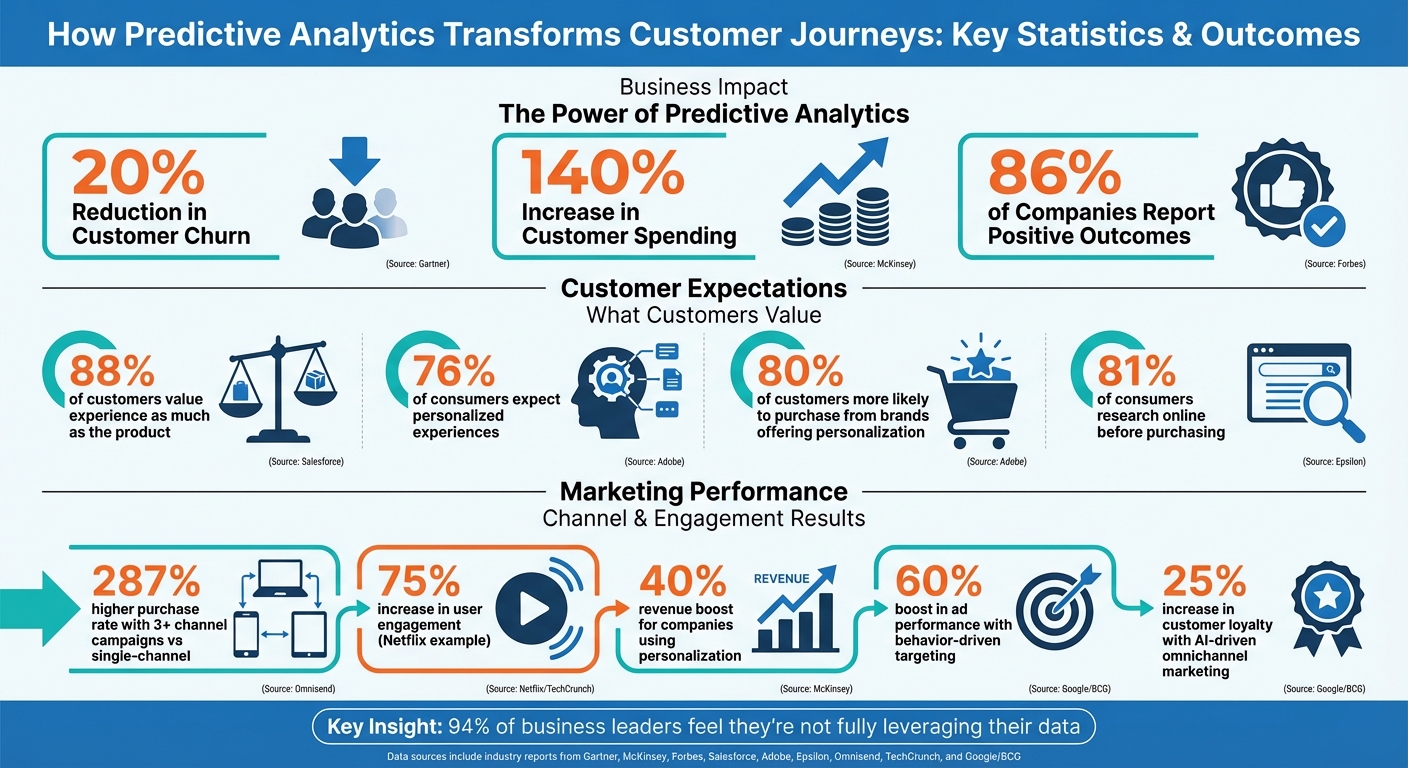
Predictive Analytics Impact on Customer Journey Performance: Key Statistics
Using Predictive Analytics to Improve the Customer Journey Course Preview
sbb-itb-058f46d
Building Customer Personas Using Predictive Data
Relying on assumptions to understand your audience often leads to a surface-level view that misses key details. Predictive analytics changes the game by using demographic, psychographic, and behavioural data to create personas based on actual customer actions. Instead of guessing, you can analyse browsing habits, engagement trends, and purchase patterns to predict behaviours. This approach provides real-time insights that pull together data from various sources to build more accurate customer profiles.
In the UAE, this process takes on additional layers of complexity due to the region's diversity. The market here is multilingual and multicultural, with many consumers switching between Arabic and English content. On top of that, mobile-first browsing dominates, making it critical to account for these preferences. For instance, a high-net-worth individual in Abu Dhabi may respond to entirely different messaging and channels compared to a digitally savvy shopper in Dubai.
Creating Personas from Data Sources
The foundation of creating reliable personas lies in combining information from various platforms into a unified system. A Customer Data Platform (CDP) is key here, as it gathers data from CRM tools, website analytics, email interactions, point-of-sale systems, and customer service logs. This results in a "Single Customer View" - a comprehensive profile that tracks every touchpoint across devices and channels.
But it’s not just about collecting contact details. Behavioural data, such as browsing habits, product usage, and purchase history, reveals what customers do. Psychographic insights, on the other hand, help explain why they do it. Social media activity and customer support interactions also provide valuable clues about preferences and sentiment. A great example of this approach is from P&O Cruises Australia. In 2017, they used this strategy to retarget website visitors with personalised ads based on their previous actions. By replacing generic banners with behaviour-driven ads, they saw a 60% boost in ad performance.
"The minute marketers start thinking all millennials are the same, they reject the behavioural and attitudinal nuances of a hugely heterogeneous population and collapse them into one big, generic mess." - Mark Ritson, Marketing Professor
Setting Journey Goals and Target Scenarios
Once personas are well-defined, the next step is to align them with specific journey goals. Since every customer takes a unique path, it’s essential to focus on scenarios that deliver the most impact. For example, targeting first-time buyers or customers at risk of churning within their first month can help prioritise your efforts. Each persona should be tied to measurable goals, whether that’s improving trial-to-paid conversion rates, increasing Net Promoter Scores (NPS), or reducing cart abandonment.
Machine learning can play a big role here by analysing historical CRM data to score prospects, making it easier to create highly targeted lists based on their likelihood to convert. This enables marketers to move away from broad campaigns and focus on precise actions. For instance, if a persona typically abandons their cart after viewing a few product pages, predictive analytics can trigger an instant discount offer or activate a chatbot to re-engage them.
Starting with high-volume, high-impact journeys - like checkout processes or onboarding flows - helps businesses gain quick wins and demonstrate value early on. Over time, they can expand into more intricate scenarios, fine-tuning their models as more data becomes available. The aim isn’t to map every possible customer journey but to focus on the ones that yield the highest conversions and align with broader business goals.
Gathering and Analyzing Data from Multiple Channels
Scattered data from disconnected systems can make understanding your customers a real challenge. Website analytics might show page views, CRM systems hold purchase histories, social media platforms capture engagement metrics, and mobile apps track in-app behaviour. However, without proper integration, all this data remains fragmented, offering only isolated glimpses of customer activity.
To overcome this, consider using a Customer Data Platform (CDP) or an advanced CRM system to bring all these touchpoints together in one place. These tools unify interactions across devices and channels by using consistent identifiers like email addresses, account IDs, or device IDs. Once integrated, predictive analytics powered by machine learning can step in to identify patterns, predict churn risks, and pinpoint where customers drop off. This approach not only delivers actionable insights but can also lead to impressive results - like reducing churn by 20% and boosting customer spending by up to 140%.
Data Sources and Predictive Insights
Different tools and platforms contribute unique insights to the broader picture:
- CRM Systems like Salesforce or Microsoft Dynamics store purchase history and demographic details, which help prioritise leads and predict churn.
- Web Analytics Tools such as Google Analytics track user behaviours like drop-off points and time spent on pages. These insights can trigger real-time actions, like displaying a pop-up offer when a customer hesitates at checkout.
- Customer Support Platforms like Zendesk analyse sentiment from customer interactions, allowing proactive responses to prevent frustration from escalating into churn.
- Social Listening Tools monitor brand mentions and sentiment across platforms, helping brands refine their campaigns based on real-time audience feedback.
Real-world examples illustrate the power of these tools. Netflix uses viewing histories across devices to refine recommendations, driving higher content consumption. FabIndia reduces cart abandonment by tracking users across platforms and sending reminders via email, WhatsApp, and push notifications. Similarly, a private bank in India uses over 200 event-based triggers to send personalised investment offers following high-value transactions, all in real time.
Adapting Data for UAE Market Conditions
In the UAE, applying predictive models requires some fine-tuning to align with the region’s unique customer behaviours and preferences. The UAE’s multilingual and multicultural population frequently switches between Arabic and English, and most users rely heavily on mobile devices for browsing. Analytics tools should be configured to accommodate these preferences and accurately track transactions in AED.
Local trends also play a big role. Shopping habits during holidays like Ramadan, engagement patterns that differ from Western markets, and the widespread use of WhatsApp for business communication are all critical factors to consider. For instance, campaigns using three or more channels see a 287% higher purchase rate compared to single-channel efforts - making cross-channel integration a must in the UAE’s retail landscape. By tailoring predictive analytics to these regional behaviours, businesses can map customer journeys more effectively and ensure their strategies resonate with local audiences.
The key takeaway? Your analytics system shouldn’t just collect data - it should interpret it with a deep understanding of UAE-specific customer dynamics. This is how you turn numbers into meaningful, actionable insights.
Mapping Journey Stages and Predicted Customer Actions
Once your data sources are unified, predictive analytics can help map out the actual paths customers follow - from their first interaction with your brand to becoming loyal advocates. This approach provides clarity on customer behaviour, helping refine strategies and build stronger connections.
Identifying Stages and Predicted Touchpoints
Predictive analytics doesn't just look at isolated metrics; it analyses the sequence and timing of interactions across various channels to identify key stages in the customer journey. While many businesses rely on traditional stages like Awareness, Consideration, Purchase, Retention, and Advocacy, today's customer journeys are far from linear. Customers often jump between stages, influenced by factors like social media, peer reviews, or online recommendations. For instance, 81% of consumers research online before making a purchase, sometimes bypassing the awareness stage entirely.
To effectively map these stages, start by listing every touchpoint where customers interact with your brand. This could include your website, mobile app, email campaigns, social media platforms, or customer service channels. These touchpoints should be integrated with a unified identifier to avoid data silos and track the complete journey. Machine learning can then analyse your CRM's historical data to pinpoint patterns - such as which customer paths lead to purchases and which lead to drop-offs. This analysis helps define the boundaries between journey stages based on real user behaviour, highlighting the "successful paths" that drive conversions and the "drop-off paths" where customers disengage. With this groundwork, predicting customer actions becomes much more precise.
Forecasting Customer Behaviours at Each Stage
Predictive analytics doesn't just map where customers are - it anticipates their next steps and even gauges their emotional state during the process. By examining historical data, machine learning can identify patterns and predict future behaviours with impressive accuracy. For example, Next Best Action (NBA) analysis uses past browsing and purchase habits to forecast what a customer is likely to do next. Meanwhile, sentiment analysis taps into tools like Natural Language Processing to interpret customer reviews and social media discussions, providing insights into how customers feel.
"Predictive analytics analyse historical and real-time data using AI and machine learning to forecast customer preferences. This enables businesses to design proactive and highly personalised experiences." - Ashvini SK, Senior Content Writer, Xerago
Real-time triggers also play a crucial role. For instance, if a customer spends an extended time on a product page, this signals intent, allowing you to respond with personalised offers or follow-ups to reduce friction and boost conversions. Similarly, if a user repeatedly visits help articles without finding a solution, you can activate a chatbot or connect them with a live agent to resolve issues before they escalate. This shift from reactive to proactive engagement is reshaping customer experiences. In fact, businesses leveraging predictive analytics in their customer journeys have seen churn rates drop by 20% and customer spending rise by up to 140%.
Finding Friction Points and Improvement Opportunities
After predicting customer actions, the next step is identifying where the journey breaks down. Predictive analytics goes beyond tracking page views or clicks - it analyses the sequence and timing of user actions to uncover exactly where customers deviate from successful paths. This method shifts decision-making from guesswork to actionable insights, which is crucial considering that 84% of marketers currently rely on assumptions due to underutilised data.
Detecting Where Customers Face Challenges
Today's friction detection tools are more advanced than ever, offering a range of solutions to identify problems quickly. Heatmaps, for instance, highlight drop-off points on websites, helping teams determine whether the issue is technical (like a broken form) or related to content (such as unconvincing copy). On the other hand, sentiment analysis uses Natural Language Processing to scan call centre logs and social media, identifying recurring complaints - even when customers express them differently. For example, if users linger on a product page for over 20 seconds without acting, it suggests hesitation. This can trigger immediate interventions like a pop-up discount or a live chat offer.
Another effective method is post-hoc analysis, which flags specific failure points in the customer experience, such as during checkout or a support interaction. AI and machine learning also play a role by detecting early signs of churn, such as reduced login activity, unusual navigation patterns, or unsubscribing from emails - all before the customer decides to leave. Once these friction points are identified, the focus should shift to resolving the most critical issues.
Focusing on High-Priority Improvements
It’s essential to prioritise key moments - like onboarding or checkout - where friction has the greatest impact on ROI. Instead of trying to optimise every step, focus on high-volume journeys. Tools like "what-if" modelling allow you to test potential changes, such as removing a step in the checkout process, and predict their impact on conversion rates before rolling them out.
Cross-channel friction is another challenge. For instance, customers abandoning a website to call customer service often indicates unresolved issues. Addressing these transitions can reduce service costs by 10% to 25% while improving efficiency. Combining operational data with experience metrics like CSAT and NPS ensures that insights are grounded in reality, eliminating bias and focusing efforts on real problems. This approach helps businesses maximise the return on their optimisation strategies while making meaningful improvements to the customer experience.
Applying AI-Driven Personalisation at Scale
AI is transforming how businesses deliver personalised experiences by addressing individual customer needs more effectively. By analysing massive datasets in real time, AI uncovers patterns that humans might miss, enabling brands to predict customer behaviours and tailor interactions accordingly. This approach isn't just about convenience - it's a game-changer. Studies show that 80% of customers are more likely to purchase from brands offering personalised experiences, and companies embracing this strategy see a 40% revenue boost compared to those that don't.
Using AI for Personalised Content
Personalisation powered by AI goes far beyond adding a customer's name to an email. Machine learning algorithms can dynamically adjust website banners, recommend products, and tailor email content based on browsing history and user intent. For example:
- Netflix uses AI to recommend shows based on viewing habits, which has driven a 75% increase in user engagement.
- Starbucks employs AI-driven omnichannel marketing to deliver personalised promotions across mobile and in-store platforms, boosting customer loyalty by 25%.
In the UAE, where bilingual navigation (Arabic/English) and high mobile usage are common, AI adapts to local preferences. Real-time, context-aware content delivery ensures users receive relevant information when and where they need it. Tools like predictive send-time optimisation ensure marketing emails land at the perfect moment, while dynamic content adjusts seamlessly across platforms like email, social media, and mobile apps.
Wick's Tailor & Automate solutions exemplify how businesses can integrate personalisation with existing data insights. By unifying customer data and deploying dynamic content across all touchpoints, brands can create consistent, adaptive experiences that cater to individual preferences.
Tracking Performance with KPIs
To measure the success of personalised strategies, tracking key performance indicators (KPIs) is essential. These metrics reveal how effectively AI-driven efforts are engaging and retaining customers:
| KPI Category | Metric | Purpose |
|---|---|---|
| Engagement | Conversion Rate Improvement | Measures how tailored content drives customer actions. |
| Loyalty | Customer Lifetime Value (CLV) | Tracks the long-term impact of personalised experiences. |
| Retention | Churn Reduction Rate | Evaluates the success of predictive efforts to retain customers. |
| Satisfaction | Net Promoter Score (NPS) | Gauges customer sentiment about personalised journeys. |
To refine these strategies, businesses should create feedback loops that allow AI systems to learn from customer interactions. Regular A/B testing of AI-generated content against control groups can validate what works best. While automation handles routine tasks, maintaining a human touch for complex or sensitive interactions ensures a balanced approach.
Measuring Results and Refining Your Approach
Once you've mapped out and optimised customer journeys, the next step is to measure results and fine-tune your approach. Predictive analytics only makes a difference when outcomes are tracked consistently, and strategies are adjusted based on actual data. Any gaps between predictions and real actions provide valuable insights. By maintaining a continuous feedback loop, you can refine your models and drive stronger, more sustainable outcomes. This process ensures that your efforts remain relevant and effective over time.
Monitoring Performance Against Predictions
The first step is to compare your predictive model's forecasts with actual customer behaviour. For instance, if your model predicts a 15% conversion rate but the actual result is 10%, it’s a clear signal to re-evaluate. Tools like customer journey analytics (CJA) allow you to monitor these gaps in real time, enabling quicker responses rather than waiting weeks to identify issues.
Key metrics like time to purchase can help you pinpoint where customers drop off, while tracking the churn rate can flag at-risk customers before they leave. Interestingly, 94% of business leaders feel they’re not fully leveraging their data - often because they fail to actively compare predictions with real-world outcomes.
To dig deeper into customer behaviour, use both explicit feedback (like NPS or CSAT surveys) and implicit feedback (such as browsing patterns or cart abandonment rates). For example, if your data shows high cart abandonment despite predicted smooth conversions, this indicates friction in the journey. Automated triggers can help address these issues immediately. Imagine a scenario where a customer spends over 20 seconds on a product page without adding the item to their cart - this could prompt a targeted offer to nudge them towards a purchase.
Wick's Four Pillar Framework is a great way to turn this type of monitoring into actionable insights, ensuring your data doesn’t just sit idle but drives meaningful change.
Refining Models for Continued Growth
The insights gained from monitoring performance should feed directly into refining your predictive models. These models aren’t static; they need to evolve as customer behaviours shift, market dynamics change, and new challenges emerge. Treat every campaign, A/B test, and customer interaction as an opportunity to improve accuracy.
Begin by focusing on high-impact areas like onboarding or checkout processes. Optimise these based on performance data, and then expand your efforts to other stages of the customer lifecycle. Tools like "what-if" scenario modelling can simulate potential changes before you implement them. For example, you could test whether shortening a form would lead to higher conversions. Once changes are made, validate their impact through A/B testing to confirm whether the adjustments align with your predictions.
The companies seeing the most success - 86% of those using predictive analytics report positive outcomes - treat their models as dynamic systems. They regularly integrate new data, update historical records from CRM systems, and ensure collaboration across departments like marketing, sales, and customer service. This cross-functional approach eliminates silos and ensures everyone operates with the same data-driven insights.
"Customer journey analytics isn't a one-time process - it's ongoing. The more businesses track customer journeys, the more they can improve experiences, boost retention, and drive higher revenue." - Ram Prabhakar, Head of Solutions and Content, Xerago
Keep an eye on KPIs such as conversion rates, churn, and engagement to evaluate how well your predictive touchpoints are performing. As your models become more refined, the rewards will follow. Companies that integrate predictive analytics into their customer journeys report a 20% reduction in churn and see customers spending up to 140% more when the experience meets their expectations.
Conclusion
Predictive analytics is reshaping how businesses connect with their customers by creating detailed personas, integrating multi-channel data, mapping customer journeys, and pinpointing areas of friction. The result? Real-time, tailored experiences that feel seamless and intuitive. Treating predictive analytics as a continuous process allows businesses to stay agile as customer preferences and market conditions evolve.
In the UAE, where a diverse, mobile-first population expects top-tier experiences, leveraging predictive analytics offers clear advantages. For instance, 88% of customers now value their experience with a company as much as its products. Companies using predictive analytics have reported 20% reductions in churn and seen customers spend up to 140% more when their needs are met. These outcomes translate directly into stronger customer loyalty, increased conversions, and smarter marketing investments.
To maximise these benefits, businesses need a unified strategy. Wick's Four Pillar Framework combines website development, SEO, content creation, data analytics, and AI-driven personalisation into one cohesive system. This eliminates silos and fragmented tools, creating a streamlined digital ecosystem that supports smarter decision-making at every customer interaction.
Today’s successful businesses don’t just react to customer behaviour - they anticipate it. By using predictive insights, they address needs before they’re even voiced, resolve issues as they arise, and refine strategies based on real-world performance. With 86% of companies adopting predictive analytics reporting positive outcomes, the shift to proactive, data-driven engagement is no longer optional.
Concentrate on key areas like onboarding and checkout, and use A/B testing and feedback loops to validate improvements. Partnering with the right experts ensures each step solidifies your foundation for long-term success in the UAE, paving the way for continuous growth and better customer experiences.
FAQs
How can predictive analytics help businesses retain customers?
Predictive analytics helps businesses keep their customers by spotting signs of potential churn before it happens. By studying customer behaviour, preferences, and how they interact with a brand, businesses can identify where customers might face difficulties or lose interest.
Armed with this information, companies can step in early to address problems, tailor their interactions, and provide timely solutions. This approach not only boosts customer satisfaction but also strengthens loyalty, creating a more stable and engaged customer base over time.
How does AI enhance personalised customer experiences?
AI has transformed how businesses deliver personalised customer experiences by analysing massive amounts of data in real-time. It picks up on customer behaviours, preferences, and trends, allowing companies to offer tailored recommendations, customised offers, and relevant content.
This approach to hyper-personalisation doesn’t just improve customer satisfaction - it builds deeper loyalty and engagement. With AI, businesses can predict what customers need and create smooth, impactful interactions at every stage of their journey.
How can businesses in the UAE use predictive analytics to meet local customer needs?
Businesses in the UAE can make the most of predictive analytics by aligning their strategies with the region's local customs and behaviours. For example, incorporating major events like Ramadan and UAE National Day into predictive models can offer valuable insights into seasonal trends and shifts in customer behaviour. Additionally, understanding the UAE's rich multicultural demographics allows businesses to segment audiences based on factors such as language, ethnicity, and regional habits, paving the way for more tailored marketing approaches.
Catering to regional preferences - like providing content in both Arabic and English - and studying engagement across multiple platforms can significantly enhance customer journey mapping. Leveraging local CRM data alongside real-time analytics enables businesses to deliver highly personalised experiences, meeting the expectations of UAE consumers who value seamless and culturally relevant interactions. By applying these strategies, companies can boost engagement and achieve stronger outcomes in this distinctive market.