
Blog / Predictive Analytics for Content Iteration
Predictive Analytics for Content Iteration
Predictive analytics helps UAE businesses fine-tune their content strategies by using data to forecast audience preferences and content performance. Instead of relying on trial and error, it leverages tools like regression models, decision trees, and neural networks to identify trends, optimize publishing schedules, and personalize content for diverse audiences.
Key insights include:
- 85% of customer conversion variations in the UAE are influenced by predictive analytics and AI.
- UAE companies using predictive SEO see measurable improvements in 6–12 weeks.
- Predictive models in the UAE achieve up to 75% accuracy, helping prioritize high-impact content.
By combining internal data (like page views and bounce rates) with external signals (like Google Trends and social media), businesses can predict content performance, minimize audience fatigue, and maximize ROI. Tools like Wick simplify implementation by automating data integration and model retraining, ensuring predictions stay accurate.
For UAE businesses, predictive analytics offers a way to stay ahead in competitive sectors like real estate, hospitality, and finance.
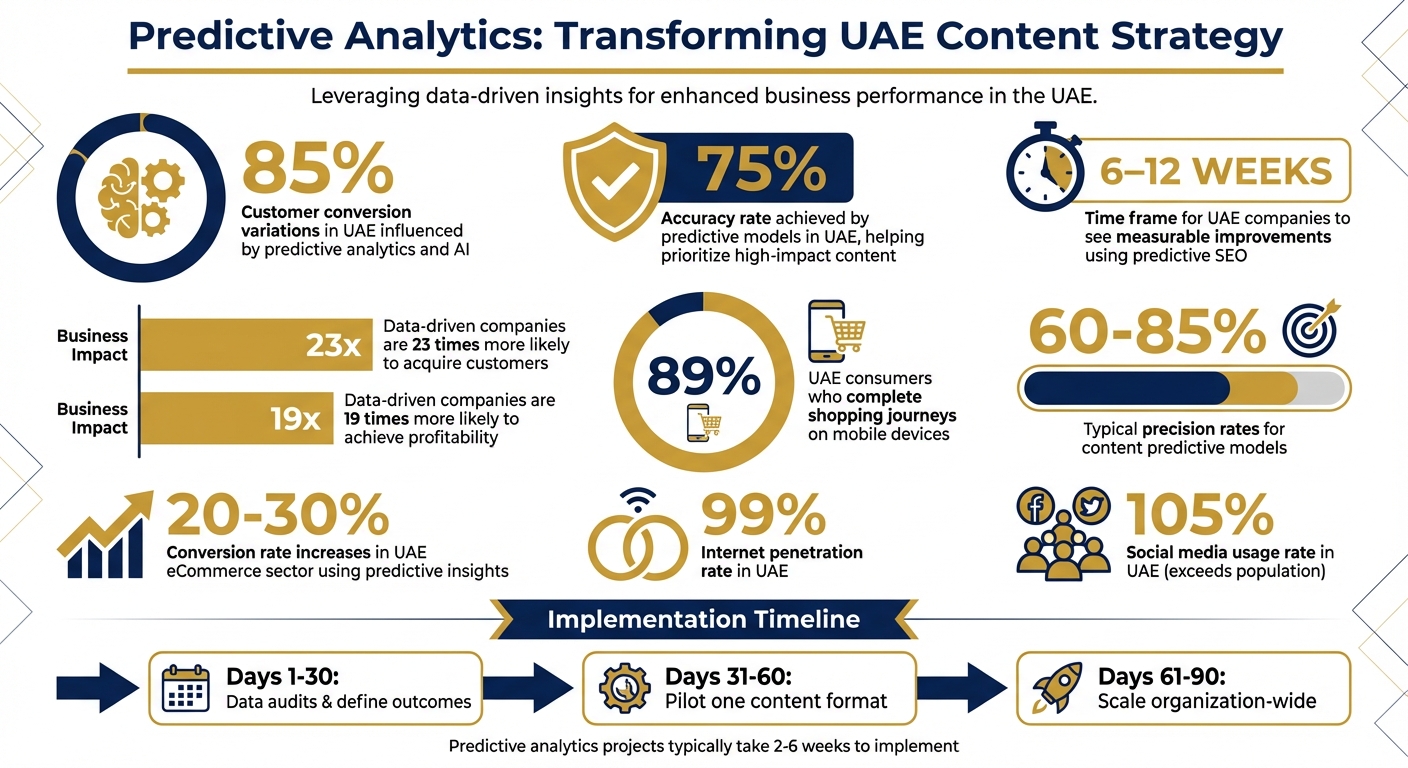
Predictive Analytics Impact on UAE Business Performance: Key Statistics
You Ask, I Answer: How to Decide What Content to Create?
sbb-itb-058f46d
Key Data Sources for Predictive Content Analytics
Creating reliable predictive models begins with assembling the right mix of data. For businesses in the UAE, combining internal metrics with external signals lays a strong foundation for these models. This blend of data is crucial for the predictive strategies discussed later.
Internal Data Sources
Internal platforms are a treasure trove for predictive analytics. First-party data from customer interactions is at the heart of privacy-conscious predictive modelling. This includes metrics like page views, conversion rates, bounce rates, and behavioural patterns such as clickstreams, navigation paths, and session recordings.
Classifying content by topics, keywords, and sentiment allows AI tools to identify what resonates with audiences. For example, monitoring which Arabic-language content performs better in Abu Dhabi compared to Dubai can guide future strategies tailored to regional tastes. Since 89% of UAE consumers complete their shopping journeys on mobile devices, mobile usage data becomes a critical element for accurate predictions.
Successful predictive systems often focus on three key metrics: "Top Content by Conversion Rate", "Trending Content" (highlighting sudden spikes in popularity), and "Suggested Content" derived from association rules algorithms. Combining qualitative behavioural insights - like time spent on a page and social engagement - with quantitative metrics such as sales data results in more robust predictive models.
External Data Sources
Internal data captures on-platform behaviour, but external sources reveal broader market trends. For instance, tools like Google Trends can help identify emerging topics before they peak. Analysing competitor content can uncover market gaps - areas where your audience is searching for information but not finding it adequately addressed.
Social media and forum discussions also provide early indicators of shifting audience interests. UAE businesses, in particular, benefit from monitoring conversations across multiple languages - English, Arabic, and Hindi - to fully understand audience sentiment.
"Hyper-personalisation - which uses artificial intelligence (AI) and real-time data to deliver curated content to people - is still considered an emerging technology in the Middle East and North Africa."
- Hanibal Ahwash, Industry Manager Google, Middle East and North Africa
This trend underscores the importance of integrating external data to meet evolving audience expectations.
Integrating Data for Actionable Insights
Bringing together diverse data sources is the key to generating actionable insights. Customer Data Platforms (CDPs) play a vital role by consolidating online and offline first-party data, offering a unified perspective essential for comprehensive predictive models. This centralisation helps standardise data across marketing and IT teams, fostering a seamless, experience-driven approach to content creation.
The integration process involves merging internal behavioural data - like scroll depth, click patterns, and session recordings - with external signals such as search trends and social media activity. Predictive models, including regression analysis, decision trees, and neural networks, then process these datasets to forecast future content needs and audience reactions even before publication. For businesses in the UAE, which cater to multicultural audiences, this approach enables sentiment analysis across diverse demographic groups, ensuring that tone and messaging align with local values.
Data-driven companies are 23 times more likely to acquire customers and 19 times more likely to achieve profitability. In the UAE’s competitive digital market, integrating data effectively turns raw information into a powerful strategic tool.
Predictive Models and Techniques for Content Iteration
Common Predictive Models in Content Analytics
Predictive models play a key role in understanding and improving content performance. Regression models like Linear and Logistic Regression help forecast continuous variables, such as revenue or traffic, and binary outcomes, such as engagement or churn rates. Meanwhile, classification models - including Decision Trees, Random Forests, and XGBoost - are ideal for categorising outputs, such as predicting whether content will lead to conversions.
Time-series models, such as ARIMA, SARIMA, and Prophet, are particularly effective for analysing sequential data. These models are great for forecasting traffic patterns over weeks or months and are especially useful for UAE businesses managing seasonal trends like Ramadan or summer slowdowns. On the other hand, clustering techniques, like K-Means, help group audiences based on shared behaviours, enabling personalised content recommendations without needing predefined labels. For more complex datasets, neural networks excel at identifying non-linear patterns, making them valuable for sentiment analysis across both Arabic and English content.
Preparing data for these models is a time-intensive process, often taking up 80% of the overall modelling effort. Clean and well-structured data is essential. Additionally, retraining models becomes necessary when performance drifts by more than 10% or after significant search engine algorithm updates.
Fine-tuning these models requires strong feature engineering, which we’ll delve into next.
Feature Engineering for Better Predictions
Turning raw data into meaningful variables can significantly enhance model accuracy. Key behavioural signals - such as average time on page, scroll depth, and bounce rates - help differentiate genuine engagement from superficial activity. Adding sentiment scores, readability metrics, and user intent insights ensures predictions align with the preferences of UAE audiences.
Temporal features are another critical component. By detrending seasonal spikes and calculating baseline interest levels, you can prevent recurring patterns from distorting long-term forecasts. Transforming timestamps into actionable variables, like "peak engagement times", or factoring in click-through rates from search results, creates more reliable predictive inputs. External factors, including social media trends, competitor activity, and search engine result page (SERP) volatility, can further enhance accuracy.
"Predictive scoring turns content into a prioritised portfolio, not a hope-driven pipeline." - Scaleblogger
To ensure data stability, techniques like normalisation (z-score or min-max scaling) and addressing missing values are essential. Combining sentiment analysis from user comments with metrics like reading time offers deeper insights into how well content resonates with the audience.
Wick's Role in Predictive Modelling

Wick builds on these predictive modelling practices, seamlessly integrating insights into marketing workflows.
Through its Capture & Store pillar, Wick organises, filters, and normalises raw data from sources like GA4, Search Console, and CRM systems. This process centralises and aligns diverse datasets, making them ready for precise modelling.
The Tailor & Automate pillar takes it a step further by embedding predictive insights directly into existing tools - whether dashboards, CRM systems, or content management platforms. This allows teams to act on forecasts instantly. Wick also automates the retraining of models when performance drops or data drifts, ensuring predictions remain accurate as conditions evolve. Models can even be tailored to specific brand voices, languages, and industry terms, ensuring relevance for UAE-focused audiences.
Predictive analytics projects with Wick typically take 2–6 weeks to implement, depending on data availability and complexity. Once deployed, these models often achieve precision rates between 60% and 85%. By turning predictive modelling into a continuous, integrated process, Wick helps businesses optimise their content strategies in response to ever-changing data patterns.
Implementing Predictive Analytics for Content Iteration
Defining Goals and Objectives
Before diving into predictive analytics, it's essential to clarify what you're trying to achieve. Are you aiming to predict which content topics will boost conversions, determine the best publishing times for Ramadan campaigns, or figure out when older articles need updates? Each goal requires a unique approach and specific data inputs.
Choose measurable KPIs that align with your objectives. For instance, use sessions to track traffic, click-through rates to gauge search relevance, average time on page for engagement, and conversion rates to measure revenue impact. Define actionable outputs, such as ranked topic lists, ROI predictions for republishing older content, or optimal publishing schedules based on audience behaviour. To keep your strategy aligned with business priorities, assign a strategic value score (1–5) to each content idea, ensuring the focus goes beyond just traffic numbers.
Set clear rules for decision-making. For example:
- Publish new content if the predictive score is 70 or higher.
- Refresh existing pieces for scores between 50–69.
- Archive content scoring below 50.
Start small with a pilot test. Select five topics, score them, and track their outcomes over 6–12 weeks to evaluate the model's effectiveness.
Building and Evaluating Predictive Models
Once your goals are clear, it’s time to choose the right predictive models for your content strategy. Regression models are great for forecasting traffic or revenue, classification models can predict binary outcomes like conversions, and time-series models like ARIMA or Prophet are ideal for capturing seasonal trends, especially relevant in the UAE market.
Expect to spend the majority of your time - up to 80% - on data preparation. This involves cleaning datasets, normalising values (using z-score or min-max scaling), and addressing any missing data before training your model. Use historical data to backtest the model by simulating past editorial decisions and comparing predicted outcomes with actual results. This helps you calculate metrics like precision and recall. Evaluate your model's performance using metrics such as mean absolute error (MAE), precision-recall, and ROI lift. Generally, content predictive models achieve precision rates between 60% and 85%, depending on the complexity of the signals.
Establish a post-mortem routine after each content sprint. Feed actual performance data back into the model to refine future predictions. Keep an eye out for model drift - if the error rate between predicted and actual traffic exceeds 10%, or if your training data is older than 6–12 months, it’s time to retrain the model. Major search engine algorithm updates also warrant retraining. Always maintain a human-in-the-loop approach, treating model outputs as recommendations rather than absolute directives, particularly for high-stakes decisions.
For beginners, start with something simple. Use tools like Excel or Google Sheets (costing around AED 22–44/month) to track a single KPI, such as monthly revenue or customer churn. As your needs grow, consider more advanced tools like Power BI (approximately AED 37/user/month) or scalable platforms like Vertex AI.
Deploying and Monitoring Predictive Systems
Once your models are refined, integrate them into your daily workflow to ensure consistent performance. For instance, connect your predictive system to your CMS or project management tools so that high-scoring topics automatically generate AI-driven outlines and assign tasks to writers.
Roll out the system in phases over 90 days:
- Days 1–30: Conduct data audits and define business outcomes.
- Days 31–60: Pilot one content format with a small team.
- Days 61–90: Scale to the entire organisation, automated marketing solutions and training teams.
Create feedback loops by incorporating performance data after each content sprint. This ongoing refinement boosts prediction accuracy over time. Use holdout groups - exclude 5% of your audience from AI-personalised content - to measure engagement and validate the system’s impact. Every AI-assisted piece should undergo quality checks to ensure factual accuracy, brand consistency, and sensitivity to cultural nuances - especially important for UAE businesses catering to both Arabic and English-speaking audiences.
Keep an eye on performance metrics. If errors between predicted and actual results exceed 10%, retrain the model as needed. Adhere to UAE data privacy regulations by maintaining data inventories, anonymising personally identifiable information (PII), and applying k-anonymity techniques. Retain raw data for 90 days and aggregated signals for up to two years to balance insights with privacy compliance.
Applications of Predictive Analytics in Marketing
By leveraging predictive models and advanced feature engineering, businesses can turn data-driven insights into impactful marketing strategies.
Predicting Content Virality
Predictive analytics can forecast which content is likely to go viral by analysing factors like topic originality, creative formats, timing, and network effects. AI tools, particularly those using Natural Language Processing (NLP), can identify emotional triggers such as joy, surprise, or outrage - emotions that often drive higher engagement and sharing. For businesses in the UAE, this means focusing on geo-specific trends and monitoring local search and social media activity to catch emerging topics before they peak.
These AI models achieve prediction accuracy rates of up to 85%, with performance forecasting reaching around 82%. They also reduce the time spent on manual content analysis by as much as 90%, freeing marketers to focus on creative tasks. Key metrics like hook strength, share velocity, and consistent watch-time are critical. Synthetic audiences - virtual user groups designed to mimic real audiences - allow brands to test content before it goes live. For UAE companies, especially those catering to both Arabic and English-speaking audiences, this method ensures content resonates locally and avoids missteps. Testing AI-suggested changes, such as adjusting hooks or calls-to-action, over a short 7–10 day period can further validate predictions and optimise cultural fit.
Personalising Content Recommendations
Predictive analytics also powers conversion propensity modelling, helping identify which UAE consumers are most likely to convert based on their behaviours, preferences, and engagement patterns. In a market where over 60% of consumers prefer WhatsApp for customer support, integrating tools like the WhatsApp Business API with predictive systems can significantly enhance personalised communication.
The UAE’s unique demographic landscape requires models that can handle bilingual voice searches (mixing Arabic and English) and hyperlocal targeting for areas like Jumeirah or Downtown Dubai. With internet penetration at 99% and social media usage surpassing 105%, businesses have access to a wealth of data. Predictive insights have already driven conversion rate increases of 20–30% in the UAE’s eCommerce sector. Companies should also focus on collecting first-party data in compliance with the UAE’s Personal Data Protection Law (PDPL) and use bilingual schema markup to address common queries effectively. This approach not only enhances customer engagement but also ensures precise ROI tracking, allowing businesses to measure the impact of every dirham spent.
Forecasting ROI for Marketing Campaigns
Predictive analytics can estimate ROI by separating "base sales" (those driven by brand loyalty and seasonal trends) from "incremental sales" directly influenced by marketing efforts. Techniques like Marketing Mix Modelling (MMM) measure the contribution of different marketing activities, while Bayesian modelling combines historical data with business insights for accurate forecasting. This is especially valuable for UAE businesses during high-spend periods like Ramadan or the Dubai Shopping Festival.
For example, Twinings partnered with Keen in 2025–2026 to create a Bayesian-based model that evaluated the financial impact of their digital, online, and trade channels. The result? A 16.5% boost in sales volume, a 28% revenue increase, and AED 15 million unlocked for additional marketing investments. Similarly, McDonald's Hong Kong used Google Analytics 4's predictive audiences to identify users "likely to purchase soon", achieving a 550% increase in app orders and a 63% reduction in cost per acquisition.
Businesses that optimise their marketing strategies across all channels using predictive analytics can experience a 15–20% improvement in ROI. The key is distinguishing between average and marginal ROI to avoid overinvesting in channels with diminishing returns. Consolidating data from CRMs, financial systems, and media platforms into a unified dataset, then testing models against past results - such as last year’s Ramadan campaign - ensures better planning for future campaigns.
Continuous Monitoring and Iteration for Long-Term Success
Predictive models don’t stay effective forever. Over time, they can lose accuracy due to changes in input data - a phenomenon known as data drift. For example, new consumer slang or seasonal search trends like those during Ramadan can alter the data landscape. Concept drift can also occur, requiring adjustments to the model’s prediction strategies. A model that starts with 80% accuracy might drop to 70% as market conditions evolve, which highlights the importance of regular performance tracking for businesses in the UAE.
Tracking Model Performance
To monitor performance effectively, you need a solid baseline - typically the first month after the model’s launch - and compare ongoing data against it. This involves tracking multiple layers of data, such as:
- Data quality metrics: Monitoring null values and type mismatches.
- Prediction drift: Keeping an eye on changes in the model’s outputs.
- Feature importance: Checking whether key features are shifting in relevance.
For precision, tools like Azure Machine Learning can measure these metrics with up to 0.00001 accuracy. Using rolling lookback windows - such as comparing a 7-day production window to a 24-day reference period - helps identify meaningful changes early on. In industries like retail and hospitality, it’s smart to plan seasonal updates ahead of events like the Dubai Shopping Festival or peak summer tourism. Automated alerts, set up through platforms like Azure Event Grid or Grafana, can notify teams when metrics like Jensen-Shannon Distance exceed set thresholds, ensuring timely action.
"When a model becomes stale, its performance can degrade to the point that it fails to add business value or starts to cause serious compliance problems in highly regulated environments."
– Microsoft Azure
Automating Retraining and Updates
When performance issues arise, retraining the model quickly is crucial. Manual updates often can’t keep up with fast-changing environments. Trigger-based retraining - initiated when accuracy drops below a certain level or when significant feature shifts are detected - outperforms fixed schedules. Tools like Apache Airflow or Prefect can automate workflows, handling everything from data collection to retraining and deployment without requiring human intervention.
Instead of sticking to a fixed retraining cycle, adjust training windows based on current performance metrics. For fast-changing areas like pricing or compliance, a refresh every 3–6 months may be necessary, while more stable topics might only need updates every 6–12 months. Connecting analytics platforms to project management tools via APIs can automate the creation of refresh tickets when performance drops, streamlining the process for your team.
"To address these challenges and to maintain your model's accuracy in production, you need to do the following: Actively monitor the quality of your model in production […] and frequently retrain your production models."
Scaling Predictive Analytics with Wick
To maintain long-term success, scaling your predictive analytics framework is just as important as retraining models. For medium to large businesses in the UAE, this means consolidating data from multiple sources - like CRMs, web analytics, and social media feeds - into a unified infrastructure. Wick’s integrated system simplifies this process, ensuring smooth model updates and efficient data management.
Wick’s Enterprise solutions offer a structured approach through its Four Pillar framework, combining data analytics with AI-driven personalisation. Key features include credential-less authentication and managed virtual network isolation, which enhance both security and scalability.
The Capture & Store pillar focuses on continuous data collection and mapping customer journeys, while the Tailor & Automate pillar supports marketing automation and real-time model adjustments. This setup allows businesses to deploy self-healing AI systems that automatically detect issues, refresh data, and schedule retraining as necessary. With 81% of B2B marketers now using AI for content creation - up from 72% in 2024 - a scalable, automated system is essential for staying competitive in the UAE’s fast-paced digital economy. Wick’s approach ensures businesses can consistently harness data insights to stay ahead in the market.
Conclusion: The Potential of Predictive Analytics
Predictive analytics offers UAE businesses the ability to anticipate future audience trends and make informed decisions. This forward-thinking approach sets apart companies that not only gather data but also transform it into actionable strategies. With studies indicating that 80% of customers are more inclined to buy from brands offering personalised experiences, and 88% of marketers reporting enhanced cross-channel personalisation through AI, the case for adopting predictive analytics is clear.
Key Takeaways
For predictive analytics to succeed, clean and unified data is essential. Without proper integration across systems like CRM, web analytics, and social platforms, even advanced models can fall short. Focus on high-impact applications such as churn prediction, lead scoring, or optimising content topics to demonstrate quick wins. Additionally, forming cross-functional teams that combine expertise from marketing, data science, and IT ensures that insights are both strategically valuable and technically viable.
Regular monitoring is also crucial to maintain the effectiveness of predictive models. These systems need periodic recalibration to adapt to changing conditions, with feedback loops in place to compare predictions against actual outcomes. For industries like retail and hospitality in the UAE, updating models around key events such as Ramadan or the Dubai Shopping Festival can yield significant benefits.
The UAE National AI Strategy 2031 aims to grow AI’s contribution to the national GDP from 9% to 45%, potentially adding AED 335 billion in value by 2031. Aligning predictive analytics initiatives with this national vision can position businesses as leaders in the region’s digital transformation.
By leveraging these insights, UAE businesses can take meaningful steps to integrate predictive analytics into their operations.
Next Steps for UAE Businesses
As the digital environment continues to evolve, aligning content strategies with predictive insights can secure a lasting competitive edge. Start by auditing your current data sources to ensure they are clean and unified - accurate predictions rely on high-quality data. Pinpoint specific challenges, such as reducing customer churn, optimising marketing budgets, or identifying content gaps, where predictive analytics can deliver tangible results.
Wick’s integrated approach exemplifies how predictive analytics can streamline processes. Their Four Pillar Framework provides a clear roadmap for implementation. The Capture & Store pillar enables continuous data collection and customer journey mapping, while Tailor & Automate focuses on real-time model adjustments and marketing automation. By consolidating data, deploying predictive models, and automating retraining, this framework paves the way for intelligent and personalised content strategies. The future of content iteration in the UAE is already here - smarter, more tailored, and driven by predictive insights.
FAQs
How can predictive analytics enhance content performance in the UAE?
Predictive analytics plays a key role in helping businesses across the UAE enhance their content performance. By tapping into historical and real-time data, companies can anticipate trends, fine-tune strategies, and tailor content to suit the preferences of a diverse audience. For instance, analysing patterns during significant periods like Ramadan or UAE National Day allows brands to align their messaging with local customs and events.
This data-driven approach also supports personalised marketing, which is highly appreciated by UAE consumers. With AI-driven insights, businesses can design content that speaks directly to specific audience segments, taking into account factors like language, demographics, and behaviour. Predictive models further aid in shaping SEO strategies by identifying search trends in advance, enabling brands to focus on the right keywords early and stay ahead of the competition.
By leveraging predictive analytics, businesses in the UAE gain the tools to make smarter decisions, foster better engagement, and drive consistent growth.
What key data is needed to create effective predictive models?
To create effective predictive models, you’ll need a combination of historical data, real-time data, and insights into key patterns like customer behaviour, search trends, engagement metrics, and content performance. These elements work together to uncover correlations and improve the accuracy of future predictions.
When businesses analyse these inputs, they gain the ability to make smarter decisions, fine-tune content strategies, and anticipate what their audience wants - ultimately driving better outcomes.
How can businesses in the UAE use predictive analytics to enhance their content strategies?
Businesses in the UAE can tap into predictive analytics to sharpen their content strategies, using data-driven insights to anticipate trends, understand customer preferences, and gauge content performance. This approach helps companies craft content that resonates deeply, especially during key moments like Ramadan or National Day, fostering stronger connections with their audience.
By diving into historical and real-time data, businesses can predict demand, tailor customer interactions, and fine-tune their campaigns. Advanced tools like AI and machine learning models make it possible to spot emerging trends early, allowing for proactive content creation. Starting with clean, well-organised data and employing techniques like regression or time series analysis can take content strategies to the next level, ensuring businesses remain competitive in the UAE's ever-evolving market.