

Blog / Personalized AI Chatbots for GCC Businesses: A Guide

Wick
December 28, 2025Personalized AI Chatbots for GCC Businesses: A Guide
AI chatbots are transforming customer experiences in the GCC region. With smartphone penetration exceeding 98% in the UAE and 34% of residents using ChatGPT daily as of 2024, the demand for fast, localized, and bilingual digital interactions has surged. Businesses across retail, banking, and government services are adopting AI chatbots to meet these expectations.
Key highlights:
- Market Growth: GCC chatbot market to grow from USD 134.2M (2024) to USD 651.8M by 2033.
- Customer Preferences: 75% of GCC consumers prefer Arabic-language platforms; WhatsApp dominates with 98% open rates.
- Performance Benchmarks: Retail chatbots target response times ≤ 0.8 seconds and 85%+ deflection rates.
To succeed, chatbots must support Arabic dialects, follow local data laws, and respect cultural norms like Ramadan timings. This guide dives into how GCC businesses can implement AI chatbots effectively, ensuring compliance and exceptional customer satisfaction.
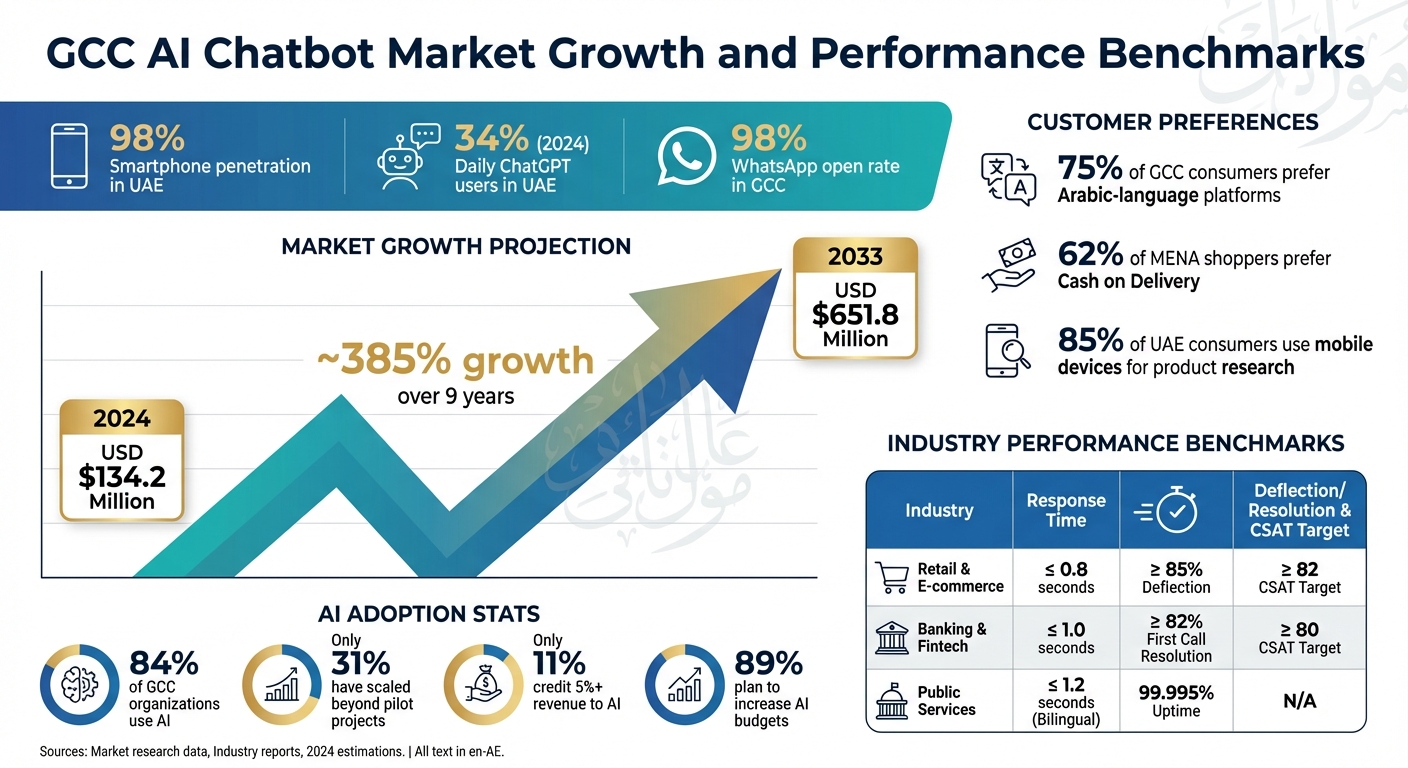
GCC AI Chatbot Market Growth and Performance Benchmarks 2024-2033
Go Global: Enhance Customer Service with Multilingual AI Chatbots
What GCC Customers Expect from Personalized Chatbots
As digital trends evolve in the GCC, customers increasingly demand chatbots that provide tailored and culturally relevant experiences. They look for interactions that grasp the nuances of their language and respect their cultural context. Let’s delve into how these expectations translate into language support, cultural sensitivity, and personalised timing.
Supporting Multiple Languages
To meet the diverse linguistic needs of the GCC, chatbots must go beyond Modern Standard Arabic and handle regional Arabic dialects like Emirati, Levantine, and Egyptian. These dialects include unique phrases and colloquialisms that make conversations feel more natural and relatable.
Arabic NLP (Natural Language Processing) plays a critical role here, requiring the ability to handle right-to-left text, understand contextual meanings, and adapt to the subtleties of different dialects. Additionally, supporting languages like Urdu and Tagalog can enhance engagement with the region’s large expatriate communities. Training chatbots on localised data ensures they can capture and reflect these linguistic nuances effectively.
Respecting Cultural Norms and Local Schedules
Cultural alignment is just as important as language capabilities. Chatbots in the GCC must be attuned to local service patterns, such as the region’s weekend peak on Friday and Saturday, which differs from the traditional Western weekend. Systems should be optimised to handle these peak periods and adapt to local events.
Interactions must also reflect local customs, including culturally appropriate greetings and sensitivity to societal norms. This is especially critical in sectors like banking, where trust is a cornerstone. Monitoring customer sentiment during key points in a conversation can help identify issues related to cultural or linguistic missteps. To maintain reliability, failover systems within the UAE should ensure 99.995% uptime during high-demand periods.
How to Personalise Content, Tone, and Timing
Personalisation in the GCC requires fine-tuning across various aspects. For instance, in e-commerce, chatbots need to maintain a response time of under 0.8 seconds to keep interactions seamless. In banking and fintech, response times should stay below 1.0 second, while public services should aim for 1.2 seconds for bilingual interactions.
Chatbots must also deliver ChatGPT-like fluency and contextual awareness on popular platforms like WhatsApp Business. Leveraging real-time data and first-party signals allows businesses to engage customers when they’re most likely to respond. In sectors like retail and travel, achieving a deflection rate of over 70% is crucial, with top performers often targeting rates above 85%, to meet the region’s demand for 24/7 self-service.
| Industry Sector | Response Time Target | Deflection/Resolution Target | CSAT Target |
|---|---|---|---|
| Retail & E-commerce | ≤ 0.8 seconds | ≥ 85% Deflection Rate | ≥ 82 |
| Banking & Fintech | ≤ 1.0 seconds | ≥ 82% First Call Resolution | ≥ 80 |
| Public Services | ≤ 1.2 seconds (Bilingual) | 99.995% Uptime | N/A |
Data Source: WDCS Technology 2025 Performance Guide
These benchmarks serve as a roadmap for designing chatbots that meet the unique demands of GCC industries.
Core Components of a Personalised AI Chatbot
Creating personalised AI chatbots for the GCC involves three essential elements that ensure both cultural relevance and technical efficiency.
Customer Data and Profile Management
Using first-party data allows chatbots to personalise interactions in real time. By integrating systems like CRM or ERP, chatbots can access customer histories and preferences, including language and dialect. For high-security industries such as banking or government services, linking with local identity systems like Emirates ID or UAE Pass ensures secure and highly tailored service delivery.
Behavioural signals, such as session context, click patterns, drop-off points, and frequently asked questions, provide deeper insights into user preferences. Collecting linguistic preferences - whether Arabic, English, or specific dialects like Emirati, Levantine, or Egyptian - ensures the chatbot communicates effectively. Sentiment analysis at key points in conversations can further refine the tone and flow of interactions. Unified analytics, which consolidate conversation transcripts, user events, and system logs, allow for cross-metric evaluations and ongoing improvements.
This robust customer profiling sets the stage for the next essential component: precise natural language processing.
Natural Language Processing for Arabic and English
Building effective Arabic NLP systems presents unique challenges, from handling right-to-left text to accurately interpreting contextual meanings. Training models on real customer data helps capture local linguistic nuances.
Fine-tuning natural language understanding (NLU) models with local expressions can improve intent accuracy from 85% to over 90%. Tools like Dialogflow or ChatGPT APIs support both English and Arabic, simplifying integration. However, the true edge lies in bilingual fluency - the ability to switch seamlessly between languages based on user input while maintaining a consistent and professional tone.
Once this linguistic intelligence is in place, the next step is connecting chatbots to the platforms most popular in the GCC.
Connecting Chatbots to GCC-Preferred Channels
In the GCC, WhatsApp is the dominant communication channel, boasting an impressive 98% instant open rate. To integrate effectively, businesses must use officially supported APIs to ensure security and reliability while accessing interactive media features. Beyond WhatsApp, maintaining an omnichannel presence across web widgets, SMS, email, and social media platforms (like Messenger) ensures broader customer reach.
For a truly seamless experience, chatbots should connect directly to backend systems such as inventory, booking, or banking platforms, while also syncing with CRM tools for context-rich interactions. Using official APIs, particularly for WhatsApp, and implementing failover systems that comply with local data laws are critical. Additionally, enabling smooth human handovers is essential - when a conversation escalates, the chatbot should automatically transfer the full transcript to the agent’s CRM interface to preserve context and build trust.
| Channel | Key Metric | Integration Priority |
|---|---|---|
| 98% Open Rate | Official Business API; CRM sync | |
| Web/Mobile App | 98%+ Smartphone Use | JavaScript widgets; API-enabled middleware |
| Local Authentication | Essential for Gov/Finance | Emirates ID; UAE Pass integration |
Industry-Specific Chatbot Applications in the GCC
AI-powered chatbots are making waves across the GCC's key industries, offering tailored solutions that align with local needs and expectations. Each sector has its own customer demands and regulatory frameworks that shape how these tools are utilised. Let’s dive into how chatbots are transforming some of the region’s most prominent industries.
Retail and E-Commerce
In the retail and e-commerce space, chatbots are proving to be game-changers. They provide personalised product suggestions, which have been shown to boost revenue by 25%. This resonates strongly with UAE consumers, 85% of whom use mobile devices to research products.
Given the popularity of Cash on Delivery - preferred by 62% of MENA shoppers - chatbots are also streamlining processes like order confirmations and delivery coordination. Retail leads the way in AI adoption, with 75% of companies in the sector using AI in at least one area of their operations. These tools not only enhance efficiency but also align perfectly with the shopping habits and preferences of the region.
Banking and Financial Services
Major players like Emirates NBD and ADCB are already leveraging chatbots for tasks such as account enquiries and personalised product recommendations. These tools also excel in fraud detection while ensuring compliance with the region’s stringent regulations.
AI is forecasted to contribute around AED 136 billion to the UAE’s financial services sector by 2035. However, implementing these solutions requires careful attention to data residency laws, as many GCC countries mandate that financial and personal data remain stored locally rather than on international cloud platforms. A great example of AI’s potential in fraud prevention comes from Careem, which used AI to detect and block 35,000 fraudulent users across its payment and delivery services. In this high-trust sector, chatbots are delivering personalised, secure, and culturally aware interactions.
| Industry | Response Time Target | Key Performance Metric |
|---|---|---|
| Retail & E-commerce | ≤ 0.8 seconds | Deflection Rate ≥ 85% |
| Banking & Fintech | ≤ 1.0 second | Compliance Accuracy ≥ 95% |
Travel and Hospitality
The travel and hospitality industry is another area where chatbots are making a significant impact. AI-powered tools like itinerary builders and 24/7 multilingual support are enhancing guest experiences. These chatbots are also helping manage loyalty programmes and address regional needs, such as halal-friendly options and family-focused travel packages.
One standout example is the Dubai Electricity and Water Authority’s virtual assistant, "Rammas." Since its launch in 2017, Rammas has handled over 6.8 million customer enquiries. This kind of consistent, round-the-clock service not only builds trust but also reduces operational costs, making it a valuable asset in a sector where customer engagement is crucial. Personalised chatbots are clearly meeting the region’s demand for culturally aware and always-available support.
Step-by-Step Implementation Guide for GCC Businesses
Introducing a personalised AI chatbot isn’t a quick fix - it’s a process that requires thoughtful planning to meet both customer expectations and business goals. Here’s how businesses in the GCC region can approach it effectively.
Setting Clear Goals and Prioritising Use Cases
Start by defining specific objectives. Are you aiming to speed up FAQ responses, simplify booking processes, or boost lead generation? Align these goals with your broader business strategy to secure buy-in from senior leadership.
After setting your goals, focus on use cases that can deliver quick wins. For instance, reducing call centre traffic during Ramadan or automating Cash on Delivery confirmations are practical examples that can show early returns on investment. By focusing on high-impact scenarios first, you create a roadmap that delivers measurable results.
Once your priorities are clear, the next step is to design conversation flows that resonate with your audience’s language and cultural nuances.
Creating Conversation Flows for GCC Audiences
When designing conversation flows, think from the customer’s perspective. Use first-party data to create detailed personas. For example, consider an Emirati professional checking their account balance late at night or a Saudi family planning a holiday during school breaks. Adjust the chatbot’s tone to fit the context: formal and precise for banking, but warm and engaging for lifestyle brands.
Ensure your Natural Language Understanding (NLU) models are equipped to handle Gulf Arabic dialects along with Modern Standard Arabic. Strive for intent recognition accuracy of over 90% across these variations. Additionally, allow for seamless language switching between Arabic and English, and even support "Arabizi" (Arabic written with Latin characters and numbers). Always include a human escalation path, complete with automatic transcript handovers to the agent’s CRM system.
With these tailored flows in place, you’re ready to move on to testing and refining your chatbot.
Testing, Launching, and Improving Performance
Once your goals and conversation flows are established, rigorous testing becomes the next priority. Start with a soft launch targeting a smaller group, such as loyalty programme members or a specific region. Use A/B testing to evaluate different response styles - short and direct answers versus more detailed ones. For retail, concise replies often lead to higher conversions, though they might slightly impact customer satisfaction scores.
Track key performance indicators (KPIs) closely. For example, aim for response times of less than 0.8 seconds in retail and under 1 second in banking. Look for a deflection rate of at least 85% in retail and a customer satisfaction (CSAT) score of 82 or higher in fintech.
Post-launch, optimisation should be an ongoing effort. Use synthetic monitoring from local data centres to catch network delays before they affect users, especially during peak times like Friday–Saturday weekends. Keep an eye on dialogue nodes to spot spikes in negative sentiment, which could indicate cultural or contextual missteps. Additionally, set up quarterly benchmarks using regional data to fine-tune your chatbot for events like the Dubai Shopping Festival.
| Performance Metric | UAE Benchmark | Target Goal |
|---|---|---|
| Response Time (Retail) | ≤ 0.8 seconds | < 800ms |
| Response Time (Banking) | ≤ 1.0 second | < 1 second |
| Deflection Rate (Retail) | ≥ 70% | ≥ 85% |
| CSAT Score (Fintech) | 78–80 | ≥ 82 |
| Arabic Intent Accuracy | > 90% | 95% across dialects |
By following these steps, GCC businesses can create chatbots that not only meet technical benchmarks but also resonate with the region’s unique customer needs and preferences.
How Wick Helps GCC Businesses Deploy Personalised AI Chatbots
Rolling out a personalised AI chatbot tailored specifically for GCC markets goes beyond just implementing advanced technology - it requires a well-thought-out strategy that blends customer insights, data, and targeted outreach. Wick's consultancy model employs a structured framework to create interconnected digital ecosystems, enabling AI-powered customer experiences. This approach is guided by a four-pillar methodology that ensures every aspect of chatbot deployment is covered.
Wick's Four Pillar Framework
Wick’s Four Pillar Framework simplifies the process of deploying AI chatbots. Here’s how it works:
- Build & Fill: This is the foundation stage, where websites are developed, and content is created to populate the chatbot’s knowledge base.
- Plan & Promote: Once the chatbot is built, the focus shifts to reaching the right audience through SEO strategies and targeted marketing campaigns.
- Capture & Store: A unified data foundation is established, enabling businesses to gain a complete, 360° view of their customers.
- Tailor & Automate: Finally, marketing automation and AI-driven personalisation strategies are implemented, allowing the chatbot to adapt to individual customer behaviours in real time.
This methodology aligns closely with the recommended multi-layered approach for AI deployment in the region, which includes building a strong data foundation, creating a cognitive marketing core, identifying value opportunities, and executing effective activation strategies. However, despite the fact that 84% of GCC organisations now utilise AI, only 31% have managed to scale beyond pilot projects. Wick’s framework bridges this gap by ensuring that each pillar delivers measurable results.
AI Personalisation and Data Analytics Capabilities
Wick’s technical expertise is tailored to meet the unique needs of GCC businesses. Their chatbots feature bilingual Natural Language Processing (NLP), enabling seamless communication in both Arabic and English. This ensures customers feel understood and valued, regardless of their language preference. Additionally, the consultancy integrates agentic AI, which can efficiently manage tasks such as booking reservations, checking inventory, or handling banking queries with precision and reliability.
The backbone of this personalisation lies in advanced data analytics. Wick sets up unified customer data platforms that monitor real-time location data, user habits, and interaction histories. This allows for highly targeted and relevant customer engagement. Why does this matter? Personalised experiences can lead to a 5% to 7% increase in revenue for GCC retailers. Telecom operators, for instance, see a return of up to US$5.90 in EBITDA for every US$1.00 spent on AI-driven personalisation. The secret to success is linking every AI initiative to clear, measurable KPIs. This data-driven approach is essential for delivering meaningful and culturally aligned customer experiences in the GCC.
GCC Client Success Examples
AI adoption in the GCC has gained significant momentum. By late 2025, adoption rates surged from 62% in 2023 to 84%. Notable examples include Saudi Aramco’s launch of a 250-billion-parameter AI model in March 2024, designed to analyse operational data and improve drilling efficiency. Similarly, in February 2025, Qatar’s Ministry of Communications and Information Technology entered a five-year partnership with Scale AI to enhance government service efficiency.
These instances highlight a broader trend, with 60% of GCC survey respondents already using AI agents in some capacity. Wick plays a key role in this transformation, helping businesses move from experimental pilot projects to fully scaled AI implementations that drive consistent value across all customer interactions.
Conclusion: Getting Started with Personalised AI Chatbots in the GCC
The chatbot market in the GCC is projected to hit US$651.8 million by 2033. Despite 84% of organisations in the region adopting AI, only 31% have moved beyond pilot stages, and a mere 11% credit at least 5% of their revenue to AI initiatives.
The potential for businesses in the GCC is undeniable. Personalised AI chatbots can provide round-the-clock multilingual support, handle high volumes of inquiries during busy periods like Ramadan, and even increase retail revenue by 5% to 7%. Plus, with over half of GCC consumers believing generative AI improves their shopping experience, the demand is clear. But success in this space requires more than just deploying software - it demands a strategic, thoughtful approach.
To begin, define your goals. Whether you're focusing on customer support, lead generation, or driving transactions, your chatbot should be trained using first-party data. This ensures interactions are accurate, context-aware, bilingual, and culturally aligned, with the option to escalate to a human when necessary. Integration with your CRM and business systems is also key to ensuring a smooth workflow.
The Four Pillar Framework by Wick, highlighted throughout this guide, offers a roadmap to move from pilot projects to fully scaled solutions. By pairing AI initiatives with measurable KPIs, businesses can create a unified data strategy, implement bilingual natural language processing, and deliver consistent value across all customer touchpoints. With 89% of GCC organisations planning to increase their AI budgets, now is the time to seize this opportunity to redefine customer engagement and fuel growth in the GCC market.
FAQs
How can businesses in the GCC design AI chatbots that align with local cultural values?
To ensure AI chatbots align with the cultural values of the GCC, businesses must focus on creating locally relevant and culturally sensitive experiences. A good starting point is designing chatbots in Modern Standard Arabic, while also incorporating regional dialects to make interactions feel more natural and relatable. It’s equally important to avoid content that might conflict with Islamic values or local social norms, steering clear of sensitive religious topics or references to practices that do not adhere to Sharia law.
Adhering to UAE AI regulations is crucial, especially when it comes to transparency, protecting user data, and eliminating bias. Training AI models with locally relevant and neutral data helps ensure inclusivity and cultural appropriateness. Providing bilingual support in Arabic and English is another key step, as it accommodates the UAE’s diverse population and the broader GCC audience.
Through AI-powered personalisation, companies like Wick can assist businesses in developing chatbots that respect cultural sensitivities while offering smooth, user-friendly interactions.
Why is integrating Arabic dialects into AI chatbots important for GCC businesses?
Integrating Arabic dialects into AI chatbots opens up a world of opportunities for businesses in the GCC region. By recognising and adapting to local dialects and nuances, these chatbots deliver responses that feel more natural and relatable. This approach not only improves communication but also boosts customer satisfaction by minimising misunderstandings and creating a smoother, more intuitive user experience.
When chatbots speak in a way that resonates with local users, they help build stronger connections. Customers feel valued and understood, which often translates into better engagement, higher conversion rates, and stronger brand loyalty. On top of that, chatbots equipped with regional language capabilities can handle a broader range of queries without the need for human intervention, making operations more efficient and cutting down on costs.
This localisation effort also aligns seamlessly with the UAE’s vision for digital sovereignty. By tailoring AI solutions to reflect the region’s unique cultural and economic landscape, businesses can support sustainable growth while staying true to local values and priorities.
How does Wick's Four Pillar Framework support AI chatbot implementation?
Wick’s Four Pillar Framework is built to streamline the adoption of AI-powered chatbots, creating a well-connected digital environment for businesses across the GCC region. By combining data insights, customised marketing strategies, and cutting-edge technologies, this framework ensures chatbots are not only efficient but also in tune with the preferences of local customers.
For businesses in the UAE, this means chatbots that go beyond generic interactions. They adapt to cultural subtleties, engage users effectively, and offer a tailored experience. The result? Enhanced communication with customers and a stronger foundation for long-term growth.