

Blog / Optimizing Third-Party Tool Integration
Optimizing Third-Party Tool Integration
Struggling with disconnected tools and messy workflows? Integrating third-party tools can transform how your systems communicate and share data in real time. By connecting platforms like CRMs, email tools, and analytics software, businesses can eliminate data silos, reduce errors, and speed up processes.
Key takeaways:
- Efficiency boost: Automation reduces manual work and errors.
- Real-time data: Immediate updates improve decision-making and customer response times.
- Scalability: Centralized integration systems handle growing operations smoothly.
- Security focus: Compliance with UAE regulations, like PDPL, is critical to avoid penalties.
Integration challenges include compatibility issues, security risks, and scalability concerns. However, using platforms like iPaaS and following structured strategies (like Wick’s Four Pillar Framework) can simplify the process. The result? A unified system that saves time, reduces costs, and enhances customer engagement.
Benefits of Optimised Third-Party Tool Integration
Improved Efficiency and Automation
Integrating third-party tools effectively can transform the way businesses operate by eliminating the need for manual data entry and reducing human error. This automated marketing approach allows teams to dedicate their energy to strategic initiatives rather than getting bogged down by repetitive administrative tasks.
The results of such integration are striking. For instance, in August 2025, General Electric implemented a supply chain integration that connected supplier data, production schedules, and IoT sensor data. This move cut inventory costs by 15% and boosted on-time delivery rates to 98.7%. The same logic applies to marketing operations - when systems work in harmony, processes become faster, smoother, and more reliable.
"Comparing marketing data to final sales data helps us see the cost of a sale... We can derive instant insights on where to begin improving our digital advertising efforts", said Juha Saarinen, Head of Traffic and Analytics at Bygghemma Finland.
This kind of operational clarity is only achievable when data flows seamlessly between systems, creating what experts often call a "single source of truth." This ensures every department has access to consistent, up-to-date information, fostering better decision-making.
Next, let’s explore how real-time data exchange takes this efficiency to the next level.
Real-Time Data Exchange
Timing can make or break marketing success, and reaching prospects within minutes often spells the difference between a conversion and a missed opportunity. Real-time data exchange eliminates delays caused by batch processing or manual updates, enabling businesses to act immediately.
The financial sector offers a compelling example. In August 2025, JPMorgan Chase processed over 100 million card transactions daily using real-time integration of transaction data, customer behaviour, and threat intelligence. This system detected fraud within 50 milliseconds and reduced false positives by 35%. Marketing teams can adopt similar strategies, using real-time access to customer behaviour data to personalise interactions and engage prospects at precisely the right moment.
Businesses that embrace this real-time approach often see dramatic results. Top-performing companies leveraging real-time data have reported up to 97% higher profit margins and 62% greater revenue growth. The difference lies in moving from reactive to proactive management. When your analytics platform, CRM, and email systems share data instantly, you can adjust campaigns in real time, responding to current performance rather than outdated reports.
This capability also lays the foundation for sustainable growth engines, ensuring your systems can keep pace as your business expands.
Scalability for Growing Businesses
As businesses grow, the complexity of their operations and the tools they use increases. Scalable integration ensures that this growth doesn’t lead to chaos. When new tools are added, they must integrate smoothly with existing systems to maintain efficiency. Without a proper integration framework, adding each new platform requires custom connections, creating a tangled web that’s both hard to manage and prone to breakdowns.
Centralised integration platforms offer a solution by simplifying data exchange. Instead of building direct connections between every tool, each system connects to a central hub. This means adding a new tool - whether it’s an email platform or an analytics solution - requires just one connection instead of multiple. Considering that the average desk worker now uses more than 11 different applications to complete their tasks, this approach is vital for maintaining operational simplicity.
A real-world example of this comes from Target, which, in August 2025, used comprehensive data integration to create 360-degree customer views by combining online browsing data, in-store purchases, and mobile app usage. This unified strategy increased customer engagement by 41% and boosted average order values by 23%. The takeaway? Scalable integration doesn’t just keep operations running smoothly as you grow - it actively supports growth by enabling your systems to handle larger data volumes without requiring a proportional increase in manual oversight.
sbb-itb-058f46d
Key Principles for Effective Third-Party Tool Integration
Compatibility and Interoperability
Successful integration starts with understanding how tools interact. In today's marketing ecosystems, there are four main architectural approaches: point-to-point connections (simple but fragile as your system grows), middleware or ESB (ideal for managing legacy systems), iPaaS platforms (great for cloud scalability), and API-first models (offering real-time, low-latency synchronisation).
Getting technical details right is a must. For example, when linking a CRM to an email platform, database fields like product IDs, SKUs, and user IDs need to align perfectly. If they don’t, you’ll face broken synchronisation and messy records. Take the case of a North American fashion brand: in November 2025, they connected Shopify with Odoo using Ksolves' Shopify-Odoo Connector. This integration automated over 3,000 monthly orders, cutting order processing time from 10–15 minutes to just 30 seconds. It also boosted inventory accuracy from 65% to nearly 100%.
Version control is another key factor. APIs evolve frequently, and ignoring deprecation schedules can break integrations. Finance teams that prioritise data hygiene before integrating often see 30–40% fewer reconciliation errors. Testing in a staging environment is crucial - simulate real-world scenarios like API timeouts or failed payments before going live.
Once compatibility is ensured, the next step is securing your integration by focusing on data security and compliance.
Data Security and Compliance
In the UAE, integrating third-party tools requires careful attention to the local regulatory framework. Organisations must comply with the UAE Federal Personal Data Protection Law (PDPL), Emirate-specific regulations, and Free Zone rules in DIFC and ADGM. Unlike GDPR, the UAE PDPL doesn’t recognise "legitimate interests" as a basis for data processing. This means explicit, detailed, and documented consent is mandatory for third-party integrations.
Data Processing Agreements (DPAs) are essential. These contracts must clearly outline what data the third-party tool can access, how it will be processed, and where it will be stored. For healthcare providers, restrictions are even tighter under Federal Law No. 2 of 2019, which prohibits transferring patient data outside the UAE without regulatory approval. Non-compliance can result in hefty penalties ranging from AED 50,000 to AED 5 million, and ADGM fines can reach up to $28 million for severe breaches.
Before proceeding, map out your data flows and conduct a Data Protection Impact Assessment. Ensure the tools you use support AES-256 encryption for stored data and TLS 1.3 for data in transit. Rotate API keys every 90 days and enable multi-factor authentication on all service accounts to minimise the risk of unauthorised access.
With security in place, the final step is ensuring real-time data synchronisation.
Real-Time Data Synchronisation
Modern marketing thrives on log-based Change Data Capture (CDC), which enables near-instant data synchronisation. This method uses event-driven architecture, with tools like Apache Kafka, AWS Kinesis, or Google Pub/Sub triggering actions immediately when events occur - be it a customer conversion, a budget threshold being crossed, or a support ticket being raised.
To streamline synchronisation, establish consistent naming conventions and data types across all platforms. This reduces the need for complex transformations, which can slow down performance. Automated validation rules are also critical - they ensure data completeness before transmission, avoiding issues that could corrupt your dataset. In fact, over 60% of reconciliation delays in mid-market UAE finance teams are caused by silent API or middleware failures.
"Everybody knows there's no AI without data, without the right data, without high quality data, without governed data." - Sridhar Ramaswamy, CEO, Snowflake
Track metrics like "time-to-insight", which measures the delay between a user event and its appearance in your reports. For UAE integrations, adhere to the UAE Smart Data Framework. This framework sets essential standards for data classification, exchange, and interoperability. A modular, decoupled architecture ensures that individual components can scale independently, preventing high data volumes from clogging up your system.
3rd Party API Integration Benefits | Why They Matter
Step-by-Step Process for Integration
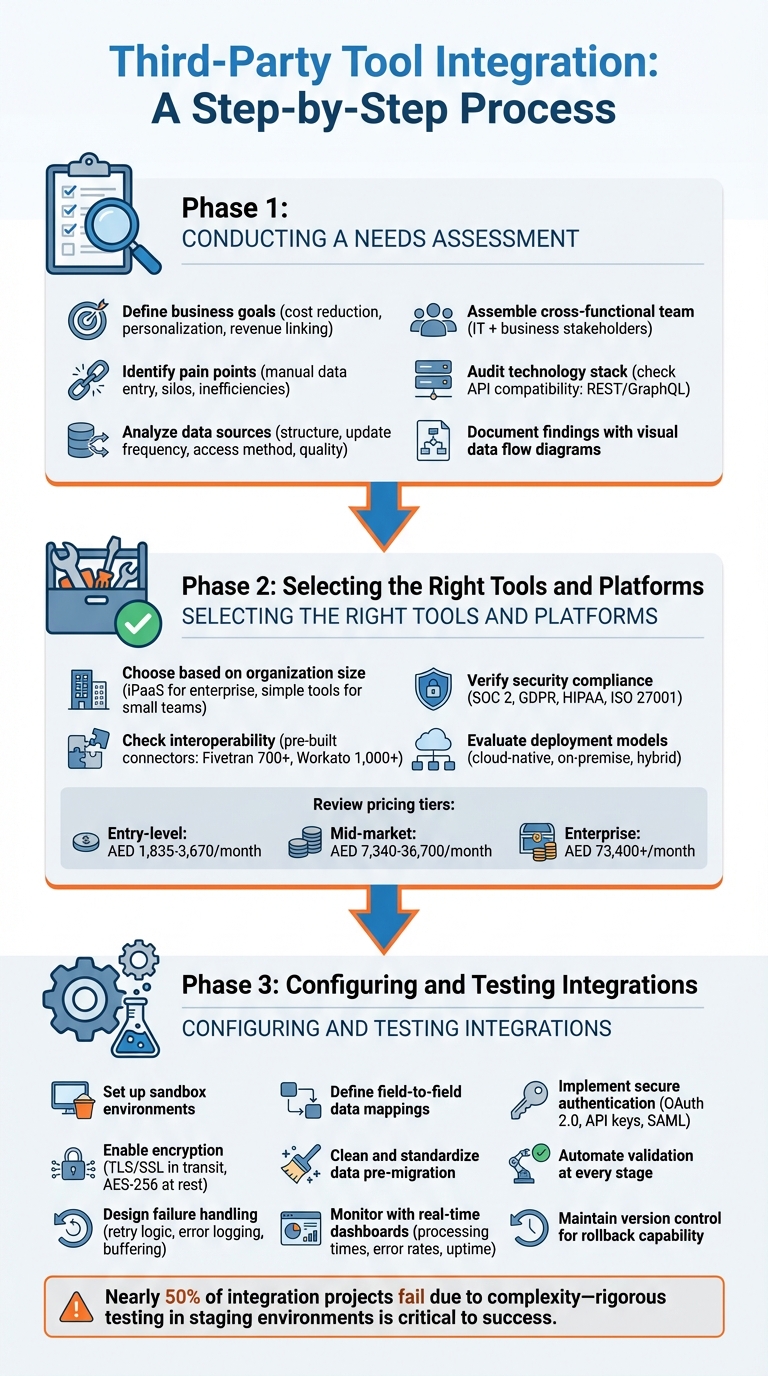
Step-by-Step Third-Party Tool Integration Process
Conducting a Needs Assessment
Start by defining your business goals. Whether you're aiming to cut costs, improve personalisation, or directly link marketing efforts to revenue, these objectives will guide your integration strategy. Assemble a team that includes IT experts and key business stakeholders to ensure all perspectives are covered.
Next, identify pain points that slow down your processes. These could include manual data entry, siloed information, or inefficiencies that impact productivity. Conduct a thorough audit of your current technology stack to spot overlaps, check API compatibility (like REST or GraphQL), and locate data bottlenecks. Analyse each data source, considering factors like its structure, update frequency (real-time or batch), how it's accessed, and its overall quality.
Set baseline metrics to measure success later. For instance, track how long it currently takes to launch a campaign. Document all findings in a centralised metadata repository using visual data flow diagrams. These diagrams will not only clarify your current system but also assist in future impact analyses. Remember, data silos are a common issue that can disrupt workflows, so addressing them is essential.
This detailed assessment will help you choose the tools and platforms that align with your goals.
Selecting the Right Tools and Platforms
The choice of tools depends on your organisation's size and complexity. If you're managing multiple applications across departments, scalable iPaaS solutions with strong governance features are ideal. For smaller teams, simpler tools that allow quick deployment may be more suitable.
Data security and compliance are non-negotiable. Look for platforms that meet standards like SOC 2, GDPR, HIPAA, and ISO 27001. Features such as role-based access control, AES-256 encryption, and detailed audit logs add an extra layer of protection. Interoperability is equally important. Platforms with extensive pre-built connectors (like Fivetran's 700+ or Workato's 1,000+ options) and support for widely used data formats (REST, GraphQL, JSON, XML) can save you significant time.
Consider deployment models carefully. Cloud-native options offer scalability and cost efficiency, on-premise solutions provide more control, while hybrid models balance both but come with added complexity. Pricing varies widely based on the solution: entry-level iPaaS plans range from AED 1,835 to AED 3,670 per month, mid-market options cost between AED 7,340 and AED 36,700, and enterprise-level implementations can exceed AED 73,400 monthly.
Once you've selected the right tools, the focus shifts to configuration and thorough testing.
Configuring and Testing Integrations
Begin by setting up and testing integrations in sandbox environments to avoid disruptions in your live system. Define field-to-field data mappings, implement secure authentication methods like OAuth 2.0, API keys, or SAML, and ensure data is encrypted both in transit (using TLS/SSL) and at rest (using AES-256).
Before migrating data, clean and standardise it to eliminate duplicates and ensure consistency. Automated validation at every stage of the process will help confirm the accuracy and completeness of your data before it flows into the integrated system. Design your integration to handle potential failures by incorporating retry logic, error logging, and buffering mechanisms to manage temporary issues like API outages or rate limits.
Use real-time monitoring dashboards to keep an eye on processing times, error rates, and system uptime. This allows you to quickly identify and address bottlenecks. Maintain version control for all integration-related assets, such as transformation scripts and schema definitions, so you can roll back changes if needed. With nearly half of integration projects failing due to complexity, rigorous testing in staging environments is critical to success.
Common Challenges in Third-Party Tool Integration
While the advantages of integrating third-party tools are clear, it's crucial to address the challenges that can disrupt smooth operations. These obstacles range from technical compatibility issues to security risks and scalability concerns.
Compatibility and Versioning Issues
One of the biggest hurdles in integration is dealing with compatibility and versioning problems. Point-to-point integrations, while straightforward, can be incredibly fragile. When APIs are updated, developers often need to rewrite code, which creates maintenance backlogs and over-reliance on specific team members. This issue becomes even more pronounced when older, on-premises databases need to interact with modern, cloud-based SaaS platforms. Mismatched data formats and protocols can lead to complete communication breakdowns.
Another common pain point is schema evolution. When a source system modifies its data structure - such as adding fields, renaming tables, or altering relationships - it can break downstream integrations if no structured management framework is in place. Without consistent naming conventions, errors multiply. In fact, 82% of enterprises report that data silos disrupt their critical workflows.
To address these challenges, many organisations turn to Enterprise Integration Platform as a Service (EiPaaS). These platforms offer pre-built connectors that automatically handle version updates, removing the need for constant manual coding. For schema changes, version control is a game-changer. Treat pipeline configurations, transformation scripts, and schema definitions like software code, enabling quick rollbacks when updates cause failures. Standardising naming conventions can also make future integrations far less error-prone.
However, compatibility isn’t the only challenge - security risks add another layer of complexity.
Security Risks and Data Privacy Concerns
In the UAE, integration security must comply with a detailed regulatory framework, including Federal Decree-Law No. 45 of 2021 (PDPL) and emirate-specific laws in the DIFC and ADGM. Non-compliance can result in hefty penalties, ranging from AED 50,000 to AED 5 million, with severe violations in the ADGM reaching up to USD 28 million.
For example, in 2025, the ADGM Commissioner of Data Protection fined Okadoc Technologies Limited USD 20,000 for failing to comply with data subject access requests. This case highlights the active enforcement of these regulations.
"Effective data protection policies serve as the foundation for sustainable growth, customer loyalty, and operational excellence." – Krystyna Sokolovska, UAE Business Setup Expert, Inlex Partners
To mitigate security risks, organisations should implement robust safeguards. These include AES-256 encryption for stored data, TLS 1.3 for data in transit, multi-factor authentication, and role-based access control. Permissions granted to third-party tools should be as limited as possible, reducing the potential damage from a security incident. Using OAuth 2.0 or 2.1 for authentication instead of static credentials and rotating API keys regularly can also minimise risks. If third-party tools store data outside the UAE, lawful transfer mechanisms like Standard Contractual Clauses or Binding Corporate Rules are essential.
While security is a critical concern, the growing volume of data introduces another challenge: scalability.
Scalability and Performance Bottlenecks
As organisations handle ever-increasing data volumes, integration systems are under mounting pressure. Many enterprise platforms require synchronous processes to complete within a 300-second window, which can cause failures when processing large datasets.
To overcome these bottlenecks, asynchronous messaging is a powerful solution. It allows systems to continue operating without waiting for immediate responses, preventing system-wide slowdowns. Replacing polling with webhooks can further reduce load and latency. For complex integrations, splitting tasks into parent-child architectures ensures that a single slow service doesn’t disrupt the entire flow.
Another way to optimise performance is by reducing "chatty" integrations. Instead of sending numerous small API requests, batch them. For example, Salesforce can handle 200 records per request, Oracle ERP Cloud supports 100, and Service Cloud allows up to 1,000. Client-side rate limiting helps align with third-party provider quotas, preventing service bans. Additionally, caching frequent API responses in tools like Redis can significantly cut down on latency and redundant external calls. Finally, cloud-native middleware platforms can scale automatically to meet growing business demands, eliminating the need for manual adjustments.
Integration Platforms for Unified Marketing Ecosystems
Once technical challenges are addressed, the next step is to build a unified marketing ecosystem that ensures smooth data flow across all tools. This approach not only solves technical issues but also brings your marketing tools together for better performance. Integration platforms play a key role here, transforming disconnected applications into a connected system that supports real-time data sharing and automation. This unified setup lays the groundwork for advanced automation and quick marketing responses.
The Role of iPaaS in Marketing Automation
Integration Platform as a Service (iPaaS) serves as a central hub for connecting different systems - whether cloud-based SaaS tools, legacy databases, or on-premise software. Instead of relying on multiple point-to-point connections, iPaaS consolidates all integrations into a single platform. This eliminates the complexity and inefficiency of managing numerous individual connections, especially as your marketing stack expands.
Currently, only 33% of marketing technology stacks are fully utilised, according to marketing leaders. This underuse often results from poor integration. To address this, around 65% of companies are replacing their marketing tools to achieve better integration and results. For enterprise organisations that may use over 100 tools in their marketing stack, centralised integration becomes essential.
iPaaS platforms simplify this process by offering pre-built connectors for widely used tools like Salesforce, HubSpot, and Slack. These platforms enable two-way, real-time data synchronisation, ensuring that when a prospect fills out a form on your website, their details are instantly updated across your CRM, email platform, and analytics tools. They also allow for data transformation - mapping, cleaning, and restructuring data so it aligns with the specific requirements of each system.
What sets iPaaS apart is its no-code automation capability. Teams can design "if this, then that" workflows across thousands of applications without needing to write custom code. This makes integration accessible even to non-technical marketers. The importance of this accessibility is underscored by the fact that 71% of employees believe integrating generative AI into workflows will save time by reducing manual tasks.
To make the most of these benefits, Wick's Four Pillar Framework offers a structured approach to building connected marketing ecosystems.
Wick's Four Pillar Framework for Integration
Wick’s Four Pillar Framework provides a step-by-step strategy for prioritising integrations based on their business impact. This approach ensures that companies systematically build interconnected ecosystems:
- Foundation (Website ↔ CRM): This initial step automates the capture of leads, eliminating the need for manual data entry.
- Feedback Loop (Website ↔ Analytics): Links behavioural data, such as clicks and time spent on a page, to CRM profiles, creating a detailed view of each prospect.
- Nurture Engine: Uses CRM data to automate personalised email campaigns and targeted content delivery.
- ROI Machine (Analytics ↔ Ad Platform): Sends conversion data back to advertising platforms like Google and Facebook, allowing for ad spend optimisation based on actual revenue rather than just clicks.
This phased strategy focuses on high-impact, low-complexity integrations that deliver quick wins before scaling up. When choosing new marketing tools, prioritise those with open, well-documented REST or GraphQL APIs and built-in connectors that work with your existing stack. It’s also important to define which platform will "own" specific data - like using your CRM for contact information and analytics tools for behavioural data - to avoid conflicts within the ecosystem.
Best Practices for Real-Time Data Exchange and Monitoring
Regular Performance Monitoring
Keeping a close eye on performance ensures that real-time data exchanges run smoothly and efficiently. This is crucial, especially when you consider that the average enterprise juggles over 1,000 applications, yet 70% of them remain unconnected. Without proper monitoring, even the best-designed systems can falter over time.
To stay ahead, break monitoring into key stages: pre-launch testing, daily checks for errors and performance, and periodic reviews of service limits. Daily tasks should include reviewing for timeouts, checking connectivity agents, and auditing recent changes that might have caused performance dips.
Pay attention to metrics like latency and throughput across multiple levels. It’s not enough to monitor averages - focus on the 90th and 99th percentiles. As Microsoft highlights:
"A workload that overperforms is as problematic as one that underperforms. The tradeoffs differ. Overperformance affects cost optimization. Poor performance affects users".
Set up automated alerts to flag issues like sudden spikes in error rates or latency exceeding acceptable thresholds, such as the 90th percentile.
Planning for Future Growth
Use performance insights to prepare your integrations for scaling as data demands grow. Address components that show signs of strain, such as overloaded databases or networks under pressure. Keep version control for all integration assets, allowing for quick rollbacks if updates lead to unexpected issues.
For tasks that take longer than two minutes, switch to asynchronous processes to avoid client timeouts and resource strain. Batching API calls can also improve scalability by reducing repetitive requests. Additionally, stagger scheduled tasks to prevent multiple integrations from running simultaneously, which can cause resource conflicts and processing delays.
Avoiding Common Pitfalls
Planning for growth is important, but it’s equally vital to avoid common mistakes that can derail integrations. Keep production and non-production data separate to ensure monitoring stays precise and avoids false alerts in live environments. Build self-healing systems by automating remediation actions like restarting services, clearing caches, or reallocating resources.
Regularly refactor code and optimise queries to reduce technical debt. Automate data validation at every step to ensure accuracy before information moves downstream. With 82% of enterprises reporting that data silos disrupt critical workflows, maintaining data quality through consistent validation is essential to prevent inconsistencies that could undermine your entire operational flow.
Conclusion
Integrating third-party tools effectively can turn disconnected marketing systems into a well-oiled machine, eliminating data silos and automating repetitive tasks. The payoff? Businesses with streamlined data integration report profit margins that are 126% higher than those struggling with fragmented systems.
These impressive results highlight the importance of having a structured integration strategy. Start with the basics - like connecting your website to your CRM - and gradually advance to real-time data exchanges and feedback loops. From the outset, prioritise security with measures like encryption, multi-factor authentication, and regular credential updates.
Interestingly, while 91% of marketers rank integration capability as the top feature when choosing tools, only 33% of the average MarTech stack actually gets used. Real-time data movement through APIs and webhooks enables marketers to act instantly, which is a game-changer. For example, organisations with real-time data access can respond to customer issues 67% faster than those relying on batch updates.
The Wick's Four Pillar Framework offers a solid foundation for building a unified digital ecosystem. By focusing on clear data governance, centralised management via iPaaS platforms, and continuous monitoring, businesses can scale their marketing operations without falling into the chaos of "spaghetti architecture" caused by poorly planned integrations. The aim isn’t just to link tools but to create a system that provides a 360-degree view of the customer journey while staying adaptable for future needs.
This cohesive approach does more than boost performance - it saves money too. Poor data quality alone costs organisations an average of AED 47.4 million (around US$12.9 million) annually. To avoid these pitfalls, focus on four key principles: ensure interoperability, automate wherever possible, monitor consistently, and design with scalability and security in mind.
FAQs
What steps can businesses take to ensure seamless integration of third-party tools?
To successfully integrate third-party tools, businesses need to prioritise compatibility and scalability. A practical starting point is using middleware solutions. These act as bridges between different applications, allowing smooth data exchange without the need for direct system-to-system connections. This method simplifies the integration process and leaves room for future expansion.
Key steps include standardising data formats, utilising secure APIs like RESTful or GraphQL, and implementing version control to avoid conflicts and ensure a secure integration. Careful planning is essential - choose tools that match your system's technical specifications to build a well-connected digital ecosystem. This ensures real-time data sharing and streamlined workflows.
For organisations in the UAE, applying these strategies can enhance operational efficiency and enable growth in an increasingly digital world.
What are the key security considerations for integrating third-party tools in the UAE?
When working with third-party tools in the UAE, data security and adherence to local laws are absolutely crucial. Begin by setting up strong access controls. For example, use OAuth 2.0/2.1 for authentication and stick to the least privilege principle - this ensures tools only access the minimum amount of data necessary. To safeguard sensitive information, encrypt all data exchanges with TLS, and make it a habit to validate inputs and outputs to guard against vulnerabilities like injection attacks.
Compliance with the UAE Data Protection Law 2021 is another key consideration. This involves maintaining transparency, managing data ethically, and respecting the rights of individuals regarding their data. Regular audits, temporary access controls, and a well-structured permission management system can help lower the chances of unauthorised access or breaches. Always integrate tools with a focus on both security and alignment with local legal requirements.
How does real-time data exchange enhance business operations?
Real-time data exchange plays a key role in improving business operations. It ensures that every system and team has access to the latest information, cutting down delays, speeding up decision-making, and boosting accuracy across the board.
When integrated tools communicate effortlessly, businesses can adapt faster to market shifts, simplify workflows, and stay flexible in their processes. This is especially helpful in marketing, where having timely insights can make a big difference in campaign performance and how effectively a company connects with its customers.