
Blog / How to Optimize Arabic Content for SEO
How to Optimize Arabic Content for SEO
Optimizing Arabic content for SEO is your gateway to reaching untapped markets in the UAE and GCC. With over 400 million Arabic speakers globally and Google dominating the UAE search market with a 96% share, addressing Arabic search intent can directly drive higher engagement, trust, and conversions. Here’s what you need to know:
- Arabic SEO is underutilized: Less competition for Arabic keywords means easier rankings compared to English.
- Dialects matter: Tailor content to Modern Standard Arabic (MSA) for formal pages and Gulf Arabic for conversational searches.
- Search behavior is unique: Arabic queries are often longer, conversational, and influenced by local events like Ramadan or Eid.
- Technical setup is critical: Ensure Right-to-Left (RTL) formatting, proper hreflang tags, and mobile optimization to meet user expectations.
- Localized keywords win: Use tools like Google Keyword Planner and SEMrush to identify high-intent Arabic keywords, including informal spellings.
- Content goes beyond translation: Localize for context, idioms, and cultural relevance, and use AED for pricing when targeting UAE audiences.
Learn About On-Site SEO - Introductory Session (Arabic Session - بالعربي)
Arabic Keyword Research
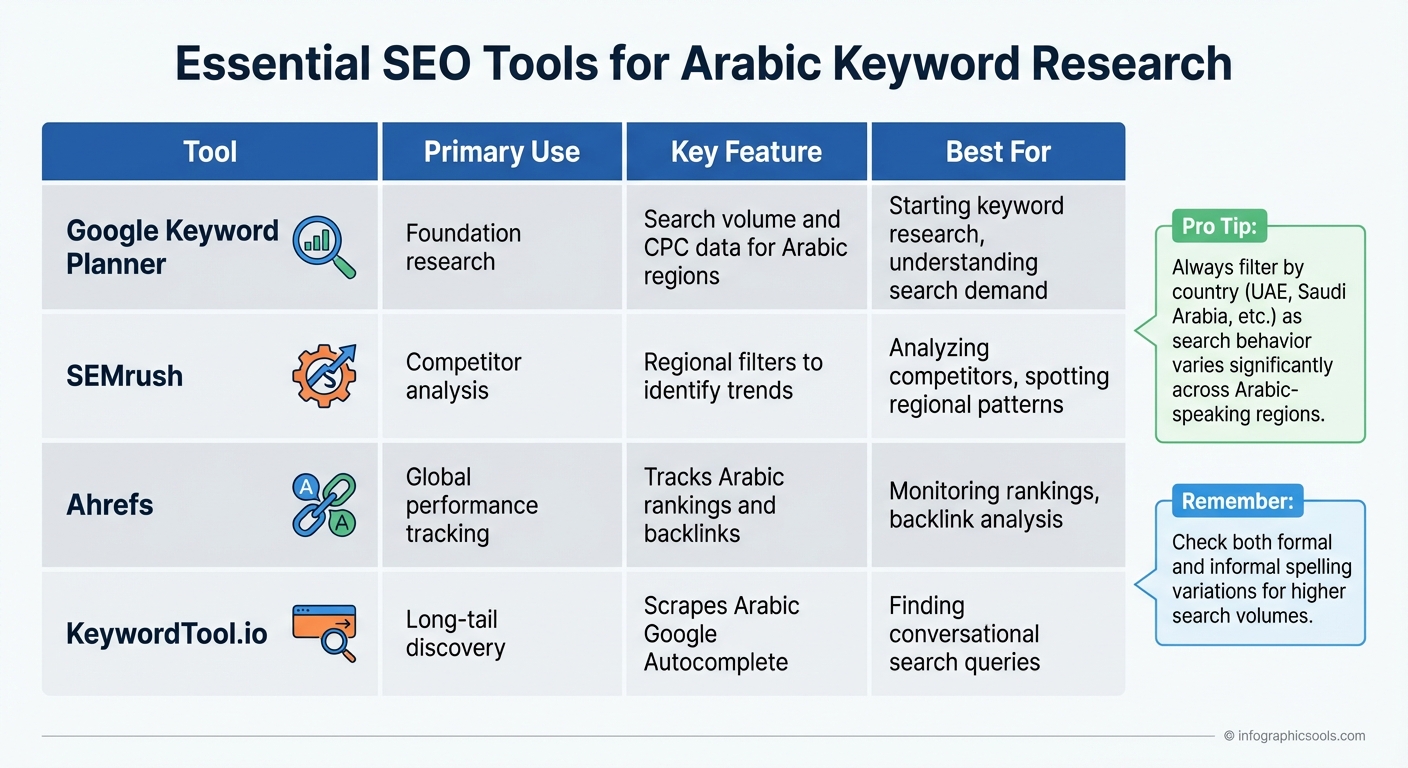
Arabic SEO Tools Comparison: Features and Best Use Cases
Arabic keyword research goes beyond simply translating English terms - it’s about understanding how people in the UAE and GCC countries actually search. With over 30 Arabic dialects - such as 'Syarra' in Saudi Arabia versus 'Arabaya' in Egypt - it’s essential to approach each market individually rather than relying on direct translations.
Spelling variations are another key factor. Many users type informally, often skipping diacritical marks like the Hamza on Alef (e.g., أ vs ا). These informal spellings frequently generate higher search volumes. To ensure thorough research, always include both formal and informal variations.
Arabic search queries also tend to be longer and more conversational. They often begin with phrases like 'How' (كيف) or 'What is' (ما هو), which reflect informational intent. These types of searches can help build trust and credibility before leading to conversions. Focus on high-intent keywords, as they typically face less competition compared to English terms.
Arabic Dialects and Regional Differences
Modern Standard Arabic (MSA) is suitable for formal content like policy pages or FAQs, but to connect with local audiences - especially for voice searches - regional dialects like Gulf Arabic (Khaleeji) are crucial. For instance, someone in Dubai might use Gulf dialect terms instead of MSA when searching for a service. Understanding and incorporating these nuances can improve your rankings in local searches and create a more authentic connection with users.
To refine your strategy, always filter keyword tools by country. For example, search behaviour and terminology in Saudi Arabia can differ significantly from the UAE. A keyword that performs well in Riyadh might have minimal relevance in Dubai. Collaborating with native speakers to review your keyword lists is essential, as literal translations often miss cultural subtleties and may sound awkward to local users.
SEO Tools for Arabic Keywords
Several tools can help streamline Arabic keyword research. Google Keyword Planner is a great starting point, offering search volume and cost-per-click data tailored to Arabic-speaking regions. SEMrush is useful for analysing competitors and spotting regional trends, while Ahrefs tracks Arabic keyword rankings and backlink data. For uncovering long-tail phrases, KeywordTool.io scrapes Google Autocomplete in Arabic, revealing what users are actively searching for.
| Tool | Primary Use | Key Feature |
|---|---|---|
| Google Keyword Planner | Foundation research | Search volume and CPC for Arabic regions |
| SEMrush | Competitor analysis | Filters to identify regional trends |
| Ahrefs | Global performance | Tracks Arabic rankings and backlinks |
| KeywordTool.io | Long-tail keywords | Scrapes Arabic Google Autocomplete |
Keep an eye on seasonal trends. Events like Ramadan, Eid, and national holidays significantly influence search behaviour. Tools like Google Trends can help you stay updated on these shifts, enabling you to adjust your strategy to capture relevant opportunities.
Customer Insights for Keyword Discovery
Your customer service and sales teams are a goldmine for discovering high-intent keywords. They frequently hear the exact terms and phrases customers use when describing their problems or asking about products in Arabic. These insights can uncover valuable keywords that traditional tools might overlook.
Ask your teams questions like: What are the most common queries from Arabic-speaking customers? Which words suggest a strong intent to purchase? This feedback can highlight pain points and conversational phrases that align with actual search behaviour. As Panamedia notes, "Literal translations ignore intent. A keyword that performs well in English may have zero search value in Arabic when translated word-for-word". Combining these real-world insights with analytical tools will give you a well-rounded keyword strategy.
On-Page Elements for Arabic SEO
After identifying your target keywords, the next step is optimising on-page elements to appeal to both search engines and users. This involves technical adjustments that accommodate Right-to-Left (RTL) text and reflect nuances that resonate with local audiences.
These tweaks not only improve your search rankings but also ensure your content feels natural and relatable to Arabic-speaking users.
Arabic Title Tags and Meta Descriptions
While title tags and meta descriptions follow the same character limits as English, the strategy needs localisation. Start your title tags with the main keyword, and only include a secondary keyword if it fits naturally. For meta descriptions, use a clear Arabic call to action (CTA) to encourage clicks. Avoid direct translations from English, as they can come across as awkward. Instead, craft phrases that sound natural to Arabic readers.
Spelling is a critical factor here. For instance, an alef with or without a hamza (أ vs ا) can yield entirely different search results. Research both formal and informal spellings and prioritise the version with higher search volume. If you're focusing on a specific country like the UAE, use regional dialect terms rather than Modern Standard Arabic (MSA) to better match local search behaviour. Mixing Arabic and English in meta descriptions can also be effective if your audience frequently switches between languages.
Finally, ensure your headings and HTML structure are optimised for RTL text.
Headings and HTML for Right-to-Left Languages
Supporting RTL text involves more than just flipping the layout - proper CSS adjustments are essential. Set dir="rtl" in your HTML tag to establish the text direction, and use <html lang="ar"> to help search engines understand the language of your content. Keep headings short and easy to scan, especially since over 85% of searches in Arabic-speaking markets are conducted on smartphones. Use clear H1, H2, and H3 tags to enhance readability and help search engines grasp your page structure.
Choose Arabic-friendly fonts like Cairo or Amiri, and increase line height to improve legibility - Arabic script can be challenging to read at smaller sizes. Manually adjust navigation menus, sidebars, forms, and tables to flow correctly from right to left. Additionally, implement hreflang tags (e.g., <link rel="alternate" href="http://example.com/ar/" hreflang="ar" />) to indicate the Arabic version of your site to search engines, reducing the risk of traffic loss.
Image Alt Text and URL Structure in Arabic
When writing image alt text, use descriptive Arabic keywords that naturally describe the image content. Replace generic file names like image1.jpg with meaningful Arabic names. You can use either Arabic script (e.g., صور-المنتج.jpg) or transliteration (e.g., suwar-al-muntaj.jpg) to help search engines properly index your images.
Keep URLs clean and descriptive, placing key Arabic keywords directly in the slug. Whether you use Arabic script, transliterated Arabic, or English, ensure the URL is simple and easy to understand. For local SEO, consider using country-code top-level domains like .ae for the UAE or .sa for Saudi Arabia to boost rankings and build trust. Spelling variations matter here too - research which version (e.g., with or without a hamza) has higher search volume before finalising your URL slugs or alt text.
Finally, compress images to maintain fast loading speeds, which is especially important for mobile users in the MENA region. This ensures a smoother user experience while keeping your site competitive in search rankings.
Creating Culturally Relevant Arabic Content
Once you've optimised your on-page elements, the next step is crafting content that truly connects with Arabic-speaking audiences. This isn't just about translating English into Arabic - it’s about understanding the nuances of how people in the UAE and GCC search, what they prioritise, and how they communicate. Here's how to make your content resonate through localisation, targeted long-tail strategies, and culturally aware expressions.
Content Localisation vs. Translation
Translation simply swaps words from one language to another, while localisation adapts the entire experience to align with cultural norms and expectations. For example, translating "hospitality" into Arabic gives you "Diyafa" (ضيافة), but this term doesn’t carry the same business-oriented context as its English counterpart. If you're targeting the hospitality industry, using "Funduq" (فندق - hotel) aligns better with search intent.
Localisation doesn’t just improve relevance - it drives results. In fact, localised content can increase monthly traffic by 10%–20% compared to basic translation efforts. A great example is a Dubai-based retailer that revamped its Arabic category pages in 2025 to include dialect-specific long-tail terms. The result? A 45% boost in organic sessions and significantly higher add-to-cart rates within just three months. The secret lies in working with native speakers who grasp both the language and the cultural context, rather than relying on automated tools.
Long-Tail Keywords in Arabic
Arabic-speaking users often start their searches with phrases like "How" (كيف) or "What is" (ما هو), creating opportunities to target highly specific, intent-driven long-tail keywords. Instead of focusing on generic terms like "car repair", aim for detailed phrases such as "best car AC repair centres in Dubai" (أفضل مراكز صيانة تكييف السيارات في دبي).
A restaurant in Dubai added an Arabic menu section complemented by localised FAQs and schema markup in 2025. This effort led to a 30% increase in reservations over just three months, driven by higher click-through rates on Arabic "near me" searches.
The more specific your keywords, the better your chances of matching user queries - and attracting qualified traffic that’s more likely to convert.
Local References and Idioms
Swap generic examples for ones that resonate specifically with audiences in the UAE and GCC. For instance, use AED instead of USD when discussing prices, mention well-known landmarks like Dubai Mall or Sheikh Zayed Road, and reference neighbourhoods familiar to your target audience.
A tourism operator in Abu Dhabi created localised Arabic landing pages highlighting family-friendly activities and itineraries. This approach resulted in a 30% rise in inquiries, as the content was more aligned with local search habits.
Dialects also matter. While Modern Standard Arabic works well for formal content, Gulf Arabic is better suited for casual queries. For example, "mobile phone" is called "Jawal" (جوال) in Saudi Arabia but "Mobile" (موبايل) in Egypt and Jordan. Additionally, align your campaigns with cultural events like Ramadan, Eid, and UAE National Day. Instead of focusing solely on sales, emphasise community values and shared experiences during these times.
"Arabic is not only a language, but also a culture" – Farah Fathy, Director of Global Digital Marketing at Globalisation Partners International.
sbb-itb-058f46d
Technical SEO for Arabic Websites
Building on keyword and content strategies, a solid technical setup ensures your Arabic website runs smoothly and connects effectively with local audiences. With over 85% of Arabic searches happening on smartphones, your site needs to be fast, configured for right-to-left (RTL) text, and optimised for local search. Here's where to focus your efforts.
Mobile Optimisation in Arabic Markets
Mobile performance is non-negotiable. Core Web Vitals - like page speed and mobile responsiveness - are critical ranking factors.
Regional hosting can significantly improve performance. With AWS offering data centre hosting in Dubai, Manama, and Fujairah, websites targeting the UAE can benefit from reduced latency and faster load times by hosting locally.
"Machine translation on a site can split components on an Arabic mobile website, which hinders a visitor's ability to buy something or convert." – Digital Gravity
Native CSS styling plays a big role here. Instead of relying on automated translation tools, collaborate with native speakers to ensure your mobile interface remains functional and user-friendly. Additionally, implementing Accelerated Mobile Pages (AMP) can further enhance mobile performance.
Don't forget to configure your website's language settings to fully support Arabic display and usability.
Arabic Language Configuration
A proper technical setup begins with enabling right-to-left (RTL) support across your site. This impacts everything from navigation menus and button placements to image alignments and sliders. Use dir="rtl" and appropriate CSS styling to ensure a smooth user experience.
Hreflang tags are a must for bilingual websites. For sites targeting UAE audiences, include tags like hreflang="ar-AE" to specify Arabic content. For example: <link rel="alternate" href="http://example.com/ar/" hreflang="ar" />. This prevents duplicate content issues and ensures search engines understand your content structure. Subdirectories (e.g., example.com/ar/) are effective for consolidating SEO authority, while .ae domains provide a strong local ranking signal.
Schema markup is another essential tool. Use it to define your Arabic content and local business details clearly. Consistency is key - ensure your Name, Address, and Phone number (NAP) are uniform across both English and Arabic versions of your site, as well as in local directories. Avoid automatic redirects based on browser language; they can disrupt indexing and annoy users.
Once your language setup is in place, shift focus to boosting your local visibility in the UAE and GCC.
Local SEO for the UAE and GCC
Your Google Business Profile is a game-changer for "near me" searches on mobile. Include bilingual descriptions in Arabic and English, and encourage reviews in both languages. This dual-language approach enhances your visibility in local search results.
List your business in regional directories, ensuring your NAP details are consistent. Create location-specific content that mentions nearby landmarks like Dubai Mall or Sheikh Zayed Road, and display prices in AED to align with local expectations.
Voice search is gaining traction in the MENA region, especially through Google Assistant. Structure your content to answer conversational, question-based queries such as "how" (كيف) or "what is" (ما هو). With around 50% of people in Gulf nations under the age of 25, tailoring your content to younger, tech-savvy users can also give you an edge.
Building Backlinks in Arabic Markets
After establishing a solid technical foundation, the next step is to build authority through backlinks. In Arabic markets, competition for high-value keywords is often lower, meaning fewer backlinks are required to rank well. However, due to weak copyright enforcement, content is frequently copied rather than cited, making proactive outreach a critical part of your strategy.
Backlinks from Arabic Websites
Start by analysing competitor backlink profiles using tools like Ahrefs to identify reputable regional sites. Incorporate digital PR strategies, such as creating original research or interactive tools, to earn credible citations. High-authority news platforms like Al Arabiya, Al Jazeera, Gulf News, The National, and Khaleej Times are excellent targets for mentions and backlinks.
One effective approach is digital PR through data journalism. By producing unique research or statistics relevant to the Arab world, you can attract attention from major publications that often link back to credible sources. Additionally, consider developing interactive Arabic-language tools, such as calculators or quizzes. These tools naturally draw backlinks when promoted effectively.
Be cautious with your backlink sources. Avoid low-quality regional directories, as they are often flagged by Google and can harm your rankings. Similarly, steer clear of purchasing links - a common practice in the region that frequently leads to penalties. Instead, focus on analysing regional sites and competitor profiles to uncover high-quality opportunities.
Partnering with Arabic Influencers
To complement your digital PR efforts, collaborate with influencers in the region. Work with bloggers and social media figures for guest posts and brand mentions. Arab consumers place a high value on community trust and are very brand-conscious, making influencer partnerships particularly impactful.
Given that 90% to 95% of internet traffic in the Arab world comes from mobile devices, ensure all influencer content is optimised for smartphones. YouTube is especially influential, as Arabs rank among the world’s top consumers of video content on the platform. Partner with YouTube creators who speak the relevant dialects and provide them with unique data to feature in their videos. Sponsoring local industry events is another way to gain backlinks from event websites and participating influencers.
Engaging with Local Forums
Influencer collaborations can naturally lead to engagement on local forums, which can further enhance your credibility. Build genuine relationships on platforms like Mawdoo3, Hawaaworld, Reddit Arabic, ExpatWoman, and Dubizzle. Use Modern Standard Arabic (MSA) for broader reach, but switch to local dialects when engaging with country-specific forums to foster trust.
Share valuable resources, such as interactive tools or original research, that naturally encourage backlinks. Avoid keyword stuffing, as it can harm your credibility and rankings.
"Impactful SEO is rarely executed by a lone wolf" – Jes Scholz, International Digital Director.
Monitoring and Improving Performance
After implementing Arabic keyword research and technical optimisation, the next critical step is performance tracking. This ensures you can measure what’s working and pinpoint areas for improvement. By setting up language-specific views in Google Analytics, you can separate Arabic traffic from other language versions, making it easier to evaluate performance independently. This segmentation is essential for analysing keywords, engagement, and conversions.
Performance tracking typically falls into three categories: leading indicators (like Arabic impressions, average position, and CTR), engagement metrics (such as session duration, scroll depth, and bounce rate on Arabic pages), and commercial outcomes (including goal completions, lead quality, and assisted conversions from Arabic sessions). For instance, a tourism operator in Abu Dhabi saw a 30% increase in inquiries after optimising Arabic landing pages to address local question formats.
Tracking Keywords and Traffic
Monitor both Modern Standard Arabic (MSA) and local dialect rankings to capture conversational and voice search queries. Google Search Console can help you isolate Arabic-specific impressions and clicks, allowing you to identify pages where high rankings don’t translate into strong CTRs. Keep an eye on spelling variations, as informal typing - like using "alef" without a "hamza" - often has higher search volumes, offering hidden opportunities.
Ensure Arabic CTAs and forms are clearly labelled in your analytics to track inquiries and purchases accurately. With Google holding over 96% of the UAE search market and more than 80% of searches happening on smartphones, it’s vital to account for mobile browsing patterns. Update your Arabic keyword targets quarterly to reflect changes in rankings and conversions, keeping pace with shifting search trends.
Analysing Conversions and Engagement
Engagement metrics provide insight into how well your Arabic content connects with users. Metrics like scroll depth, session duration, and bounce rates on Arabic pages can highlight problem areas. For example, high bounce rates might indicate issues with Right-to-Left (RTL) formatting, especially on mobile devices, which can negatively impact conversions.
Try A/B testing Arabic title tags and meta descriptions to determine whether formal or conversational language performs better in terms of CTR. Categorise Arabic pages by their purpose - service pages versus blogs - and assess which types drive the most conversions. Keep in mind that engagement and conversion rates often fluctuate during key periods like Ramadan, Eid, and UAE National Day, so factor these seasonal trends into your performance reviews.
Adapting to Algorithm Updates
Search engines frequently update their algorithms, making regular adjustments essential. Stay on top of Core Web Vitals, mobile-first indexing, and updates that specifically impact Arabic content. Conduct routine audits of hreflang tags and RTL compatibility to avoid indexing problems. Tools like SEMrush (starting at AED 440/month) or Ahrefs (starting at AED 364/month) can help you monitor competitors and uncover areas where you might need to allocate more resources.
Keep an eye on official announcements from search engines and stay active in regional SEO communities to stay informed about algorithm changes. With 90% to 95% of the Arab population accessing the internet via mobile devices, optimising mobile UI and page speed should remain a top priority. As voice search grows, focus on Arabic titles that align with question-based queries like "How to", "What is", or "Best" to meet evolving user needs.
Conclusion
Optimising Arabic content for SEO in the UAE and GCC requires a thoughtful mix of regional insight, technical expertise, and ongoing adjustments. By understanding the nuances between Modern Standard Arabic and local dialects like Gulf Arabic, you can better address your audience's specific search intent.
Despite Arabic being spoken by 422 million people, it makes up only 1–1.5% of online content. This gap presents a massive opportunity to capture untapped regional search queries.
Key technical elements like RTL formatting, hreflang tags, and mobile-first indexing are non-negotiable. A smooth mobile experience isn’t just a technical necessity - it directly influences rankings and user conversions. When paired with content that resonates with local audiences, it fosters trust and boosts engagement.
Once the technical and cultural groundwork is laid, tracking progress becomes essential. As highlighted in earlier sections on keyword research and content localisation, aligning these efforts is critical for success.
"Arabic localisation is a lot more than a single tick list on your SEO to-do list – it is a growth strategy that cements your presence in one of the most competitive global markets." - GTECH
To measure success, focus on tracking Arabic-specific impressions, click-through rates, and conversions separately from English data. This approach helps uncover high-intent queries and refine your strategy every quarter. The relatively lower competition for high-volume Arabic keywords compared to English gives brands a distinct edge. Whether you’re in retail, tourism, or F&B, consistent investment in Arabic SEO can drive long-term growth in the UAE and GCC markets.
FAQs
How can I research Arabic keywords effectively for different dialects?
To effectively research Arabic keywords across different dialects, it’s essential to recognise the linguistic and regional diversity within Arabic-speaking communities. Dialects such as Gulf, Egyptian, Levantine, and Maghrebi Arabic differ widely in vocabulary and search habits, making it crucial to tailor your approach to these regional nuances.
Start by leveraging tools that offer localised search data and insights into trends specific to each dialect. For instance, users in the UAE often mix Arabic and English in their search queries. Understanding this behaviour and incorporating terms that align with local preferences can help you build a keyword strategy that genuinely connects with your audience.
For formal content, focusing on Modern Standard Arabic (MSA) is a smart move. However, when targeting conversational or region-specific searches, adapting keywords to fit particular dialects is essential. This balance ensures your content stays relevant and appealing to a broad and diverse audience.
What are the key technical SEO considerations for Arabic websites?
When working on SEO for Arabic websites, paying close attention to certain technical details is crucial. For starters, ensuring proper support for right-to-left (RTL) text formatting is a must. This is key to maintaining the readability of Arabic script and delivering a user-friendly experience.
Next, dive into Arabic keyword research to align your content with the search habits and preferences of users in the region. Understanding how people search in Arabic can make a big difference in connecting with your audience.
Another important step is using localized metadata in Arabic. This includes crafting titles, meta descriptions, and alt text in Arabic to boost your site's visibility in search engine results. Additionally, make the necessary technical tweaks to accommodate Arabic characters in URLs, sitemaps, and schema markup. These adjustments help search engines interpret and rank your content accurately.
By addressing these elements, you'll be better positioned to engage your audience in the UAE and beyond while improving your site's performance in search rankings.
Why is cultural localization important for Arabic SEO success?
Cultural localization plays a key role in Arabic SEO, especially in the UAE, where Arabic is the official language and a variety of dialects, such as Gulf and Levantine Arabic, are widely spoken. Tailoring your content to reflect these linguistic and cultural nuances makes it more relatable and engaging for your target audience.
But localization goes beyond just translating words. It involves adapting visuals, layout, and even technical elements like right-to-left (RTL) formatting. These adjustments not only improve the user experience but also signal to search engines that your content is relevant to the local culture. This can lead to improved rankings and better visibility.
By aligning your content with local norms and search intent, cultural localization helps build trust with your audience, encourages engagement, and strengthens your presence in Arabic-speaking markets.