

Blog / Multi-Channel Campaign Automation Trends in 2025
Multi-Channel Campaign Automation Trends in 2025
Marketing in 2025 is all about unifying customer interactions across channels like WhatsApp, email, SMS, and social media. Businesses in the GCC region are leveraging automation to increase engagement by 166%, boost conversion rates by 24%, and grow revenue by 23%. With 90% of companies prioritising omnichannel strategies, this shift is no longer optional. Here’s what you need to know:
- Automation connects platforms seamlessly: A customer browsing on Instagram might trigger a WhatsApp message or email, creating a unified experience.
- AI-powered personalisation is key: Predictive analytics now anticipate customer needs, while generative AI creates tailored content for Arabic and English audiences.
- Real-time coordination matters: Campaigns sync across platforms, ensuring every interaction feels connected and timely.
- Bilingual automation is essential in the GCC: With 71% of consumers expecting personalised interactions, tools now switch between Arabic and English effortlessly.
The GCC’s high smartphone penetration (96%) and increasing use of AI tools make this transformation inevitable. Businesses integrating multi-channel automation are not just engaging customers - they’re driving growth.
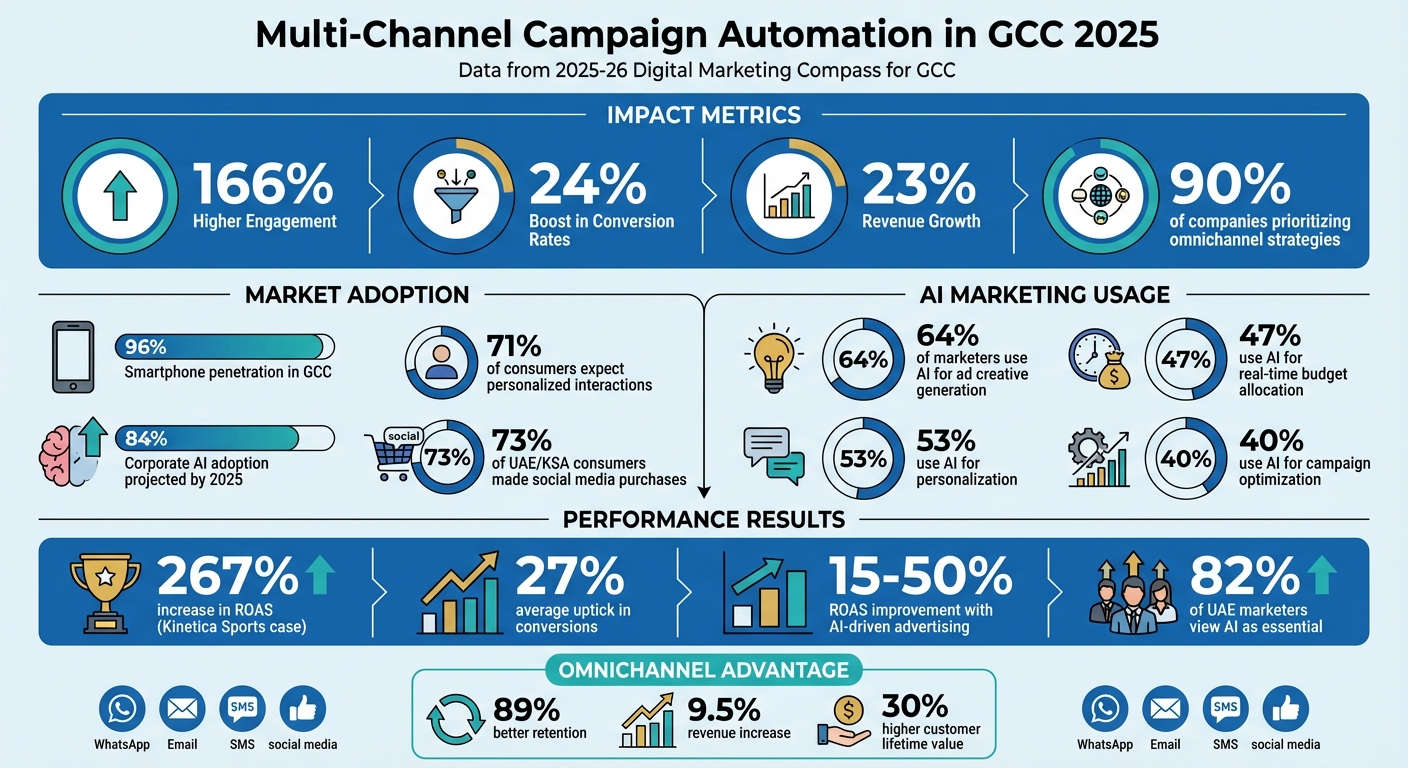
Multi-Channel Campaign Automation Impact in GCC 2025: Key Statistics and Performance Metrics
When to Use Multi-Channel vs. Omni-Channel Marketing
Key Trends in Multi-Channel Campaign Automation in 2025
Three transformative trends are reshaping automation in the GCC region. First, AI-powered personalisation has moved beyond basic segmentation to anticipate customer needs before they even express them. Second, real-time coordination ensures that every interaction - whether on Instagram or WhatsApp - is seamlessly aligned. Third, bilingual automation reflects the region's linguistic dynamics, where switching between Arabic and English is a daily norm.
AI-Driven Personalisation and Predictive Analytics
GCC businesses are shifting away from static audience segmentation and embracing individualised experiences that adapt instantly to customer behaviour. AI models now predict actions like a customer's likelihood to respond to promotions or their risk of disengagement, enabling businesses to launch retention campaigns before losing them. This evolution from reactive to predictive engagement is a defining factor for businesses aiming to lead the market.
"The ability to move beyond reactive personalization to predictive, one-to-one engagement is what will separate market leaders from laggards in the 2025-26 ecosystem." - The 2025-26 Digital Marketing Compass For GCC
Generative AI is taking personalisation to another level by crafting tailored ad copy, visuals, and messages that align with regional nuances. In the GCC, 64% of marketers now use AI for ad creative generation and 53% for personalisation. This isn’t just a trend - it’s a staple of modern marketing operations. Customer Data Platforms (CDPs) play a central role by integrating data from email, social media, and physical stores to create a comprehensive view of each customer. Meanwhile, bilingual conversational AI chatbots handle complex queries in both Arabic and English on platforms like WhatsApp and Telegram, offering 24/7 support that feels natural and responsive.
Building on predictive personalisation, real-time coordination ensures that every customer interaction is cohesive and well-timed.
Real-Time Campaign Coordination Across Channels
Predictive analytics may help shape messaging before a customer acts, but real-time coordination ensures that every subsequent touchpoint aligns perfectly. Advanced platforms now synchronise campaigns across channels like social media, email, SMS, and display ads, creating a seamless customer journey regardless of where they interact with a brand. This unified approach integrates CRM, point-of-sale, and ERP systems, bridging the gap between online and offline experiences.
AI-powered intent recognition plays a key role by identifying customer needs from inbound messages and directing them to the right channel or agent instantly. In the GCC, where app downloads increased by 2.6% year-over-year in Q2 2025 (compared to 0.5% globally), speed and accuracy in responses are essential. Automation tools also boost creative agility, allowing marketing teams to refresh ad content multiple times a week based on real-time performance metrics. With 47% of GCC app marketers using AI for real-time budget allocation and 40% for campaign optimisation, the benefits are evident.
"User acquisition remains the engine. Scale comes from creative rigour, AI-powered optimisation, and faster feedback loops from test to budget." - Shy Rahimi, Managing Director of MENA, Bidease
Bilingual Campaign Automation for GCC Audiences
In the GCC, linguistic diversity calls for more than just translation. Automation tools now employ advanced intent recognition to ensure responses resonate in both Arabic and English. This is crucial in a region where language preferences heavily influence purchasing decisions and brand loyalty. Arabic-first content, particularly through influencer marketing and shoppable posts, plays a significant role in driving engagement.
Natural Language Processing (NLP) tools now monitor feedback in real time across both languages, adjusting messaging to reflect sentiment. As Arabic voice search becomes more prevalent, brands are creating voice-driven campaigns tailored to local dialects. Generative AI supports these efforts by managing messages, tagging intent, and delivering responses that feel personalised and culturally relevant. This is especially important in markets like the UAE and KSA, where 73% of consumers made purchases through social media in the past year. Bilingual automation is no longer a luxury - it’s a necessity for effective customer engagement in the region.
Performance Max and AI Max Campaign Automation
Performance Max and AI Max bring a fresh approach to campaign automation in the GCC, leveraging AI to deliver personalised and efficient advertising strategies. These tools combine platforms like Search, YouTube, Display, Discover, Gmail, and Maps into a single system. The AI allocates budgets to the best-performing channels, analysing hundreds of signals - such as device type, user location, time of day, and browsing habits - to adjust bids in real time for every auction. This dynamic approach is especially useful in the GCC, where consumer behaviour often shifts dramatically during key events like Ramadan, Eid, and the Dubai Shopping Festival. By unifying these processes, the system enhances bidding strategies and optimises creative assets.
Adaptive Bidding & Cross-Channel Optimisation
Performance Max's Smart Bidding feature delivers measurable results, including a 19% boost in conversions and an 18% increase in unique search queries, all while maintaining flexible ROAS (Return on Ad Spend) targets. The system is also equipped to meet retention goals, allowing marketers to place aggressive bids for high-value or lapsed customers.
Another standout feature is omni-channel bidding, which optimises campaigns for both online sales and in-store visits. This is a crucial advantage for GCC retailers who operate across digital and physical storefronts. The AI also adapts creative assets to fit each platform. For instance, ads on YouTube are distinct from those on Gmail but still align with the campaign’s overall objectives.
"Cross-channel bid optimisation allows you to scale the benefits of auction-time bidding across all channels to find the highest-ROI opportunities, no matter which channel they happen on." - Google Ads Help
These adaptive bidding strategies set the stage for improved performance across GCC markets.
Performance Insights for the GCC Region
Businesses in the GCC adopting Performance Max are seeing impressive results. Take Kinetica Sports, for example. Operating in the UAE and globally, the company achieved a 267% increase in ROAS and a 600% surge in website traffic after implementing the platform. On average, advertisers report a 27% uptick in conversions or value while keeping costs per acquisition steady. In the UAE, AI-driven advertising has boosted ROAS by 15% to 50%, with 82% of marketers in the country now viewing AI as essential to their strategies.
The platform’s Insights cards provide marketers with valuable data, such as emerging search trends and new customer segments based on real-time intent. Additionally, asset reporting offers transparency into which creatives - whether Arabic or English headlines, images, or videos - are performing best. For a bilingual market like the GCC, this ensures campaigns are culturally relevant while maximising their impact. Notably, nearly 50% of UAE travellers say AI-targeted ads influence their destination choices.
sbb-itb-058f46d
Email and Retargeting Automation in the GCC
Email and retargeting automation play a crucial role in recovering lost sales and building customer connections in the GCC's bilingual market. These systems are designed to adapt workflows in real time, accounting for both cultural nuances and significant calendar events. Let’s explore how abandoned cart recovery and upselling campaigns showcase the benefits of automation.
Abandoned Cart Recovery and Upselling Campaigns
Abandoned cart automation tackles the staggering 60% cart abandonment rate seen in international e-commerce by sending behaviour-driven, incentive-based reminders.
Take Ramadan, for instance. During this key period, IKEA launched automated campaigns tailored to cultural sensitivities, resulting in a 23% increase in regional transactions.
Upselling campaigns also thrive with automation. By using recommendation engines, businesses can increase average order values by 20–30%. These engines analyse past purchases and browsing habits to suggest complementary products. The most effective workflows combine multiple channels - like email, WhatsApp, and SMS - to engage customers wherever they are most active.
Bilingual Retargeting for Better Engagement
Building on the success of recovery and upselling strategies, bilingual retargeting has become a must-have in the GCC. Studies show that 75% of consumers in the region prefer websites in their native language, and 60% abandon sites that lack proper Arabic localisation. Modern automation platforms now eliminate the need for manual language selection by using auto-detection to identify user preferences right from the first interaction.
"The retailers thriving in data-driven retail GCC markets are those who view personalisation not as a technical feature but as a cultural bridge." – Aneesh Sreedharan, CEO, 2Hats Logic Solutions
Bilingual chatbots and AI tools have also advanced significantly. They now accommodate right-to-left (RTL) text orientation, local dialects, and messaging tailored to religious observances like Ramadan. A great example is Floward, a gifting brand that used the Braze platform to launch a Valentine's Day campaign. By integrating retargeting across WhatsApp, push notifications, and email, and applying Recency, Frequency, and Monetary (RFM) analysis to segment lapsed users, Floward successfully re-engaged inactive customers, driving noticeable increases in revenue and conversions.
What sets successful campaigns apart is their move from simple translation to full cultural intelligence. Automated workflows now go beyond language to adapt visuals, messaging, and timing to align with regional values - such as modest imagery and family-focused content - while maintaining brand consistency across both Arabic and English touchpoints.
These email and retargeting strategies align seamlessly with broader multi-channel automation efforts, extending across social media, messaging platforms, and even in-store experiences.
Future Outlook: AI and Data Unification in GCC Marketing
The GCC region is stepping into a transformative era where AI and unified data systems are set to redefine how brands engage with their audiences. By 2025, corporate adoption of AI in the region is projected to hit 84%. This shift moves beyond basic automation, focusing on intelligent, real-time marketing that treats customers as individuals rather than broad demographic groups. While advanced automation has already demonstrated its ability to boost engagement, the integration of unified data systems promises even greater precision and real-time impact across multiple channels.
Customer Data Platforms (CDPs) and Machine Learning Models
Customer Data Platforms (CDPs) are becoming the backbone of modern marketing strategies in the GCC. These platforms centralise data from various sources - email, social media, mobile apps, CRM tools, and even in-store interactions. This approach is crucial, especially considering that GCC businesses currently utilise only 30% to 50% of their available customer data.
When combined with machine learning, CDPs enable marketers to predict essential metrics like churn risk, responsiveness to promotions, and content preferences - often before the customer even acts. This proactive approach is made possible by robust local data infrastructures, which ensure compliance with regional data localisation rules while running advanced AI models.
"An AI-powered customer value management engine can transform telco data into a competitive advantage, delivering personalised experiences and real business impact." – Mahmoud Makki, Partner, Strategy& Middle East
The rise of Arabic-focused Large Language Models, such as Jais and Falcon 40B, further enhances the localisation of automated campaigns. These tools ensure that marketing efforts resonate deeply with regional audiences.
Growth Metrics and AI Impact in the GCC
The integration of AI and unified data systems is more than just a technological advancement - it’s a measurable driver of financial and operational success. GCC telecom operators, for example, can generate up to AED 21.67 in EBITDA for every AED 3.67 invested in AI-powered marketing personalisation engines over a five-year period. Beyond revenue, embedding AI into sales and marketing processes has led to 15% to 30% improvements in customer acquisition efficiency.
Unified, cross-channel strategies powered by AI deliver impressive results, including 166% higher engagement, 24% better conversion rates, and 23% increased revenue compared to single-channel methods. Predictive AI models have also proven highly effective in reducing churn. In some cases, proactive, personalised resolution offers have cut expected customer loss by 40% to 60% after service disruptions.
The focus is shifting away from surface-level metrics like clicks and impressions. Instead, marketers are prioritising business-critical outcomes such as customer retention, average order value, and the effectiveness of promotions. With access to increasingly advanced tools, the challenge lies in interpreting complex data and turning those insights into actionable strategies that deliver tangible growth.
Conclusion: Using Multi-Channel Automation for Competitive Advantage
A recent survey reveals that 72% of UAE marketers face challenges in engaging customers effectively, while 65% believe a major shift in customer engagement strategies is necessary by 2025. These figures highlight the pressing need for businesses in the GCC to rethink their marketing approaches to sustain growth.
Data shows that unified omnichannel strategies can significantly outperform single-channel methods. They boost retention by 89%, increase revenue by 9.5%, and deliver a 30% higher customer lifetime value. In the GCC, companies that integrate multiple communication channels with unified customer profiles achieve better engagement results. Gartner even predicts that omnichannel marketing will become a top growth driver by 2025. The challenge now lies in how quickly businesses can adopt and implement these strategies effectively.
"Marketing can no longer be seen as only a creative or brand-building function – it has to be a growth engine. Executives want conversion rates, not just narratives." – Wassim Derbi, Head of Strategic Marketing and Brand Communication, Hyundai UAE and Genesis UAE
To turn these insights into action, businesses should start by centralising customer data using tools like a CDP (Customer Data Platform) or CRM. This ensures that conversations initiated on platforms like WhatsApp maintain their context when transitioning to email or phone calls. With the region's high smartphone penetration, mobile optimisation becomes a priority, alongside bilingual AI tools to cater to the diverse audience. Companies must focus on ROI-driven metrics such as customer acquisition costs and lifetime value, avoiding distractions from vanity metrics. Adopting an agile approach - testing, learning from real-time data, and adjusting strategies quickly - is key to staying ahead.
Considering the GCC's unique market dynamics, such as widespread mobile usage, a strong preference for messaging apps like WhatsApp, and a bilingual consumer base, businesses have a unique opportunity. By aligning automation strategies with these local preferences and leveraging unified data systems combined with culturally relevant personalisation, companies can not only stay competitive but lead the way in the market.
FAQs
How does AI-driven personalisation improve marketing strategies in the GCC region?
AI-powered personalisation is reshaping how brands in the GCC approach marketing. By analysing massive datasets - like browsing behaviours, purchase trends, and location details - AI can predict what customers want and deliver tailored offers and messages instantly. This not only boosts customer engagement and loyalty but also leads to higher conversion rates.
In the UAE, companies are increasingly tapping into AI to make the most of previously underused data for precise targeting. A great example: regional telecom operators have seen impressive results using AI-driven marketing tools. For every AED 3.67 invested, they've achieved up to AED 21.67 in EBITDA. By offering timely and relevant interactions, AI helps businesses stay ahead in a competitive market while building stronger connections with their customers.
How does bilingual automation enhance customer engagement in the UAE?
In the UAE’s multicultural landscape, bilingual automation plays a key role in enhancing customer engagement. By offering personalised and timely communication in both Arabic and English, businesses can align with the linguistic preferences of their audience. This approach doesn’t just make communication clearer - it also fosters trust and loyalty by respecting the cultural and language subtleties that matter to customers.
Beyond language preferences, bilingual automation ensures consistent messaging across multiple platforms, including email, WhatsApp, SMS, and social media. This creates a seamless brand experience, no matter the language or communication channel customers choose. As the UAE continues to prioritise digital transformation, adopting bilingual automation has become essential for meeting customer expectations and supporting long-term growth.
Why is real-time coordination important for successful multi-channel marketing?
Real-time coordination plays a crucial role in multi-channel marketing, enabling businesses to react instantly to customer actions and preferences. By analysing behaviour as it unfolds, campaigns can adjust in real time to deliver tailored and timely messages. This not only boosts engagement but also improves conversion rates.
Such an approach keeps marketing efforts aligned and effective across all platforms, ensuring customers enjoy a consistent and unified experience. In the rapidly evolving GCC market, where consumer expectations are exceptionally high, this level of coordination is key to staying competitive and driving long-term growth.