

Blog / What Are Modular Workflow Automation Architectures?
What Are Modular Workflow Automation Architectures?
Modular workflow automation architectures break down business processes into independent, reusable components (modules) that work together through standardised interfaces like APIs. This approach simplifies scaling, updating, and integrating systems without disrupting the entire workflow. Unlike monolithic systems, which are rigid and require full-system updates, modular systems allow businesses to update or replace specific parts as needed.
For UAE companies, modular automation is especially useful. It supports local requirements like bilingual communication (Arabic/English), Gulf Standard Time, and compliance with regional regulations like VAT. It also helps businesses expand across GCC markets by adding region-specific modules for currencies, tax rules, or local holidays.
Key Features of Modular Workflow Automation:
- Independent Modules: Each module handles a specific task (e.g., invoicing, lead capture) and can be updated separately.
- Scalability: Scale individual modules during peak periods (e.g., Ramadan or Dubai Shopping Festival) without overhauling the system.
- Standardised Interfaces: Modules communicate via APIs or events, ensuring smooth integration.
- Customisation for the UAE: Easily meet local needs like AED currency, Arabic/English localisation, and government compliance.
Benefits for UAE Businesses:
- Faster Updates: Adjust to regulatory changes or market demands without disrupting workflows.
- Cost Efficiency: Focus resources on specific modules, reducing overall maintenance costs.
- Flexibility: Add or modify modules for GCC expansion or AI integration.
While modular systems require higher initial investment in design and governance, their long-term benefits - like easier maintenance and scalability - make them ideal for UAE businesses aiming for growth and efficiency.
Automating Workflows with a Deterministic Network of Modular Agents
Core Principles of Modular Workflow Automation
Modular architectures thrive on three essential principles: clear module boundaries, loose coupling combined with high cohesion, and standardised interfaces. These principles allow systems to adapt to changes without requiring a complete overhaul, making workflows more efficient and manageable.
Defining Clear Module Boundaries
Each module in a workflow should focus on a single, well-defined business capability - and nothing more. For example, modules might handle tasks like "lead intake", "qualification scoring", "proposal generation", or "billing in AED." When a module tries to take on too many responsibilities, it becomes harder to update, test, or replace. A module's boundaries are defined by its inputs, outputs, and success metrics, which ensure it delivers value effectively.
For organisations in the UAE, integrating with government portals - like customs systems, VAT e-invoicing, or free-zone authorities - provides a natural way to define module boundaries. For instance, when a government API is updated, only the relevant integration module requires adjustments, leaving the rest of the workflow untouched. A UAE telecom provider, for example, might break down its operations into separate modules for "SIM activation", "KYC verification", and "billing".
To ensure a module is properly defined, it should:
- Represent a specific business capability that both business and IT teams can clearly understand.
- Document its interface, detailing the inputs it consumes and the outputs it produces.
- Be independently deployable and monitorable.
- Manage its own data schema.
- Maintain defined service-level agreements (SLAs), such as a response time of under 300 milliseconds or a success rate of 99.5% or higher.
- Be replaceable without affecting other modules, provided it adheres to the same interface.
Ensuring Loose Coupling and High Cohesion
Loose coupling ensures that modules interact only through stable interfaces, such as APIs or events, rather than accessing each other's internal data or logic. Meanwhile, high cohesion keeps a module's internal logic tightly focused on its specific purpose, grouping related tasks together while keeping unrelated concerns separate. This combination makes it easier to scale, debug, and update modules individually while reducing dependencies.
Take, for example, an "email notification" module in a UAE e-commerce platform. Its sole responsibility should be composing and sending emails via a simple API. It shouldn't depend on the internal workings of "order processing" or "inventory" modules - only on agreed-upon event formats or payloads. This separation allows the retailer to modify email strategies, such as adding Arabic/English localisation or customising campaigns for Ramadan, without disrupting the order logic.
To achieve loose coupling, common patterns include:
- Event-driven architecture: Modules publish and subscribe to events like "InvoiceIssued" or "LeadScored" via a message bus.
- API gateways: These manage routing and security for inter-module communication.
- Asynchronous queues: These eliminate timing dependencies between modules.
- Configuration-based routing: This ensures compliance with local requirements through flexible settings.
For example, a UAE bank could enable a "Fraud Detection" module to listen for "TransactionCreated" events and respond independently, leaving the core payment-processing module unaffected by fraud detection logic.
Standardised Interfaces and Interoperability
For modules to work seamlessly together, they need standardised methods of communication that are independent of their internal workings. APIs (like REST, GraphQL, or gRPC) facilitate synchronous operations such as "GET /invoices/{id}", while event streams allow modules to respond to business events asynchronously. Data contracts (defined using tools like JSON schemas or OpenAPI specifications) establish a shared understanding of the structure, types, and meaning of exchanged data, acting as a binding agreement between producers and consumers.
This approach is especially crucial for UAE-based organisations integrating with local government systems, collaborating with GCC partners, or connecting to global SaaS tools. Best practices for interface standardisation include:
- Maintaining a central API and schema registry to document and version all module interfaces.
- Ensuring backward compatibility to minimise disruptions during updates.
- Using contract testing to verify compliance with interface agreements before deployment.
- Standardising naming conventions, error codes, and formats, such as date/time (e.g., 2025-12-31T23:59:59+04:00 for UAE time) and currency (e.g., 1,250.50 AED) across all APIs.
Key Components of Modular Workflow Automation Architectures
A modular workflow automation system is structured around three distinct layers: process modules, an orchestration and coordination layer, and a data and integration layer. These layers work together seamlessly, enabling UAE organisations to efficiently update and adapt their workflows. Each layer plays a unique role in creating a flexible system that evolves with changing business demands.
Process Modules
Process modules are self-contained units, each designed to perform a specific business function. For instance, UAE organisations might use a lead capture module to gather enquiries from websites and social media, an SLA monitoring module to track response times based on the UAE's working week, a payment processing module integrated with local and regional banks, or a VAT invoicing module compliant with Federal Tax Authority regulations.
These modules are designed to be interchangeable and reusable. Think of them like building blocks - plugging into any compatible system without needing modifications. For example, a "customer verification" module created for one department can also serve sales, service, or compliance teams. The module operates independently, managing its internal processes while interacting with other systems through a predefined interface. This approach mirrors the Module Type Package (MTP) standard widely used in process industries.
Orchestration and Coordination Layer
The orchestration layer acts as the system's brain, directing the flow of tasks between modules based on business rules. It determines the sequence of actions - for instance, routing a high-value lead from Dubai to a senior sales team or triggering an escalation process if service response times exceed agreed limits. While process modules handle individual tasks, the orchestration layer ensures they work together smoothly.
This layer typically includes several components: a workflow engine with visual modelling tools, an execution engine to run workflows, task management tools for assigning work, and monitoring dashboards to track performance. By centralising business rules here, UAE organisations can adapt quickly to changes. For instance, when the Central Bank updates reporting requirements or VAT regulations shift, adjustments can be made in one place instead of across multiple modules. Additionally, it handles technical aspects like retries, rolling back failed transactions, and managing timeouts.
Data and Integration Layer
The data and integration layer ensures all modules and external systems work together harmoniously. It standardises data definitions for entities like "customer", "lead", or "order" and manages integration through APIs, webhooks, and event buses. This layer also addresses critical functions such as authentication, logging, and data transformation.
For UAE organisations operating in hybrid environments - combining on-premise systems, regional cloud services, and global SaaS platforms - this layer is indispensable. It centralises data exchange while accommodating localisation requirements. This includes storing monetary values in AED, formatting dates and times in Gulf Standard Time (e.g., 2025-12-31T23:59:59+04:00), using appropriate decimal separators (e.g., 1,250.50), and supporting bilingual content in Arabic and English. Without this layer, organisations risk creating fragile, point-to-point integrations that become harder to manage as systems grow. A unified approach ensures compliance with local regulations and operational efficiency in the UAE.
sbb-itb-058f46d
Benefits and Trade-Offs of Modular Workflow Automation
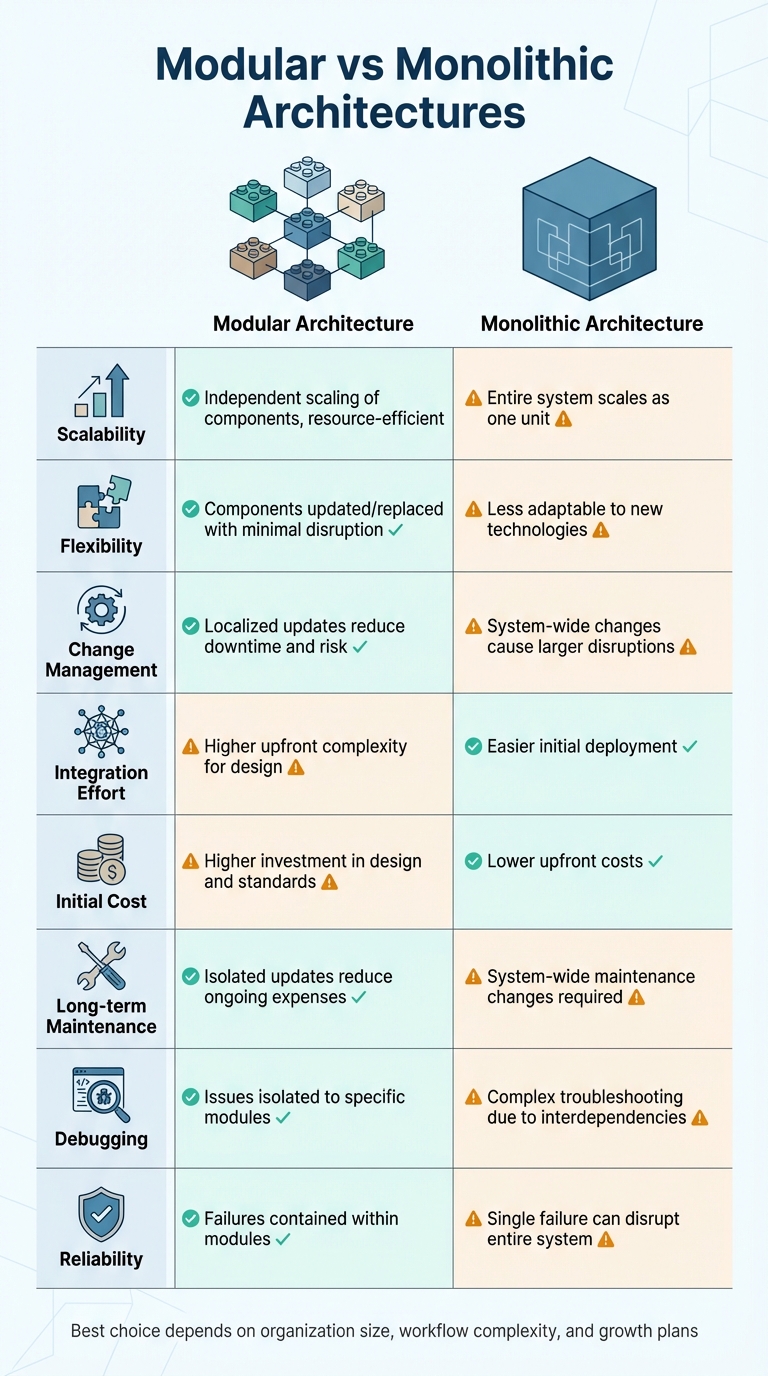
Modular vs Monolithic Workflow Automation Architecture Comparison
Building on the foundational principles of modular architectures, this approach offers a range of benefits and trade-offs, particularly relevant to the UAE's dynamic business landscape.
Key Benefits for UAE Organisations
Modular workflow automation allows businesses in the UAE to scale specific process modules independently, ensuring efficient allocation of cloud resources. For instance, during high-demand periods like Ramadan or the Dubai Shopping Festival, retailers can expand fulfilment modules without scaling the entire system, optimising cloud spending in AED. This flexibility is especially useful for industries like hospitality, aviation, and retail, which often face seasonal fluctuations.
Another advantage is the ability to adapt quickly to regulatory changes and market demands. For example, if the UAE Central Bank updates reporting standards or the Federal Tax Authority revises VAT regulations, organisations can adjust specific compliance modules without disrupting other operations. This modularity also enables faster development, testing, and deployment, which is crucial for AI-driven automation experiments. Multi-entity businesses operating across mainland UAE and free zones can share core modules - like finance or procurement - while integrating entity-specific compliance modules, reducing duplication and effort.
Troubleshooting is also simplified, as issues can be isolated within individual modules rather than combing through an interconnected system. This localisation of updates not only cuts maintenance costs but also allows for incremental improvements, helping organisations manage both capital and operational expenditures more effectively.
However, while these benefits are significant, modular architectures come with their own set of challenges.
Potential Challenges and Trade-Offs
Adopting a modular architecture typically requires higher initial investment in design, integration standards, and governance frameworks. For instance, defining clear module boundaries, establishing consistent data contracts, and creating robust APIs are critical to preventing integration complexities and avoiding module sprawl, where duplicated functionalities increase maintenance burdens.
This shift also necessitates organisational change. Teams must move from project-based approaches to a product-oriented mindset, taking ownership of specific modules. This transition demands closer collaboration between IT, business, and compliance teams. Managing governance - especially for versioning, testing, and deployment - becomes more complex, as changes to shared modules can impact multiple business units or legal entities. For organisations with smaller teams or stable workflows, sticking with a monolithic system may initially prove more cost-effective.
Comparison Table: Modular vs Monolithic Architectures
Here’s a quick comparison of modular and monolithic architectures to highlight their key differences:
| Aspect | Modular Architecture | Monolithic Architecture |
|---|---|---|
| Scalability | Allows independent scaling of components, saving resources | Scaling requires treating the entire system as a single unit |
| Flexibility | Components can be updated or replaced with minimal disruption | Less adaptable to new technologies or requirements |
| Change Management | Localised updates reduce downtime and risk | System-wide changes may lead to larger disruptions |
| Integration Effort | Higher upfront complexity for design and integration | Easier to deploy initially |
| Initial Cost | Higher investment required for design and standards | Lower upfront costs |
| Long-term Maintenance | Isolated updates reduce ongoing maintenance expenses | Maintenance often involves system-wide changes |
| Debugging | Issues can be isolated to specific modules | Troubleshooting is more complex due to interdependencies |
| Reliability | Failures are contained within individual modules | A single failure can disrupt the entire system |
This table underscores the trade-offs between the flexibility and scalability of modular systems versus the simplicity and lower initial costs of monolithic ones. Each organisation must weigh these factors based on its specific needs and resources.
Designing Modular Workflow Automation with Wick's Four Pillar Framework
Wick's Four Pillar Framework offers a practical approach to modular architecture, enabling UAE businesses to implement scalable and flexible workflow automation. Each module in this framework is designed to operate independently, making it easier to adapt and grow.
Mapping Modular Principles to Wick's Framework
The framework divides automation into four distinct modules, each with a well-defined role, inputs, outputs, and performance metrics:
- Build & Fill: This module manages digital assets like websites, landing pages, and tracking systems. These assets are foundational and consumed by other modules.
- Plan & Promote: Acting as the campaign orchestrator, this module coordinates workflows across platforms such as email, paid media, and social channels, without embedding platform-specific logic.
- Capture & Store: This is the data and integration hub, handling data ingestion, identity resolution, and storage. It provides reusable services accessible through standardised schemas.
- Tailor & Automate: Focused on decision-making and automation, this module uses data and AI models to personalise customer journeys. It remains loosely coupled to other systems through event triggers or APIs.
This modular design allows UAE organisations to update or replace individual pillars without disrupting the entire system. For example, a retailer in Dubai could switch its email service provider within the Tailor & Automate module while keeping its data structure in Capture & Store and campaign planning in Plan & Promote intact. This flexibility creates a robust foundation for integrating data and AI to improve automation.
Using Data and AI for Modular Automation
Wick integrates AI-driven personalisation into the Tailor & Automate module as reusable services accessible via APIs. These services handle tasks like next-best-offer recommendations, send-time optimisation, churn prediction, and budget allocation. This setup allows the Plan & Promote module to dynamically request decisions during campaign orchestration.
The modular AI approach means organisations can experiment with different algorithms - such as testing recommendation models tailored to UAE shoppers’ preferences for Arabic or English content - without affecting the system's overall logic. AI models are trained on aggregated data from Capture & Store and are fine-tuned to reflect seasonal trends, like Ramadan shopping patterns or weekend sales peaks in the UAE. This structure enhances flexibility, allowing each AI service to scale independently and be updated safely.
Governance and Continuous Optimisation
To ensure the framework operates effectively, each module is governed with clear accountability and performance metrics:
- Capture & Store: Overseen by Data & Insights, with KPIs like event capture rates and data latency.
- Tailor & Automate: Managed by Marketing Automation, focusing on metrics such as conversion rates and model accuracy.
- Plan & Promote: Directed by Growth teams, tracking campaign cycle times and AED budget efficiency.
- Build & Fill: Evaluated based on page speed and form completion rates.
Dashboards provide UAE stakeholders with the ability to filter data by brand, emirate, or language, and alerts are triggered when performance metrics fall below expectations. This governance model also supports controlled experiments, such as A/B testing within the Tailor & Automate module, without affecting the stability of other modules. This enables safe, incremental improvements while maintaining system integrity.
Conclusion
Modular workflow automation architectures simplify complex processes by breaking them into independent, reusable components that connect through standardised interfaces. For businesses in the UAE, this approach offers the flexibility to scale specific modules, update systems seamlessly, and respond quickly to market shifts - key advantages in fast-paced industries like logistics, finance, and e-commerce. These benefits are rooted in the foundational principles of modular design.
The principles of clear module boundaries, loose coupling, and high cohesion empower organisations to innovate while maintaining control. Instead of overhauling entire systems, businesses can replace or upgrade individual components, reducing downtime and long-term costs.
For UAE organisations working toward Vision 2030 and the National AI Strategy 2031, modular architectures provide a solid groundwork. They align with the UAE’s digital transformation goals by supporting compliance with local data regulations, enabling real-time analytics for AED-based budgeting, and allowing teams to develop in parallel. Whether it’s managing increased demand during Ramadan or streamlining supply chains in free zones, modular systems adapt without requiring a complete system overhaul.
Building on these modular principles, Wick's Four Pillar Framework offers a practical guide for implementation. By organising Build & Fill, Plan & Promote, Capture & Store, and Tailor & Automate into distinct yet interconnected modules, UAE businesses can experiment with AI models, optimise campaigns, and maintain system stability. This approach turns fragmented digital efforts into cohesive, efficient strategies that drive growth.
While setting up a modular system requires an upfront investment in documented interfaces, the long-term rewards - scalability, easier maintenance, and cost savings - equip UAE organisations to thrive in an ever-evolving market.
FAQs
How do modular workflow automation systems benefit businesses in the UAE?
Modular workflow automation systems provide businesses in the UAE with an effective way to improve efficiency, cut costs, and scale operations in a way that suits their specific needs. By incorporating AI-powered tools and consolidating customer data, these systems simplify processes and enable smarter decision-making.
What sets these systems apart is their ability to align with the UAE's distinct cultural and business requirements. From handling currency in AED to using metric measurements and crafting personalised marketing strategies, they ensure businesses can offer tailored and meaningful customer experiences. This not only strengthens customer relationships but also supports long-term growth in a competitive market.
What are the essential principles for designing modular workflow automation architectures?
Designing modular workflow automation architectures calls for a well-thought-out strategy to ensure systems are efficient, scalable, and flexible. Here are some key principles to keep in mind:
- Independence of modules: Each module should operate on its own, making it easier to adjust or scale individual components without disrupting the entire system.
- Standardised integration: Consistent use of APIs and uniform data formats ensures smooth communication between different modules.
- Reusability: Build modules that can serve multiple workflows. This approach not only reduces development time but also cuts down on resources.
- Adaptability: Design modules to be easily updated or extended, so they can keep up with new requirements or changes.
- Clear responsibilities: Define specific roles for each module. This simplifies maintenance and makes troubleshooting more straightforward.
- Automation-focused design: Prioritise automating repetitive tasks and ensure modules coordinate seamlessly to boost overall efficiency.
By applying these principles, organisations can create systems that not only streamline operations but also evolve effortlessly with changing demands.
What obstacles might UAE businesses encounter when adopting modular workflow systems?
UAE businesses encounter a range of hurdles when implementing modular workflow systems. One major challenge lies in seamlessly integrating various digital tools with their existing infrastructure. Additionally, ensuring data security and privacy while adhering to local regulations remains a critical concern. Another key issue is establishing smooth communication between different system modules, which is essential for efficient operations.
Cultural considerations also play a significant role. Factors such as language preferences, regional business norms, and customer expectations can add layers of complexity to the process. To navigate these challenges, businesses should focus on a tailored, data-driven strategy that respects the UAE's unique market dynamics and regulatory landscape.