

Blog / Mobile SEO Trends in GCC Markets 2025
Mobile SEO Trends in GCC Markets 2025
Mobile SEO is no longer optional in the GCC. With over 90% smartphone penetration in the UAE and Saudi Arabia and internet speeds averaging 125 Mbps, users demand fast, mobile-friendly experiences. By 2025, search rankings are determined by mobile site performance, and user expectations are higher than ever.
Key takeaways:
- Core Web Vitals: Your site must load fast (LCP under 2.5 seconds), respond quickly (INP under 200ms), and maintain visual stability (CLS below 0.1).
- Voice Search Growth: Voice queries are rising, with 40–50% annual growth in the GCC. Optimise for Arabic dialects and conversational phrases.
- Video & Visual Search: Platforms like TikTok, YouTube, and Google Lens are becoming search tools. Use high-quality visuals, geo-tags, and bilingual captions.
- AI & Personalisation: AI tools like BERT and MUM prioritise intent-based search, making Answer Engine Optimisation (AEO) crucial. Personalised content tailored to GCC-specific needs builds trust and engagement.
- Arabic SEO: With Arabic content still underrepresented online, optimising for both Modern Standard Arabic and Gulf dialects offers a competitive edge.
The GCC’s mobile-first landscape is evolving rapidly. Brands that prioritise speed, local relevance, and user experience will thrive, while those that don’t risk losing visibility and revenue.
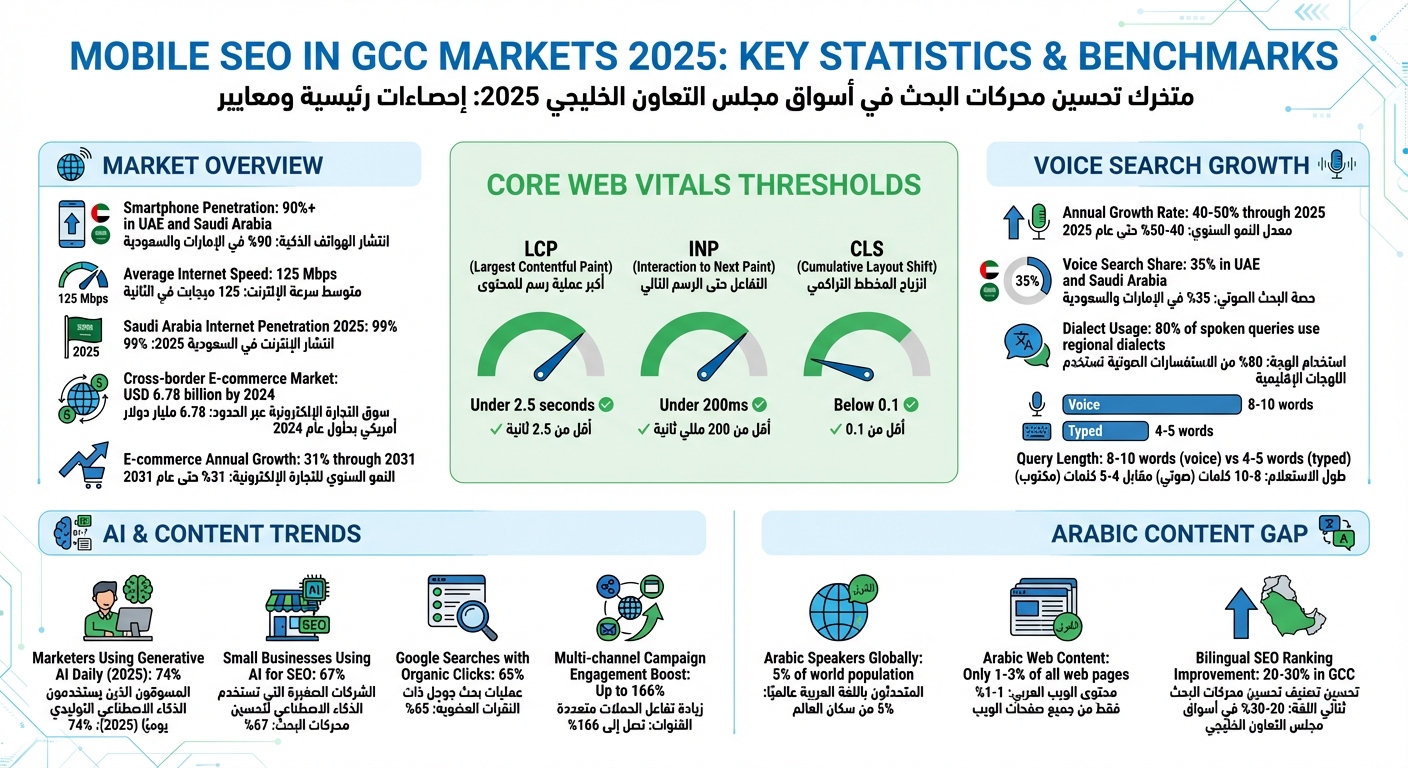
Mobile SEO Statistics and Core Web Vitals Benchmarks for GCC Markets 2025
Master On-Site SEO and Mobile Responsiveness for 2025 success!
Core Web Vitals and Mobile Page Speed
Getting mobile performance right is crucial for thriving in the GCC's mobile-driven search landscape. Google's Core Web Vitals focus on three key metrics that influence mobile rankings: Largest Contentful Paint (LCP), which measures how quickly the main content loads; First Input Delay (FID) - soon transitioning to Interaction to Next Paint (INP) - which tracks page responsiveness; and Cumulative Layout Shift (CLS), which evaluates visual stability. In the GCC, where mobile internet speeds average 125 Mbps in Saudi Arabia and smartphone usage exceeds 90% in the UAE, these metrics matter immensely.
Picture this: a user in Dubai or Riyadh clicks on a product page expecting instant responsiveness. If your LCP is slower than 2.5 seconds, your FID/INP exceeds 200 milliseconds, or your CLS is above 0.1, Google takes note - and so do your users, often by leaving. Common culprits include oversized images and ads that load late. Solutions? Compress images with formats like WebP or AVIF, preload essential visuals, and ensure banners have fixed spaces - especially on right-to-left (RTL) Arabic interfaces - to maintain stability.
These metrics aren't just technical details - they directly shape user experience and influence load times.
Fast Load Times for GCC Users
Slow-loading pages stand out for all the wrong reasons. Users now compare web experiences to the near-instant responsiveness of mobile apps. If a bilingual product page takes more than a couple of seconds to load, shoppers are likely to abandon it for a smoother alternative. Cutting load times from 4 seconds to under 2.5 seconds can significantly improve conversion rates, especially during high-demand periods.
To assess performance, use a mix of real-world data from the Chrome User Experience Report and Google Search Console's Core Web Vitals report, alongside lab tests in PageSpeed Insights configured for mid-range Android devices common in the GCC. This combination provides a clear picture of how users in cities like Sharjah, Jeddah, or Doha experience your site, beyond controlled test environments. Translating these improvements into business terms - like connecting a 20% better LCP score to increased revenue in AED during a campaign - can make technical tweaks more relevant to business goals.
While speed is non-negotiable, other strategies like AMP also play a role in the region.
AMP Adoption in GCC Markets
Although Accelerated Mobile Pages (AMP) no longer guarantee higher rankings, some GCC news sites and content platforms still rely on AMP to ensure fast, straightforward performance, especially when internal engineering resources are limited. In e-commerce, AMP adoption is more selective. Brands often use it for ad landing pages or content hubs while keeping primary checkout processes on their main sites.
Looking ahead to 2025, many decision-makers in the region see AMP as one tool among many for achieving strong Core Web Vitals. Increasingly, businesses are investing in modern, mobile-first approaches like Progressive Web Apps (PWAs) or headless storefronts. These options deliver comparable or even better speed without AMP's design restrictions - ideal when personalisation and AI-driven features are central to their strategy.
Voice Search for Arabic Dialects
In the GCC region, the growing use of mobile devices is driving a surge in voice search through AI assistants. Just like mobile performance metrics, optimising voice search requires a customised approach tailored to this unique market.
One of the biggest hurdles is recognising dialects. While Modern Standard Arabic (MSA) serves as a common ground, about 80% of spoken queries are made in regional dialects. For instance, Gulf Arabic is prevalent in the UAE, while Saudi Arabia has its own distinct dialects, varying between cities like Riyadh and Jeddah. These dialects differ in vocabulary, pronunciation, and sentence structure, making it challenging for speech recognition systems to interpret them accurately. As a result, users often mix MSA, local dialects, and even English within a single query. When misinterpretations occur, they might switch to formal Arabic to get better results.
Voice search use is on the rise and shows no signs of slowing down. Projections suggest that voice search in the GCC will grow by 40–50% annually through 2025, with the UAE and Saudi Arabia contributing around 35% of searches conducted via voice. Users are increasingly turning to voice assistants for immediate, location-specific needs, asking questions like "أفضل مطعم سوشي قريب مني في دبي؟" (Best sushi restaurant near me in Dubai?) or "شلون أروح لمول الإمارات اليوم؟" (How do I get to Mall of the Emirates today?). These conversational, natural queries differ significantly from typed searches, pushing mobile SEO strategies to focus more on long-tail, question-based content.
Conversational Search Query Patterns
The rapid expansion of voice search is shifting how queries are structured, favouring more naturally phrased and conversational language. Spoken queries are typically longer - averaging 8–10 words compared to 4–5 for typed searches - and often include regional slang or casual expressions[13]. For example, a user in Abu Dhabi might say, "يا جماعة، أي بنك مفتوح الحين في أبوظبي؟" (Hey everyone, which bank is open now in Abu Dhabi?) when seeking immediate information. This shift from keyword matching to understanding intent calls for semantic SEO and long-tail keyword strategies.
Content should reflect natural speech patterns. For example, framing queries like "Where can I find the best falafel restaurant near me in Riyadh?" or "وين ألقى أحسن مطعم فلافل قريب مني في الرياض؟" can make a big difference. Structuring content with clear Q&A sections and incorporating schema.org markup - especially FAQPage and Speakable schemas - can increase the chances of being featured as the spoken response by voice assistants.
Regional Voice Search Optimisation
To fully harness the potential of conversational voice search, digital strategies must account for regional dialects. Start by creating FAQ pages tailored to how Emirati, Saudi, or Qatari users naturally phrase their questions. Use schema.org markup to highlight these answers for search engines. Additionally, implement hreflang tags for ar-AE to ensure UAE-based queries are matched with the right content. Geo-targeted structured data, such as LocalBusiness schema, can further enhance accuracy for location-specific details like operating hours and contact information.
Regular testing is essential. Tools like Google’s Speech-to-Text API can help evaluate how well your content aligns with transcribed voice queries. Testing key phrases using Google Assistant or Siri in the UAE can also reveal which information is spoken aloud. Monitoring voice search impressions in Google Search Console, along with tracking referral traffic and featured snippet performance, provides valuable insights into conversational query trends. Tools like AnswerThePublic, which supports Arabic language variants, can uncover emerging voice search patterns in GCC markets[13].
Consultancies like Wick use data-driven approaches to align SEO and AEO strategies with actual voice-query behaviours. For instance, Wick's AEO strategy significantly improved engagement for Qatar's leading dairy producer by managing their digital ecosystem, including UX/UI updates, website maintenance, and social media strategies.
Visual and Video Search
Following the trends of mobile performance and voice search, visual and video search have become essential tools for engaging audiences in the GCC region. Platforms like YouTube Shorts, TikTok, and Instagram Reels are no longer just for entertainment; people now use them to search for products and services. For instance, in the UAE and Saudi Arabia - where smartphone usage exceeds 90% - users search directly on platforms like TikTok or YouTube for terms such as "best smartphones in Dubai" or "Abaya styles 2025 UAE". This change means brands need to expand beyond Google and optimise their video content across these platforms to catch the attention of users actively searching for specific products or services.
Google Lens is also gaining popularity, especially among younger, tech-savvy users. By pointing their cameras at items like clothing, home décor, or even restaurant menus, users can instantly identify products and find nearby businesses. To capitalise on this, brands should ensure product images are clear, high-quality, and feature recognisable local settings, such as Dubai's malls or the UAE skyline. Image file names and alt text should include both Arabic and English keywords with location tags, like "gold-kandora-dubai-uae.jpg", paired with alt text such as "Emirati man wearing gold kandora in Dubai, UAE". Adding product schema with AED prices, availability, and reviews makes it easier for search engines to connect these images to shoppable products via Google Lens.
Arabic Transcriptions and Geo-Tags
Arabic transcriptions and subtitles play a key role in helping algorithms on platforms like YouTube and TikTok understand spoken content, improving keyword matching and topic relevance for GCC viewers. Including both Modern Standard Arabic and Gulf dialects in captions ensures alignment with local voice and text search habits. Using time-coded SRT files in Arabic and English not only improves accessibility but also boosts completion rates - a factor that platforms use to rank videos. For short-form content, creators should leverage native captioning tools and include concise, keyword-rich Arabic descriptions along with UAE-specific hashtags like #دبي and #ابوظبي to connect with local audiences.
Geo-tagging videos with precise UAE locations, such as Dubai Marina or Abu Dhabi Corniche, helps platforms identify content as locally relevant, increasing its visibility in "nearby" or city-specific feeds. For businesses like restaurants or retail stores, combining geo-tags with visuals of recognisable landmarks and Arabic signage strengthens the local context for both users and algorithms. Consistency across video metadata - titles, descriptions, hashtags (e.g., #DubaiFood or #UAEStyle), and a linked Google Business Profile - further enhances local SEO signals. For brands operating across the GCC, creating separate playlists for each country with relevant geo-tags and AED pricing for UAE content ensures videos are easily associated with the right market.
Video SEO for E-Commerce
Short vertical videos showcasing product demos, unboxings, and try-ons perform exceptionally well in driving engagement and clicks to product pages, especially when designed for mobile-first platforms. Live shopping streams and time-sensitive promotions during Ramadan and Eid are particularly effective, as they tap into the region's cultural rhythms and sense of urgency. Videos with high watch times, repeated views, and shares also send strong authority and relevance signals to platforms, boosting visibility. With cross-border e-commerce in the GCC projected to hit USD 6.78 billion by 2024 and growing at 31% annually through 2031, video SEO is becoming a cornerstone for brands looking to thrive in this space.
To maximise impact, product videos should feature eye-catching thumbnails that clearly display the items in use. Incorporating visuals that resonate locally - such as modest fashion or family-oriented settings - along with Arabic or bilingual text overlays summarising key benefits can significantly improve engagement. Titles and descriptions should include targeted commercial keywords paired with local modifiers like "buy online in UAE", "price in AED", or specific city names to match GCC search habits. Additionally, using VideoObject schema on product and landing pages - complete with details like name, description, thumbnail URL, duration, and embed URL - enables Google to feature rich video snippets in mobile search results, especially for how-to and review queries. Grouping related videos into category-specific playlists, such as "UAE Electronics Reviews" or "Abaya Collection 2025", creates topical clusters that platforms like YouTube can easily recommend to users.
sbb-itb-058f46d
AI-Powered Personalisation and AEO
AI is reshaping how search results work in the GCC, building on mobile performance and natural language trends. Google's AI models, BERT and MUM, are now central to mobile search in the region. BERT focuses on understanding natural, conversational queries, which is particularly useful in places like the UAE, where people often search using a mix of Arabic and English or informal phrases on mobile devices. MUM takes this further by handling multiple content types - text, images, and video - while also linking related queries across languages like Arabic and English. For brands in 2025, this means moving beyond basic keyword strategies. Instead, they must organise content around specific search intents, whether users are seeking information, comparing products, ready to make a purchase, or looking for local details like "open now near Dubai Marina".
This shift also highlights the importance of Answer Engine Optimisation (AEO), a strategy designed to deliver direct answers on mobile. AEO doesn’t just aim to rank content high in search results; it focuses on being the go-to response for AI assistants, chatbots, and featured snippets. In GCC markets, where 74% of marketers globally are projected to use generative AI daily by 2025, AEO is becoming a must-have. To succeed, brands need to structure their content with clear Q&A sections, concise explanations, and proper schema markup.
AI-driven personalisation is another game-changer for mobile SEO in the GCC. By using first-party data from sign-ups, loyalty programs, or WhatsApp, brands can customise content, recommend products, and even adjust language settings. For example, a retailer in Dubai could personalise product recommendations and AED pricing based on whether the user is an Emirati national or an expatriate. They could also promote weekend offers tailored to local shopping habits. This level of personalisation not only boosts engagement and conversions but also aligns with regional privacy standards through clear, consent-based practices.
AI for Dialect Recognition
AI is now fine-tuning search results by recognising local dialects, a crucial feature in the GCC, where Gulf Arabic dialects are widely used. Users often combine Arabic and English or include region-specific terms like "Salik", "Ejari", or "khaliji style". AI-powered dialect recognition ensures these queries are interpreted correctly, even when English brand names are mixed with Arabic words or slang. To optimise for this, content teams should focus less on simple keyword lists and more on how AI interprets dialectal phrases. Using FAQ schema and LocalBusiness markup can help AI models map these phrases to relevant services or locations, such as specific emirates or neighbourhoods. Additionally, voice-search-ready phrasing - like "How much is Salik in Dubai?" or "Where can I renew my car registration in Abu Dhabi?" - ensures smoother matches between spoken queries and online content.
SEO vs. AEO in GCC Markets
SEO and AEO serve different purposes but complement each other in GCC markets. SEO focuses on driving rankings and clicks, measured through metrics like impressions, rankings, and on-site engagement (e.g., time on page and AED conversions). AEO, on the other hand, is about delivering direct answers, evaluated by off-site visibility and how often AI platforms cite the content.
SEO relies on personalisation through first-party data and segmentation, while AEO depends on AI platforms that provide tailored answers before users even click. This requires content that resonates with both Arabic and English-speaking audiences. SEO strategies often include optimised pages, blogs, and structured category pages. In contrast, AEO demands concise answer blocks, clear FAQs, how-to guides, and schema-enriched content that AI models can easily extract.
With 65% of Google searches resulting in organic clicks and 67% of small businesses globally using AI to enhance SEO, GCC brands that combine both approaches are better positioned to capture attention across traditional search results and AI-driven answer platforms. Tools like Wick's unified digital ecosystem, which integrates SEO, analytics, and AI-driven personalisation, can help brands stay ahead. These AI-powered strategies also build on earlier trends in mobile speed, voice search, and visual search across the GCC.
Arabic SEO and E-E-A-T Signals
Google's E-E-A-T framework - Experience, Expertise, Authoritativeness, and Trustworthiness - is a critical factor shaping mobile SEO strategies in the GCC. With Arabic speakers accounting for about 5% of the world’s population but Arabic content making up only 1–3% of web pages, there’s a massive gap waiting to be filled by brands that prioritise Arabic SEO. But succeeding in this space takes more than just translation - it requires localised trust signals that resonate with GCC audiences, especially on mobile, where over 90% of users browse the web.
E-E-A-T becomes even more crucial for YMYL (Your Money or Your Life) topics, such as finance, healthcare, government services, and religious content. These subjects are highly sought after on mobile devices in the UAE and Saudi Arabia. To build credibility, brands should showcase regional expertise through Arabic author bios with relevant credentials, GCC-specific case studies featuring AED figures, and visible trust indicators like UAE government approvals or chamber memberships. Leveraging structured data to clearly present authorship and business information further reinforces these trust signals, ensuring content resonates with GCC mobile users.
Trust also hinges on creating mobile experiences tailored to local preferences. This means employing right-to-left layouts, Arabic fonts optimised for mobile, and imagery that reflects local culture. Messaging aligned with regional holidays and traditions also plays a big role. GCC users often check for tangible trust indicators like UAE trade licences, local addresses (e.g., Dubai, Abu Dhabi), and regional phone numbers before making online transactions.
Arabic vs. English Mobile SEO
While local trust signals are vital, understanding the differences in how users search in Arabic versus English is just as important. Optimising for both languages in the GCC requires distinct strategies, each with unique challenges and advantages. For instance, Arabic keyword clustering needs to consider dialect variations - such as Gulf Arabic phrases like "مطاعم دبي" (Dubai restaurants) - and right-to-left text alignment. On the other hand, English SEO focuses on long-tail phrases in Latin script, like "best cafes in Dubai". Tools like SEMrush can help identify high-volume Arabic terms and common transliterations (e.g., "shawarma"), while English SEO often targets global search volume with geo-specific phrases like "Affordable Housing in Riyadh."
A bilingual approach can significantly enhance mobile rankings in competitive GCC markets, with regional SEO studies reporting improvements of 20–30%.
| Aspect | Arabic Mobile SEO | English Mobile SEO |
|---|---|---|
| Competition | Lower content volume makes ranking easier for well-optimised sites. | High competition, especially for generic and commercial terms. |
| User Expectations | Requires RTL layout, Arabic UI, and local cultural elements - even if users search in English. | Familiar interface for expats and professionals; influenced by global UX norms. |
| Keyword Behaviour | Mix of Modern Standard Arabic, Gulf dialects, and transliterations; emphasis on local terms. | Consistent global terminology; relies heavily on brand and category keywords. |
| E-E-A-T Signals | Strong focus on visible local presence, Arabic bios, and regional authority due to limited high-quality Arabic content. | Broader pool of established authorities; more reference signals like backlinks and citations. |
| Technical Implementation | Complex (e.g., RTL, Arabic fonts, hreflang ar/en) but yields high engagement and trust. | Simpler setup; often prioritised by global brands at the expense of tailored Arabic experiences. |
| Business Impact | Higher conversions among locals due to relevance and trust; ideal for public-sector and regulated industries. | Strong appeal for tourists, expats, and B2B audiences but may underperform with locals if Arabic content is lacking. |
Building Trust with GCC Audiences
To win over GCC audiences on mobile, brands need localised content paired with culturally relevant user experiences. Start by creating mobile-friendly Arabic content that uses Modern Standard Arabic for broader reach, while incorporating Gulf dialect terms where relevant. Ensure layouts are right-to-left and use Arabic fonts that display well on mobile devices.
When researching keywords, avoid direct translations between Arabic and English. Instead, focus on native Arabic terms, popular transliterations (e.g., "shisha", "Dubai mall timings"), and location-based modifiers specific to the UAE, such as "in Dubai Marina" or "near BurJuman".
Strengthen E-E-A-T by publishing GCC-specific case studies and testimonials, including client names, locations, and AED figures when possible. Display trust badges like UAE government approvals, media features, or industry awards. Fully optimise Google Business Profiles in both Arabic and English, ensuring they include UAE addresses, Arabic descriptions, and 24-hour format opening times. Fast-loading pages are a must for GCC mobile networks, so use techniques like image compression, lazy loading, and CDNs. Adding Arabic CTAs (e.g., "اشتر الآن", "تواصل معنا اليوم") and offering Arabic customer support options further enhance trust.
Finally, align your content strategy with key GCC moments. Create in-depth Arabic guides and FAQs around Ramadan, Eid, back-to-school, and UAE National Day. Support this content with expert insights, such as advice from nutritionists for fasting or financial planners for Zakat-related topics. For companies like Wick, integrating Arabic SEO with data-driven strategies and AI personalisation can solidify E-E-A-T signals throughout the mobile user journey, ensuring trust and credibility at every interaction.
Conclusion
GCC mobile SEO is now laser-focused on tailoring strategies to user-specific behaviours, from voice searches in Gulf Arabic to visual queries and AI-driven responses. With smartphone usage surpassing 90% in the UAE and Saudi Arabia, and internet penetration in Saudi Arabia expected to hit 99% by January 2025, businesses that overlook mobile-first strategies risk falling behind in this fast-growing market.
As mobile technology advances, the demand for precise, answer-focused content is soaring. The transition from traditional SEO to Answer Engine Optimisation (AEO) is reshaping how users discover information. By 2025, 74% of marketers globally are expected to rely on generative AI for content creation, with tools like ChatGPT and Google Gemini now directly citing sources. For brands, this means producing authoritative, question-driven content that can serve as "answer seeds" for these AI systems. To stay competitive, businesses must optimise for conversational queries, use structured data, and expand their reach beyond Google to platforms like YouTube and TikTok. Multi-channel campaigns on these platforms have been shown to boost engagement by up to 166%.
Voice search, visual cues, and AI personalisation are no longer optional - they’re essential. GCC users demand bilingual Arabic-English content, culturally relevant experiences, and locally optimised tactics. Take Noon, for instance: they effectively use geo-targeted keywords like "Best Online Shopping in Saudi Arabia", localised Ramadan promotions, and Arabic calls-to-action such as "اشتر الآن" to enhance visibility and drive conversions in a cross-border e-commerce market projected to reach USD 6.78 billion by 2024.
To capitalise on these trends, brands should integrate AI for dialect recognition, optimise for voice and visual search using schema markup, and build trust with customised E-E-A-T signals. When combined with mobile-first strategies, a unified approach - blending SEO, AEO, content creation, and AI personalisation - can strengthen digital ecosystems and sustain growth across the GCC.
The businesses that embrace these shifts, leveraging data-backed strategies, local insights, and AI-driven tools, will set the pace. Those who resist change, however, risk being left behind in an ever-evolving digital landscape.
FAQs
How can businesses adapt their SEO strategies for voice search in GCC countries?
To optimise for voice search in GCC countries, businesses should focus on using natural, conversational language that mirrors how people speak. Including local dialects and phrases that resonate with the region's culture can make a big difference. It's also smart to target long-tail keywords and question-based queries since voice searches often come in the form of complete questions or sentences.
Make sure your website is fully mobile-friendly, as most voice searches happen on mobile devices. Using structured data markup can also help search engines better understand your content within the regional context. Don't forget to prioritise localised search terms and consider providing content in Arabic to connect with a broader audience. By tailoring your approach to user intent and regional preferences, you can improve your chances of appearing in voice search results.
How is AI transforming mobile SEO in the GCC region?
AI is transforming mobile SEO in the GCC by introducing smarter strategies and tailored content that align with user preferences. It simplifies optimisation tasks, ensuring websites are not only mobile-friendly but also in sync with the latest search engine requirements.
Through the analysis of user behaviour and search trends, AI boosts engagement and helps improve rankings. For businesses navigating the region's competitive digital market, this technology is becoming a crucial asset.
Why is Arabic SEO important for businesses in the GCC region?
Arabic SEO plays a crucial role for businesses in the GCC by bridging the gap between brands and local audiences through language and cultural alignment. By focusing on Arabic search queries, companies can boost their visibility on search engines, connect more authentically with their audience, and deliver a user experience that aligns with regional preferences.
This approach not only enhances user engagement but also opens up more opportunities for conversions. It signals a brand's dedication to understanding the specific needs of GCC consumers, making it an important strategy for sustained growth in the region.