
Blog / Top Mobile SEO Challenges in Gulf Markets
Top Mobile SEO Challenges in Gulf Markets
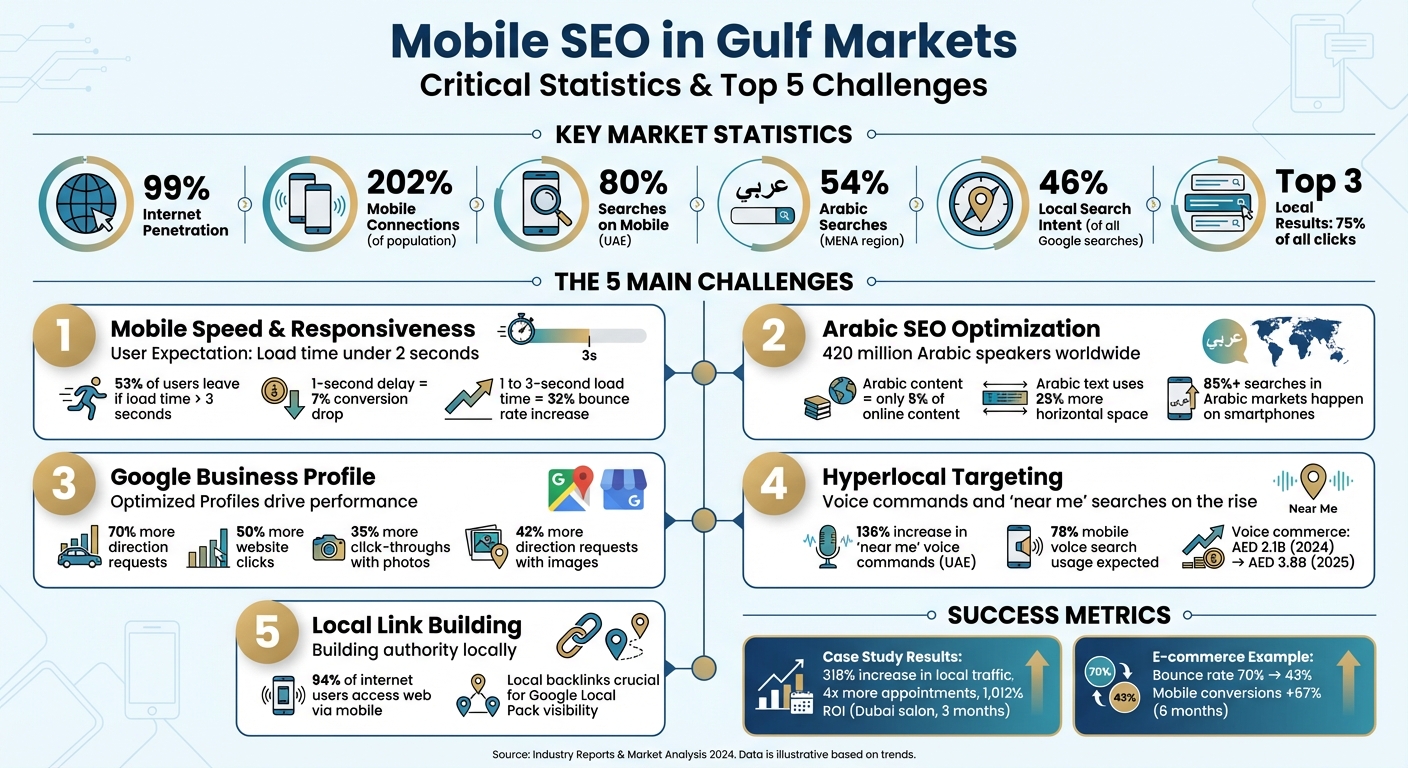
Mobile SEO is critical in Gulf markets like the UAE, where mobile devices dominate online activity. With internet penetration at 99% and mobile connections at 202% of the population, businesses must ensure their mobile platforms deliver fast, user-friendly, and locally relevant experiences. Key challenges include:
- Mobile responsiveness and speed: Gulf users expect websites to load in under 2 seconds, with delays causing higher bounce rates.
- Arabic SEO: With 54% of searches in Arabic, optimising for right-to-left (RTL) layouts, localised keywords, and bilingual content is essential.
- Google Business Profile (GBP): Many businesses fail to maintain complete and consistent profiles, limiting visibility in local searches.
- Hyperlocal targeting: Ignoring neighbourhood-specific keywords and voice search trends leads to missed opportunities.
- Local backlinks: Securing high-quality regional links is difficult but vital for improving local rankings.
Businesses that address these issues can improve mobile visibility, user engagement, and revenue. A focused approach combining responsive design, Arabic localisation, hyperlocal keywords, and strong GBP management is key to a winning content marketing strategy in Gulf markets.
Mobile SEO Statistics and Challenges in Gulf Markets
Challenge 1: Mobile Responsiveness and Page Speed Problems
In the Gulf's mobile-first digital world, ensuring mobile performance isn't just a good idea - it's a necessity. Despite the UAE's advanced mobile infrastructure, many businesses still fall short with websites that lag or fail to adapt to smaller screens. With 53% of mobile users leaving sites that take longer than 3 seconds to load, the stakes couldn't be higher.
How Poor Mobile Responsiveness Affects Rankings
Google now prioritises the mobile version of websites when ranking search results, thanks to mobile-first indexing. If your site forces users to zoom in, hides content, or uses hard-to-read fonts, your rankings are bound to take a hit. As John Mueller, Google's Search Advocate, puts it:
"Mobile-first indexing has become a part of life".
In the UAE, where over 9.6 million people use smartphones, a non-responsive website doesn’t just frustrate users - it sends negative signals to Google, leading to higher bounce rates and lower rankings. On the flip side, optimising metrics like Largest Contentful Paint (LCP) can improve conversion rates, while every extra second of load time pushes more users away.
Page Speed Expectations in the Gulf
Gulf users demand fast-loading websites - under 2 seconds, to be exact - a standard driven by the region's cutting-edge digital infrastructure. Compare this to the global average mobile load time of 7–9 seconds in 2026, and it's clear that businesses in the Gulf have a golden opportunity to stand out.
The numbers are telling: a single second delay in page load time can cut conversions by 7%, while moving from a 1 to 3-second load time increases bounce rates by 32%. Google's Core Web Vitals provide clear benchmarks for mobile performance:
- LCP: 2.5 seconds or less
- Interaction to Next Paint (INP): Under 200 milliseconds
- Cumulative Layout Shift (CLS): Below 0.1
Websites that meet these standards often see 24% lower bounce rates and 35% higher conversions.
Solutions for Speed and Responsiveness
To tackle these challenges, start with a responsive web design that uses flexible grids and CSS media queries, ensuring your site adjusts effortlessly to various screen sizes. Include touch-friendly buttons and maintain readable line spacing.
Images are often the biggest culprit behind slow loading times, accounting for up to 78% of a webpage's total weight. Switching to WebP or AVIF formats can shrink image sizes by 25–35% compared to traditional JPEGs. Lazy loading ensures images load only when necessary, speeding up the initial page experience.
Here are additional steps to improve performance:
- Use a Content Delivery Network (CDN) with servers in cities like Dubai, Riyadh, and Doha to cut latency.
- Enable Gzip or Brotli compression to reduce file sizes.
- Minify CSS and JavaScript files and defer non-critical scripts to prioritise essential content.
- For content-heavy pages, adopt Accelerated Mobile Pages (AMP) for near-instant loading.
Lastly, ensure content parity between your mobile and desktop versions. This means identical content, structured data, and metadata to avoid penalties from Google.
As Maram Nuuman, SEO Specialist at Lucidly, says:
"On mobile, speed is the difference between a click and a bounce".
sbb-itb-058f46d
Challenge 2: Arabic SEO Problems for Mobile Users
Speed and responsiveness are just part of the equation for Gulf businesses aiming to improve mobile SEO. Tackling language-specific challenges is equally important, especially in a bilingual digital environment. With 54% of Google searches in the MENA region conducted in Arabic compared to 34% in English, neglecting Arabic optimisation means losing out on a massive portion of your mobile audience. This is especially critical as mobile usage continues to drive commerce. Despite over 420 million Arabic speakers worldwide, Arabic content makes up only about 5% of all online content.
Right-to-Left (RTL) Optimisation Issues
Arabic’s right-to-left (RTL) script introduces unique technical challenges. User interfaces must be mirrored - menus, sidebars, progress bars, and elements like back arrows need to flip direction - while universal components like media controls and social media icons stay as they are.
Bidirectional text, where Arabic is mixed with left-to-right elements like phone numbers, URLs, or English brand names, can disrupt layouts and punctuation. If not handled correctly with <bdi> tags or CSS properties like unicode-bidi: isolate, these mixed directions can confuse users. GTECH highlights the importance of addressing these issues:
"Failure to optimise for critical elements of the right-to-left experience may greatly limit your ranking".
Arabic text also takes up 25% more horizontal space than English, which can distort layouts designed for Latin scripts. On mobile, Arabic fonts must be at least 14px to remain legible on small screens.
Beyond these technical hurdles, businesses also need to account for digital marketing trends like language-specific search habits.
Localisation for Arabic and English Users
In Gulf markets, translation alone doesn’t cut it. Keywords perform differently depending on the language and region. For example, "mobile phone" is searched as "جوال" (jawwal) in Saudi Arabia but "موبايل" (mobile) in Egypt and Jordan. This means Arabic and English require separate keyword strategies rather than relying on direct translations.
Search behaviours also vary. Arabic queries are often conversational or phrased as questions starting with "How" or "What is", while English searches tend to be shorter and more transactional. With over 85% of searches in Arabic-speaking markets happening on smartphones, tailoring content to these patterns is crucial.
Adapting content for Arabic users - rather than just translating it - can increase monthly traffic by 10% to 20%. This involves more than just words; imagery, layout, and tone must also align with audience expectations. Using Modern Standard Arabic (MSA) ensures broad appeal, but incorporating Gulf Arabic dialects for local services can make content more relevant.
Solutions for Arabic SEO
Bridging the gap between technical optimisation and cultural relevance requires a mix of strategies. Start with proper technical implementation: add the dir="rtl" attribute to your HTML tag and use hreflang tags (e.g., ar-AE for Arabic in the UAE) to guide search engines in serving the right language version. Structure URLs with language-specific subdirectories like /ae-ar/ and /ae-en/ to improve navigation for both users and search engines.
Choose Arabic-friendly fonts like Janna, Aref Ruqaa, or Katibeh to ensure readability on mobile screens. Adjust line spacing and use selection controls instead of free-text inputs to make typing easier on small devices.
For forms, normalise digit inputs by converting Arabic-Indic digits (٠١٢٣) to Latin digits (0123) on the backend to avoid validation errors. However, for marketing materials, Arabic-Indic digits resonate better with native users, while dashboards and financial data should stick to Latin digits for clarity.
Collaborate with native speakers to adapt content to regional dialects and match local search intent. As GTECH emphasises:
"Arabic localisation is a lot more than a single tick list on your SEO to-do list – it is a growth strategy that cements your presence in one of the most competitive global markets" , often requiring expert digital consulting to execute effectively.
Addressing these language-specific challenges creates a strong foundation for tackling broader mobile SEO issues in the region.
Challenge 3: Poor Google Business Profile Optimisation for Mobile
After addressing mobile SEO and technical improvements, the next step is ensuring your business is easy to find in mobile searches. With around 80% of searches in the UAE happening on smartphones, your Google Business Profile (GBP) acts as your mobile storefront. Unfortunately, many businesses in the Gulf region leave their profiles incomplete or inconsistent, which can seriously harm their visibility in mobile search results.
Why GBP Is Critical for Local Mobile SEO
Local searches dominate mobile usage in Gulf countries. About 46% of all Google searches have local intent, with users frequently searching for services "near me" or in specific areas like Dubai Marina or Business Bay. The competition for visibility is fierce: the top three local search results grab 75% of all clicks.
Businesses with active and well-maintained GBPs perform far better. For example, companies with optimised profiles can see up to 70% more direction requests and 50% more website clicks compared to inactive ones. Take the case of a luxury salon in Dubai that struggled with low local visibility. By working with a digital marketing agency in 2025, they implemented a bilingual content strategy, added high-quality photos, and integrated local keywords into their GBP. The result? A 318% increase in local blog traffic, four times more walk-in appointments, and a 1,012% ROI in just three months.
Another key factor is accurate business hours. Profiles often lose visibility during "closed" hours, so keeping your schedule updated is crucial for users searching in real time. Additionally, in competitive markets like Dubai, a fully verified and optimised GBP is a must for running Local Services Ads.
Common GBP Optimisation Mistakes
Inconsistent Name, Address, and Phone (NAP) details can hurt your rankings. When your information varies across platforms, Google may lose trust in your profile, which can negatively impact visibility. SEO consultant Sadiq Saleem explains:
"Inconsistent NAP (Name, Address, Phone) details are a primary ranking killer".
| Element | Common Mistake | Best Practice for Mobile SEO |
|---|---|---|
| Business Name | Keyword stuffing (e.g., "Best Cafe Dubai") | Use your official business name only |
| Photos | Using stock or low-quality images | Upload high-quality, unique, real-time photos |
| Reviews | Ignoring negative feedback | Respond professionally to all reviews within 48 hours |
| Categories | Selecting only one broad category | Choose one specific primary and up to nine secondary categories |
| Posting | No updates for months | Post updates, offers, or news at least once a week |
Other common errors include keyword stuffing in business names, selecting overly broad categories, and neglecting visual content. Profiles with photos see 35% more click-throughs and 42% more direction requests compared to profiles without images. Additionally, many businesses in the Gulf fail to optimise their profiles in both Arabic and English, missing out on a large segment of the local audience.
How to Optimise GBP for Mobile
To boost your mobile visibility, ensure that your NAP details are consistent across all platforms. Using a local UAE landline (with the +971 code) can also help build trust with residents. Choose a specific primary category, like "Italian Restaurant" instead of just "Restaurant", to improve your relevance in niche searches.
Regularly upload high-quality, authentic photos - aim for at least three images each of your exterior, interior, team, and products. To improve discoverability, name image files with local keywords, such as "seo-expert-dubai-office.jpg". Keep your profile active by posting weekly updates about offers, events, or news.
Enable the "Messaging" feature to let mobile users text your business directly from search results. Use the Q&A section to address common questions, providing instant clarity. Adding Local Business Schema markup to your website can further help Google display your location, operating hours, and reviews more effectively. Lastly, respond to all reviews within 48 hours - this includes both positive and negative feedback. Research suggests it takes between 30 to 33 positive reviews to offset the impact of a single one-star review.
Challenge 4: Missing Hyperlocal Keyword Targeting
Hyperlocal Keywords in Gulf Markets
In the Gulf's mobile-first world, focusing on hyperlocal keywords is a game-changer. While many businesses aim for broad terms like "restaurant in Dubai" or "plumber in Abu Dhabi", they often overlook the hyperlocal searches happening at the neighbourhood level. Hyperlocal SEO hones in on specific areas like Dubai Marina, Business Bay, Al Nahyan, or Al Barsha, instead of targeting entire cities. And it’s worth noting: 46% of Google searches are local.
The Gulf's diverse audience creates unique search behaviours. A tourist might type "best shawarma near Burj Khalifa", while a resident searches for "AC repair in Dubai Marina". Unlike generic keywords, hyperlocal targeting requires bilingual strategies, especially since 54% of Google searches in the MENA region are in Arabic. Mobile users also prioritise speed and convenience, often using terms like "open now" or "24/7 service" to find instant solutions.
Visibility in local searches is fiercely competitive. The "local pack" - the top three results for local searches - grabs 75% of all clicks. Without optimising for neighbourhood-specific terms, businesses risk missing out on nearby customers actively searching for services. For instance, a dental clinic targeting "dentist in Dubai" faces stiff competition, but narrowing it down to "dentist in Abu Dhabi Al Nahyan" attracts more focused, high-intent traffic. This hyperlocal strategy also lays the groundwork for optimising voice-driven searches.
Voice Search and Mobile Intent
Voice search is rapidly changing how people discover businesses in the Gulf. By 2025, over half of all searches in the Middle East will be voice-based, and the UAE is already seeing a 136% increase in "near me" voice commands, with mobile voice search usage expected to climb to 78%.
Voice queries tend to be conversational, requiring content that mirrors natural language in both Arabic and English. In the UAE, where users often mix Arabic and English in a single query, you might see searches like "Find me a good shawarma place near Business Bay with parking".
Anne Hill from Digital Bee Studio sums up the shift perfectly:
"The digital future of the UAE is multilingual, mobile, and voice-driven. Brands that master both voice search optimisation and Arabic SEO will dominate search results."
Voice commerce is also booming, with transactions forecasted to grow from AED 2.1 billion in 2024 to AED 3.8 billion in 2025. Mobile users increasingly expect quick, actionable results - whether they’re booking appointments, ordering food, or finding directions. Businesses that fail to align their content with these conversational patterns risk losing out on high-intent customers.
How to Optimise for Hyperlocal Keywords
To succeed in hyperlocal SEO, start by building bilingual keyword sets tailored to specific neighbourhoods. Combine your core services with district names, like "AC repair Sharjah Al Majaz" or "أفضل مقهى في دبي". Add proximity markers such as "opposite Mall of the Emirates" to attract users searching near popular landmarks.
Develop dedicated landing pages for each neighbourhood you serve. These pages should highlight local landmarks, events, and neighbourhood-specific promotions to boost geo-relevance. Link these pages to your Google Business Profile and use LocalBusiness Schema markup to help search engines identify your exact location and operating hours.
For voice search, create FAQ pages that answer natural-language questions like "Who is the best dentist near me in Dubai right now?" or "Where can I find 24/7 AC repair in Abu Dhabi?". Ensure your mobile site supports Right-to-Left (RTL) formatting and UTF-8 encoding to cater to Arabic-speaking users. Embed interactive Google Maps on each landing page to make navigation seamless.
Lastly, target "micro-moments" by using modifiers such as "open now", "24/7", or Arabic equivalents like "بالقرب مني" throughout your content and metadata. These time-sensitive keywords capture users with immediate needs, turning hyperlocal searches into real-world visits and sales.
Challenge 5: Weak Local Mobile Link Building
Why Local Backlinks Matter for Mobile SEO
Local backlinks play a critical role in signalling your business's credibility to Google. Securing high-authority links from UAE or Saudi-based websites can significantly enhance your geo-relevance, helping you rank in Google's Local Pack - the coveted top three map results essential for mobile visibility. Considering that over 80% of searches in the UAE are conducted on smartphones, these backlinks are a direct pathway to capturing mobile user attention.
"Location relevance is gold for competitive, high-intent keywords" - Louis Pretorius, Local SEO Consultant
These local backlinks boost your prominence, a crucial ranking factor that Google evaluates alongside relevance and distance. Without them, even the best services can be overshadowed in competitive markets like Dubai, Abu Dhabi, or Riyadh. The real challenge lies in acquiring these valuable links, which we'll delve into next.
Difficulties in Building Local Links
Building quality local backlinks in the Gulf region is no easy feat. Many prominent regional websites maintain strict editorial standards, often rejecting content that feels overly promotional. This means your outreach efforts need to offer well-researched, newsworthy material that provides genuine value. Additionally, bilingual content - catering to both Arabic and English speakers - can not only increase your audience reach but also improve the quality of links you earn.
The competition in bustling hubs like Dubai and Sharjah is fierce, making it harder to secure placements on authoritative platforms. Adding to the complexity, many global SEO tools fail to provide granular insights tailored to Gulf markets, forcing marketers to rely on manual research or specialised local tools. There’s also the risk of falling into the trap of low-quality directories or link farms, which can harm your rankings rather than help them. Understanding these barriers is essential for crafting a successful local link-building strategy.
Link-Building Methods That Work
To tackle these challenges, focus on these effective local link-building strategies:
- Authoritative Local Directories: Start by listing your business on trusted platforms like Yellow Pages UAE, the Dubai Chamber of Commerce, and Bayut. These provide geo-relevant backlinks that strengthen your local presence.
- Regional News Outlets: Pitch expert insights or industry reports to outlets like Arabian Business, Zawya, or Arab News. Earned media from these platforms can significantly enhance your domain authority.
- Local Influencers and Collaborations: Partner with influencers or key opinion leaders on Instagram and TikTok. Through product reviews or collaborations, you can gain natural referral links and amplify your reach.
- Community Sponsorships: Sponsoring local events can earn you mentions on event pages, a valuable source of backlinks.
"Successful link building in the UAE requires a Google UAE-focused, high-quality, and locally relevant approach" - Felix Rose-Collins, CEO of Ranktracker
Additionally, using country-specific domains like .ae or .sa and creating bilingual content assets - such as market research reports or infographics - can attract high-quality links from both Arabic and English-speaking industry leaders. These steps are instrumental in building local authority and maintaining strong mobile visibility.
Using Wick's Four Pillar Framework for Mobile SEO
Addressing mobile SEO challenges effectively requires a unified, well-rounded approach rather than isolated fixes. Wick's Four Pillar Framework offers a structured strategy to tackle responsiveness, Arabic optimisation, local visibility, and link-building. This framework creates a streamlined mobile SEO plan by addressing these challenges collectively.
Build & Fill: Mobile-Friendly Development and Content
The first step is building a responsive website that adapts effortlessly to the UAE's 9.6 million smartphone users. Wick ensures that mobile and desktop content remain consistent, including headings, structured data, and internal links, to maintain rankings under Google's mobile-first indexing. Technical improvements, such as viewport meta tags, image compression using WebP formats, and lazy loading, help achieve the critical 3-second load time threshold to minimise user drop-offs.
This pillar also incorporates RTL (right-to-left) formatting, catering to Arabic-speaking users. Touch-friendly designs with easily tappable buttons and readable typography enhance usability. Additionally, creating bilingual content optimised for both Modern Standard Arabic and Gulf-specific dialects ensures relevance across diverse audiences.
Plan & Promote: Data-Driven SEO and Link Building
This pillar focuses on hyperlocal keyword targeting and building local authority. Wick conducts advanced keyword research tailored to voice search and "near me" queries, which are increasingly common in mobile searches. Google Business Profiles (GBPs) are optimised for both Arabic and English users to boost visibility and engagement metrics.
Efforts to secure backlinks include targeting regional news outlets and trusted local directories such as Yellow Pages Middle East and Dubai.com. Using country-specific domains like .ae or .sa further strengthens local signals. Monitoring regional SERP rankings ensures alignment with Google's dominant market presence in the region.
Strategic planning is complemented by ongoing performance tracking to refine these efforts further.
Capture & Store: Analytics for Mobile Performance
Analytics play a key role in this framework. Wick tracks Core Web Vitals - LCP (Largest Contentful Paint), FID (First Input Delay), and CLS (Cumulative Layout Shift) - to ensure mobile pages load quickly and maintain layout stability. Tools like GA4 and heatmaps identify user drop-off points, helping to fine-tune mobile user journeys.
By focusing on performance metrics, Wick identifies opportunities to enhance mobile retention. Even small improvements in speed can result in noticeable reductions in bounce rates.
| Strategy Pillar | Key Mobile Focus Area | Impact on Mobile SEO |
|---|---|---|
| Build & Fill | RTL Alignment & Responsive Design | Better readability and faster load times for local users |
| Plan & Promote | Bilingual GBP & Hyperlocal Keywords | Increased visibility in Google Maps and local searches |
| Capture & Store | Core Web Vitals & Mobile UX Tracking | Lower bounce rates and improved mobile rankings |
Conclusion: Mobile SEO Opportunities in Gulf Markets
The Gulf region presents immense potential for businesses focusing on mobile SEO, especially in a market where 94% of internet users access the web through mobile devices. However, challenges like poor responsiveness, gaps in Arabic localisation, weak Google Business Profile setups, missing hyperlocal targeting, and limited local link-building efforts often stand in the way. Addressing these issues with a well-rounded mobile SEO plan can lead to substantial improvements.
Take, for example, an e-commerce fashion brand in Dubai. By focusing on speed and user experience, they managed to slash their mobile bounce rate from 70% to 43% and boost mobile conversions by 67% in just six months.
"In the UAE, where digital adoption is high and mobile penetration is off the charts, your website's mobile experience drives local rankings, traffic, and sales." – Louis Pretorius
This highlights how a strong mobile experience directly influences business outcomes.
To succeed, businesses must adopt a mobile-first strategy. With the majority of searches in the UAE happening on smartphones, it’s essential to integrate mobile-first thinking into every aspect of operations - development, content creation, local SEO, and analytics. Regularly monitoring Core Web Vitals, using heatmaps to study user behaviour, and refining hyperlocal keyword strategies are practical steps to ensure continuous progress.
A unified approach, such as Wick's Four Pillar Framework, provides a clear path to achieving long-term mobile SEO success. The Gulf markets, with their high smartphone usage, bilingual search patterns, and growing voice search trends, are ripe for businesses that prioritise technical excellence and tailored, localised content. These efforts not only enhance user experience but also deliver measurable returns on investment.
FAQs
What mobile fixes should I prioritise to rank in the UAE?
To improve mobile SEO performance in the UAE market, start with responsive web design. This ensures your website adapts seamlessly to different screen sizes, offering visitors a smooth browsing experience.
Equally important is focusing on page loading speed. Slow-loading pages can frustrate users and hurt your rankings. Key actions include compressing images to reduce file sizes and using browser caching to store resources locally, so pages load faster on repeat visits. These steps are essential for creating a mobile-friendly experience that caters to users across the region.
How can I implement Arabic SEO without disrupting my mobile layout?
To implement Arabic SEO while keeping your mobile layout intact, start by ensuring proper RTL (Right-to-Left) support. Use CSS properties like direction: rtl; to align text appropriately, and make sure all elements adapt to this format. Localisation is equally important - adjust dates, numbers, and currency formats to reflect local standards, such as using the AED currency symbol.
Thoroughly test your layouts to identify and fix any issues caused by mixing LTR (Left-to-Right) and RTL content. Beyond layout adjustments, focus on optimising your Arabic content by using accurate metadata, descriptive slugs, and relevant alt text. This ensures your design remains user-friendly and mobile-compatible while catering to Arabic-speaking audiences.
What local backlink sources work best in the Gulf?
In UAE markets, some of the most effective local backlink sources are reputable UAE-based websites, local directories, and regional media outlets. Prioritise high-authority news platforms, industry-focused websites, and directories that maintain accurate and consistent NAP (Name, Address, Phone Number) details.
Another key strategy is optimising your Google Business Profile and earning backlinks from trusted UAE business or community websites. These steps can play a big role in improving your local search rankings and building credibility within the region.