
Blog / 5 Metrics to Track in Real-Time Campaign Dashboards
5 Metrics to Track in Real-Time Campaign Dashboards
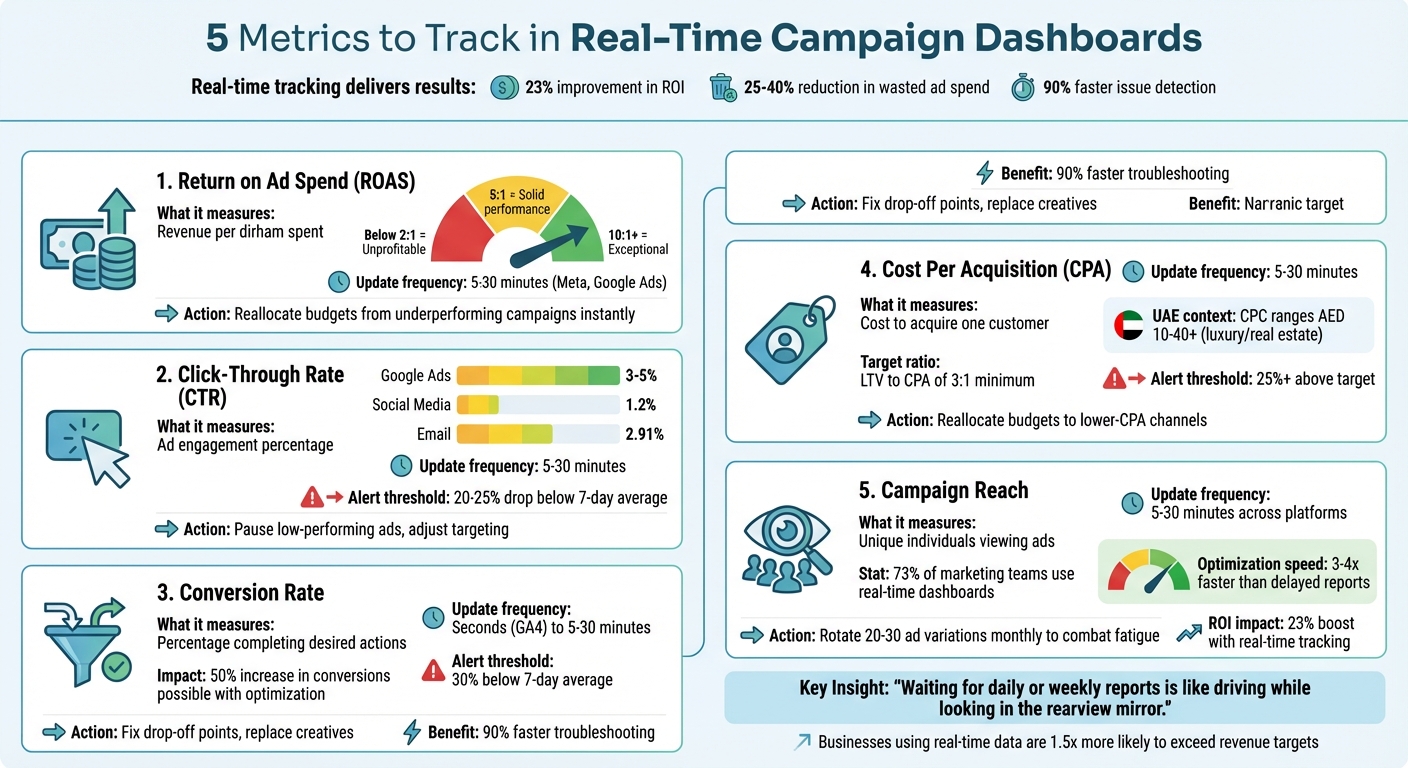
In today's fast-paced marketing environment, relying on outdated weekly reports can cost you both time and money. Real-time dashboards offer a solution, enabling you to monitor campaigns as they happen and make immediate adjustments. Tracking the right metrics can improve ROI by 23%, reduce wasted ad spend by 25–40%, and detect issues 90% faster. Here are the five key metrics every marketer should monitor in real time:
- Return on Ad Spend (ROAS): Measures revenue per dirham spent. Adjust budgets instantly for underperforming campaigns.
- Click-Through Rate (CTR): Tracks ad engagement. Helps identify targeting or creative issues quickly.
- Conversion Rate: Shows how well campaigns are achieving goals like purchases or sign-ups. Detects drop-offs in the funnel.
- Cost Per Acquisition (CPA): Links spend to customer acquisition. Avoid overspending by reallocating budgets in real time.
- Campaign Reach: Tracks unique viewers. Ensures ads are visible to the right audience without creative fatigue.
Real-time data ensures smarter decisions, faster optimisations, and better results for campaigns running in the UAE's competitive market. Solutions like Wick’s Four Pillar Framework help unify data for actionable insights, ensuring every dirham is spent wisely.
5 Essential Real-Time Marketing Metrics to Track for Campaign Success
1. Return on Ad Spend (ROAS)
Real-Time Tracking Capability
ROAS, or Return on Ad Spend, tells you how much revenue you earn for every dirham spent on advertising. Platforms like Meta, Google Ads, TikTok, and LinkedIn update their data in near real-time, typically within 5–30 minutes. Google Analytics 4 takes it a step further by offering updates within seconds. This near-instant access to data is crucial for gauging the profitability of your campaigns as they run.
Relevance to Campaign Performance
ROAS is a key indicator of how profitable your campaigns are. For context, a ratio of 5:1 is considered solid, while anything above 10:1 is exceptional. On the other hand, a ROAS below 2:1 usually points to unprofitable campaigns. Tracking this metric allows you to adjust your ad budgets effectively, shifting resources away from underperforming channels and doubling down on the ones that deliver results.
Actionability for Optimisation
Real-time ROAS data enables you to act quickly. If an ad isn’t performing well, you can pause it and redirect funds to better-performing campaigns. To make this process even smoother, you can set thresholds - like a 25% drop in performance - to trigger automated alerts. Colour-coded signals (green for good, yellow for caution, and red for urgent action) can help you stay on top of your campaigns without needing to constantly monitor them manually.
Alignment with ROI Goals
ROAS also helps ensure your ad spend aligns with your revenue goals, making it easier to justify investments to stakeholders. For example, if your cost of goods sold (COGS) accounts for 50% of your revenue, you’ll need a ROAS of 2.0 just to break even. This metric provides a clear framework for balancing costs and revenue.
sbb-itb-058f46d
2. Click-Through Rate (CTR)
Real-Time Tracking Capability
Click-Through Rate (CTR) reflects the percentage of clicks an ad receives compared to its total impressions. Most advertising platforms provide updates on CTR within 5–30 minutes, with Google Analytics 4 offering refreshes in seconds, and Meta Ads updating every 5–15 minutes. This near-instant feedback is invaluable for spotting issues like landing page errors almost immediately.
Relevance to Campaign Performance
CTR acts as a clear indicator of how appealing your content is to your audience. A high CTR signals that your messaging resonates, while a low CTR points to potential problems with targeting or content alignment. On platforms like Google Ads, higher CTRs not only improve campaign performance but also boost Quality Scores, which can lead to better ad placements and reduced costs. CTR benchmarks vary depending on the medium: Google Ads typically range from 3%–5%, social media campaigns average about 1.2%, and email campaigns hover around 2.91%.
Actionability for Optimisation
Having real-time CTR data allows for quick decision-making. You can pause underperforming ads, adjust bids, or refine your audience targeting. Setting up automated alerts to notify you when CTR drops 20–25% below your 7-day rolling average can help you address performance issues before they escalate. This proactive approach ensures faster adjustments and maximises return on investment.
Alignment with ROI Goals
CTR plays a critical role in determining ROI by influencing both traffic volume and cost per click (CPC). A higher CTR often leads to lower CPC, improving profitability. However, a high CTR paired with poor on-site engagement could signal a "clickbait trap", where clicks fail to convert. Monitoring CTR in real time helps identify such misalignments, potentially cutting wasted ad spend by 25–40%.
3. Conversion Rate
Real-Time Tracking Capability
Conversion rate tracks the percentage of visitors who take a desired action, such as making a purchase, signing up for a newsletter, or filling out a lead form. With Google Analytics 4, you can access conversion data within seconds, whereas platforms like Meta and Google Ads typically update within 5–30 minutes. This near-instant tracking allows you to identify issues - like broken tracking pixels - in minutes rather than days. This quick detection capability reduces troubleshooting time by 90%, making it invaluable for assessing campaign performance on the fly.
Relevance to Campaign Performance
Conversion rate is a macro-level metric that shows whether your campaign is meeting its main objectives. High traffic alone doesn’t guarantee success - if your conversion rate is low, it could point to issues such as misaligned offers, poor landing page design, or targeting the wrong audience or using an ineffective Middle East content strategy. By monitoring both macro conversions (e.g., purchases, sign-ups) and micro conversions (e.g., add-to-cart actions, form starts), you can pinpoint where users drop off in the funnel.
The modern Indian fashion brand Attrangi leveraged VWO's platform to track conversion rates alongside micro-interactions, such as zoom icon clicks. This analysis uncovered specific drop-off points in the mobile user journey, resulting in a 50% increase in conversions and a 78.68% boost in revenue.
Actionability for Optimisation
Real-time conversion data empowers you to act immediately. Automated alerts can notify you when conversion rates fall 30% below your 7-day rolling average. These alerts enable rapid adjustments, like replacing underperforming creatives, tweaking call-to-action elements, or resolving technical issues - all while the campaign is live. Acting quickly can cut wasted ad spend by 25–40%.
Alignment with ROI Goals
Conversion rates are directly tied to your ROI. They determine how effectively your ad spend turns into revenue. Businesses using real-time analytics report a 23% higher campaign ROI compared to those relying on delayed batch reporting. Real-time insights let you shift budgets to high-performing channels immediately, ensuring every dirham is spent wisely with the help of expert digital consulting. In contrast, delayed data can lead to a 20–30% loss in potential campaign results. Pairing conversion rate monitoring with cost-per-acquisition metrics ensures your campaigns deliver measurable business outcomes.
4. Cost Per Acquisition (CPA)
Real-Time Tracking Capability
Cost Per Acquisition (CPA) is the amount spent to turn a potential lead into an actual customer. Most advertising platforms offer almost real-time updates - Meta, for instance, refreshes data every 5–15 minutes, while Google Ads updates every 15–30 minutes. This rapid data flow means you can quickly identify overspending or CPA exceeding targets by 25% or more, rather than waiting for daily summaries. In competitive markets like Dubai, where cost-per-click (CPC) rates for sectors like luxury or real estate can range from AED 10 to AED 40 or more, having this level of visibility helps avoid unnecessary budget losses while campaigns are still running.
Grasping the importance of real-time CPA tracking is key to understanding its role in campaign success.
Relevance to Campaign Performance
CPA stands out because it ties your marketing spend directly to revenue. Unlike metrics like cost per click, which measure activity at the top of the sales funnel, CPA focuses on end results that influence your bottom line. A healthy business usually aims for a Customer Lifetime Value (LTV) to CPA ratio of at least 3:1. For example, if acquiring a customer costs AED 300 and their lifetime value is only AED 600, you're barely covering costs once operating expenses are included.
Actionability for Optimisation
The ability to access real-time CPA data offers actionable insights that can improve campaign performance instantly. Teams can reallocate budgets from channels with high CPAs to those with lower ones without delay. AI-driven automated alerts can be set up to notify you when CPA surpasses your target thresholds, ensuring rising costs are addressed immediately. This allows quick actions like pausing poorly performing ads, swapping out creatives to combat audience fatigue, or refining targeting by adding negative keywords - all while the campaign is still active.
Alignment with ROI Goals
By leveraging these insights, reducing acquisition costs directly impacts profitability. Real-time CPA monitoring helps maximise return on investment by cutting wasteful spending that might otherwise go unnoticed until weekly reports arrive. A dashboard with a traffic light system (green/yellow/red) can help prioritise focus on campaigns where CPA is drifting away from targets. Comparing real-time CPA to your Average Order Value ensures you're not spending more to acquire a customer than they bring in with their initial purchase. This immediate feedback allows for smarter budget adjustments while there's still time to capitalise on opportunities, rather than discovering issues after funds have already been spent. For many brands, choosing a digital marketing agency with the right technical expertise is the first step toward implementing these real-time systems.
5. Campaign Reach
Real-Time Tracking Capability
Tracking your campaign's reach in real time gives you a clear view of how many unique individuals are seeing your ads or content. Platforms like Meta Ads, TikTok Ads, and Google Ads update reach metrics quickly - within 5 to 30 minutes - making it easier to stay on top of your campaigns. For instance, Meta updates every 5–15 minutes, TikTok every 10–20 minutes, and Google every 15–30 minutes. It's no wonder that 73% of marketing teams depend on real-time dashboards for these insights. This data is crucial for adjusting your targeting as your campaign unfolds.
In competitive areas of the UAE, such as Dubai Marina or Business Bay, hyper-local targeting requires constant monitoring. Real-time reach data helps ensure your ads are hitting the intended neighbourhoods, allowing you to fine-tune your approach if your targeting is too broad or too narrow.
Relevance to Campaign Performance
Reach plays a critical role in your marketing funnel by laying the groundwork for brand awareness. Even the best content won't succeed if it isn't visible to enough people. It's important to understand the difference between reach and impressions: reach counts unique viewers, while impressions include repeat views. For example, if your reach is high but engagement starts to decline, it could mean your audience is experiencing creative fatigue.
"Awareness is about visibility. Even great content won't get the attention it needs if your reach is low." – Nitin Patkar, Senior Solutions Engineer, Supermetrics
Actionability for Optimisation
Real-time tracking of reach allows you to act quickly. If your reach is strong but engagement is fading, it might be time to refresh your ads - rotating 20–30 variations monthly can help combat audience fatigue. On the other hand, if your reach is underwhelming, you may need to broaden your audience or pivot to more relevant segments using live demographic data. Teams leveraging real-time dashboards are able to optimise campaigns 3–4 times faster than those relying on delayed reports.
For influencer campaigns, real-time reach tracking ensures that posts go live as planned and reach the right audience. Tools like unique UTM links or discount codes can help verify that the creator's audience matches your campaign's goals.
Alignment with ROI Goals
Centralising real-time reach data helps you make quick budget adjustments, which can lead to a 23% boost in overall ROI. This feedback loop also reduces wasted ad spend by 25–40%.
Take, for example, a beauty brand in January 2026 that used the InfluenceFlow platform to manage 10 creators. By tracking reach, engagement, and sales impact in real time, they identified their top 3 performers within 30 days. This allowed them to shift their strategy mid-campaign, improving their ROI from 2:1 to 4.5:1. With real-time reach data, you can turn visibility into actionable insights that directly enhance profitability.
Marketing Dashboard Tutorial: How to Analyze and Track Marketing Performance
Conclusion
Tracking metrics like ROAS, CTR, conversion rate, CPA, and reach in real-time changes the game for decision-making. Businesses that act swiftly based on data-driven insights are 1.5 times more likely to exceed their revenue targets. With real-time monitoring, you can spot underperforming campaigns, fix broken tracking pixels, or address budget pacing issues in minutes, cutting down on wasted spend.
In the UAE's fast-moving digital landscape, relying on weekly reports could mean missing critical opportunities. Real-time insights empower you to make immediate adjustments, boosting ROI and reducing inefficiencies. These metrics help create a unified view of your campaign performance, ensuring every dirham is used wisely in the ever-evolving UAE market.
"Waiting for daily or weekly reports to understand campaign performance is like driving while looking in the rearview mirror." – Gideon Banks, Marketing Analytics Expert
Solutions like Wick's Four Pillar Framework provide unified dashboards that focus on actionable insights instead of vanity metrics. Wick’s data analytics and marketing automation services deliver tools that allow businesses to make real-time improvements. Whether you're running campaigns in Dubai Marina or targeting audiences across the Emirates, having timely data ensures smarter budget allocation, faster optimisation, and consistent growth.
The aim is to enable faster, more informed decision-making that delivers results. With the right tools and approach, marketing evolves from reactive problem-solving to proactive profit-building.
FAQs
What’s a good ROAS for my business in the UAE?
A good ROAS (Return on Ad Spend) for businesses in the UAE generally starts at 4:1. This means that for every AED 1 spent on advertising, you should ideally generate AED 4 in revenue. However, this figure isn't set in stone - it depends on factors like your industry, profit margins, and the goals of your campaign.
For example, certain industries or seasonal campaigns, such as those during Ramadan, might see higher ROAS due to increased consumer spending. To get the most out of your efforts, make sure your benchmarks are tailored to your specific objectives and the current market dynamics.
How often should my real-time dashboard refresh?
Most real-time dashboards update every 5 to 15 minutes, ensuring that data stays current and actionable. This refresh rate allows for quick decision-making and timely tweaks to campaigns, keeping everything aligned with the latest insights.
How do I set alert thresholds for CTR, conversion rate and CPA?
To establish alert thresholds for metrics like CTR, conversion rate, and CPA, rely on automated tools to create performance benchmarks. Base these thresholds on historical data or specific campaign objectives. For example, you could set a CPA alert to trigger if costs surpass your target by 10%. Using relative thresholds, such as percentage changes, helps minimise unnecessary alerts and ensures you focus only on significant deviations. This approach allows for timely notifications, enabling you to make quick and effective campaign adjustments.