

Blog / Top Metrics for ROI in UAE Digital Campaigns

Wick
January 12, 2026Top Metrics for ROI in UAE Digital Campaigns
Want better ROI from your UAE digital campaigns? Start by tracking the right metrics.
Here’s what you need to know:
- Click-Through Rate (CTR): Measures ad engagement. A 3–5% CTR is solid for Google Ads in the UAE.
- Conversion Rate: Tracks actions like purchases or lead forms. A high CTR but low conversions? Fix your landing page.
- Customer Acquisition Cost (CAC): Shows how much you spend to gain a customer. Keep it lower than your CLV (Customer Lifetime Value).
- Return on Ad Spend (ROAS): Calculates revenue for every dirham spent. Aim for 400–799% for profitability.
- Customer Lifetime Value (CLV): Measures a customer’s long-term worth. Helps you focus on retaining high-value customers.
With 99% of the UAE population online and 97% using smartphones, success hinges on mobile optimisation, bilingual content, and tracking multi-platform journeys. Tools like GA4 and server-side tracking can refine your strategy and boost ROI.
Let’s break down these metrics and how they work in the UAE’s dynamic digital landscape.
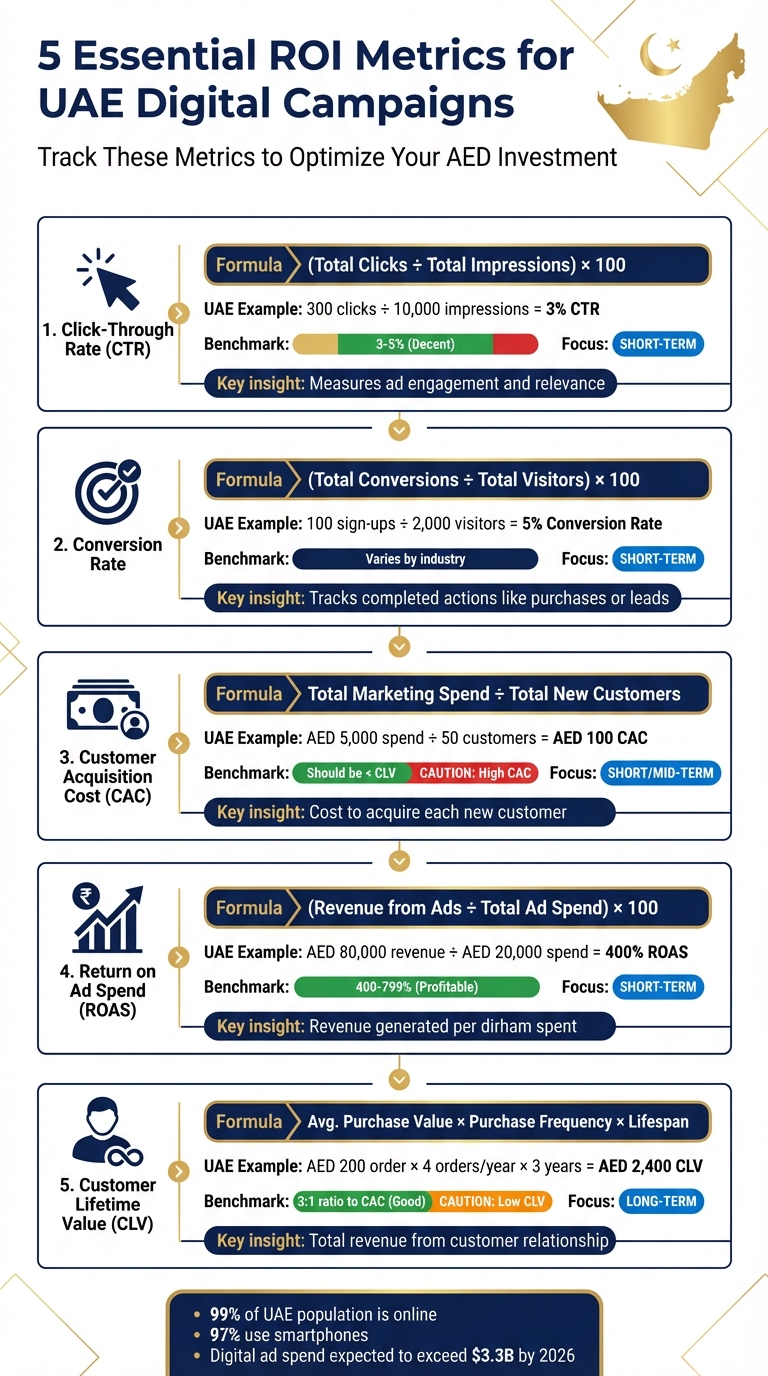
5 Essential ROI Metrics for UAE Digital Campaigns: Formulas, Benchmarks & Examples
1. Click-Through Rate (CTR)
Definition and relevance to UAE digital campaigns
Click-Through Rate (CTR) measures the percentage of people who click on your ad after seeing it. It’s calculated by dividing the number of clicks by impressions and multiplying the result by 100. This straightforward formula helps gauge how well your ad resonates with your target audience. In the UAE, where digital connectivity is exceptionally high, CTR serves as a key indicator of how effectively your ad copy, headlines, and targeting strategies grab attention and drive engagement.
CTR is far from just a superficial metric. A higher CTR can improve your Google Quality Score (rated out of 10), which in turn reduces your Cost-Per-Click (CPC) and secures better ad placements.
How the metric is calculated and interpreted
To truly understand your campaign’s performance, it’s crucial to grasp how CTR is calculated and what it signifies. In the UAE, a CTR of 3–5% is generally seen as a solid benchmark for Google Ads, though this varies depending on the industry. However, if your CTR is high but conversions remain low, it’s a red flag. This often points to issues with your landing page - perhaps it’s not loading fast enough, isn’t mobile-friendly, or lacks relevant content.
"A CTR of 3-5% is considered decent, but it depends on your industry. Always aim to improve by testing ad headlines and descriptions." - The Digital Creations
Factors influencing the metric in the UAE market
Several unique factors shape CTR performance in the UAE. With a staggering 97% smartphone penetration, it’s critical that ads load swiftly and are optimised for mobile devices. Additionally, the bilingual nature of the market makes A/B testing between Arabic and English ad copy essential. This approach helps identify which language performs better with specific audience segments. Beyond language, cultural considerations also come into play - your ad visuals and messaging must align with local societal values to resonate effectively.
Practical application for ROI optimisation
To maximise ROI, regularly experiment with your campaigns. Test different headlines, calls-to-action (CTAs), and imagery, and closely monitor CTR across various platforms to identify what works best. Incorporate negative keywords to refine targeting and attract high-intent users. Weekly CTR reviews can help you spot trends and fine-tune your strategy for better results.
2. Conversion Rate
Definition and Relevance to UAE Digital Campaigns
Conversion rate measures the percentage of visitors who complete a specific action, such as making a purchase, filling out a lead form, clicking a WhatsApp link, or placing a phone call. It’s calculated using the formula: (Number of Conversions ÷ Total Visitors) × 100. While the click-through rate (CTR) shows how many people clicked on an ad, the conversion rate reveals whether those clicks are translating into meaningful outcomes for your business.
In the UAE's digitally active market, tracking conversions can be tricky. Users often jump between platforms like TikTok, YouTube, and WhatsApp. Without assigning a monetary value to these conversions, it’s hard to determine the profitability of your campaigns. Let’s dive deeper into how this metric is calculated and what it can tell you about your campaign’s performance.
How the Metric Is Calculated and Interpreted
To calculate conversion rate, use this formula: (Number of Conversions ÷ Total Visitors) × 100. For additional insights, you can also calculate the lead close rate by dividing the number of conversions by the number of leads.
A high conversion rate usually means your website design, offers, and audience targeting are all aligned effectively. However, if you notice a high CTR but a low conversion rate, it could indicate a mismatch between the promise of your ad and the experience on your landing page. Ideally, aim for a return ratio between 5:1 and 10:1 after accounting for all costs. For businesses outside e-commerce, assigning a dirham value to leads can make profitability clearer. For example, if one in 10 leads converts into a customer worth AED 1,000, you might set the value of each lead at AED 100.
Factors Influencing the Metric in the UAE Market
In the UAE, several local factors can impact conversion rates. With a predominantly mobile-first audience, any hiccups in your mobile checkout process or lead forms can significantly hurt conversions. Additionally, WhatsApp has become a key conversion channel, with many users preferring "Click-to-WhatsApp" links for direct communication with businesses.
The online-to-offline (O2O) shopping journey is also a major trend in the UAE. Many customers research products online but make their purchases in physical stores. Tracking "Store Visit Conversions" is crucial to getting a full picture of your ROI. Compliance with the UAE's Personal Data Protection Law (PDPL) is another important factor. Including a compliance note on data collection forms can help build trust and positively influence your conversion rates.
Practical Application for ROI Optimisation
To optimise ROI, set up GA4 to track key conversion events like whatsapp_click, generate_lead, and purchase. Segment your data by device type - if mobile conversions are underperforming, it’s a clear sign to improve the mobile experience.
Ensure WhatsApp referrals are UTM-tagged and tracked as independent conversion events, as these interactions often signal high intent in the UAE market. For businesses with physical stores, integrating your Point-of-Sale (POS) systems with CRM data helps link in-store sales directly to your digital ad spend. Switching from last-click attribution to data-driven attribution in GA4 can also provide a clearer understanding of multi-touchpoint consumer journeys common in the UAE. Regular A/B testing of headlines, CTAs, and landing pages can further improve conversion rates. These steps ensure every conversion is accurately tracked and contributes to maximising your ROI.
3. Customer Acquisition Cost (CAC)
Definition and Relevance to UAE Digital Campaigns
Customer Acquisition Cost (CAC) is the total amount spent to acquire a new customer. This includes all sales and marketing expenses over a given period, divided by the number of new customers acquired during that time. In the UAE's dynamic digital market - where ad spending is expected to surpass USD 3.3 billion by 2026 - knowing your CAC is critical. As advertising platforms become more saturated and competitive, costs increase, making efficient customer acquisition a priority. Without server-side attribution, CAC figures can be inflated. When paired with Customer Lifetime Value (LTV), CAC offers insight into whether your strategy is profitable or if you're spending more on acquiring customers than they bring in revenue .
How the Metric Is Calculated and Interpreted
The basic formula for calculating CAC is:
Total Marketing Expense ÷ Number of Acquired Customers.
For lead-based models, use:
LTCR × CPL.
For more advanced tracking, the formula is:
(Media Cost ÷ Conversion Rate) / Revenue Efficiency.
In UAE e-commerce, CAC for purchases typically ranges from AED 35 to AED 180, while real estate booking costs can fall between AED 1,100 and AED 4,800. A strong benchmark is an LTV to CAC ratio of at least 3:1, meaning each customer should generate three times the cost of acquiring them. If your CAC is climbing while conversion rates stay flat, it could point to higher ad costs, poor targeting, or ineffective creatives.
Factors Influencing the Metric in the UAE Market
Several factors make CAC unique in the UAE. With 95% of users browsing on mobile devices, optimising for mobile is non-negotiable. User journeys are often fragmented - TikTok, for instance, reaches 118% of adults due to multiple accounts.
"Creative is no longer an asset - it's the performance algorithm's fuel." – MetaSocial.ae
The UAE's Personal Data Protection Law (PDPL) has introduced privacy restrictions that impact tracking. Brands relying on pixel-based tracking may face signal loss, which inflates CAC . Additionally, creative performance plays a larger role than ever. Successful UAE brands rotate 20–40 active creatives monthly to combat ad fatigue. Content tailored for local audiences, in both Arabic and English, along with user-generated content, performs up to 3.7× better than static banners. Tackling these challenges with strategic adjustments can significantly reduce CAC.
Practical Application for ROI Optimisation
To improve ROI and lower CAC, consider the following:
- Use server-side tracking: Implement Meta’s Conversions API (CAPI) to reduce signal loss by 25–55%, directly lowering CPA.
- Optimise mobile landing pages: Even a 1% boost in conversion rates can cut CAC by 10–28%.
- Adopt a hybrid funnel strategy: Combine Meta for demand creation with Google Search for capturing intent. This approach has helped UAE brands in mid-funnel industries reduce CAC by 30–60%.
- Leverage GA4's data-driven attribution: Identify assist channels like YouTube or TikTok that may not directly close sales but contribute to awareness and lower overall CAC.
4. Return on Ad Spend (ROAS)
Definition and Relevance to UAE Digital Campaigns
ROAS is a key metric for understanding how effectively your ad spend translates into revenue. It measures the AED earned for every AED spent on advertising, making it particularly important in the UAE, where 99% of the population is online, and 97% use smartphones. Unlike ROI, which factors in all business costs, ROAS focuses solely on ad performance, giving businesses a precise view of their ad campaigns' success.
"ultimate metric that shows whether your ad investment is paying off." – The Digital Creations
With search ad spending in Dubai expected to reach around AED 958 million by 2028, knowing which platforms deliver the best returns is more important than ever.
How the Metric Is Calculated and Interpreted
The formula for ROAS is straightforward: ROAS = (Revenue ÷ Ad Spend) × 100. For example, spending AED 10,000 and generating AED 40,000 in revenue results in a 400% ROAS.
A ROAS of 100% means you’re breaking even - covering your ad costs but not making a profit. Many UAE businesses aim for a ROAS of 400–799% to ensure profitability, while anything over 800% indicates exceptional performance and potential for scaling. For campaigns without direct sales, such as lead generation, assigning a value to leads can help estimate ROAS. For instance, if one in ten leads results in a AED 1,000 sale, each lead might be valued at AED 100.
| ROAS Level | Interpretation | Recommended Action |
|---|---|---|
| < 100% | Loss | Pause or rework the campaign immediately |
| 100%–300% | Break-even or low | Refine audience targeting and improve ad creatives |
| 400%–799% | Profitable | Scale successful campaigns while managing costs |
| 800%+ | Outstanding | Increase budget and focus on that channel |
Factors Influencing the Metric in the UAE Market
Several factors unique to the UAE affect ROAS performance. One major challenge is platform fragmentation. For instance, YouTube reaches 94% of UAE internet users, while TikTok’s reach exceeds 118% of adults due to multiple accounts per user. Consumers in the UAE often navigate across platforms - seeing an ad on TikTok, searching on Google, and completing a purchase via WhatsApp - making it tricky to attribute conversions accurately. Adopting data-driven attribution models is essential to track the full customer journey.
Brand maturity also impacts ROAS. New brands may see lower initial returns as they work on building awareness, while established brands with strong recognition often achieve better results from the start. Additionally, ad formats play a role: search ads targeting high-intent keywords generally produce better ROAS than display ads aimed at raising awareness. These factors highlight the importance of precise budget allocation and campaign management.
Practical Application for ROI Optimisation
Improving ROAS in the UAE market requires strategic adjustments. Begin by monitoring ROAS weekly to identify underperforming campaigns - those with ROAS below 300–400% - and shift the budget to better-performing ones. Use automated bidding strategies, such as Target ROAS in Google Ads, which leverage machine learning to optimise bids in real time based on conversion likelihood.
For retailers with physical stores, integrating point-of-sale (POS) data with digital ad platforms can provide a "Blended ROI", which accounts for in-store revenue generated by online ads. To ensure accurate cross-channel ROAS reporting, connect Google, Meta, and TikTok ad accounts to GA4 for seamless cost data integration. These steps can help businesses make smarter decisions and maximise the impact of their ad spend.
5. Customer Lifetime Value (CLV)
Definition and Relevance to UAE Digital Campaigns
Customer Lifetime Value (CLV) estimates the total revenue a customer is expected to bring in during their entire relationship with your brand. Unlike ROAS, which focuses on short-term returns, CLV provides a broader perspective by considering revenue over months or even years. This metric is especially crucial in the UAE's competitive market, where acquiring new customers often costs far more than retaining existing ones. By focusing on CLV, businesses can make smarter, long-term investments in customer acquisition. It complements immediate metrics like ROAS and CAC, offering a more comprehensive view of campaign performance.
How the Metric Is Calculated and Interpreted
The formula for CLV is straightforward:
(Average annual revenue per customer × Number of years they remain active) – Cost per Acquisition.
For example, a Dubai-based retailer with customers spending AED 2,000 annually over three years would have a CLV of AED 6,000, minus the cost of acquiring that customer. By tracking this data in GA4, businesses can pinpoint which marketing channels attract customers with the highest lifetime value.
Factors Influencing the Metric in the UAE Market
Accurately tracking CLV in the UAE requires solid attribution models, especially given the fragmented digital landscape. With 99% of the population online and 97% using smartphones, consumers engage across multiple platforms, making it essential to integrate data from all channels. For instance, YouTube reaches 94% of UAE internet users, while TikTok’s reach among adults exceeds 118%. These platform-specific trends highlight the need for precise data collection and analysis. Moreover, businesses must ensure their practices comply with UAE's Personal Data Protection Law (PDPL).
Practical Application for ROI Optimisation
To make the most of CLV insights, start by integrating your Point-of-Sale system with your CRM. This allows you to connect in-store purchases to your digital campaigns, creating a unified view of your customers' value. Use GA4 to monitor returning session data and segment CLV by factors like channel, device, or demographic. This segmentation helps refine your strategy. Loyalty programmes, whether through trackable cards or apps, are another effective tool to gather data on purchase histories and marketing touchpoints. Additionally, nurture leads with segmented email campaigns and targeted remarketing to encourage repeat purchases and extend customer lifecycles. By focusing your marketing spend on channels that deliver the highest long-term returns, you can optimise your ROI.
The How & What of Retention Marketing in UAE and KSA | Part 3
Metric Comparison Table
To better understand how these metrics function in practice, here's a detailed table outlining their formulas, calculation methods, and real-world UAE examples in AED. This breakdown also clarifies which metrics are ideal for short-term campaign decisions and which are more suited for long-term growth strategies.
| Metric | Formula | Calculation Method | UAE Example (AED) | Benchmark | ROI Term |
|---|---|---|---|---|---|
| Click-Through Rate (CTR) | (Total Clicks / Total Impressions) × 100 | Divide total clicks by impressions to measure ad relevance | 300 clicks / 10,000 impressions = 3% CTR | 3%–5% (Decent) | Short-term |
| Conversion Rate | (Total Conversions / Total Visitors) × 100 | Divide successful actions by total website sessions | 100 sign-ups / 2,000 visitors = 5% Conversion Rate | Varies by industry | Short-term |
| Customer Acquisition Cost (CAC) | Total Marketing Spend / Total New Customers | Divide total campaign costs by the number of new customers | 5,000 AED spend / 50 new customers = 100 AED CAC | Should be lower than CLV for profitability | Short/Mid-term |
| Return on Ad Spend (ROAS) | (Revenue from Ads / Total Ad Spend) × 100 | Divide revenue generated from ads by the ad spend | 80,000 AED revenue / 20,000 AED spend = 400% ROAS | 300%–400% (Target) | Short-term |
| Customer Lifetime Value (CLV) | Avg. Purchase Value × Purchase Frequency × Lifespan | Multiply average order value by yearly orders and customer lifespan | 200 AED order × 4 orders/year × 3 years = 2,400 AED CLV | 3:1 ratio to CAC (Good) | Long-term |
This table makes it clear which metrics are best for immediate decision-making (like CTR and ROAS) and which are essential for shaping long-term strategies (like CLV).
For service-based businesses, assigning a monetary value to each lead can help calculate ROI when sales happen offline. For instance, if one in 10 leads converts and the average customer generates 1,000 AED, each lead would have an estimated value of 100 AED.
Conclusion
For businesses in the UAE, tracking the right metrics isn't just a nice-to-have - it’s what separates random spending from smart, profitable investments. By focusing on key indicators like CTR, conversion rate, CAC, ROAS, and CLV, companies can gain both immediate clarity and long-term strategic insight. These metrics reveal which channels attract quality leads and which ones drain resources, allowing you to cut unprofitable tactics and channel your budget into what delivers results. In fact, 75% of marketers have reported improvements in their organisation's credibility and trust by leveraging such data-driven approaches. These metrics are the foundation of a strategy that continuously evolves and integrates seamlessly with broader digital efforts.
Tools like Google Analytics offer centralised dashboards that bring together data from multiple platforms. This means you can make real-time campaign tweaks while ensuring your sales and marketing teams rely on a single, accurate source of truth.
In a fast-moving market like the UAE, where the global digital marketing industry is expected to hit $786.2 billion by 2026, businesses that excel in metric tracking will be primed to claim their share of the growth. By zeroing in on these metrics, companies can eliminate wasteful tactics and focus on strategies that deliver measurable returns. Start by applying SMART criteria to your KPIs and running A/B tests to fine-tune your ROI strategy.
At Wick, we use these insights to design bespoke digital marketing strategies that drive growth and measurable success for UAE businesses.
FAQs
How can I increase the click-through rate (CTR) for my digital campaigns in the UAE?
Boosting your click-through rate (CTR) begins with truly understanding your audience and crafting campaigns that align with their preferences. In the UAE, where local traditions and cultural relevance play a major role, precise targeting and engaging ad content are essential.
Start by fine-tuning your audience segmentation. Focus on factors like location (e.g., Dubai, Abu Dhabi), language preferences (Arabic or English), and specific interests such as high-end shopping or seasonal promotions for occasions like Ramadan or UAE National Day. This way, your ads reach the right people at the right time.
Next, create ad copy that connects with your audience. Use action-driven language, highlight the benefits rather than just the features, and include trust-building elements such as "Certified" or "Free Shipping within UAE". Adding urgency with phrases like "Limited Offer until 30/10/2025" can also encourage immediate clicks.
For even better results, take advantage of Wick's Four-Pillar Framework. This data-driven strategy analyses audience behaviour, optimises ad creatives, and adjusts bids automatically to create personalised campaigns. With performance tracking in AED (د.إ) and localised reporting formats (dd/mm/yyyy), Wick’s approach ensures your CTR improves while maximising your return on investment.
How can I improve conversion rates for digital campaigns in the UAE?
To improve conversion rates in the UAE, focus on three key areas: localisation, technical optimisation, and data-driven strategies. Start by customising your content for the local audience. This means offering bilingual options in Arabic and English, displaying prices in AED (د.إ) with correct formatting (e.g., AED 1,250), and using the dd/MM/yyyy date format. Build trust by incorporating UAE-specific payment gateways like PayFort and promoting offers such as ‘Free Shipping within UAE’, which are particularly appealing to local customers.
Make sure your website is mobile-friendly and loads quickly - ideally in under 2 seconds. Simplify the checkout process with features like single-page forms and auto-fill options for Emirates ID, which can significantly reduce user friction. Keep an eye on critical metrics like click-through rate (CTR), bounce rate, and cost-per-acquisition (CPA). Running A/B tests on elements such as headlines or call-to-action buttons can help pinpoint what resonates best with your audience.
Wick takes a data-driven approach to help businesses in the UAE fine-tune these aspects. By using advanced analytics, AI-powered personalisation, and marketing automation, Wick develops campaigns that improve user experience and drive consistent growth, all while aligning with UAE market standards.
What is Customer Acquisition Cost (CAC) and how can I optimise it in the UAE?
Customer Acquisition Cost (CAC) is a straightforward metric: you calculate it by dividing your total marketing spend by the number of new customers gained within a specific timeframe. For instance, if you spend AED 150,000 on marketing and bring in 300 new customers, your CAC would amount to AED 500 per customer.
To make your CAC more efficient, focus on a few key strategies:
- Pinpoint and address high-cost marketing channels.
- Work on improving your conversion rates to get more value out of your campaigns.
- Use data-driven forecasting to plan smarter campaigns.
Leverage tools like marketing automation and offer personalised deals to streamline your efforts. Keep a close eye on your metrics - adjusting your campaigns weekly can help ensure your CAC stays within your target range. By embracing a data-focused approach that aligns with the UAE market's unique dynamics, you can craft a more cost-effective digital marketing strategy.