

Blog / How Metadata Impacts Arabic SEO in Gulf Markets
How Metadata Impacts Arabic SEO in Gulf Markets
Metadata is crucial for Arabic SEO in Gulf markets because it directly influences search rankings and user engagement. With over 96% of UAE searches happening on Google and 85% on mobile, businesses targeting Arabic-speaking users must optimise metadata to rank higher and connect with local audiences.
Key points to know:
- Arabic metadata (title tags, meta descriptions, alt text) helps search engines understand your content and encourages clicks.
- Localisation matters: Dialect differences (e.g., "جوال" in Saudi Arabia vs. "موبايل" in the UAE) and right-to-left formatting require attention.
- Low competition for Arabic keywords makes it easier to rank compared to English, but success depends on native-level expertise.
- Technical fixes: Use hreflang tags, mobile-friendly designs, and schema markup to improve visibility.
- Measure results: Tools like Google Search Console and Analytics help track rankings, click-through rates, and user behaviour.
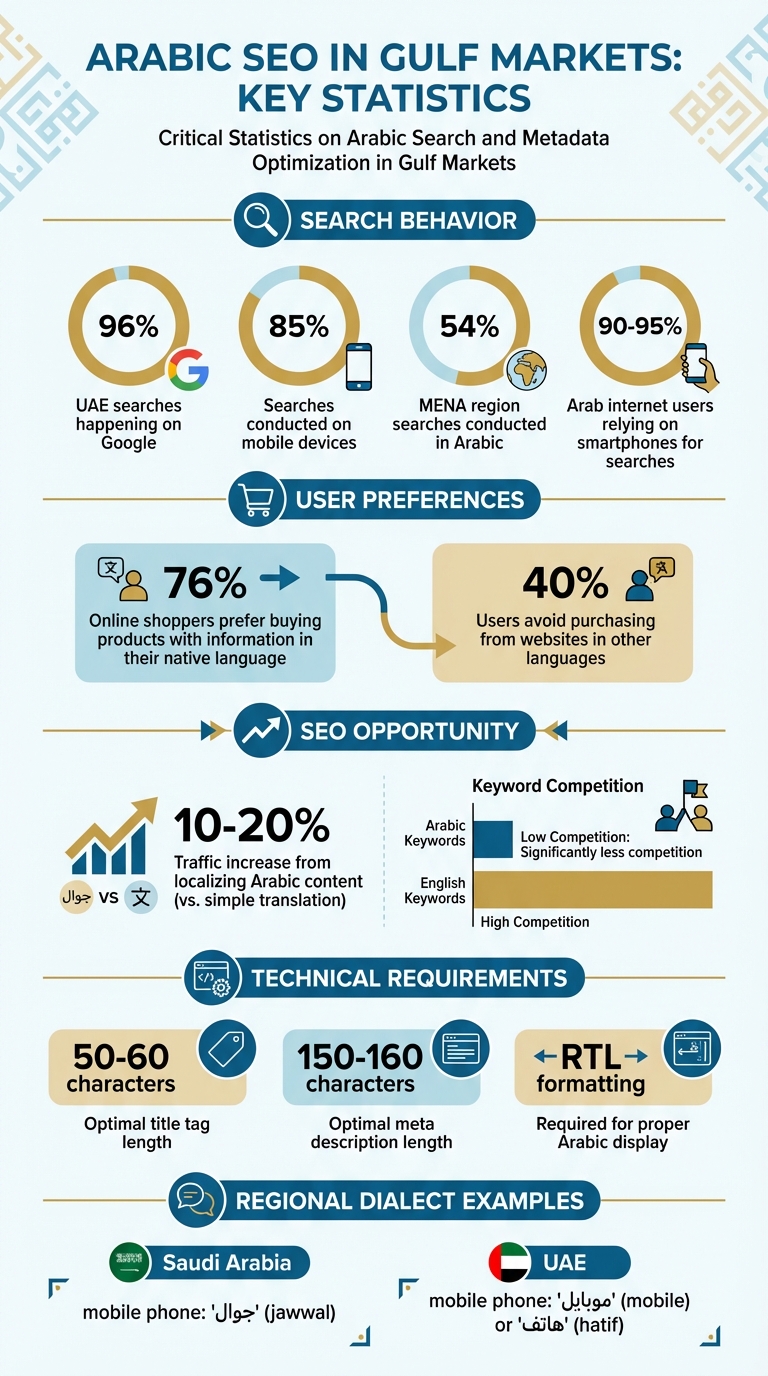
Arabic SEO Statistics and Key Metadata Optimization Metrics for Gulf Markets
What Is Metadata and Why It Matters for Arabic SEO
Metadata acts as a bridge between your website and search engines, providing algorithms with essential information about your content and helping them decide when to display your pages. For businesses in the Gulf, metadata often serves as the first impression for potential customers - it’s what they see before they even click on your site.
With 54% of searches in the MENA region conducted in Arabic, well-optimised Arabic metadata can play a crucial role in connecting with local users. As Jordan Boshers, Chief Digital Strategist at Istizada, highlights:
"Google Arabic is one of the most under-exploited marketing opportunities on the web".
In Gulf markets, where competition for Arabic keywords is lower, metadata becomes even more valuable. While English SEO in the UAE is highly competitive, Arabic search terms often rank faster and bring greater visibility. However, achieving success in Arabic SEO requires expertise in the native language. GO-Globe emphasises:
"Do not translate any metadata from your native language to the local Arab language; rather, pay for a native SEO copywriter".
Main Types of Metadata for SEO
Title tags are the clickable headlines that appear in search results. To be effective, they should include your primary keyword at the start and stay within 50–60 characters. In Gulf markets, it’s important to use phrases that reflect how locals actually search, rather than relying on direct translations.
Meta descriptions are the brief summaries displayed under the title tag in search results. These should include keyword variations and a clear Arabic call-to-action to encourage clicks. Keep them between 150–160 characters for optimal performance.
Image alt text describes your visual content for search engines. This is especially impactful in the MENA region, where Google Image Search generates significant traffic. Ensure each image has descriptive Arabic alt text that naturally incorporates relevant keywords.
Structured data (schema markup) helps search engines better understand your content, potentially earning you rich snippets. Using schema markup for lists, FAQs, or definitions in Arabic can improve your chances of appearing in Google’s Knowledge Graph.
Hreflang tags are vital for websites targeting multiple languages or Gulf countries. They prevent duplicate content issues and ensure users see the correct version of your site based on their location and language preferences.
When properly implemented, these metadata elements can work together to improve your visibility and rankings.
How Metadata Influences Arabic Search Rankings
Optimising metadata directly affects your site’s performance in search rankings. For example, Google.ae prioritises local relevance, so using country-specific domains (like .ae or .sa) along with localised metadata can significantly enhance your rankings.
Arabic’s right-to-left (RTL) text direction also requires proper technical support. Poor RTL implementation can cause display issues, particularly on mobile devices - a critical concern since 90% to 95% of Arab internet users rely on smartphones for searches.
Native-language metadata builds trust with users. Studies show that 76% of online shoppers prefer buying products with information in their native language, and 40% avoid purchasing from websites in other languages. In industries like healthcare, finance, and legal services, metadata in Arabic not only signals cultural understanding but also enhances credibility.
Additionally, organic Arabic search results often occupy more above-the-fold space compared to English results, as there are fewer PPC ads in Arabic searches. This gives well-optimised metadata a better chance of standing out and capturing user attention without competing heavily against paid ads.
Common Metadata Challenges in Gulf Markets
To fully reap the benefits of well-optimised Arabic metadata, it's essential to understand and address the unique challenges faced in Gulf markets. These challenges can significantly impact search visibility and require careful consideration.
Dialect Differences Across Gulf Countries
In the Gulf region, the same product or service can have entirely different names depending on the country you're targeting. Take "mobile phone" as an example: in Saudi Arabia, it's commonly referred to as "جوال" (jawwal), while in the UAE and other Gulf nations, people are more likely to search for "موبايل" (mobile) or "هاتف" (hatif). This linguistic diversity often goes unnoticed by keyword research tools that rely solely on Modern Standard Arabic (MSA), leading to missed opportunities to target high-traffic local terms.
Spelling inconsistencies also play a role. For instance, variations like including or omitting the Hamza on Alef (أ vs ا) can significantly alter search results. These nuances highlight the importance of tailoring your metadata to reflect local language habits.
Technical Issues with Right-to-Left Script
Arabic's right-to-left (RTL) script presents technical challenges that can disrupt how metadata is displayed if not properly managed. One common issue is that Arabic translations often exceed the character limits for title tags and meta descriptions, resulting in truncation.
Proper RTL formatting requires specific CSS styling and layout adjustments across your website. As GTECH notes:
"Arabic demands that websites support RTL layout, which can have consequences on web design, navigation, and user experience".
When these adjustments are overlooked, the results can be disastrous. Digital Gravity warns:
"Machine translation on a site can split components on an Arabic mobile website, which hinders a visitor's ability to buy something or convert".
Additionally, many Content Management Systems (CMS) aren't designed to handle RTL scripts natively. Without the right configurations, metadata may display incorrectly in search results, negatively impacting click-through rates and user experience. Proper setup, including support for hreflang tags, is crucial to avoid these pitfalls.
Limited Competition for Arabic Keywords
Despite these challenges, Gulf markets offer a significant opportunity for businesses willing to invest in Arabic SEO. Digital Gravity's Team DG highlights:
"Surprisingly it's easy to rank for high search volume keywords in Arabic search engine results, thanks to the low competition in industries in the Arabic language".
The complexity of Arabic, with its 30+ dialects, RTL script, and intricate grammar, acts as a barrier to entry. This has left many businesses hesitant to compete in Arabic search markets, creating opportunities for those who do. Websites can often rank for niche Arabic keywords with minimal backlinks.
However, success in this space depends on genuine localisation, not just direct translation. Panamedia underscores this point:
"A keyword that performs well in English may have zero search value in Arabic when translated word-for-word".
To truly capitalise on this opportunity, it's essential to work with native speakers who understand both the technical requirements and the cultural nuances of each Gulf market.
How to Optimise Metadata for Gulf Audiences
To effectively connect with Gulf audiences, especially Arabic-speaking users, and improve your search visibility, it's crucial to refine your metadata. Below are strategies tailored to the unique characteristics of this market.
Research Keywords for Gulf Markets
Keyword research for Gulf markets requires a nuanced approach. Direct translations between Arabic and English aren't effective - each language demands separate keyword research. Google dominates the UAE search landscape, holding over 96% of the market share. Tools like Google Keyword Planner and Ahrefs, configured for UAE-specific parameters, are excellent starting points.
Take into account the dialect and spelling variations discussed earlier to ensure your keywords resonate locally. Gulf countries often have subtle differences in Arabic dialects, so precision matters.
Focus on long-tail, conversational keywords. Arabic users frequently phrase their searches as questions, such as "how" or "what is". While Modern Standard Arabic (MSA) offers broad coverage, incorporating Gulf Arabic expressions for localised services can enhance user engagement. Additionally, with over 80–85% of searches occurring on smartphones, ensure your keyword strategy prioritises mobile users.
Stay on top of trending searches by monitoring platforms like Instagram and TikTok, as these heavily influence consumer behaviour in the Gulf. Tools like Farasa, which offer Arabic-specific natural language processing (NLP) analysis, can help you understand how search engines interpret your keywords.
Use these insights to create Arabic title tags that are both targeted and locally appealing.
Write Better Arabic Title Tags
Your Arabic title tags need to be concise and impactful. Place your primary Arabic keyword naturally at the beginning of the title to avoid truncation in search results, as Arabic translations often run longer than English ones. Pay attention to local spelling variations and write in a tone that feels conversational yet professional.
Avoid keyword stuffing - your title should flow naturally and clearly convey the value of the page to Gulf users.
Create Effective Arabic Meta Descriptions
Once you've nailed the title tags, focus on crafting meta descriptions that engage Gulf users by addressing their search intent directly.
Include a clear Arabic call-to-action to encourage clicks. While it's essential to incorporate secondary keywords, the priority should be on creating compelling, user-focused copy. Arabic search queries are often longer and more conversational than English ones, so consider addressing common questions and concerns directly.
Keep your meta descriptions concise to ensure they display fully in search results. Additionally, align your messaging with major regional events like Ramadan, Eid, or UAE National Day to enhance relevance. Gulf consumers value credibility and brand reputation, so maintain a formal yet approachable tone to build trust.
Optimise Image Alt Text and Structured Data
Don’t overlook the importance of image metadata. Write clear, descriptive Arabic alt text that includes relevant keywords. With visual search growing among Arabic-speaking users, this step is essential for improving visibility.
Enhance your content's context by adding schema markup tailored to Gulf-specific details, such as AED pricing. Also, ensure that all image metadata follows right-to-left (RTL) formatting for Arabic content.
Set Up Hreflang Tags for Multilingual Content
To target Gulf audiences effectively, implement hreflang tags to signal the intended language and region for each page. For example, use hreflang="ar-AE" for Arabic content aimed at UAE users and hreflang="en-AE" for English content in the UAE. Each page should include a self-referencing tag along with alternate language tags.
| Target Audience | Language Code | Region Code | Combined Hreflang Attribute |
|---|---|---|---|
| Arabic Speakers in UAE | ar | AE | hreflang="ar-AE" |
| English Speakers in UAE | en | AE | hreflang="en-AE" |
| Arabic Speakers in KSA | ar | SA | hreflang="ar-SA" |
| General Arabic Speakers | ar | (None) | hreflang="ar" |
Set hreflang tags at the page level, ensuring each individual page references its specific alternate versions. Use language-specific URL structures, such as /ae-ar/ and /ae-en/, to make navigation intuitive for both users and search engines.
Avoid automatic redirects based on browser language, as these can disrupt search engine indexing. Consistency is critical - missing hreflang tags on some pages can weaken your overall SEO framework. Proper implementation ensures seamless connections between your content and its intended Gulf audience.
sbb-itb-058f46d
How to Measure Metadata Performance
Once you've localised your Arabic metadata, it's crucial to evaluate how well it's performing. A reliable tool for this is Google Search Console, which provides valuable insights into the performance of Arabic keywords, including impressions and click-through rates (CTR). Given Google's dominance in the UAE market, this platform is a dependable resource for assessing your metadata's visibility.
Separate tracking for Arabic and English. Analysing Arabic and English metadata independently allows you to uncover regional opportunities. For instance, if your Arabic metadata shows a high CTR in Search Console but a high bounce rate in Google Analytics, it might indicate that the meta description is either misleading or not aligned with user expectations. This mismatch often occurs when the metadata doesn't accurately reflect the page content or when right-to-left (RTL) formatting issues discourage engagement. By examining this data, you can connect your SEO efforts to measurable market outcomes.
Monitor Rankings and Traffic for Arabic Queries
Considering the unique challenges of RTL formatting and dialect differences, it's important to track local relevance through impressions and clicks. Google Search Console's Performance report is particularly useful for monitoring impressions, clicks, and CTR for Arabic queries. Pay close attention to mobile performance, as over 85% of searches in the MENA region are conducted on smartphones.
Specialised tools like Ranktracker's SERP Checker or Ahrefs can help you monitor keyword rankings across Gulf markets. Regional variations matter significantly: for example, a keyword like "سيارة" might perform better in Saudi Arabia, while "عربية" could yield stronger results in the UAE. To refine your analysis, set geotargeting preferences in Google Search Console for each Gulf country to better understand regional metadata performance.
Beyond tracking rankings, user engagement metrics provide additional validation for your optimisation efforts.
Review Metadata Performance Data
Rankings are just one piece of the puzzle. Engagement metrics reveal whether your metadata is successfully reaching the right audience. Use Google Analytics to monitor bounce rates, time spent on the page, and organic traffic growth. If Arabic pages show high bounce rates, it could mean the metadata doesn't accurately describe the page content.
Additionally, track conversion rates to assess the quality of traffic generated by Arabic metadata. For example, how many users arriving through organic search complete actions like inquiries or purchases?. By creating custom segments in Google Analytics 4, you can isolate Arabic-speaking visitors and study their behaviour separately from English-speaking users. This segmentation helps you identify which metadata elements are driving meaningful engagement. With these insights, you can refine your metadata strategy to better address the nuances discussed earlier.
Wick's Four Pillar Framework for Metadata Optimisation
Wick's Four Pillar Framework weaves metadata optimisation into a cohesive digital strategy designed for Gulf Arabic SEO. Instead of treating metadata as a standalone task, this framework integrates it into a broader digital ecosystem, combining technical accuracy with a deep understanding of local preferences and cultural nuances.
Plan & Promote: Metadata Optimisation for Search Engines
Successful metadata planning starts with acknowledging the distinctions between Modern Standard Arabic and regional dialects. Wick's approach involves conducting keyword research tailored to specific dialects and accounting for spelling variations to capture higher search volumes across Gulf markets. This process also ensures that technical configurations fully support Arabic content. In fact, localising Arabic content, rather than relying on simple translations, can boost monthly traffic by 10% to 20%. This meticulous planning lays the groundwork for more accurate analytics tracking.
Capture & Store: Leveraging Analytics for Metadata Insights
Wick's analytics tools monitor organic traffic, keyword rankings, and click-through rates (CTR) to fine-tune metadata performance. By separating Arabic and English analytics streams, businesses can pinpoint which metadata delivers the best results and make adjustments accordingly. Since Saudi Arabia leads in Arabic search query volume, followed by Egypt and the UAE, this data helps businesses prioritise their localisation efforts. These insights are then channelled into automated personalisation strategies.
Tailor & Automate: AI-Powered Personalisation in Metadata
AI tools play a key role in aligning metadata with cultural nuances and shifting search patterns. With voice search gaining popularity in the MENA region, AI-driven personalisation incorporates conversational Arabic phrases and long-tail keywords to better reflect the spoken dialects used in voice queries. Wick's framework also employs schema markup and structured data to help AI-powered search systems accurately index and interpret the structure of Arabic content. This approach goes beyond basic translation, fostering a stronger connection with users and enhancing brand trust.
Conclusion
To wrap up, here's a quick recap to help you move forward effectively.
Optimising metadata for Arabic SEO in Gulf markets demands a combination of cultural understanding, technical expertise, and a solid grasp of local search behaviour. Businesses that focus on dialect differences, subtle spelling variations (like inconsistent hamza usage), and proper right-to-left formatting can achieve noticeable boosts in both search rankings and user engagement. With over 85% of searches in Arabic-speaking regions happening on smartphones, ensuring your metadata is mobile-friendly isn’t just important - it’s non-negotiable.
The potential here is immense. High-volume Arabic keywords often face much less competition than their English counterparts. But to truly capitalise on this, businesses must treat Arabic and English as separate markets. This means conducting dedicated keyword research for Arabic and leveraging native language expertise to align with authentic search intent.
As GTECH aptly states:
"Arabic localisation is a lot more than a single tick list on your SEO to-do list – it is a growth strategy that cements your presence in one of the most competitive global markets."
– GTECH
Take actionable steps like auditing your metadata for proper right-to-left formatting, researching local spelling quirks, and using hreflang tags to target specific regions. With voice search gaining traction across the MENA region, incorporating conversational and question-based keywords into your strategy is critical to staying visible.
FAQs
How do regional dialects affect Arabic SEO in Gulf markets?
Regional dialects hold a significant influence on Arabic SEO in Gulf markets, directly shaping how users search online and engage with content. In the UAE, for instance, Gulf Arabic dominates informal searches, social media interactions, and localised content. On the other hand, Modern Standard Arabic (MSA) is typically reserved for formal or official contexts. This creates a unique dynamic where users often turn to dialect-specific terms rather than formal language during their online searches.
To boost visibility and engagement in these markets, it’s crucial to incorporate dialect-specific keywords and language that resonates culturally into your SEO approach. Technical adjustments, such as implementing right-to-left (RTL) formatting and considering regional preferences, can also significantly improve user experience and search engine performance. By tailoring your content to match local search behaviours, you can establish a stronger connection with Gulf audiences and drive consistent growth within these markets.
How can I optimise Arabic metadata for better SEO in UAE markets?
To improve Arabic metadata for SEO in UAE markets, start by ensuring right-to-left (RTL) text alignment. This step is crucial for maintaining readability in Arabic and creating a user-friendly experience.
Leverage semantic HTML tags to structure metadata properly. These tags help search engines interpret your content more effectively, boosting its relevance in search results.
It's also important to customise metadata to align with local dialects and preferences, making it relatable to Gulf audiences. Use Arabic keywords that reflect regional search patterns and linguistic subtleties. This approach can significantly enhance visibility and engagement in UAE search rankings.
Why is native-level knowledge essential for Arabic SEO in Gulf markets?
Having native-level knowledge is a game-changer for Arabic SEO. It ensures that your content truly connects with local audiences by addressing the nuances in culture, language, and behaviour. Arabic, as a language, is incredibly diverse, with regional differences in dialects and expressions. Take the Gulf region, for example - while Modern Standard Arabic (MSA) might work for broader campaigns, using Gulf-specific dialects often leads to better engagement and stronger connections with the audience.
Cultural relevance can't be ignored either. The tone of your content, the imagery you choose, and the alignment with local values all play a massive role in how users interact with your website. These elements directly affect metrics like user engagement and bounce rates, which, in turn, influence your search engine rankings.
On the technical side, there are specific requirements to consider. Correct right-to-left (RTL) formatting is essential for Arabic content, as is the proper use of hreflang tags to guide search engines and users to the right language version of your site. These technical details demand specialised expertise to ensure your website is both accessible and fully optimised for Gulf-based search engines.
By addressing these linguistic, cultural, and technical aspects, native-level expertise becomes the key to crafting SEO strategies that truly resonate with Gulf audiences.