
Blog / Marketing Automation and UAE Data Privacy Rules
Marketing Automation and UAE Data Privacy Rules
Marketing automation in the UAE offers businesses powerful tools to engage customers, but it also brings strict legal responsibilities under the UAE Personal Data Protection Law (PDPL). This law, effective since 2022, governs how personal data is collected, processed, and stored, requiring explicit consent and prioritising individual rights.
Here’s what you need to know:
- Consent is mandatory: Automation workflows must secure clear, specific consent for each campaign. Pre-checked boxes don’t count.
- Data subject rights: Users can access, correct, or delete their data and object to profiling or automated decisions.
- Transparency is key: Inform users about data collection and processing upfront, and maintain detailed records for compliance.
- Cross-border transfers: Data sent outside the UAE must meet equivalent protection standards, with special rules for free zones like DIFC and ADGM.
- Penalties are steep: Fines can reach AED 36.7 million (USD 10 million) per breach, alongside reputational risks.
UAE's Personal Data Protection: A Comprehensive Guide
Core PDPL Principles for Marketing Automation
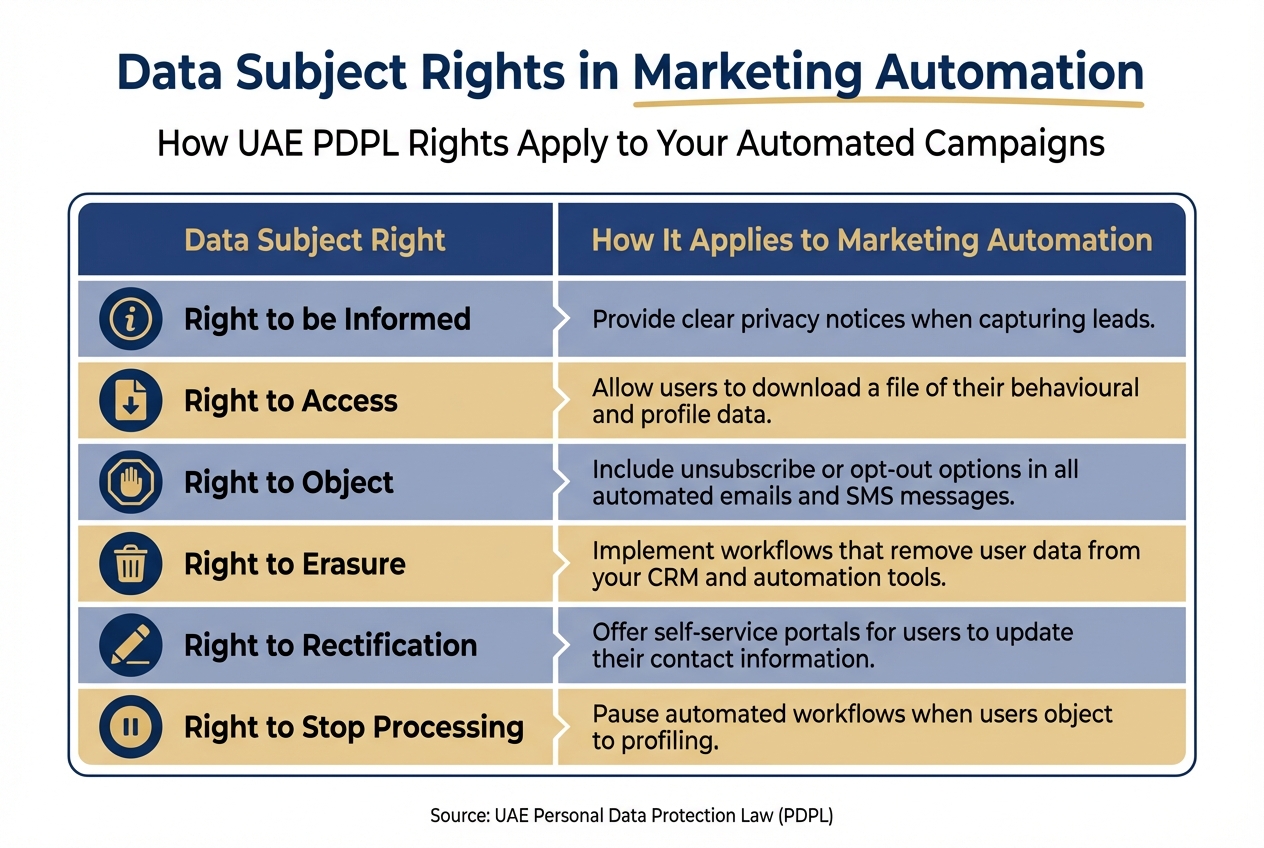
Data Subject Rights Under UAE PDPL for Marketing Automation
The UAE PDPL sets out key rules that govern how marketing automation should function. These rules translate into specific technical requirements for every automated workflow, lead scoring model, and personalisation tool you use.
Transparency and Accountability
Marketing automation systems must handle data in a fair, transparent, and lawful way. This means you need to inform users about what data you’re collecting, why you’re collecting it, and who you might share it with - before the data is processed. Your privacy policy must also explain any automated profiling or decision-making processes.
Accountability is equally important. Organisations are required to keep detailed records of all personal data processing activities. These records should include the categories of data processed, authorised personnel, processing timelines, and the technical measures in place to ensure security. These records must be made available to the UAE Data Office upon request. If your marketing automation involves high-risk technologies or large-scale profiling, appointing a Data Protection Officer (DPO) is mandatory. Once you’ve ensured transparency, the next step is obtaining clear consent and establishing a lawful basis for processing.
Consent and Lawful Basis for Processing
Under the PDPL, processing personal data without explicit consent is prohibited. For marketing automation, this means users must provide a "clear positive statement or action" to indicate their agreement. Pre-checked boxes don’t meet this standard. Organisations must be able to prove that consent was given, and users must have an easy way to withdraw it.
Consent is specific to each campaign. For example, if you’re running separate email campaigns and retargeting ads, each requires its own consent process. Additionally, individuals have the right to object to their personal data being used for marketing or surveys. When someone exercises this right, automation platforms must immediately stop processing their data. These consent mechanisms are essential for respecting and upholding data subject rights.
Data Subject Rights
Marketing automation systems must support individuals’ rights to access, correct, or delete their personal data. Systems should also enable data to be provided in a machine-readable format, supporting the right to data portability.
Users have the right to challenge decisions made entirely through automated processes, such as profiling that evaluates personal traits, behaviours, or preferences. For instance, if your lead scoring system automatically excludes prospects based on demographic factors, users must be able to contest that decision. Automation systems should include features to handle subject access requests, data export, and deletion workflows.
| Data Subject Right | How It Applies to Marketing Automation |
|---|---|
| Right to be Informed | Provide clear privacy notices when capturing leads |
| Right to Access | Allow users to download a file of their behavioural and profile data |
| Right to Object | Include unsubscribe or opt-out options in all automated emails and SMS messages |
| Right to Erasure | Implement workflows that remove user data from your CRM and automation tools |
| Right to Rectification | Offer self-service portals for users to update their contact information |
| Right to Stop Processing | Pause automated workflows when users object to profiling |
Best Practices for PDPL-Compliant Marketing Automation
Implementing the principles of the PDPL requires careful attention to technical settings and workflow design. Below, we break down actionable steps to help you stay compliant while running effective automated marketing campaigns.
Consent Management and Personalisation
Your opt-in forms are the cornerstone of PDPL compliance. They must feature unchecked boxes by default, as pre-ticked boxes fail to meet the law's standard for clear, affirmative consent. For each campaign, secure explicit consent separately - prior approvals cannot be reused.
Make it simple for users to withdraw consent. The PDPL requires that opting out should be as easy as opting in. If a user decides to stop participating in profiling or automated marketing, your system must immediately halt data processing for those activities.
To balance personalisation with privacy, use pseudonymisation. This method separates identifiable information from behavioural data, allowing you to deliver tailored content while safeguarding personal details. Maintain thorough records of when and how consent was obtained, what it covers, and the process for withdrawal.
Data Minimisation and Purpose Limitation
Building on consent requirements, focus on collecting only the data absolutely necessary for your objectives. Regularly audit your data collection processes to ensure compliance and consider using progressive profiling to gather information incrementally. According to Article 5 of the PDPL, data collection should be sufficient but limited to its specific purpose. For example, a newsletter subscription form typically only requires an email address.
Tag each data point with its corresponding consent purpose to prevent misuse and set automated workflows to delete or anonymise data once its purpose has been fulfilled. For instance, if a lead has not interacted with your communications for a specified period, your system should either delete their information or initiate a re-engagement campaign to renew consent. The PDPL mandates that personal data must not be retained beyond its intended use.
Automated Decision-Making and Profiling
When using marketing automation tools like lead scoring, behavioural triggers, or predictive analytics, you're engaging in profiling - automated processes that evaluate personal aspects such as interests, preferences, or location.
Transparency is key. Your privacy policy should clearly outline the logic behind automated systems and their potential impact on users. For example, if your lead scoring model excludes prospects based on company size or geographic location, users have the right to challenge such decisions. Ensure opt-out options are readily available and maintain human oversight to prevent systems from making decisions entirely on their own.
If your organisation engages in systematic profiling or processes sensitive data through automation, appointing a Data Protection Officer (DPO) is mandatory. Additionally, before implementing any new automated technologies that might pose significant privacy risks, conduct a Personal Data Protection Impact Assessment (DPIA). This evaluation helps identify potential risks and ensures that your safeguards adequately protect user rights. These practices are essential for embedding PDPL compliance into your automated marketing strategies.
sbb-itb-058f46d
Security and Cross-Border Data Transfers
Security Measures for Marketing Data
Under the PDPL, safeguarding personal data is a top priority, especially when it comes to your marketing automation platform. These platforms often handle sensitive information, and the law requires both Controllers and Processors to implement robust technical and organisational measures to ensure the confidentiality, integrity, and availability of this data. In short, security needs to be baked into your system's design.
A key pillar of your security strategy should be access control. Keep detailed records of who has access to the data to prevent unauthorised use and ensure accountability. Additionally, configure your platform to only collect and store the bare minimum amount of data necessary. Regularly auditing your security systems is another must - it helps you verify that your protective measures are up to the mark.
It’s also essential to have a breach notification protocol in place. If a breach occurs, you’re required to notify the UAE Data Office immediately. Considering the staggering costs of data breaches - ranging from US$7 million to US$10 million - along with the fact that 83% of organisations that experience one breach often face subsequent incidents, prevention and swift action are non-negotiable.
When working with marketing automation vendors, formalise the relationship through a legally binding contract. This document should outline the scope of data processing, security requirements, and what happens to the data after the processing period ends - whether it’s erased or returned to the Controller. Lastly, invest in comprehensive staff training on PDPL requirements to further fortify your data security framework.
While these measures focus on protecting data within the UAE, equal attention must be given to international data transfers.
Cross-Border Data Transfer Rules
Given that many marketing automation platforms store data across borders, compliance with cross-border data transfer regulations becomes essential. Under the PDPL, any data transferred outside the UAE must be safeguarded to ensure recipients provide protection equivalent to UAE standards.
You can transfer data to countries deemed to have an "adequate level of protection" by the UAE Data Office. These typically include EU/EEA nations such as Austria, Belgium, France, Germany, Ireland, and the Netherlands, as well as other jurisdictions like the UK, Canada, Japan, New Zealand, Singapore, and South Korea.
For transfers to countries without an adequacy decision, additional safeguards are required. This can include Standard Contractual Clauses or other written agreements that establish a clear protection framework. It’s also important to conduct due diligence on your vendors to confirm their compliance and security practices. Keep detailed records of all cross-border data transfers, including the purpose of processing and the security measures in place.
Lastly, remember that the federal PDPL does not cover financial free zones like DIFC or ADGM, which have their own data protection rules. If your marketing operations span both onshore UAE and these zones, you’ll need to navigate and comply with multiple regulatory frameworks.
Integrating Compliance with Wick's Four Pillar Framework

Aligning with the PDPL can do more than just meet regulatory demands - it can also make your marketing efforts more effective. Wick's Four Pillar Framework provides a structured way to embed data protection into your digital marketing strategy. By doing so, it transforms compliance requirements into opportunities for business growth. Here's how each pillar helps turn PDPL compliance into a strategic advantage.
Wick's Tailor & Automate Pillar
The Tailor & Automate pillar is the core of PDPL-compliant marketing automation. Its focus is on creating personalised experiences and automating workflows while respecting individual rights. For instance, Article 18 of the PDPL gives individuals the right to object to automated decisions that significantly impact them. Wick ensures these automated decisions are reviewed manually when needed, balancing regulatory compliance with operational efficiency.
Consent management is another critical component of this pillar. The PDPL mandates that consent must be specific, clear, unambiguous, and easy to withdraw. Wick addresses this by using double opt-in processes and centralised preference centres. These features allow customers to manage their profiling preferences with ease, fostering trust and increasing engagement.
Building a Connected Digital Ecosystem
The Four Pillar Framework doesn't just focus on individual components - it connects them into a seamless digital ecosystem. This is especially important for businesses in the UAE, where three distinct legal regimes govern data protection: the Federal PDPL, DIFC Data Protection Law, and ADGM Data Protection Regulations. Wick's connected ecosystem tracks data flows automatically and applies the right safeguards based on where the data is registered, processed, and where data subjects are located.
For example, Article 7 of the PDPL requires organisations to maintain a "special record" of personal data, including details about cross-border transfers. Wick's centralised governance model automates this process, making it easier to demonstrate compliance to the UAE Data Office whenever needed. The system also integrates Privacy by Design principles, incorporating encryption and pseudonymisation from the outset. With penalties for non-compliance ranging from AED 50,000 to AED 5 million (approximately $13,600 to $1.36 million), this approach not only safeguards customer data but also protects your business from costly fines.
Table: PDPL Compliance Features Across Marketing Automation Stages
| Marketing Automation Stage | PDPL Requirement / Best Practice | Wick's Compliance Feature |
|---|---|---|
| Data Collection | Obtain explicit, informed consent (Art. 6); provide clear privacy notices. | Centralised consent management with double opt-in. |
| Processing | Purpose limitation & minimisation (Art. 5); appoint DPO for systematic assessments. | Intent-based segmentation; automated purpose-check; DPO appointment support. |
| Storage | Data minimisation; secure storage with encryption (Art. 20). | Automated data purging/anonymisation once purpose is fulfilled; encrypted storage. |
| Usage | Right to object to direct marketing (Art. 17); transparency in automated decisions. | One-click unsubscribe; preference centres for profiling opt-outs; manual review for high-impact decisions. |
| Cross-Border Transfer | Adequate protection levels or approved contractual safeguards (Art. 22, 23). | Real-time tracking of data residency; automated application of Standard Contractual Clauses. |
Conclusion
Marketing automation has the potential to redefine customer engagement in the UAE, especially when carefully aligned with the nation's strict data privacy laws. The Personal Data Protection Law (PDPL), along with frameworks from DIFC and ADGM, not only set regulatory standards but also open doors to earning customer trust - though failing to comply can result in steep financial penalties.
Adopting these privacy measures isn't just about meeting legal requirements; it's a way to build trust that endures. Start by embedding privacy into your processes: obtain clear consent, honour objections to direct marketing, conduct manual reviews for high-impact automated decisions, minimise data usage, and ensure proper safeguards for transferring data across borders.
Wick's Four Pillar Framework offers a strategic approach to turn compliance hurdles into business advantages. For instance, the Tailor & Automate pillar balances respecting individual rights with delivering personalised customer experiences. Meanwhile, a connected digital ecosystem ensures data flows are tracked across the UAE's regulatory landscape, keeping compliance records aligned with the UAE Data Office's standards.
When you pair automation with strong privacy practices, you're doing more than avoiding fines - you’re building a foundation for growth. Businesses that manage data responsibly earn customer trust, which leads to loyalty and stronger brand value. By weaving privacy into every stage of your marketing automation, you can achieve both compliance and sustainable success.
FAQs
How does the UAE's Personal Data Protection Law (PDPL) impact marketing automation?
The UAE's Personal Data Protection Law (PDPL), outlined in Federal Decree-Law No. 45/2021, places a strong emphasis on responsible and transparent handling of personal data. For businesses, this means obtaining clear and explicit consent before collecting or using personal data - especially in marketing automation campaigns.
To stay compliant, organisations must provide mechanisms that allow individuals to access, correct, or limit the use of their data. Additionally, the law mandates data protection by design and default, ensuring privacy safeguards are built into systems from the outset. Cross-border data transfers are also tightly regulated, requiring businesses to implement stringent measures to protect sensitive data during international exchanges.
Incorporating these compliance steps into your marketing automation efforts not only helps you adhere to legal requirements but also builds credibility with your audience. Wick’s expertise in crafting well-integrated digital solutions can support your efforts to align with UAE data privacy laws, enabling growth while respecting the local regulatory framework.
What happens if you don’t comply with UAE data privacy laws when using marketing automation?
Failure to adhere to the UAE's Personal Data Protection Law (PDPL) when using marketing automation tools can lead to legal penalties, hefty fines, and serious harm to your reputation. The PDPL mandates that businesses follow strict data protection measures, including obtaining explicit consent from individuals, protecting personal data, and honouring the rights of data subjects.
Ignoring these requirements doesn't just invite legal and financial trouble - it can also undermine customer trust, a cornerstone for lasting success in the UAE's regulated and trust-focused market. Aligning your marketing strategies with PDPL guidelines is not just a legal obligation but a key to sustainable growth.
How can businesses in the UAE ensure compliance with data privacy laws when transferring data internationally?
To meet the requirements of the UAE Personal Data Protection Law (PDPL) for international data transfers, businesses need to ensure the destination country provides an acceptable level of data protection. This means confirming that the legal framework in the receiving country aligns with the standards set by the UAE. If the destination lacks sufficient safeguards, businesses can adopt additional measures like contractual clauses or binding corporate rules to remain compliant.
In many cases, businesses must obtain explicit consent from individuals before transferring their data overseas, unless specific exceptions apply, such as fulfilling legal obligations or serving the public interest. To stay compliant and safeguard privacy rights, companies should regularly review their transfer processes, carry out risk assessments, and seek advice from legal professionals when necessary.