
Blog / How to Manage Cross-Channel Campaigns with Collaborative Tools
How to Manage Cross-Channel Campaigns with Collaborative Tools
Cross-channel campaigns ensure your brand delivers consistent, connected customer experiences across platforms like email, social media, SEO, and paid ads. By integrating actions - like triggering a personalised social ad after an email click - you can significantly boost engagement and conversions. The key to success? Using collaborative tools that centralise campaign management, automate workflows, and unify customer data.
Key Takeaways:
- Why It Matters: Brands using three or more channels see conversion rates 287% higher than single-channel efforts. Disjointed campaigns frustrate 87% of customers.
- Tools to Use: Look for platforms with unified dashboards, real-time data integration, and AI-powered automation for better insights and efficiency.
- Steps to Follow:
- Select tools that unify data and simplify collaboration.
- Create centralised workspaces to streamline communication and reduce delays.
- Build workflows connecting teams and tools for seamless execution.
- Track performance across all channels using real-time dashboards.
For UAE businesses, features like Arabic language support, AED currency handling, and WhatsApp integration are essential to meet local market expectations. By implementing these strategies and tools, you can optimise campaign performance while delivering consistent, personalised customer experiences.
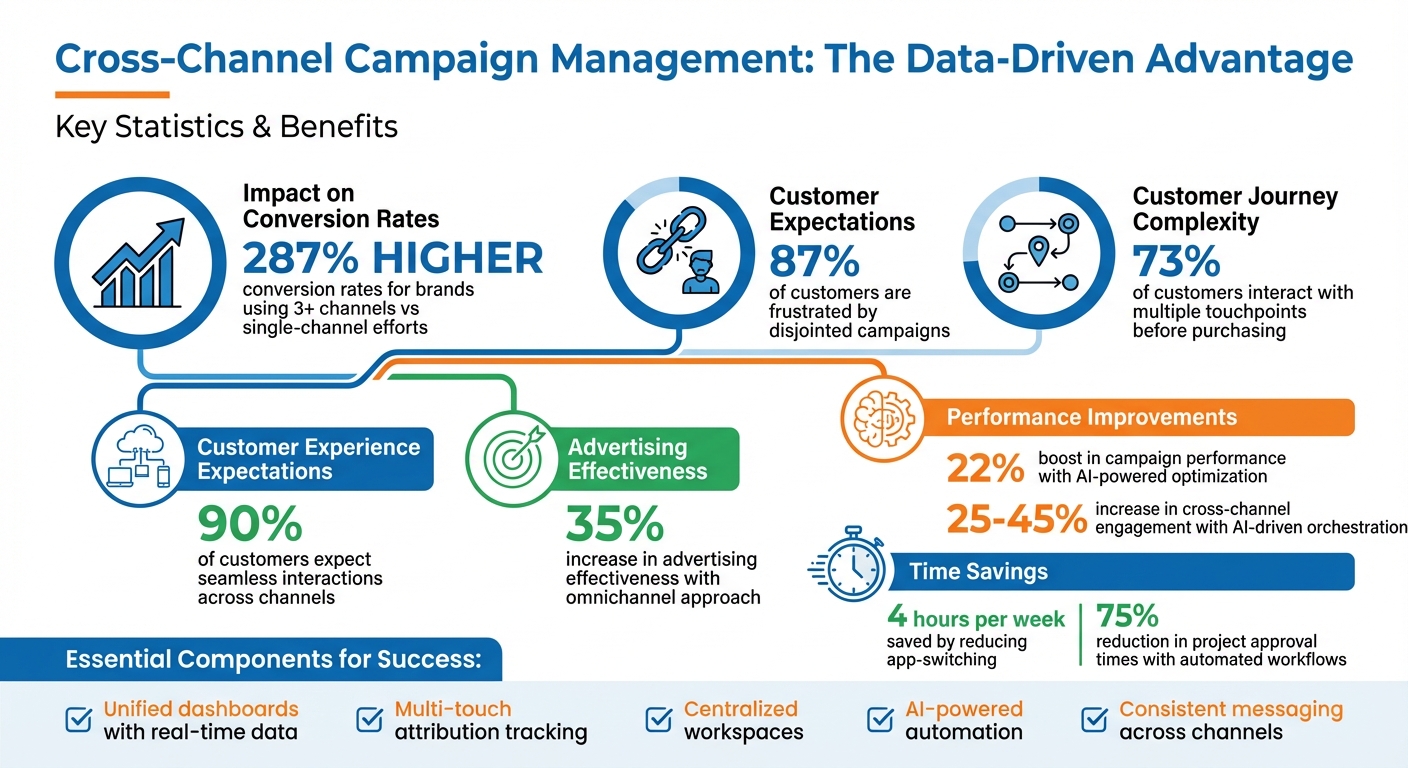
Cross-Channel Campaign Management: Key Statistics and Impact
Multi-Channel Campaign Launch Agent Demo
sbb-itb-058f46d
Step 1: Choose the Right Collaborative Tools
When managing complex cross-channel campaigns, the tools you use can make or break your strategy. The ideal platform should unify data, automate workflows, and provide full visibility across all channels.
Look for platforms with unified dashboards that integrate real-time, API-driven data. This enables immediate insights and automation across channels like social media, search, email, and programmatic ads. Another must-have? Accurate content previews - the ability to see exactly how your content will appear on different platforms (social, email, SMS) during the planning stage. This feature helps avoid costly errors and ensures your brand remains consistent across channels. Tools powered by AI and automation can also add value by detecting anomalies, suggesting budget reallocations, and scaling personalised content creation. As Katie Zandonella, Fractional Marketing Officer at Zandonella Marketing Solutions, explains:
AI will undoubtedly pave the way for delivering highly personalised experiences at scale, ultimately boosting campaign effectiveness and efficiency.
Choosing the right tools lays the foundation for a smoother cross-channel campaign process.
Key Features for Team Collaboration
Collaboration tools should do more than just share files - they should help your team work seamlessly from a single, centralised source of truth.
The best platforms offer structured workflows with features like approval chains, task dependencies, and automated notifications. These functions help reduce delays and ensure brand consistency, even when managing campaigns across time zones or coordinating with external agencies.
Another critical feature is multi-touch attribution. Unlike last-click models, this approach credits every interaction in the customer journey, giving you a clearer picture of which channels are driving results. Additionally, centralised workspaces - where goals, audience profiles, and creative assets are stored - help eliminate information silos and keep everyone aligned.
Tools Adapted for the UAE Market
For businesses in the UAE, certain features are essential to address the region's unique needs. Your platform should support Arabic language integration and offer AI-powered translations for chat, documents, and emails. This is crucial in a market with a diverse, multilingual audience.
Ensure your tool can handle local data formats, such as AED currency, Gulf Standard Time (GST), and regional campaign identifiers. Given the popularity of conversational marketing in the UAE, platforms with WhatsApp integration are invaluable for tasks like following up on abandoned carts. Lastly, prioritise platforms with role-based access controls and robust data encryption to comply with both local regulations and global privacy standards like GDPR.
With the right tools in place, you're ready to move on to building centralised workspaces in the next step.
Step 2: Create Centralised Campaign Workspaces
After choosing your collaboration tools, the next step is to set up a centralised workspace - a single hub where your team can access everything from campaign requirements and assets to timelines and communications. By cutting down on constant app-switching, you can save nearly four hours a week and reduce the 1,200 daily task switches per employee.
A centralised workspace ensures nothing slips through the cracks and keeps everyone on the same page. Since the pandemic, 69% of marketers say collaboration has become harder, making structured workspaces even more essential. Take Aerotek’s marketing coordinator, Matt Andrews, as an example. When he brought six teams together on one platform in January 2026, he cut the typical campaign planning cycle by about 1.5 weeks. That’s the power of a unified system.
Now, let’s dive into how to organise your workspace for success.
Structure Your Campaign Elements
Once your workspace is centralised, it’s time to organise it. Structure your campaigns so that every asset - whether it’s a video, a social post, or a web banner - contributes to a consistent message. Use nested hierarchies to map out relationships between overarching programmes, specific activations, and individual tasks. This setup allows managers to focus on big-picture goals while team members track their day-to-day responsibilities, cutting down on the need for constant status meetings.
Custom fields like Campaign Phase, Priority, or Approval Stage can make searches faster and trigger automated notifications. Linking shared assets, such as a hero video that feeds into social media clips, also prevents duplicate work . Diana Dvorkin, Global Campaigns Lead at Asana, sums it up well:
"Managing campaigns is the best job in that you get to work with everyone. But it's the hardest job in that you have to organise everyone."
Automate Tasks and Notifications
Automation can take your workspace to the next level. Use dynamic request forms with conditional logic to capture campaign briefs and automatically generate projects with pre-filled task lists, assigned owners, and timelines . Automated notifications can also update the team as tasks move between stages (e.g., from 'Drafting' to 'Under Review'), helping to minimise downtime .
To avoid bottlenecks, set up escalation rules. For instance, if an approval is delayed for more than 48 hours, the system can reassign or escalate the task automatically. At Moneytree, Marketing Project Manager Alex B. introduced automated proofing workflows in January 2026. This reduced approval cycles from seven days to just four, speeding up projects by 75%. In fact, structured workflows like these can cut overall project approval times by as much as 75%.
AI-powered tools like "Smart Status" can also help by generating weekly updates for stakeholders based on real-time data, saving hours of manual reporting. Ambient reporting features, which continuously update campaign statuses, are becoming the norm . These tools keep your team moving forward across all channels without missing a beat.
Step 3: Build Cross-Functional Workflows
Once you've set up a centralised workspace, the next step is to create workflows that connect different teams and tools, ensuring your approach moves beyond just collecting data to executing dynamic campaigns. To avoid working in silos, use collaborative tools that act as a central hub, bringing together data from your website, CRM, and social platforms. This helps you build detailed customer profiles and coordinate actions seamlessly across channels. For instance, an abandoned cart could trigger a sequence: an email reminder, followed by a social media retargeting ad, and then an SMS with a discount offer.
Here’s the payoff: campaigns using three or more channels can achieve conversion rates that are 287% higher than single-channel efforts. A great example comes from Floward, a UAE-based gifting brand. In 2025, they tackled customer churn by launching an integrated Valentine’s Day campaign. Using a unified engagement platform, they combined WhatsApp, push notifications, in-app messages, and emails. By leveraging RFM analysis to segment customers, they re-engaged inactive users and saw a notable increase in revenue. This type of integration sets the stage for smart automation and consistent messaging across all customer touchpoints.
Use AI and Data Analytics
AI tools can dramatically cut the time spent planning and executing campaigns - from 8–18 hours down to just 1–2 hours. These tools analyse customer behaviour across channels in real time, helping you identify the best moments to send messages and the most effective channels for each user. In a market as diverse as the UAE, AI also offers real-time translation and localisation, letting you connect with international audiences while keeping your brand voice consistent.
The numbers speak for themselves: AI-powered optimisation can boost campaign performance by 22%, and cross-channel engagement can increase by 25–45% with AI-driven orchestration. As Christian Sculthorp, Founder of WallPanels, explains:
"AI is not a replacement for human creativity and strategy. Rather, it's a tool that can help marketers work more efficiently and effectively."
While AI takes care of timing and targeting, it’s crucial to ensure your creative message remains consistent across all platforms.
Maintain Consistent Messaging Across Channels
Consistency matters - nearly 90% of customers expect seamless interactions, and many grow frustrated if they have to repeat information. To meet these expectations, create detailed brand guidelines that cover tone, visuals, and messaging. These guidelines ensure every team stays aligned with your brand voice.
Take UAE retail giant Majid Al Futtaim as an example. Within a year of adopting a unified platform, they centralised communications for their SHARE Rewards programme. Their cross-functional Marketing Technology Team automated 110 lifecycle campaigns, reaching over 5.5 million recipients through a well-coordinated mix of channels. Lauren Hawk, Chief Communications Strategist at Tinge Communications, provides a clear takeaway:
"The best practice for managing cross-channel campaigns is ensuring consistent branding and messaging across all platforms. Understand the unique strengths and audiences of each channel and tailor your content accordingly, while maintaining a unified voice."
Step 4: Track Campaign Performance
After setting up unified workspaces and streamlined workflows, the next step is tracking performance. This ensures your integrated campaign management strategy delivers results. Here’s the challenge: 74% of brands struggle with cross-channel attribution and consolidating data. Without proper tracking, it’s impossible to pinpoint which channels are driving success and which ones are draining resources.
Monitor Metrics Across All Channels
Bring all your data together in one place - use a unified dashboard to monitor performance in real time. Modern tools can automatically pull data from social media platforms, search engines, email campaigns, and even offline interactions via APIs, saving you time and effort.
Focus on four key metric categories:
- Efficiency: Metrics like CPC (cost per click), CPM (cost per thousand impressions), and CPA (cost per acquisition).
- Engagement: Indicators such as CTR (click-through rate), likes, and shares.
- Bottom-Line Impact: Numbers like total revenue, ROAS (return on ad spend), and LTV (lifetime value).
- Volume: Metrics including impressions, reach, and sessions.
Make sure your definitions are consistent across platforms. For example, a “conversion” on Facebook should align with your “goal” in Google Analytics to keep comparisons accurate.
Set up automated alerts to flag any unusual changes in performance. For instance, if your CTR drops 20% below the 7-day rolling average, you’ll know immediately. This is a common practice among top-performing marketing teams - 87% of them use data dashboards to guide decisions. Considering that 73% of customers interact with multiple touchpoints before making a purchase, multi-touch attribution becomes critical. As the Prescient Team puts it:
"When your marketing channels operate in silos, each platform becomes a cheerleader for itself, inflating its contribution while missing how your channels actually work together."
Review your data weekly for quick adjustments and monthly for bigger strategic changes. Use tools with drill-down capabilities so you can move from an overall campaign view to the performance of specific ads. This allows for real-time budget tweaks and smarter resource allocation.
Compare Tool Features with Tables
Not all tools are built equally when it comes to analytics. To choose the right one, compare features based on your campaign needs. Here’s a quick breakdown:
| Tool Category | Examples | Best For | Key Strength |
|---|---|---|---|
| All-in-One Analytics | Matomo, Google Analytics 4 | Budget-conscious teams | Seamless integration with Google tools; GA4 is free |
| ETL & Data Blending | Windsor.ai, Coupler.io, Supermetrics | Automating data flow | Pulls data from 300+ sources into Sheets or BI tools |
| Agency Reporting | AgencyAnalytics, TapClicks | Multi-client management | 80+ integrations; automated white-labelled reports starting at AED 217/month |
| Enterprise Platforms | Adobe Campaign, Salesforce, Oracle | Large-scale automation | Advanced customer journey mapping and AI-driven forecasting |
Dominic Hill, VP Digital at Ecom Department, emphasises the importance of streamlined data access:
"Both our internal agency team members and our clients need accurate cross-channel data that is available in a few clicks... The ability to be nimble and move between cross-channel data points 'on the go' is a big value."
Here’s a surprising fact: only 16% of marketing tech stacks currently offer accurate cross-channel measurement. That’s why it’s critical to select tools that provide real-time data integration, customisable dashboards, and role-based permissions. This ensures that every stakeholder sees the data they need - without exposing sensitive information.
How Wick's Four Pillar Framework Supports Campaign Management
Managing cross-channel campaigns is far simpler when all your tools work within a single, unified system. That’s the idea behind Wick's Four Pillar Framework - it turns fragmented marketing efforts into a streamlined process, eliminating the hassle of juggling multiple platforms and providers. This approach ensures that clean, consistent data flows seamlessly into every tool you use.
The framework addresses a key issue in the UAE market, where 39% of brands struggle with technology silos, relying on disconnected, channel-specific solutions. Wick changes this by creating a "single source of truth", linking marketing data directly to CRM systems and sales outcomes. This is especially important in competitive markets like the UAE, where consumers expect brands to remember their preferences across every interaction.
The benefits of this framework aren’t just theoretical - they’re backed by tangible results. For example, Wick partnered with Baladna, Qatar's top dairy producer, to unify their digital ecosystem. By implementing a Customer Data Platform (CDP), they automated email marketing and managed social media on Instagram, Facebook, and X, boosting their digital presence and driving noticeable growth in Qatar. Similarly, for Hanro Gulf in the UAE, Wick spearheaded a digital transformation by launching a regional website, optimising SEO, and running targeted paid campaigns - laying a solid foundation for future growth.
Apply the Four Pillars to Your Collaborative Tools
The Four Pillar Framework works seamlessly with your collaborative tools, removing manual tasks and breaking down data silos.
- Build & Fill: This pillar focuses on setting up the digital infrastructure - websites, e-commerce platforms, and SEO foundations - that act as the backbone for your campaign tools. Standardised design templates and centralised asset libraries ensure consistency and eliminate inefficiencies.
- Plan & Promote: Through integrated workflows, this pillar synchronises efforts across SEM, social media, and programmatic advertising. It ensures unified messaging across platforms and aligns marketing and sales teams using shared data.
- Capture & Store: By implementing CDPs and advanced analytics, this pillar unifies data from disparate systems. This creates a 360-degree customer profile, crucial for effective cross-channel campaigns. Wick currently manages over 1 million first-party data points for clients, helping brands avoid frustrating their customers - 87% of whom dislike repeating information across touchpoints.
- Tailor & Automate: This pillar leverages AI to deliver personalised, scalable interactions. Personalisation has been shown to boost revenue by 10% to 15%, all while reducing the need for manual input.
| Pillar | Integration with Collaborative Tools | Key Services for UAE Businesses |
|---|---|---|
| Build & Fill | Lays the groundwork for digital assets. | Website Development, SEO, Content Management |
| Plan & Promote | Aligns paid and organic reach. | SEM, Social Media Ads, Programmatic Advertising |
| Capture & Store | Consolidates data into a centralised CDP. | CDP Implementation, Analytics, Customer Journey Mapping |
| Tailor & Automate | Scales personalisation using AI and automation. | AI-Driven Personalisation, Marketing Automation |
Use Wick's Services for Cross-Channel Campaigns
Wick's Advanced and Enterprise plans provide the infrastructure your campaigns need. These plans allow for real-time budget adjustments, reallocating funds from underperforming tactics to those delivering better results. This is crucial, as brands using three or more channels in their campaigns often see conversion rates jump by 287% compared to single-channel efforts.
Wick’s expertise in SEO, data analytics, and AI-driven personalisation gives it an edge over many other platforms. For instance, Olive Branch Properties benefited from a full digital transformation, including AI-powered customer service and automated communications. Wick also managed their website, social channels, and even podcast production, ensuring consistent engagement throughout the customer journey. This comprehensive approach is what sets successful cross-channel campaigns apart from disjointed ones.
Adelso Quijada, Head of Marketing GCC at Al Marai, summarised the impact of Wick's integrated strategy:
"Overall, I highly recommend Wick and MB to any business looking for a reliable and effective digital marketing partner. Their expertise, creativity, and dedication to delivering results are truly impressive."
What makes Wick stand out in the UAE and GCC markets is its deep understanding of regional dynamics. With over half of companies now engaging customers through at least eight channels, having a partner who can unify these touchpoints into a cohesive system is no longer just helpful - it’s essential for staying competitive.
Conclusion
Achieving success across multiple channels means breaking down silos and ensuring data flows seamlessly. Start by choosing tools that encourage collaboration and bring your digital ecosystem together. From there, focus on creating centralised workspaces, setting up workflows that connect different teams, and monitoring performance across every stage of the customer journey - not just the final interaction. This unified strategy lays the groundwork for tailoring campaigns effectively to the UAE market.
In the UAE, coordinated campaigns are a must. When all channels work in harmony through an omnichannel approach, advertising effectiveness increases by 35%. Even more compelling, brands that utilise at least three distinct channels experience significantly higher conversion rates compared to those relying on just one. These aren't small improvements - they're what separate campaigns that underperform from those that deliver measurable growth.
Earlier, we discussed the importance of a unified digital ecosystem. Wick's Four Pillar Framework makes this operational by connecting every aspect of your campaign. This framework is particularly useful for UAE businesses, addressing challenges like fragmented technology and the demand for real-time personalisation. By integrating components such as website development, SEO, data analytics, and AI-driven automation, the framework ensures that every campaign element strengthens the others. This approach is especially critical in a market where 87% of consumers express frustration when they have to repeat information across different channels.
Evaluate how prepared your organisation is for integration. Map out the customer journey to spot any weak points and align your content calendar so updates across social media, email, and your website deliver a consistent message at the same time. With the right tools and a unified framework, your team can shift from managing disconnected campaigns to delivering cohesive, data-driven experiences that convert.
Whether you're managing a mid-sized business or leading enterprise-level campaigns, the core principles remain unchanged: centralised data, synchronised messaging, and ongoing optimisation across every channel your customers engage with.
FAQs
What’s the quickest way to start a cross-channel campaign without changing our whole tech stack?
The quickest way to roll out a cross-channel campaign without completely revamping your tech stack is by leveraging a collaborative platform that works seamlessly with your current tools. These platforms simplify the entire process - campaign planning, execution, and performance tracking - across various channels. This approach saves time, boosts coordination, and avoids the need for significant system overhauls.
How do we connect email, social, ads, and WhatsApp without duplicating work?
To make managing cross-channel campaigns easier, consider using an integrated marketing platform. These platforms bring together data and automate workflows across channels like email, social media, ads, and WhatsApp. This not only keeps your messaging consistent but also reduces the amount of manual work involved.
When incorporating WhatsApp into your marketing strategy, connect it with your other channels. By using unified customer profiles and automating customer journeys, you can reuse existing assets, ensure your messaging stays aligned, and provide a smooth experience for your audience across all platforms.
Which cross-channel metrics matter most for budget decisions in the UAE?
When planning budgets, focusing on the right metrics is crucial. In the UAE, Return on Ad Spend (ROAS), Customer Acquisition Cost (CAC), and engagement indicators such as Click-Through Rate (CTR) and conversion rates are essential benchmarks. These metrics guide smarter budget allocation by highlighting the most effective channels and ensuring better cost management.
This becomes especially important during major periods like Ramadan or UAE National Day, when shifts in market trends and audience behaviour can greatly influence campaign results. By keeping an eye on these metrics, businesses can adapt their strategies to maximise impact during such critical times.