
Blog / How Machine Learning Predicts Marketing ROI
How Machine Learning Predicts Marketing ROI
Machine learning is changing how businesses in the UAE approach marketing. Instead of relying on guesswork, companies are using data-driven models to predict campaign performance and optimise spending. Key takeaways include:
- AI boosts results: Businesses using AI see up to 30% better campaign performance and 46% higher ROI.
- Data is critical: Clean, connected data from past campaigns, customer behaviour, and web analytics is essential for accurate predictions.
- Better decisions: Machine learning helps forecast ROI, reduce customer acquisition costs, and improve retention rates.
- Real-world examples: Companies like Optify and Emirates NBD have achieved impressive results, such as cutting costs and improving customer interactions.
Maximizing Marketing ROI A Machine Learning Framework for E commerce Customer Lifetime Value Predict
Data Inputs Required for Machine Learning Models
Machine learning models thrive on clean, well-organised data to accurately predict marketing ROI. The quality of your predictions depends entirely on the inputs you provide. Christopher Van Mossevelde, Head of Content at Funnel, puts it succinctly:
"Predictions are only as strong as their inputs. In marketing, that means clean, connected data and models built on real performance signals."
The stakes are high - poor data quality is a major reason why 60% of AI projects fall short or fail altogether. Generally, machine learning models need 10,000+ outcomes and 12 to 24 months of historical data to deliver reliable predictions. Despite the potential, marketing analytics currently shapes only 53% of decisions, leaving nearly half reliant on instinct rather than data. Let’s break down the critical data sources that drive these predictions.
Historical Campaign Performance
Past campaign data forms the backbone of your model. Metrics like impressions, click-through rates (CTR), conversion events, and cost-per-acquisition (CPA) are essential. However, raw numbers alone don’t suffice. You also need to include campaign parameters such as budget allocation, channel mix (e.g., social, display, paid search), and details about the creative elements used [6,7].
Timing matters too. Your historical records should account for seasonality, day-of-week patterns, and campaign duration, as these factors can significantly influence performance. Additionally, tracking adstock effects - the lingering impact of past advertising on behaviour - provides deeper insights. To ensure consistency, centralise data from platforms like Google Ads, Meta Ads, and TikTok Ads into a unified, normalised dataset. Be sure to include precise revenue data tied to specific customer conversions and total investment figures for accurate ROI calculations.
Customer Behaviour and CRM Data
While campaign metrics lay the groundwork, CRM data adds a layer of behavioural insights. Details like purchase histories, support tickets, email engagement, and recent transactions feed into predictive models. Combining historical purchase trends with live CRM signals allows for a more dynamic understanding of customer behaviour.
Different types of models utilise CRM data in various ways. For instance:
- Classification models use purchase histories and lead attributes to identify customers likely to churn [7,11].
- Clustering models group customers based on browsing habits, basket sizes, and buying cycles for segmentation [7,13].
- Regression models rely on customer lifetime value (LTV) to predict future sales and revenue impact [7,12].
One ongoing challenge is identity resolution - ensuring that CRM, ad platform, and web analytics data align to track the same customer across their entire journey. Companies that use predictive analytics for retention have seen improvements of 10–15%, and 80% of customers are more likely to buy from brands offering personalised experiences powered by data.
Web Analytics and Social Media Insights
Web analytics offers structured metrics - like impressions, CTR, CPA, and conversion rates - that establish baseline channel efficiency. But their real value lies in clickstream data and engagement patterns, which reveal how visitors interact with your site, where they drop off, and which actions lead to conversions.
Social media data adds another dimension. By using natural language processing (NLP), you can analyse customer sentiment and track brand perception over time. Engagement metrics like likes, shares, comments, and follower growth help measure the effectiveness of messaging and brand awareness.
To enhance model accuracy, consider external factors such as market sentiment, competitor activity, and broader economic trends. These variables help prevent models from misassigning ROI changes to internal efforts when external forces are at play. Use tracking URLs across all social media posts and ads to directly link online activity to business outcomes.
Choosing the Right Machine Learning Algorithms
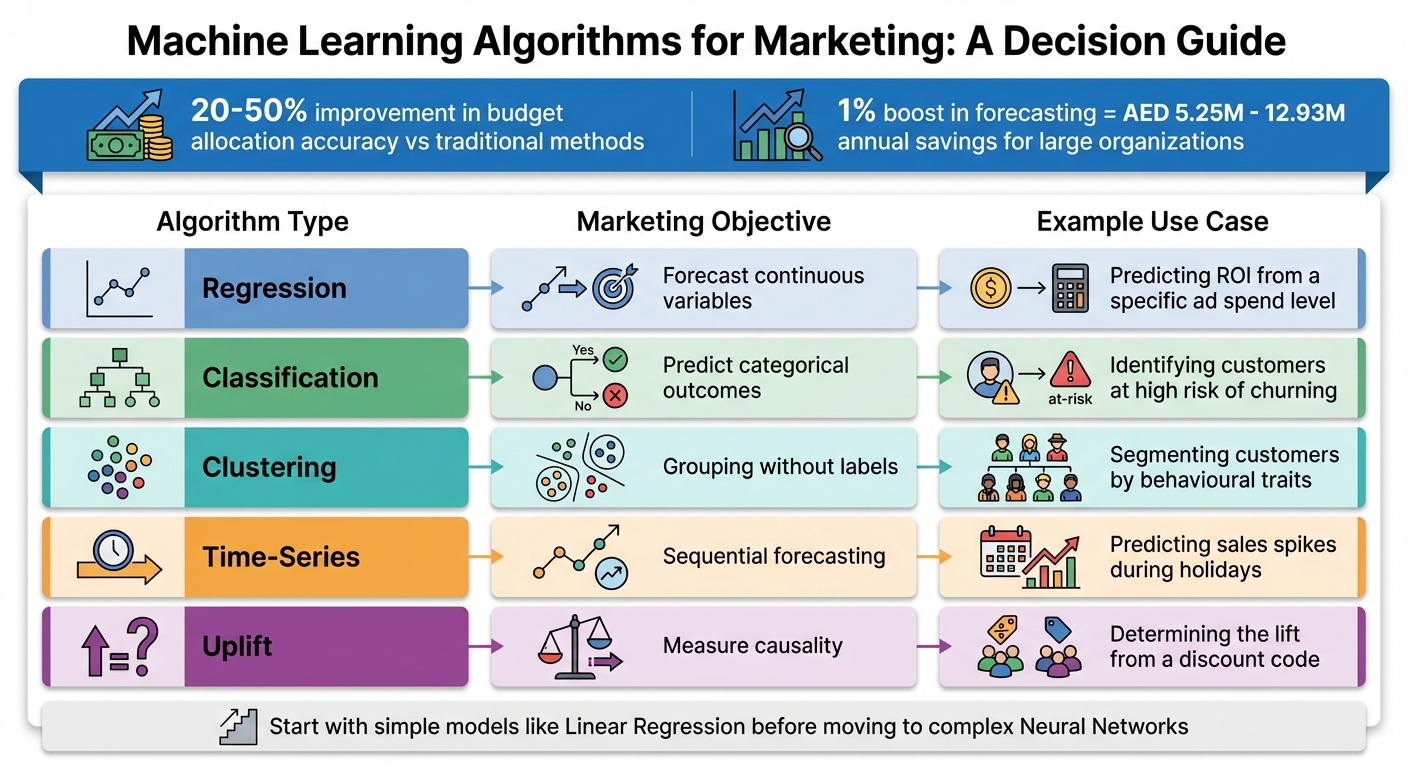
Machine Learning Algorithms for Marketing ROI: Types, Objectives, and Use Cases
When it comes to accurate ROI forecasting, picking the right machine learning algorithm is just as important as having quality data. Start by identifying your goals - are you forecasting revenue, spotting churn risks, or segmenting customer behaviour? Once you know your objective, choose an algorithm that aligns with it.
Roman Vinogradov, VP of Product at Improvado, highlights the critical role of data in this process:
"Predictive modelling only performs as well as the data behind it. Effective predictive workflows rely on unified historical data, consistent identifiers, and controlled metric logic."
For example, regression models are ideal for questions like "How much revenue will this campaign generate?" Classification algorithms work well for identifying customer churn, while clustering models are perfect for segmenting audiences. Here's a quick guide to match marketing objectives with the right algorithms:
| Algorithm Type | Marketing Objective | Example Use Case |
|---|---|---|
| Regression | Forecast continuous variables | Predicting ROI from a specific ad spend level |
| Classification | Predict categorical outcomes | Identifying customers at high risk of churning |
| Clustering | Grouping without labels | Segmenting customers by behavioural traits |
| Time-Series | Sequential forecasting | Predicting sales spikes during holidays |
| Uplift | Measure causality | Determining the lift from a discount code |
Machine learning can improve budget allocation accuracy by 20–50% compared to traditional methods. For large organisations, even a 1% boost in forecasting precision could save between AED 5.25 million and AED 12.93 million annually. Start with simple, interpretable models like Linear Regression or Decision Trees to gain trust before moving to more complex systems like Neural Networks.
Regression Models for ROI Forecasting
Regression models are the go-to choice for predicting continuous outcomes, such as revenue, Customer Acquisition Cost (CAC), or deal sizes. Linear Regression is a solid starting point, but if your data involves overlapping variables (like multiple campaigns running simultaneously), techniques like Lasso and Ridge Regression can prevent overfitting.
Bayesian Regression is becoming increasingly popular for Marketing Mix Modelling (MMM). It combines historical data with prior business knowledge, making it more effective at handling noisy or limited data. This method produces stable forecasts, which is especially useful when data quality is inconsistent.
A great example comes from Twinings, which adopted a Bayesian predictive model. The result? A 16.5% boost in sales volume and AED 14.7 million in added revenue. By re-evaluating seasonality patterns and dynamically adjusting budgets, they moved away from static quarterly plans.
To build effective regression models, consider including variables like ad spend, campaign duration, audience demographics, lead quality, and historical performance.
Once you've forecasted revenue, you can shift your focus to understanding customer behaviour using classification models.
Classification Algorithms for Customer Retention
Classification models are designed to answer "yes or no" questions: Will this customer churn? Is this lead qualified? Will this user convert? These models categorise data based on historical patterns.
Advanced algorithms like Random Forests and Gradient-Boosted Models (e.g., XGBoost, LightGBM) excel at capturing non-linear relationships, making them particularly effective for customer retention. These tools help identify at-risk customers early, enabling proactive retention efforts.
However, class imbalance can be a challenge. For example, if only 5% of leads convert, the model may skew towards predicting non-conversion. Techniques like Synthetic Minority Oversampling (SMOTE) can address this by balancing the dataset. Always test model predictions with holdout groups or small A/B experiments to confirm their impact in real-world scenarios.
Clustering Algorithms for Customer Segmentation
Clustering models differ from regression and classification because they work without predefined labels. They uncover patterns by grouping customers based on behaviour, demographics, or purchase history. This makes them a powerful tool for developing personas and performing micro-segmentation.
Popular clustering methods include K-Means and Hierarchical Clustering. These techniques reveal natural groupings in your audience, such as high-value frequent buyers, price-sensitive customers, or seasonal shoppers.
In November 2025, Seidensticker, an e-commerce company, used clustering to optimise spending. By reallocating budgets to high-ROI segments and reducing waste on ineffective campaigns, they increased revenue by 11.5% while cutting total ad spend by 11.7%. The insights allowed them to identify which customer segments responded best to paid campaigns versus organic conversions.
Clustering becomes even more effective when combined with other models. For instance, you could segment your audience with clustering and then use classification models within each segment to predict churn risk. This layered approach can outperform single-model strategies by 15–30% in noisy marketing environments.
Training and Validating Predictive Models
After selecting the right algorithm, the next step is to train it using historical data and validate its accuracy to ensure reliable ROI forecasts. A common practice is to split your dataset into three parts: 70% for training, 15% for validation, and 15% for testing. Each portion serves a distinct purpose: the training set helps the model learn patterns, the validation set fine-tunes its parameters, and the test set provides a final assessment on completely unseen data.
For ROI forecasting, the order of events in the data matters. You can’t use future data to predict past outcomes. This is where walk-forward validation becomes critical. It mimics real-world forecasting by training the model on data up to a specific point, predicting the next period, and then expanding the training window to repeat the process. This method ensures the model is rigorously validated and its predictions remain reliable over time.
Training Models on Historical Data
The training phase involves feeding the model high-quality historical data to identify patterns between inputs - like ad spend, audience demographics, or campaign duration - and outputs such as revenue or conversions. Clean, well-organised data from CRMs, ad platforms, and web analytics is essential for strong model performance.
To avoid overfitting, techniques like k-fold cross-validation can be employed. This helps ensure the model uncovers patterns that generalise to future scenarios rather than simply memorising the training data. With sufficient learning, many AI systems can forecast with an accuracy range of 10–15% compared to actual performance within three to six months.
Model Validation and Performance Metrics
Once the model is trained, validating its performance is key to ensuring it works well with unseen data. Metrics like Mean Absolute Error (MAE) provide an intuitive measure of average errors, while Root Mean Squared Error (RMSE) penalises larger deviations more heavily, making it useful for scenarios where big mispredictions are costly. For classification tasks, such as predicting customer churn or lead qualification, metrics like Precision, Recall, and AUC (Area Under the Curve) are particularly relevant.
Beyond statistical metrics, real-world validation is critical. Incrementality testing is one effective approach. For instance, keep a 10% Universal Holdout Group that doesn’t interact with AI-driven campaigns, then compare their Lifetime Value (LTV) to that of the exposed group. This provides a tangible measure of the model’s ROI impact.
Finally, models need ongoing monitoring after deployment. Market conditions can shift, causing performance degradation. To address this, plan for periodic retraining - monthly or quarterly - to keep predictions accurate over time.
sbb-itb-058f46d
Applying Machine Learning Predictions to Marketing Decisions
Once your machine learning model proves reliable, the real value lies in transforming its predictions into actionable marketing strategies. This is where machine learning evolves from a technical tool into a strategic asset, influencing how budgets are allocated, audiences are targeted, and ROI is optimised.
Budget Allocation Across Channels
Machine learning can pinpoint which marketing channels deliver the best ROI, helping you allocate your budget more effectively. By analysing historical data, market-response models predict how different platforms will perform with increased spending. For instance, you can simulate reallocating 10% of your budget from Meta to television and forecast the potential revenue impact.
These simulations provide clarity on where to invest for the strongest returns while identifying the point at which additional spending becomes less effective. Attribution models like Markov Chain and Shapley Value enhance this process by analysing the entire customer journey to assign credit for conversions more accurately.
What’s more, AI-powered budget impact modelling significantly reduces the time required for analysis - from 12–18 hours to just 2–3 hours. This efficiency allows marketers to quickly adapt their strategies and optimise spending not just across channels but also within customer engagement efforts.
Improving Customer Retention Rates
Predictive analytics aren't just about boosting revenue - they also help keep your customers loyal. Tools like churn modelling, lifetime value forecasting, and propensity scoring enable you to identify customers who are at risk of leaving. By defining churn based on buying cycles and using centralised first-party data, these models become even more precise.
Once you’ve identified high-risk customers, automated outreach through email, SMS, or customer support can be triggered when churn risk thresholds are met. Focusing on customers with high predicted lifetime value ensures you get the most out of your retention efforts. Jessica Schanzer, Lead Product Marketing Manager at Klaviyo, highlights the importance of this approach:
"Once you can easily identify people that are at risk of churning, you can pivot and develop a marketing strategy to keep those customers."
Retention strategies are not only effective but cost-efficient - retaining or re-acquiring a customer is estimated to be six times cheaper than acquiring a new one. With churn rates for some customer segments reaching up to 70%, the stakes are high.
Testing Different Budget Scenarios
Machine learning also allows you to test various budget scenarios, refining your strategy before making financial commitments. Scenario modelling lets you compare different approaches, such as an aggressive growth plan versus a more conservative strategy, while quantifying the trade-offs involved. These simulations take into account complex factors like seasonality, channel elasticity, marginal ROI, and competition.
The predictive power of machine learning algorithms can achieve 20–50% greater accuracy in budget allocation compared to traditional methods. For large companies, even a 1% improvement in forecasting accuracy can result in annual savings of AED 5.25 million to AED 12.93 million. AI-powered predictions typically hit an accuracy rate of 85%, and 93% of CMOs using generative AI report measurable ROI gains.
Sensitivity analysis further sharpens decision-making by revealing which factors - such as the offer, channel, or audience - have the greatest impact on revenue. It also helps determine when additional spending in a specific channel no longer yields profitable returns. By establishing confidence intervals (e.g., 90%+), marketers can make risk-aware decisions and monitor model performance monthly to ensure predictions remain reliable.
These insights shift marketing from reactive guesswork to proactive, data-driven planning, ensuring every dirham spent delivers maximum results.
Using Wick's Four Pillar Framework for Implementation

Machine learning predictions thrive on reliable data infrastructure and automation to turn insights into actionable outcomes. Wick's Four Pillar Framework offers a structured approach, creating a closed-loop system where data intelligence informs predictive modelling, which then drives automated execution.
Interestingly, research highlights that up to 80% of AI projects fail when they don't connect to clear business objectives. By focusing on two critical pillars - Capture & Store and Tailor & Automate - businesses can establish a strong foundation for sustainable, AI-powered growth.
Capture & Store: Building Data Infrastructure
The quality of machine learning models hinges on the quality of the data they rely on. The Capture & Store pillar focuses on creating a unified first-party data strategy, which is essential for accurate predictions. This involves centralising data from sources like CRM systems, web analytics, and financial platforms to form a "single source of truth".
Start by documenting your current metrics - such as costs, labour, time, and outcomes - over 4–8 weeks to establish a baseline. This baseline enables a clear "before-and-after" comparison, helping to demonstrate ROI. Businesses that leverage first-party data for AI report a 30% boost in performance, a crucial advantage in a world moving away from third-party cookies.
A unified data infrastructure also supports closed-loop reporting, directly linking marketing efforts to sales outcomes. This not only improves the accuracy of predictions but also ensures every dirham spent can be tracked back to its revenue impact.
Once your data is centralised and organised, the next step is to focus on automating actions based on these insights.
Tailor & Automate: AI-Driven Personalisation
With a solid data foundation in place, the Tailor & Automate pillar comes into play, using AI to personalise experiences and automate tasks that drive impact. This includes optimising email campaigns, automating ad bidding, and refining lead scoring. By automating these processes, AI turns predictions into tangible results.
A great example is Twinings, which partnered with Keen to implement a Bayesian-based predictive model for scenario planning. The results? A 16.5% increase in sales volume, a 28% revenue boost, and AED 14.7 million in additional revenue.
Looking ahead to 2026, robust ROI measurement will require a 10% universal holdout group - customers who aren't exposed to AI-driven ads. This approach, powered by Causal AI, helps measure true incrementality. Combining platform data, Marketing Mix Modelling (MMM), and Geo-Lift incrementality tests ensures predictions are reliable and budget decisions are well-informed.
Conclusion
Machine learning is reshaping marketing in the UAE, shifting the approach from reactive analysis to forward-looking intelligence. This allows businesses to predict ROI, test budget scenarios, and fine-tune spending strategies before campaigns even begin. In a competitive and multicultural market like the UAE, where 85% of customer conversion variation is linked to AI and predictive analytics, this evolution is a game-changer.
However, success in this space isn’t just about using algorithms. It hinges on building a solid foundation of first-party data, validating insights rigorously, and automating processes to turn predictions into actionable strategies. For instance, marketers who integrate AI with first-party data report a 30% improvement in performance, and predictive models can increase email conversion rates by an impressive 125%.
"Predictive analytics marks a turning point in marketing effectiveness. It helps teams move from reactive reporting to proactive decision-making, where every action is grounded in evidence rather than instinct." - Christopher Van Mossevelde, Head of Content, Funnel
The financial impact speaks volumes. AI-driven marketing teams can reduce overhead costs by up to 10.8% while increasing profit margins by over 25%. Many aim for a Marketing Efficiency Ratio (MER) of 5.0x, meaning every AED 1 spent returns AED 5.00.
At the heart of this transformation is Wick's Four Pillar Framework. By focusing on Capture & Store for unified data management and Tailor & Automate for AI-powered personalisation, this approach helps businesses build self-sustaining marketing ecosystems. The future of marketing isn’t about spending more - it’s about smarter, predictive strategies that drive sustainable growth.
FAQs
How does machine learning help boost marketing ROI in the UAE?
Machine learning is transforming marketing in the UAE by leveraging predictive analytics to forecast campaign results. This helps businesses allocate budgets wisely and use resources more efficiently. By analysing data such as market trends, audience behaviour, and seasonal shifts, machine learning takes the guesswork out of marketing, making campaigns more precise and impactful.
In a multicultural and multilingual environment like the UAE, AI-powered tools are particularly effective. They adapt to the diverse needs of the audience, ensuring better engagement. For example, these tools can tailor campaigns to align with key local events such as Ramadan or UAE National Day, creating messages that truly resonate with the local audience. This data-driven strategy not only enhances customer targeting but also ensures smarter spending, ultimately delivering a stronger return on investment.
What types of data are essential for machine learning to predict marketing ROI?
Accurate predictions for marketing ROI through machine learning hinge on a few key data types. Historical campaign data - including metrics like ad spend, channel performance, and timing - lays the groundwork by revealing past trends and outcomes. On top of that, customer data, such as demographics, engagement history, and purchase patterns, plays a vital role in spotting trends and forecasting future results.
For reliable predictions, refining and cleaning this data is essential. Focusing on meaningful elements like campaign costs, customer lifetime value, and seasonal trends ensures the data is actionable. When paired with advanced algorithms, these inputs allow marketers to simulate campaigns, fine-tune strategies, and make decisions rooted in data - all with the goal of boosting ROI while reducing potential risks.
How can businesses use machine learning to optimise budget allocation?
Machine learning offers businesses in the UAE a smarter way to manage their budgets by analysing data and predicting results. By tapping into factors like market trends, audience behaviour, and seasonal shifts, machine learning models can forecast return on investment (ROI) with impressive accuracy. This means businesses can make more informed and strategic decisions about where to allocate their funds.
Another powerful feature is the ability to run simulations. By using historical performance data and testing various scenarios, businesses can pinpoint the most effective budget allocation strategies. On top of that, AI-driven tools provide real-time insights, allowing budgets to adapt dynamically. This ensures that resources are focused on high-performing channels while cutting down on wasteful spending. The result? Better ROI and a more efficient use of resources.