
Blog / Machine Learning in Omnichannel Campaign Planning
Machine Learning in Omnichannel Campaign Planning
Machine learning is reshaping marketing by automating workflows, analyzing vast data instantly, and enabling real-time adjustments. It improves personalization, increases revenue (by 5–15%), and enhances ROI (by 10–30%). In omnichannel campaigns, it creates seamless customer journeys across physical and digital touchpoints, boosting retention (89%) and loyalty (83%). The UAE, with its high internet penetration (99%) and smartphone usage (65%), offers a fertile ground for machine learning-driven marketing, supported by the Digital Economy Strategy.
Key machine learning applications include:
- Supervised Learning: Predicts customer behavior (e.g., churn, preferences) using labeled data.
- Unsupervised Learning: Identifies hidden patterns from unstructured data, improving segmentation and insights.
- Reinforcement Learning: Optimizes channel decisions dynamically, increasing efficiency and conversions.
- Predictive Analytics: Forecasts customer lifetime value (CLV) and recommends next-best actions (NBA) for immediate engagement.
Unified data platforms, compliance with UAE's Personal Data Protection Law, and advanced tools like CDPs ensure high-quality, actionable insights. Businesses in the UAE leveraging machine learning report higher conversions, reduced operational inefficiencies, and improved campaign performance.
Creating an Omni Channel Customer Experience with ML, Apache Spark, and Azure DatabricksTodd Dube Ca
sbb-itb-058f46d
Machine Learning Models for Campaign Planning
Each model plays a part in creating a more precise and efficient campaign strategy.
Supervised Learning for Customer Segmentation
Supervised learning uses labelled historical data to train models that classify customers into specific segments based on known outcomes. By analysing past examples, these models predict future behaviours such as the likelihood of churn, product preferences, or content interests.
"Supervised learning is the go-to approach when you possess labelled data, which means that each data point is associated with a correct outcome. This explicitly defines correct outcomes." – Shiv Viswanathan, Product Manager
One practical use of supervised learning is propensity modelling. For instance, algorithms like regression or decision trees can group customers by price sensitivity. This helps businesses identify whether a customer group is more likely to respond to online promotions or offline loyalty rewards. With 71% of B2C customers expecting companies to understand their personal preferences during interactions, this approach becomes increasingly critical. After establishing these clear segments, unsupervised learning takes over to explore deeper behavioural patterns.
Unsupervised Learning for Behaviour Insights
Unlike supervised learning, which relies on labelled data, unsupervised learning works with unlabelled data to uncover hidden patterns and structures. These models analyse behaviours - like browsing habits, device preferences, or session durations - and group customers into distinct segments without any predefined categories. They’re also effective at spotting anomalies that may signal fraud or friction.
In 2025, GlobalMart implemented an AI-backed unsupervised learning system, leading to a 37% improvement in segmentation accuracy, a 28% boost in conversion rates, and a 42% enhancement in online-offline integration. Beyond clustering, these models examine site browsing behaviours and even semantic data to create affinity profiles. Such profiles reveal customer intent across various channels, offering marketers a clearer picture of user motivations. These insights are invaluable for omnichannel campaigns, helping businesses identify previously overlooked customer behaviours and segments.
Reinforcement Learning for Channel Optimisation
Reinforcement learning (RL) takes campaign planning a step further by optimising channel decisions dynamically. It approaches omnichannel marketing as a sequential decision-making problem, often modelled using Markov Decision Processes, to streamline the customer journey. RL agents learn through trial and error, balancing innovative channel strategies with proven ones to find the most effective path to conversion.
| Feature | Fixed Rules | RL-Driven Optimisation |
|---|---|---|
| Segmentation | Manual, static segments | Dynamic, individual-level intent |
| Channel Selection | Fixed rules (e.g., "Email first, then SMS") | Decisions based on conversion probability |
| Learning Speed | Slow A/B testing (one variable at a time) | Continuous, autonomous experimentation |
| Cost Control | Manual budget monitoring | Automated cost-capping and ROI optimisation |
RL also solves cross-channel challenges by linking actions in one channel (like email) to customer responses in another (like in-store or online). For example, it allocates resources wisely by only using costlier channels, such as SMS or WhatsApp, when the likelihood of conversion is high - helping save on budget. A collaboration between IBM Research and Saks Fifth Avenue demonstrated RL’s potential, as it boosted store profits by 7%–8% through optimised direct mail campaigns. By continuously learning from positive and negative outcomes, RL outpaces traditional A/B testing, ensuring campaigns are both efficient and cost-effective.
Data Preparation and Integration
For machine learning (ML) models to perform effectively, they need high-quality data to work with. Before diving into predictive analytics or optimising marketing channels, businesses must focus on collecting, cleaning, and unifying customer data from every interaction point. A well-prepared, consolidated dataset is the backbone for accurate customer segmentation, predictive insights, and streamlined campaign planning.
Data Collection and Cleaning
The process begins with a thorough audit of all data sources. This step helps identify where customer data resides - be it on platforms like Noon, eCommerce systems, or even physical stores. Addressing gaps early on can save businesses from costly errors down the line.
When collecting data, focus on behavioural, transactional, demographic, and engagement information. Quality should always take precedence over sheer volume. For example, Nike saw a 110% revenue boost in the first year of using SAP Emarsys' AI-powered engagement platform. This was achieved by leveraging clean, unified data to deliver personalised customer experiences. Similarly, AI-powered data capture tools can reduce manual errors by 65%, ensuring ML models get reliable inputs.
Once data is collected, it's essential to deduplicate and standardise it. This includes resolving identity issues and ensuring consistency in formats like dates, currency (AED), and naming conventions. A unified and clean dataset paves the way for seamless integration across marketing channels.
Unified Data Integration Across Channels
Bringing data together from multiple sources is where intelligent integration comes into play. Customer Data Platforms (CDPs) are particularly effective, as they centralise information from systems like OMS, POS, CRM, and digital channels in real time. Donna-Marie Bohan, Senior Content Marketing Specialist at Bloomreach, highlights this point:
"Unifying data from multiple channels requires solid data architecture. Start with a customer data platform (CDP) that can centralise and normalise data from all touchpoints".
Woolworths offers a great example of this in action. Within just three months of implementing Bloomreach Engagement and Content, the supermarket managed to send over 200,000 personalised communications - via SMS, push notifications, and email - based on unified customer data. Businesses that centralise their data often see a 20%–30% boost in repeat purchases and a 25% drop in operational inefficiencies.
Real-time tools like Kafka or AWS Kinesis are invaluable for capturing immediate customer actions, such as cart abandonment or product browsing. These tools enrich customer profiles on the spot, enabling timely recommendations. Hybrid lakehouse architectures like Snowflake, BigQuery, or Databricks further enhance this process by combining raw data (e.g., JSON logs) with structured datasets from systems like CRM or POS. This flexibility supports the dynamic needs of ML models.
Compliance with UAE Data Regulations
Data preparation isn’t just about technical precision; it also requires strict adherence to legal standards. In the UAE, the Personal Data Protection Law (Federal Decree-Law No. 45 of 2021) has been in effect since 2 January 2022. This law applies to both local and overseas entities handling the personal data of individuals located in the UAE.
When using machine learning for customer profiling or automated decisions, businesses must secure explicit, easily revocable consent from individuals. The law also allows people to object to automated processes that analyse their personality, behaviour, or location. For high-risk ML applications, such as advanced profiling systems, businesses must conduct a Data Protection Impact Assessment (DPIA) and may need to appoint a Data Protection Officer (DPO).
Cross-border data transfers are another critical area. Moving customer data outside the UAE to cloud-based ML platforms is only allowed if the destination country offers adequate protection or if specific contractual safeguards are in place. Non-compliance can result in fines ranging from AED 50,000 to AED 5 million.
To mitigate risks, businesses can implement pseudonymisation techniques, as outlined in Article 7 of the PDPL. This approach ensures that personal data cannot be linked to an individual without additional information. Centralised CDPs also simplify compliance by managing consent across all channels and maintaining data minimisation principles throughout the ML process. Beyond avoiding penalties, adhering to these regulations builds trust and reinforces the credibility of marketing campaigns.
Predictive Analytics in Campaign Planning
Predictive analytics takes campaign planning to the next level in the UAE market by building on earlier machine learning models. With unified data, it can forecast customer behaviour, suggest actionable steps, and ensure resources are used efficiently. This is particularly valuable in the UAE's competitive digital space, where internet penetration stands at 99%, and 65% of consumers rely on smartphones during their retail journeys. In such a tech-savvy market, predictive analytics provides an edge that can directly impact business outcomes. One of its key applications is in models like Customer Lifetime Value (CLV), which help allocate resources effectively.
Customer Lifetime Value (CLV) Modelling
CLV modelling is all about identifying which customers are likely to bring in the most revenue over time, enabling businesses to optimise their marketing budgets. Traditional methods often fall short in the UAE, where the customer base is diverse and the media landscape is fragmented. Modern CLV models, however, use advanced techniques like probabilistic frameworks and deep learning to handle the challenges of noisy and sparse data.
Take Amperity as an example. This platform processes over 15 billion customer records daily to create unified profiles for CLV predictions. Their approach combines Random Forest models with Extended Pareto/NBD and feature-weighted linear stacking, which has reduced Mean Absolute Error (MAE) by 7.42%. Despite the importance of CLV, only 42% of companies can measure it accurately, even though 89% acknowledge its role in building brand loyalty. For UAE businesses, this represents a huge opportunity to stand out by focusing on long-term profitability rather than just short-term sales.
Precision is key when developing CLV models. Multi-stage frameworks often start with a binary classifier to predict churn probability, followed by regression models to estimate Average Order Value (AOV) and purchase frequency. High-cardinality features like postal codes or email domains benefit from using Empirical Bayesian encoders, which map categorical values to historical purchase trends. This level of detail ensures that marketing budgets are directed towards high-value customer segments, whether for loyalty programmes, exclusive offers, or personalised retention efforts.
Next-Best Action (NBA) Recommendations
While CLV models focus on long-term customer value, Next-Best Action (NBA) recommendations are designed for immediate engagement. These predictive models analyse past behaviour to determine the best course of action in real time. For instance, they might trigger a personalised email when a customer abandons their cart or launch a retargeting ad based on browsing habits. This kind of automation reduces delays and manual effort, which is crucial in a market where 80% of consumers are more likely to buy when they receive personalised experiences.
A key technique in NBA recommendations is uplift modelling, which identifies "persuadable" customers - those who would respond positively to an offer but wouldn’t convert otherwise. Grid Dynamics explains:
"The uplift framework enables the evaluation of specific treatments for specific customers at specific points of time. The best treatment can be determined by evaluating multiple possible actions and choosing the option that is expected to deliver the highest uplift".
Advanced tools like sequential models (e.g., LSTM networks with attention) and real-time sentiment tracking further refine NBA recommendations, ensuring cross-channel actions are as effective as possible. In the UAE, where omnichannel strategies result in an 80% higher rate of incremental store visits, these capabilities ensure every interaction - whether via SMS, push notifications, or email - is geared toward maximising conversions.
When implementing NBA models, it’s essential to address data bias. Techniques like Propensity Score Matching (PSM) or Heckman correction can help account for non-random treatment assignments in historical data. Start by defining specific actions for customer segments - such as targeting those who browse but don’t purchase - and automate triggers across two or three main channels like email and SMS. This streamlined approach ensures measurable results without overwhelming your team or your audience.
Wick's Four Pillar Framework: Machine Learning Integration
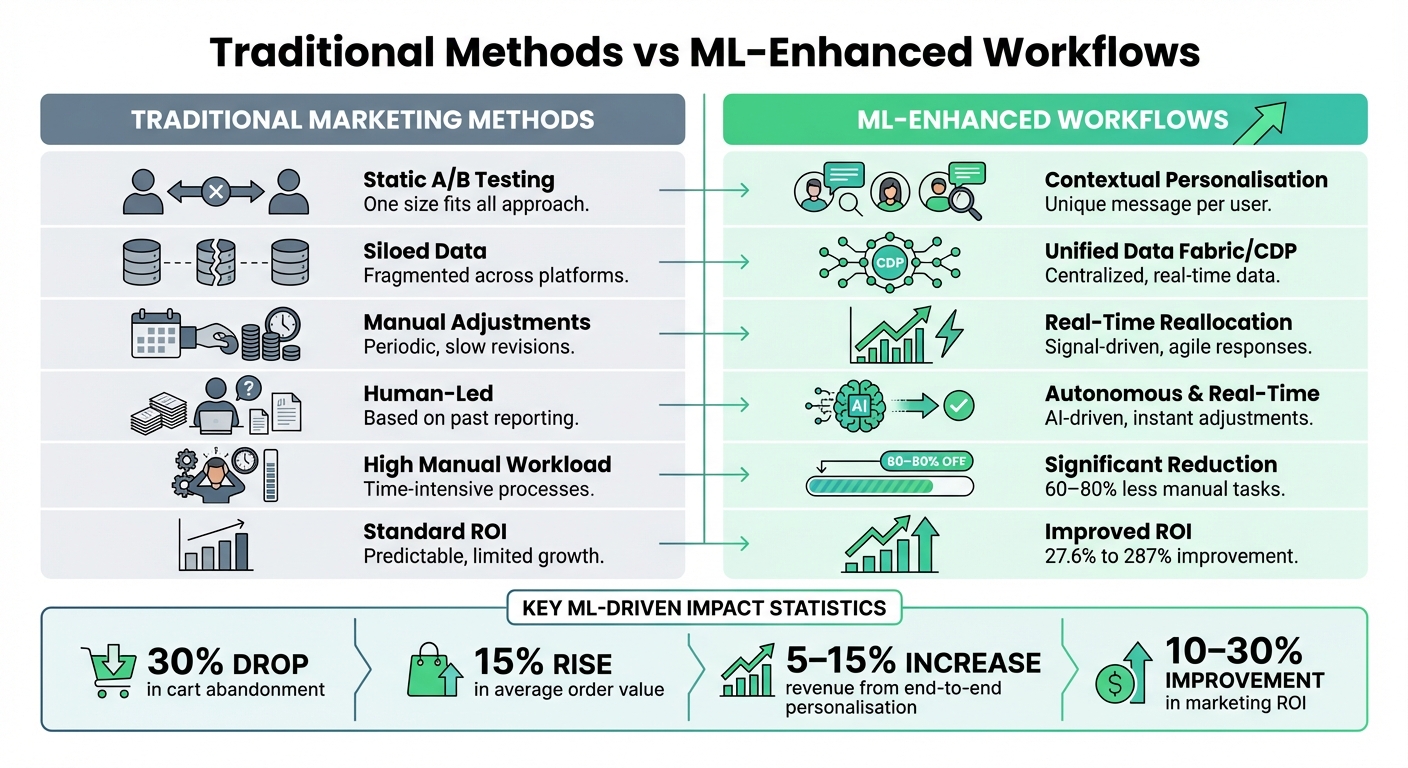
ML-Enhanced vs Traditional Marketing Workflows Comparison
Wick's Four Pillar Framework weaves machine learning into every layer of a campaign. It seamlessly connects website development, content creation, social media management, SEO, marketing automation, and data analytics. This approach uses data from every customer interaction - whether on a website, social media, or at checkout - to create a unified system that tackles fragmented identities. This challenge is especially relevant in the UAE, where 65% of consumers rely on smartphones during their shopping journeys. By combining unified data with predictive insights, the framework allows for more agile campaign execution.
Building Connected Digital Ecosystems
At the heart of this framework is identity resolution, a machine learning process that consolidates scattered data points - like email addresses, device IDs, and transaction records - into a single customer profile. This step is crucial in the UAE, where consumers often switch between devices. For instance, a shopper might browse on a laptop, compare prices on their phone, and complete the purchase on WhatsApp. Without a unified view, predictive models lack the full picture. Wick’s approach ensures continuity across channels. If a customer abandons their cart on your website, the system can instantly send a personalised WhatsApp message, keeping the interaction seamless.
The framework also incorporates generative AI to streamline content creation across platforms. Instead of manually drafting social media posts, emails, or SMS campaigns, machine learning generates multiple content variations in seconds. This feature is especially beneficial for UAE businesses that need content in both English and Arabic, ensuring local preferences are respected while maintaining brand consistency. A case in point: Currys, a U.K.-based retailer, unified 500 legacy applications under a single commerce cloud. This allowed them to handle millions of interactions during peak times, with omnichannel shoppers being 27% more likely to make repeat purchases.
AI-Driven Personalisation for Campaign Efficiency
Wick’s framework takes personalisation to another level with contextual personalisation, moving beyond traditional A/B testing. Instead of showing the same "winning" variant to all users, machine learning tailors messages to each individual based on their real-time behaviour. For example, bimago, an interior design brand, used this method to dynamically select banner variants during sessions, achieving a 44% higher conversion rate compared to standard A/B testing. This precision comes from tracking micro-signals like clicks and scrolls, which feed into predictive models to deliver the most effective creative.
In the UAE’s competitive market, personalised experiences are essential. Brands using personalised WhatsApp broadcasts have seen returns as high as 40X on ad spend, with 74% of messages being opened. The framework also employs agentic AI, which determines the best timing and channel for engagement. For example, if a shopper tends to browse in the evening but makes purchases in the morning, the system adjusts accordingly, reducing wasted efforts and optimising budgets for high-intent moments.
ML-Enhanced Workflows vs. Traditional Methods
Machine learning integration transforms workflows by cutting manual tasks by up to 80%, enabling teams to focus on strategy rather than routine operations. Traditional methods rely on static segmentation and periodic A/B tests, reacting to past behaviour. In contrast, ML-enhanced workflows use real-time signals to dynamically reallocate budgets from underperforming channels to those with higher potential. For instance, if Instagram ads perform better than email on a given day, the system shifts spending in real time, a capability that sets Wick’s framework apart.
| Feature | Traditional Methods | ML-Enhanced Workflows |
|---|---|---|
| Testing Strategy | Static A/B testing (one size fits all) | Contextual personalisation (unique message per user) |
| Data Management | Siloed across platforms | Unified data fabric/CDP |
| Budget Allocation | Manual, periodic adjustments | Real-time, signal-driven reallocation |
| Decision Making | Human-led, based on past reports | Autonomous, real-time adjustments via AI |
| Efficiency | High manual workload | 60–80% reduction in manual tasks |
| ROI Impact | Standard | 27.6% to 287% improvement |
Businesses that use AI-driven orchestration report a 30% drop in cart abandonment and a 15% rise in average order value. According to McKinsey, end-to-end personalisation can boost revenue by 5–15% and improve marketing ROI by 10–30%. These improvements come from systems that learn from every interaction and adapt instantly. Wick’s framework simplifies these complexities, allowing businesses to focus on growth while achieving operational efficiency and campaign success in omnichannel marketing.
Conclusion: Machine Learning's Future in Omnichannel Campaigns
Benefits of Machine Learning in Omnichannel Marketing
Machine learning is reshaping marketing strategies in the UAE, shifting from broad, generic campaigns to real-time, personalised interactions across all customer touchpoints. In fact, AI explains 85% of the variation in customer conversions in the UAE. Businesses leveraging machine learning for campaign orchestration report significant improvements, with end-to-end personalisation driving revenue increases of 5%–15% and boosting ROI by 10%–30%. These gains are largely due to machine learning's ability to solve "identity drift" - the challenge of identifying a single customer across multiple platforms and interactions.
Beyond personalisation, machine learning simplifies operations, allowing smaller teams to perform at a high level. By automating repetitive tasks like ad bidding, content curation, and channel optimisation, it reduces manual workloads. Small and medium-sized businesses using AI-driven forecasting tools have seen returns improve by 30%–40%. With digital ad spending in the UAE projected to surpass AED 9 billion by 2026, companies that adopt machine learning are better positioned to thrive in a competitive market. These advantages come to life through adaptable frameworks that respond to changes in real time.
How Wick Supports Growth with Machine Learning
Wick brings these benefits to life through its integrated, machine-learning-powered approach. Its Four Pillar Framework weaves machine learning into every stage of campaign planning, from data collection to dynamic budget adjustments. Central to this system is the creation of a unified data fabric - a single, reliable source that combines behavioural and transactional data from all UAE-based touchpoints. This enables advanced capabilities like identity resolution, predictive analytics, and next-best-action models, which guide the most effective steps for each customer segment. For example, the system can send a personalised message to a customer who abandoned their cart or reallocate ad spend from underperforming channels to high-performing ones - all within the same hour.
Aligned with the UAE National Strategy for Artificial Intelligence 2031, Wick's approach not only delivers measurable ROI but also contributes to the country’s economic goals, targeting AED 335 billion in growth. Wick ensures compliance with the UAE Data Protection Law and focuses on data quality, offering businesses a modular implementation strategy. This allows companies to start with a single high-impact area - such as luxury retail or F&B - before scaling the solution across their entire operation. This phased rollout minimises disruptions while delivering clear, actionable results. As Andrew Ng aptly put it, "AI is the new electricity". Wick ensures UAE businesses can harness this transformative power to achieve scalable and sustainable marketing success in a data-driven world.
FAQs
What data do I need to start ML-based omnichannel planning?
To put ML-based omnichannel planning into action, start by collecting detailed data on customer preferences, behaviours, and interactions across every channel. This means looking at both digital platforms and offline touchpoints. With this data, you can create personalised and well-coordinated campaigns, which can lead to better efficiency and stronger results.
How can I prove ML-driven personalisation improves ROI in the UAE?
Personalisation powered by machine learning has proven its worth, especially when you look at the numbers. For instance, personalised emails consistently outperform generic ones, driving much higher conversion rates - this is particularly evident in industries like retail and e-commerce.
In markets as dynamic as the UAE, adopting data-driven strategies can make a big difference. Studies show these approaches can increase campaign ROI by up to 20%, offering a smart way to maximise marketing efforts and achieve better results.
How do I stay compliant with the UAE PDPL when using ML profiling?
To align with the UAE Personal Data Protection Law (PDPL) when employing machine learning profiling, it’s crucial to prioritise transparency in how data is collected and processed. Clearly inform individuals about the purpose of profiling and, where necessary, secure their explicit consent. Additionally, ensure people can exercise their rights, such as accessing their data or objecting to its use.
Strengthen your approach by implementing robust security measures and conducting regular audits to maintain accountability. Adhere to rules governing cross-border data transfers and, if applicable, appoint a Data Protection Officer (DPO). Lastly, make privacy training a regular part of your organisational practices to stay compliant and informed.