

Blog / Localized Content for Gulf Retail Audiences
Localized Content for Gulf Retail Audiences
Localized content is a must for retail success in the Gulf. With 90% of purchases influenced by online content and 89% of UAE shoppers relying on digital tools, businesses need to deliver messaging that resonates with Emiratis, expatriates, and international visitors. Here’s what you need to know:
- Language matters: 56.2% of consumers prefer information in their native language over price. Use a mix of Modern Standard Arabic (MSA) for formal content and Gulf Arabic (Khaleeji) for emotional connections.
- Cultural alignment: Campaigns tied to Ramadan, Eid, or Saudi National Day generate higher engagement. For example, UAE retail sales hit AED 242.28 billion during Ramadan 2023.
- Digital-first shoppers: With 99% social media adoption, platforms like Instagram and TikTok drive both online and offline purchases. Mobile optimisation is critical as UAE consumers spend 17 days/month browsing on smartphones.
- Personalisation drives loyalty: 65% of UAE shoppers expect tailored experiences, while 72% are willing to pay more for quality products. Personalised campaigns can boost revenue by 8–10%.
To thrive, brands must ensure bilingual content, respect Islamic values, and meet UAE-specific formatting standards (e.g., DD/MM/YYYY dates, AED currency). By blending these strategies, businesses can connect with one of the world’s most diverse and lucrative retail markets.
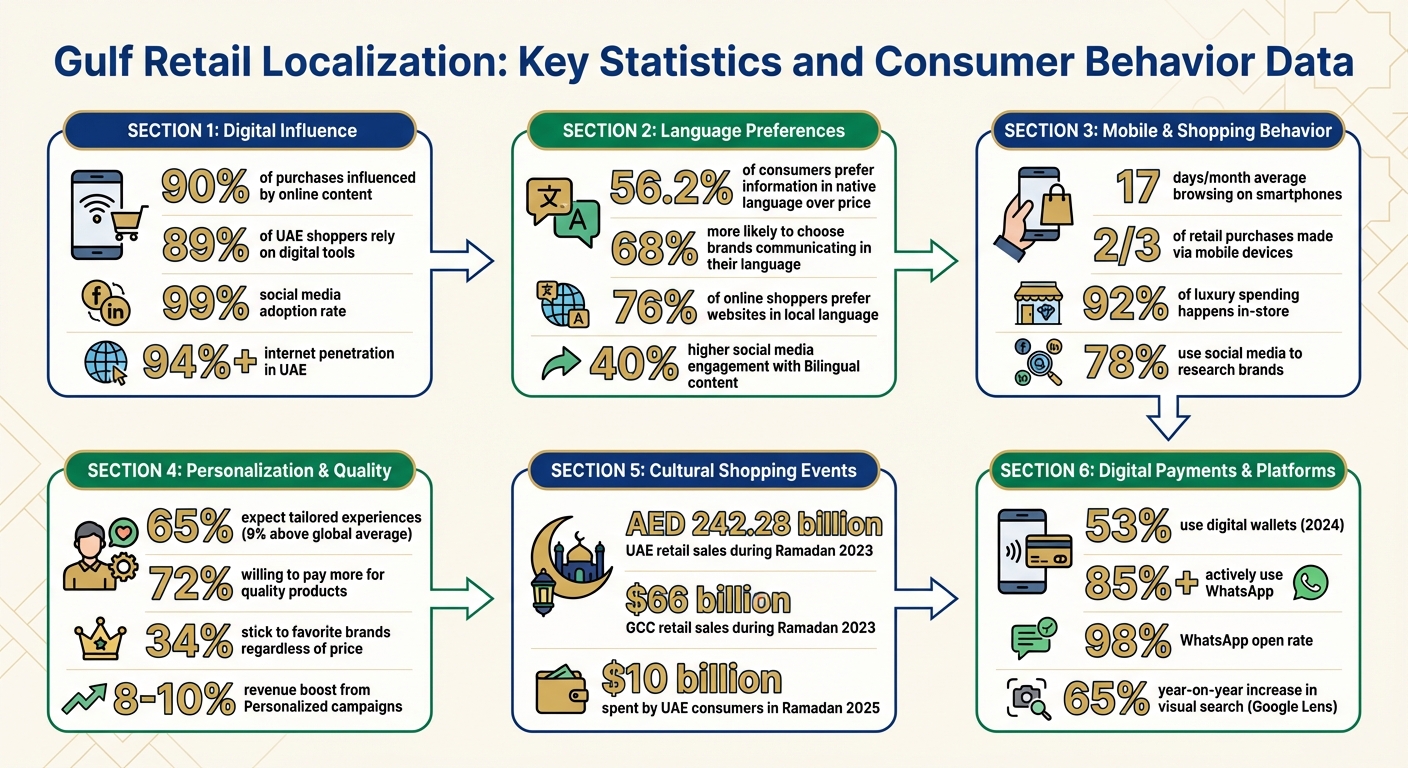
Gulf Retail Localization: Key Statistics and Consumer Behavior Data
Inside Saudi Retail in 2025: 5 Trends Shaping the Kingdom w/ Ghadi Ali
How Gulf Consumers Shop and Make Purchases
Shoppers in the Gulf region skillfully combine traditional values with modern technology when making purchasing decisions. In the UAE, consumers effortlessly switch between online and offline channels. Mobile devices play a central role in their shopping habits: on average, people spend 17 days a month browsing products on their smartphones, and two-thirds of recent retail purchases were made via mobile devices. Despite this, physical stores remain indispensable, especially for luxury purchases, with 92% of spending in this category happening in-store. To succeed in this market, businesses need to create content that appeals to mobile users while also encouraging foot traffic to physical locations.
Cultural Factors That Influence Shopping Decisions
Family values and Islamic traditions are at the core of Gulf shopping habits. For instance, Nissan markets its SUVs in the UAE as "family cars", focusing on their role in bringing loved ones together - an approach that contrasts sharply with its more technical campaigns in the US. Women, who influence around 80% of household purchasing decisions in Dubai, often prioritise products that benefit the entire family.
Shopping behaviour in the Gulf is also deeply tied to the Islamic calendar. Retail sales across the GCC reached $66 billion during Ramadan in 2023, a figure comparable to Black Friday sales. In Ramadan 2025, UAE consumers alone spent $10 billion. Aligning marketing campaigns with key cultural moments - like Ramadan, Eid Al Fitr, Eid Al Adha, and Saudi National holidays - can significantly increase their impact.
Brand loyalty is strong but must be earned through cultural alignment. While 72% of UAE consumers are willing to pay more for high-quality products and 34% stick to their favourite brands regardless of price, they expect brands to show a genuine understanding of local traditions and values. A great example is Unilever's Comfort campaign for Saudi National Day in September 2024. The brand created a stunning floral masterpiece in Jeddah using 125,000 fresh flowers across 94 square metres, all while conducting the campaign in Arabic to honour national pride.
"Marketing in the UAE today is no longer just the art of promotion - it is the engineering of trust, technology, and cultural sensitivity." – Garant Business Consultancy
The Gulf market is diverse, with distinct segments. Emiratis tend to value prestige, heritage, and Arabic-language content, while Dubai's expat population - making up 88.5% of the total - has varied preferences. Emirati women, for example, spend 43% of their income on fashion and respond well to messaging in Gulf Arabic dialects. Meanwhile, expatriates often prefer English for technical details but appreciate Arabic content for its emotional resonance.
These cultural nuances also influence how Gulf consumers interact with brands in the digital space, where advanced technology meets local expectations.
Digital Platforms in Gulf Retail
Social media has evolved into a shopping hub. With nearly 99% of the UAE population active on social platforms and 78% using them to research brands, businesses must create content that performs well on these platforms. Visual search tools like Google Lens are gaining traction, with a 65% year-on-year increase in usage and one in five searches having commercial intent. This digital activity complements the traditional in-store experience, creating a seamless shopping journey for Gulf consumers.
Personalisation is a non-negotiable expectation. Gulf shoppers demand a personal touch - 65% of UAE consumers expect individualised experiences, a figure 9% higher than the global average. Coca-Cola's "Share a Coke" campaign in 2015 is a great example of successful localisation. By replacing its logo with popular Arabic names like Ahlam, Mohamed, and Nouf, the brand tapped into the region's traditions of sharing and personalised gifting.
Digital payment options are gaining ground. Trust in digital payment methods is growing, with 53% of consumers using digital wallets in 2024. "Buy Now, Pay Later" services are also becoming popular among younger shoppers. Additionally, with over 85% of UAE residents actively using WhatsApp, brands should prioritise customer service and order updates on this platform.
| Shopping Priority | UAE Consumer Behaviour | Content Implication |
|---|---|---|
| Quality over price | 72% will pay more for premium products | Highlight craftsmanship, durability, and heritage |
| Mobile research | Browse 17 days/month on smartphones | Ensure mobile optimisation and fast loading speeds |
| Personalisation | 65% expect tailored experiences | Customise content by nationality, language, and preferences |
| Social responsibility | 51% read nutrition labels | Emphasise ethical sourcing and sustainability |
According to McKinsey Partner Abdellah Iftahy, the Gulf consumer is "more price sensitive, digitally savvy, and socially responsible". Over half of consumers in the UAE and KSA are reducing their spending due to economic uncertainty. However, they continue to prioritise quality and expect a seamless blend of online and offline shopping experiences. To meet these expectations, brands need to deliver value while maintaining the premium image that Gulf shoppers respect.
Core Components of Gulf Content Localization
Creating effective localized content for the Gulf region goes far beyond simple translation. It requires a careful balance of linguistic accuracy, cultural sensitivity, and regional formatting. To connect with both Emiratis and the diverse expatriate community in the UAE, three key elements - language choices, cultural alignment, and UAE-specific formatting - must work in harmony.
Language and Regional Dialect Choices
The UAE's diverse population demands a thoughtful approach to language. Modern Standard Arabic (MSA) and Gulf Arabic (Khaleeji) serve distinct purposes in communication. MSA is ideal for formal situations like legal documents and government interactions, while Gulf Arabic offers a more relatable tone, perfect for social media, customer service, and marketing campaigns.
A bilingual strategy is essential in the UAE. While English dominates business communication, Arabic is often considered the "language of trust and heritage". This dual-language approach can increase social media engagement by up to 40%. With over 200 nationalities in the UAE, this strategy enables brands to connect with Emiratis, who prefer Arabic for emotional resonance, and expatriates, who typically lean on English for clarity in technical matters.
"It's more than just translating words - it's about creating an emotional connection that builds brand loyalty and drives business results." – Alef Creates
Native Gulf Arabic speakers are indispensable for creating authentic content. Automated tools often fail to capture the subtle regional nuances, leading to an "uncanny valley" effect where the translation feels slightly off. Native speakers ensure the content feels natural and relatable.
Another technical detail to consider: Arabic text expands by about 25% compared to English, which can impact user interface design, button sizes, and mobile layouts. It’s also critical to ensure designs fully support right-to-left (RTL) text orientation.
Respecting Local Values in Content
Islamic values and family traditions underpin Gulf retail content. Marketing efforts must align with the cultural calendar, especially during Ramadan - a period when mobile Google searches in the region rise by 5%, making it a crucial time for retailers.
A standout example is the 2022 campaign by Khaled Al-Shehhi, which turned the Burj Khalifa into a donation centre. By aligning with local values, the campaign raised 1.2 million meals and demonstrated the emotional impact of culturally aligned messaging.
Visual content should reflect local norms. Imagery that highlights family and community resonates far more than depictions of individualism. Colour choices also carry specific meanings: green symbolises prosperity and Islam, blue conveys trust and professionalism, and red can evoke national pride or serve as a warning.
Gender roles also influence content strategies. While online shopping among women is on the rise, significant purchase decisions in UAE households are often influenced by male family members. Content should acknowledge these dynamics without relying on stereotypes.
Additionally, certain products are prohibited under Islamic law. Marketing campaigns must avoid showcasing items that could offend religious sentiments. Thorough research into local regulations is crucial before launching any campaign.
UAE Formatting Standards (en-AE)
Formatting details are critical for building trust and driving conversions. The UAE follows specific standards that differ from American and other international formats. For example, dates are written as DD/MM/YYYY (e.g., 25/01/2026), avoiding confusion with the American MM/DD/YYYY format.
Currency is always displayed as "AED" followed by the amount, such as "AED 450.00", rather than using a currency symbol. This is important in a region with multiple currencies, including the Saudi Riyal and Kuwaiti Dinar. Numbers over three digits use comma separators (e.g., 1,234,567.89), and decimals are indicated with a dot.
| Element | UAE Standard (en-AE) | Retail Example |
|---|---|---|
| Date | DD/MM/YYYY | Delivery by 15/02/2026 |
| Currency | AED with space | AED 1,299.00 |
| Numbers | Comma separator, dot decimal | 2,500 items sold for AED 125,750.50 |
| Temperature | Celsius | Store at 4°C or below |
| Measurements | Metric system | 500 grammes, 1.5 metres |
| English variant | British English | Colour, centre, licence |
Spelling conventions like "licence" instead of "license" and "organise" instead of "organize" should also be followed.
Temperature is always displayed in Celsius (e.g., 35°C instead of 95°F), and the metric system is used for measurements. For example, a television would be described as "165 centimetres" rather than "65 inches", and fabric would be sold "per metre" instead of "per yard."
These formatting standards are the backbone of effective retail content in the Gulf region, ensuring clarity and trustworthiness for local audiences.
Practical Methods for Creating Gulf Retail Content
Understanding the cultural and linguistic nuances of the Gulf region is only the starting point. To truly connect with this market, these insights must be reflected in every aspect of your retail content. From product descriptions to social media campaigns and personalised messaging, every piece of content should meet local expectations and adhere to regional standards. Here's how you can put these strategies into action.
Writing Product Descriptions for Gulf E-Commerce
Striking the right tone in product descriptions is key. In the Gulf, this often means using a mix of Modern Standard Arabic (MSA) and Gulf Arabic (Khaleeji). MSA works well for formal elements like technical specifications or warranty details, while Khaleeji brings a relatable, conversational tone to lifestyle products. This approach matters because 68% of consumers are more likely to choose a brand that communicates in their native language.
Tailor your messaging to different audience segments. For Emirati customers, highlight luxury and heritage. For expatriates, focus on practicality and functionality. Research shows that 56.2% of consumers prioritise receiving information in their own language over the price of the product.
Mobile optimisation is non-negotiable. With internet usage exceeding 94% in the UAE and mobile devices dominating access, product pages must be mobile-friendly. Pages should load quickly and display correctly on smaller screens to ensure a seamless user experience.
Pay attention to details like pricing and measurements. Display prices as "AED 1,299.00" and use metric units, such as "165 centimetres" for a television instead of "65 inches." Similarly, describe fabric as sold "per metre" instead of "per yard." These small adjustments reduce confusion and build trust, especially in a region where multiple currencies and measurement systems coexist.
Social Media Campaigns for Gulf Markets
With a social media penetration rate of 98.99%, the UAE is one of the most connected markets globally. Platforms like YouTube, WhatsApp, and Instagram dominate, with YouTube reaching 88% of consumers, WhatsApp boasting 7.98 million users and a 98% open rate, and Instagram engaging 7.73 million users. Each platform demands customised, culturally aware content to drive engagement.
Bilingual content is especially effective. Brands that use both Arabic and English see significantly higher engagement rates. For video content, bilingual messaging can boost watch time and retention among GCC viewers by over 25%.
"In the GCC, bilingual content isn't a trend - it's a necessity."
Campaigns that resonate with Gulf audiences often focus on shared values and emotional appeals. For example, the Burj Khalifa donation campaign successfully raised 1.2 million meals through a visually powerful, humanitarian-focused approach. Similarly, Nissan adapted its messaging for the UAE by presenting its vehicles as "family cars", emphasising the region's strong focus on togetherness and community, instead of highlighting technical features as in its U.S. campaigns.
Data-Driven Content Personalisation
Personalisation in the Gulf requires blending data insights with cultural sensitivity. In 2021, a major Middle Eastern retailer launched a campaign that sent millions of personalised messages weekly via email and SMS. By tailoring offers to specific shopping behaviours - like targeting Monday impulse buyers with ready-to-eat meal deals - the brand achieved an 8% to 10% revenue increase compared to generic campaigns.
Advances in technology have streamlined this process. AI tools now handle around 70% of translation work, leaving human experts to focus on refining cultural nuances and maintaining the brand's unique voice. This hybrid approach ensures efficiency without losing the emotional connection that fosters loyalty.
Audience segmentation remains crucial. As discussed earlier, Emiratis respond well to messages that emphasise community pride and exclusivity, while expatriates are drawn to content highlighting accessibility and global appeal. Using consented first-party data from both online and offline sources helps create accurate customer profiles and deliver tailored experiences.
"Hyper-personalisation - which uses artificial intelligence (AI) and real-time data to deliver curated content to people - is still considered an emerging technology in the Middle East and North Africa."
- Hanibal Ahwash, Industry Manager at Google Middle East and North Africa
sbb-itb-058f46d
Applying Wick's Four Pillar Framework to Gulf Retail
Creating effective localised content for Gulf retail involves more than just understanding cultural nuances - it requires a structured approach that ensures all marketing efforts work together. Wick's Four Pillar Framework provides this structure, turning scattered strategies into a unified digital ecosystem tailored for the UAE and the broader GCC region.
This framework addresses key challenges faced by Gulf retailers: catering to a diverse population of over 200 nationalities, balancing Arabic and English preferences, and meeting the expectations of consumers seeking personalised experiences and value for their dirham.
Build & Fill: Crafting Gulf-Oriented Websites and Content
The starting point is ensuring technical compatibility for Arabic script and bilingual content. Right-to-Left (RTL) design is essential for Arabic, influencing alignment, navigation, and overall layout. Seamless toggling between RTL Arabic and Left-to-Right (LTR) English should be prioritised.
Incorporating Modern Standard Arabic (MSA) for formal uses and Gulf Arabic for conversational engagement is a strategic necessity. Research highlights the importance of this approach: 68% of consumers prefer brands communicating in their native language, and 76% of online shoppers are more likely to buy from websites in their local language.
Technical readiness is another cornerstone - websites must load quickly and display properly across all devices. Visual content should reflect local environments and diverse communities while respecting Islamic values and cultural norms. For example, Unilever's brand Comfort successfully embraced cultural participation in September 2024 by sponsoring the 94th Saudi National Day. Their fully Arabic campaign strengthened their regional presence through authentic engagement.
This foundational work sets the stage for the next step: targeted promotion.
Plan & Promote: SEO and Advertising for UAE Consumers
To stand out in Gulf markets, bilingual keyword research and platform-specific strategies are essential. Platforms like WhatsApp, YouTube, and Instagram dominate the region, each requiring tailored content. For instance, YouTube reaches 88% of Gulf consumers, making it ideal for product demonstrations, while Instagram thrives on lifestyle imagery.
Timing campaigns around cultural events can yield impressive results. For example, retail sales in the GCC during Ramadan 2023 reached AED 242.28 billion, nearly matching Black Friday figures. Coca-Cola Middle East adapted its global "Christmas Truck" campaign for Ramadan, featuring a truck delivering bottles at street-party Iftars, creating content that resonated locally.
Bilingual content also drives engagement, with brands reporting up to 40% higher social media interaction compared to English-only campaigns. Localised marketing can even boost conversion rates by as much as 75%.
While promotional efforts attract traffic, personalisation ensures these interactions leave a lasting impact.
Tailor & Automate: AI-Powered Personalisation for Gulf Retail
AI has transformed personalisation, making it more accessible and efficient. Today, 70% of translation work can be handled by AI, with human input refining the cultural nuances.
"It used to be that the effort was 70% translation, 30% localisation, but that's almost backwards now. Now, you can generate the translation using an AI tool and then bring in a writer, editor, or marketer for the localisation parts." - Derek Gleason, Senior Content Lead, Shopify
AI enables detailed segmentation by analysing demographics, buying habits, and real-time behaviour. For example, a leading Middle Eastern retailer in 2021 sent millions of personalised messages weekly, targeting Monday impulse buyers with ready-to-eat meal offers, resulting in an 8% to 10% revenue increase compared to generic campaigns.
Automation also simplifies localised content creation, allowing for tailored ad copy across Emirates or targeted email campaigns. AI can even generate visuals that reflect regional settings, all while adhering to UAE National Media Council guidelines and Islamic principles.
"Hyper-personalisation - which uses artificial intelligence (AI) and real-time data to deliver curated content to people - is still considered an emerging technology in the Middle East and North Africa. That said, people in the region do believe personalisation will positively impact their digital interactions in the future." - Hanibal Ahwash, Industry Manager, Google Middle East and North Africa
Wick's framework thrives on integration. The Build & Fill pillar lays the groundwork with localised content, Plan & Promote drives targeted traffic through culturally relevant channels, and Tailor & Automate delivers personalised experiences at scale. Together, these pillars align with the expectations of Gulf consumers, as highlighted by KPMG Lower Gulf: "UAE customers, in particular, want more personalised experiences, value for their dirham, and seamless, omnichannel processes".
Tracking Performance and Refining Your Approach
Achieving localisation success in Gulf retail depends on using data to fine-tune strategies that translate into measurable revenue. Businesses must focus on tracking key metrics to understand how their content resonates with local audiences and use these insights to continuously improve their approach.
Metrics for Measuring Localisation Results
In the Gulf region, measurable insights are crucial for assessing localisation efforts. Key indicators of success fall into several categories:
- Engagement Metrics: Metrics like likes, saves, shares, and comments reveal how well content connects with local audiences. For instance, bilingual brands in the UAE see up to 40% higher social media engagement compared to English-only content, validating the effectiveness of bilingual strategies.
- Conversion Metrics: Data points such as conversion rates, ROI, and cart abandonment rates help determine whether localised messaging turns interest into purchases.
- Behavioural Metrics: Bounce rates, click-through rates, and average session length highlight whether users find localised websites engaging and easy to navigate.
Platform-specific metrics are also critical in the Gulf. For example, WhatsApp messages boast a 98% open rate in the UAE, making them a key performance indicator for direct marketing campaigns. On platforms like TikTok and Instagram, watch time and retention rates show the impact of localised video content, with retention improving by over 25%. Additionally, tracking SEO performance - such as rankings for dialect-specific keywords and organic traffic growth - helps confirm the success of bilingual strategies.
These metrics provide the foundation for making informed adjustments, ensuring localisation efforts remain effective.
Using Data to Improve Content Over Time
Turning raw data into actionable strategies requires regular analysis. Start by segmenting analytics by specific Gulf regions, as consumer behaviours and dialect preferences can vary significantly between countries like Saudi Arabia, the UAE, and Qatar. A test market approach can be effective: implement localised changes, such as translated calls-to-action, in a smaller market with strong performance, and then expand successful strategies to other high-value markets.
First-party data is invaluable for refining local personas and improving content delivery. By analysing demographic profiles, purchase histories, and user activity, businesses can personalise content and timing more effectively. Such personalisation typically drives a 10% to 15% revenue increase on average. However, the quality of data is critical - while 73% of Gulf consumer companies track data, 50% report significant inaccuracies, highlighting the importance of maintaining clean, reliable data. Regular audits of technical setup are essential, ensuring analytics account for Right-to-Left design elements and that keyword tracking distinguishes between Modern Standard Arabic and local dialects for precise insights.
Conclusion: Why Localisation Matters for Gulf Retail
In the Gulf, content localisation is about much more than just translating words - it's about creating authentic connections with consumers who value cultural relevance. The statistics back this up: 56.7% of Middle East consumers prioritise having information in their native language over the price of a product. With GCC economies generating around AED 6.2 trillion in real GDP, the opportunity for businesses to tap into this market with tailored strategies is immense.
The business benefits are equally striking. Take, for instance, a retailer whose customised campaign led to an 8–10% boost in revenue, or another that doubled its return on advertising spend, putting them on track to generate AED 367 million annually.
"Gulf Arabic localisation isn't just another regional dialect adaptation, it's the linguistic gateway to the world's wealthiest per-capita markets." - Wordminds
But localisation isn't just about financial gains. It's a bridge to trust and credibility, which are essential for long-term success in Gulf markets. Arabic, especially Gulf Arabic (Khaleeji), remains the language of trust and heritage in the region. By using this dialect, brands can establish an emotional connection that resonates deeply with local audiences. Respecting Islamic values, understanding regional preferences, and crafting culturally appropriate content transform foreign brands into trusted, familiar names.
The Gulf retail landscape is changing fast. With internet penetration surpassing 94% in the UAE and mobile commerce growing at 19% annually, businesses have more avenues than ever to engage with consumers. By aligning data-driven insights with cultural nuances - whether through RTL design, dialect-specific messaging, or personalised imagery - brands can offer the premium, culturally relevant experiences that Gulf consumers demand. Those who commit to thorough localisation will be best positioned for sustained growth in this dynamic market.
FAQs
How can businesses effectively incorporate Gulf Arabic into marketing strategies?
To make the most of Gulf Arabic in marketing strategies, businesses need to tailor their content to reflect the specific linguistic and cultural characteristics of the Gulf region. Gulf Arabic, also known as Khaleeji Arabic, stands apart from other Arabic dialects, so crafting messages that feel genuine is key to connecting with audiences in the UAE, Saudi Arabia, Qatar, Kuwait, Bahrain, and Oman.
Incorporating Gulf Arabic into slogans, social media posts, and advertisements helps establish a sense of trust and familiarity. For a wider audience, blending Arabic with English in bilingual content can effectively engage both locals and expatriates. Campaigns should also align with regional customs and traditions, highlighting shared values while showing respect for the local culture. This thoughtful approach not only strengthens connections but also fosters deeper engagement and boosts business outcomes.
What cultural events should Gulf retailers focus on in their marketing?
Retailers in the Gulf should focus on key events that resonate deeply with the region's cultural and religious values to connect with their audience effectively. Take Ramadan, for example - a month that revolves around fasting, prayer, and spending time with family. Marketing during this sacred period often highlights themes like generosity, togetherness, and spirituality. Right after Ramadan, Eid al-Fitr brings a festive atmosphere, making it the perfect time for campaigns centred on celebrations, gift-giving, and heightened shopping activity.
Another important occasion is UAE National Day, celebrated on 2 December. This day is all about patriotic pride and community spirit, offering retailers a chance to design campaigns that tap into these sentiments. Additionally, events like the Hajj pilgrimage season and other regional festivals also shape shopping habits and consumer behaviour. Aligning marketing efforts with these moments not only shows respect for local traditions but also helps foster meaningful connections with Gulf consumers.
Why is personalised content essential for building brand loyalty in the UAE?
Personalised content plays a crucial role in cultivating brand loyalty in the UAE. With its vibrant mix of Emiratis, expatriates, and international visitors, the region offers a unique opportunity for businesses to connect on a deeper level. By crafting messages that align with local values, preferences, and behaviours, brands can build trust and establish a strong sense of relevance among their audience.
For instance, showcasing elements of cultural heritage and exclusivity tends to resonate strongly with Emirati customers. On the other hand, expatriates may respond more positively to messages that emphasise practical advantages. Leveraging AI-driven insights and real-time data allows businesses to deliver timely and relevant messages in both Arabic and English, ensuring communication feels authentic and culturally aligned. This tailored approach not only improves the customer experience but also strengthens long-term loyalty in the UAE's dynamic, multicultural landscape.