

Blog / IoT Analytics in Marketing: Key Benefits
IoT Analytics in Marketing: Key Benefits
IoT analytics is transforming marketing by using data from connected devices like wearables, sensors, and smart gadgets to provide real-time insights and personalised customer experiences. This shift enables businesses to understand consumer behaviour better, predict needs, and improve engagement. Key benefits include:
- Real-time insights: Analyse customer actions instantly for tailored marketing.
- Personalisation: Deliver individualised offers based on specific behaviours.
- Predictive analytics: Identify and address potential customer churn early.
- Dynamic pricing: Adjust prices based on live data for better revenue models.
- Inventory forecasting: Use IoT data to manage stock efficiently.
- Cross-functional alignment: Share IoT insights across departments for unified strategies.
With 30.9 billion IoT devices projected by 2025, leveraging this data is essential for businesses in the UAE to enhance customer satisfaction, boost loyalty, and stay competitive.
Scott Amyx Speaking on Redefining the Marketing Paradigm with IoT
1. Real-Time Customer Behavior Insights
IoT devices have revolutionised how marketers understand customer behavior. These gadgets - ranging from sensors to wearables - collect continuous data on how customers interact with products and spaces. From tracking in-store foot traffic to analysing product usage, this wealth of information allows marketers to base decisions on hard data rather than guesswork.
Impact on Customer Experience
The ability to respond in real time has reshaped how businesses engage with their audience. For example, geofencing technology like iBeacons can send personalised SMS or in-app offers to customers as they approach a retail store, tailoring these messages based on their purchase history and current location. This approach ensures marketing feels helpful rather than invasive.
In industries like finance and insurance, real-time data from telematics enables businesses to offer timely and relevant deals. By combining live IoT data with historical customer information, companies gain a comprehensive view of each individual, making it easier to deliver personalised experiences at just the right moment. This kind of precision sets the stage for leveraging advancements like 5G to further scale real-time marketing efforts.
Data-Driven Decision-Making
IoT-powered analytics enable businesses to adopt event-based marketing strategies. For instance, a telecom provider can monitor data usage and suggest an upgrade just as a customer nears their plan limit. The results speak for themselves: 50% of companies using real-time analytics report higher customer retention, loyalty, and revenue growth.
However, challenges persist. While 80% of business leaders aim to use analytics for real-time engagement, only 22% feel their systems are up to the task. The problem often lies in siloed data, which prevents seamless information sharing across departments.
"An important part of successful real-time marketing is being able to smartly narrow the likely options a customer will be offered based on what you already know about them or about customers like them" – Jeff Alford, SAS Marketing Insights Editor
Scalability and Technological Integration
Modern network infrastructure is critical to supporting the growing number of connected devices while ensuring the speed needed for real-time responses. Retailers, for example, can adjust product placement in stores by analysing movement patterns, while manufacturers can use embedded sensors to understand how customers are using their products. When these data streams are integrated with CRM systems, they become actionable insights that drive smarter decisions.
2. Hyper-Personalised Customer Experiences
IoT analytics has revolutionised how businesses engage with customers, moving away from generic demographic targeting to a more precise, individualised approach. Instead of blasting the same message to thousands, companies now deliver the right offer at the right moment. This shift resonates strongly in the UAE, where consumers increasingly expect digital interactions tailored to their specific needs. By leveraging data, businesses are creating personalised experiences that deepen customer connections.
Impact on Customer Experience
IoT-powered personalisation represents a major departure from traditional marketing methods. In the past, marketers relied on broad assumptions about customer groups. Today, connected devices provide detailed insights into individual preferences and behaviours. For instance, insurance companies now use telematics data from vehicles to craft policies based on actual driving habits, rather than relying on generic risk profiles.
"IoT marketing has turned this [one-size-fits-all] concept on its head. Now, the focus is on the individual consumer." – Eleanor Hecks, Managing Editor, Designerly
This shift aligns with consumer expectations. Globally, 64% of people want companies to respond more quickly to their changing needs. In the UAE, the hospitality sector has embraced IoT and digital marketing integration, significantly improving customer satisfaction and operational efficiency. Similarly, manufacturers of smart appliances and vehicles are bypassing traditional dealerships, using sensor data to engage directly with customers based on how they actually use their products.
Data-Driven Decision-Making
The financial sector offers a compelling example of how real-time data transforms customer interactions. Banks are now using data from ATMs and mobile apps to present "next-best action" offers during live interactions. This approach ensures marketing feels helpful rather than intrusive, addressing genuine needs as they arise.
Technological advancements are driving this level of hyper-personalisation. The global voice recognition market, for example, is projected to grow from approximately US$10 billion in 2020 to nearly US$50 billion by 2029. Additionally, AI integration is expected to contribute around US$13 trillion to the global economy by 2030. These technologies allow brands to process immense amounts of sensor data, enabling them to anticipate customer needs more effectively. This capability sets the stage for even more proactive strategies, which will be explored further in the next section on predictive analytics.
3. Predictive Analytics for Churn Prevention and Retention
With IoT analytics in play, businesses can pinpoint at-risk customers by continuously monitoring device usage. For example, if a smart appliance sits idle for days or a wearable device's sync frequency drops, predictive models flag these behaviours as potential churn indicators. This early detection enables companies to address issues before dissatisfaction builds to the point where customers consider switching providers. These predictive insights help shape personalised strategies to keep customers engaged.
Impact on Customer Experience
Predictive analytics shifts the focus from reacting to problems to proactively addressing them. IoT sensors can detect issues before users even realise there's a problem. Take the example of a connected car: it can automatically schedule a service appointment when sensors detect irregularities. This proactive care resonates with customers, especially since 28% of consumers leave brands due to repeated disappointments.
"IoT is here to stay. Data that is properly collected and used improves the quality of our experiences with brands across various industries." – Jonathan Moran, Customer Intelligence, SAS
Businesses that leverage IoT insights report a 20% boost in customer satisfaction. Why? Because their interventions feel timely and helpful, not invasive. For instance, telecommunications providers can monitor declining data usage and offer personalised incentives at just the right moment - meeting customer needs before they even think about leaving.
Business Efficiency and Cost Savings
Preventing churn through predictive analytics isn't just about keeping customers happy - it also makes good business sense. Companies using this approach have seen cost reductions of up to 25%. By addressing issues early, they avoid expensive reactive measures, such as emergency repairs or high call centre volumes, not to mention the steep costs of replacing lost customers. Scheduled maintenance triggered by IoT sensors ensures problems are resolved efficiently, while marketing automation handles retention efforts seamlessly.
Data-Driven Decision-Making
Combining IoT insights with historical customer data creates a powerful tool for preventing churn. This integration enables businesses to build detailed behavioural profiles and take targeted actions to retain customers. Gibson Brands illustrates this approach well:
"We really want to take the data and understand what they need next. We want to understand how we can connect individual fans based on where they are and how they want to interact with us."
With this data-driven strategy, companies can automate personalised retention efforts. Whether it’s offering a discount, sharing a useful product tip, or sending a timely service reminder, these actions are tailored to individual usage patterns. This approach is particularly effective, given that 23% of customers say generic, mass-marketing efforts actually harm their loyalty. By addressing customer needs with precision, businesses can strengthen relationships and reduce churn.
4. Optimised Pricing and Revenue Models
IoT analytics is transforming pricing strategies by replacing outdated static models with dynamic, real-time adjustments. For example, Internet Service Providers (ISPs) now monitor how quickly and frequently users consume data, enabling them to fine-tune pricing to suit individual needs. Similarly, financial institutions leverage live data from ATMs and mobile apps to deliver personalised "next-best offers", moving beyond the limitations of traditional pricing models. This dynamic approach aligns with earlier discussions on real-time engagement and personalisation.
Data-Driven Decision-Making
Precision pricing is another standout feature of IoT-driven marketing. By tapping into IoT data, businesses can determine the best price points at the right time. Telecommunications companies, for instance, use network usage data to develop volume-based pricing and customise data plans. Meanwhile, insurance companies rely on telematics to create risk-based premiums tailored to individual behaviours.
"Gathering this information and stitching it together with other data... allows the ISPs make better informed marketing decisions. The price, volume and validity of the marketing offers can be checked to ensure its relevance for individual consumers." – Jonathan Moran, Customer Intelligence, SAS
Business Efficiency and Cost Savings
IoT analytics doesn't just refine pricing; it also boosts operational efficiency and cuts costs. Retailers, for example, use iBeacons and geofencing to send location-based push offers that consider a customer’s proximity and purchase history. This strategy improves conversion rates without the expense of mass marketing campaigns. Manufacturers are also shifting gears by embedding sensors in products, enabling "Product-as-a-Service" models. Instead of one-time sales, they charge customers based on actual usage, which not only ensures predictable revenue but also reduces costs tied to overstocking and manual inventory management.
Scalability and Technological Integration
The economic potential of IoT is staggering. By 2030, it’s expected to contribute AED 20.2–46.3 trillion to the global economy, with 62–65% of that value coming from B2B applications. The rollout of 5G technology further enhances this potential, supporting faster data transfers and more sophisticated real-time analysis for revenue optimisation. However, realising this value hinges on system interoperability - about 40% to 60% of IoT’s economic potential depends on different platforms working seamlessly together. These advancements highlight how IoT insights are reshaping pricing and marketing strategies across industries.
sbb-itb-058f46d
5. Inventory and Demand Forecasting
IoT analytics is reshaping how businesses in the UAE handle inventory and anticipate customer needs. With RFID tags and connected sensors, companies can now track products in real-time, eliminating the hassle and errors of manual stock counts. These smart tools provide instant updates on stock levels, locations, and when replenishments are needed. This shift moves warehouses from a reactive approach to a proactive one, enabling them to respond swiftly to actual consumer demand. The result? Smarter, data-driven forecasting that helps businesses stay ahead.
Data-Driven Decision-Making
The accuracy of IoT-powered forecasting is impressive. Take Boddie-Noell as an example - they adopted SAS Visual Forecasting and achieved a forecast error of just 0.1% in Q1. This precision is achieved by blending real-time IoT data with historical sales trends and customer demographics. In the UAE, retailers are leveraging Wi-Fi and video monitoring to understand in-store shopper behaviours, predict demand, and improve shelf layouts. By introducing intelligent automation into demand planning, businesses can boost accuracy by 6% while saving planners nearly half their time - about 47%.
Business Efficiency and Cost Savings
Accurate forecasts are just the beginning. Smart sensors take things further by enhancing operational efficiency across the board. These sensors don’t just monitor inventory; they optimise the entire supply chain. For instance, IoT devices can map out the most efficient transport routes and identify underused assets, ensuring that stock reaches UAE retail outlets on time. For temperature-sensitive goods, sensors track conditions during transit, minimising waste due to spoilage. Tools like digital twins allow managers to simulate scenarios and analyse data before making costly physical changes.
"The warehouse of the future will be open space where automated pallets self-organise based on real-time demand." – Dan Mitchell, Business Director, Retail and CPG Industry Practice, SAS
Scalability and Technological Integration
With IoT-connected devices expected to hit 30.9 billion by 2025, generating a staggering 79 Zettabytes of data, integrating IoT platforms with cloud-based ERP systems is becoming essential. This integration breaks down data silos, giving businesses unified, real-time access to inventory insights. For companies new to IoT analytics, starting with pilot projects offers a low-risk way to explore specific use cases before scaling up. Additionally, edge computing processes data locally, cutting down on delays and ensuring inventory updates happen instantly.
6. Cross-Functional Decision-Making and Alignment
Building on earlier discussions about real-time engagement and hyper-personalisation, cross-functional IoT analytics ensures that decision-making across departments is aligned and unified. Instead of marketing, operations, and product development teams working in silos, IoT data acts as a shared foundation everyone can trust. For example, telematics data from connected vehicles can simultaneously guide insurance policy underwriting and targeted marketing campaigns. By using a shared data source, businesses base their decisions on solid evidence rather than assumptions. This approach enables actionable insights to flow seamlessly across all areas of the organisation.
Data-Driven Decision-Making
The adoption of data-driven collaboration is reshaping how businesses in the UAE and beyond operate. Retailers, for example, are using IoT sensors to monitor in-store foot traffic. This data helps them fine-tune store layouts, adjust staffing schedules, and enhance product placement - all while boosting customer engagement. A European grocery chain implemented an integrated analytics system to measure the ROI of its marketing efforts. This allowed them to cut their marketing budget by over 10% without losing revenue. When they optimised their strategies at the original budget level, they achieved a 3% increase in revenue alongside notable profit gains. Such precision is only possible when marketing and finance teams collaborate using the same data sets.
Business Efficiency and Cost Savings
Unified IoT analytics can deliver substantial cost savings across various departments. For instance, effective marketing analytics can reduce budgets by 15–30%, while reinvesting these savings into optimised campaigns often leads to a 2–5% increase in sales. High-performing organisations using advanced data analytics are 20 times more effective at acquiring new customers and five times better at retaining existing ones compared to their lower-performing counterparts. A global consumer goods company applied a unified analytics solution across more than 60 countries and product categories. This allowed managers to compare ROI across regions and product lines, improving spending efficiency and enabling successful marketing strategies to be transferred between markets.
Scalability and Technological Integration
Unified decision-making becomes even more powerful when paired with scalable IoT systems. As IoT networks grow, businesses need solutions that can scale alongside them. Integrating IoT data with cloud-based platforms creates a shared analytical framework, enabling all departments to align on ROI metrics. This integration enhances organisational agility, but there’s still room for improvement. Only 10% of senior marketing executives feel their organisations are "very effective" at leveraging analytics insights. To address this, prioritising user-friendly interfaces and real-time simulation tools is key. Analytics platforms capable of delivering campaign performance insights in seconds - rather than days - empower teams to make mid-campaign adjustments that drive better results across the board.
Comparison Table
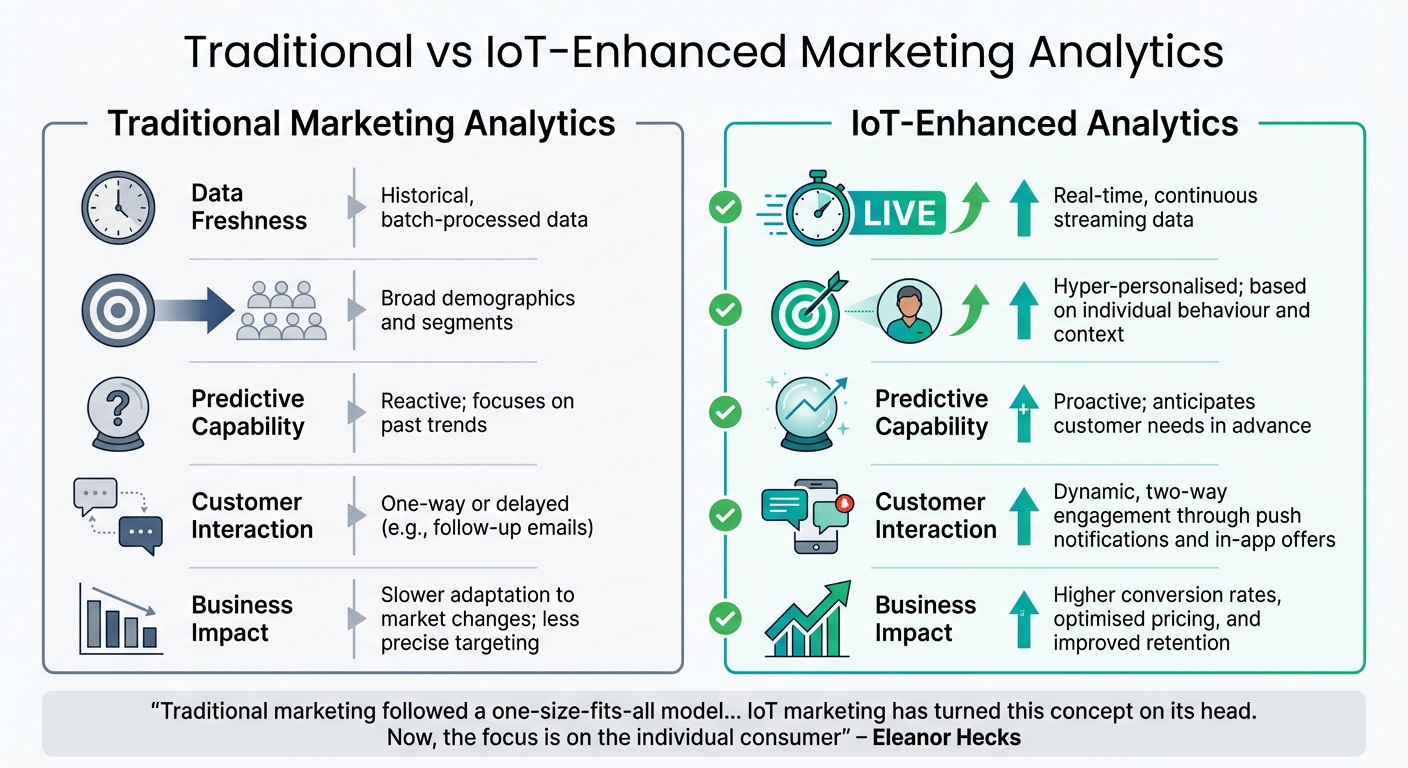
Traditional vs IoT-Enhanced Marketing Analytics Comparison
When comparing traditional marketing analytics to IoT-powered analytics, the advantages of the latter become strikingly clear. The way data is gathered and analysed through IoT devices leads to actionable insights that can reshape how businesses interact with their customers, offering faster responses and more precise targeting.
Traditional marketing analytics depends on historical transaction data, broad demographic trends, and batch-processed information. On the other hand, IoT-driven analytics leverages live data streams from interconnected devices like wearables, smart home systems, and connected cars, capturing detailed, real-time behavioural patterns.
Here’s a breakdown of the key differences:
| Dimension | Traditional Marketing Analytics | IoT-Enhanced Analytics |
|---|---|---|
| Data Freshness | Historical, batch-processed | Real-time, continuous streaming data |
| Personalisation Depth | Relies on broad demographics and segments | Hyper-personalised; based on individual behaviour and context |
| Predictive Capability | Reactive; focuses on past trends | Proactive; anticipates customer needs in advance |
| Customer Interaction | Often one-way or delayed (e.g., follow-up emails) | Dynamic, two-way engagement through push notifications and in-app offers |
| Business Impact | Slower adaptation to market changes; less precise targeting | Higher conversion rates, optimised pricing, and improved retention |
This comparison underscores how IoT analytics revolutionises marketing by enabling real-time, personalised insights. Unlike traditional methods that predict future behaviour based on past actions, IoT analytics anticipates customer needs as they arise. For example, a smart refrigerator can detect when items are about to expire and send a discount offer for replacements just when the customer needs them.
"Traditional marketing, in contrast, followed a one-size-fits-all model... IoT marketing has turned this concept on its head. Now, the focus is on the individual consumer" – Eleanor Hecks, Managing Editor, Designerly
Conclusion
IoT analytics is reshaping the marketing landscape in the UAE by gathering real-time data from smart devices like wearables, home appliances, and in-store sensors. This shift from traditional, demographic-based tactics to dynamic, context-aware strategies is becoming a necessity in the UAE's highly competitive market. It’s an opportunity for businesses to embrace modern technologies and stay ahead of the curve.
The benefits of IoT analytics are undeniable. It has become the backbone of precision marketing across various industries in the UAE. With 64% of consumers expecting faster responses, businesses can now use IoT analytics to deliver personalised, real-time marketing experiences. For industries like hospitality, retail, and financial services, this means more than just meeting customer expectations - it leads to better conversion rates, stronger customer loyalty, and streamlined operations that fuel long-term growth.
"For businesses to remain competitive, embracing the potential of IoT in their marketing efforts is a necessity." – Eleanor Hecks, Managing Editor, Designerly
The integration of 5G and AI with IoT analytics is only accelerating this transformation. Consider this: the global voice recognition market is forecasted to grow from approximately AED 36.7 billion in 2020 to nearly AED 183.5 billion by 2029. This highlights the immense potential for businesses adopting IoT analytics now. Whether it’s using geofencing to trigger timely in-store promotions, telematics for customised insurance policies, or predictive analytics to restock products before customers even ask, IoT analytics allows UAE businesses to craft experiences that feel personal and immediate.
For businesses in the UAE, leveraging IoT insights alongside unified digital strategies is key to driving growth. At Wick, we specialise in building integrated digital ecosystems that combine advanced IoT analytics with strategic marketing, ensuring your business thrives in today’s fast-changing marketplace.
FAQs
How does IoT analytics improve marketing personalisation?
IoT analytics taps into real-time data from connected devices, including location information, usage patterns, and sensor inputs. This treasure trove of data helps create detailed customer profiles, allowing marketers to tailor personalised, context-aware offers and content that match individual preferences and needs.
With insights into consumer habits and behaviours, businesses can deliver marketing messages that resonate more deeply, elevate customer experiences, and foster stronger relationships with their audience. This method doesn’t just enhance engagement - it boosts the effectiveness of marketing campaigns, driving results that truly matter.
What challenges do businesses face when implementing real-time IoT analytics in marketing?
Implementing real-time IoT analytics in marketing is no small feat, and several challenges can make the process more complex. For starters, IoT devices generate an enormous amount of data. This sheer volume can easily overwhelm traditional systems, making it necessary to adopt advanced technologies like edge computing to handle data efficiently and extract useful insights without delays.
Another hurdle is integrating data from various IoT devices with existing platforms like CRM or ERP systems. These integrations often run into compatibility issues, creating data silos that can disrupt the flow of information and make seamless operations harder to achieve.
On top of that, ensuring data quality and security becomes increasingly difficult as the scale grows. Poor-quality or incomplete data can lead to flawed insights, while organisations operating in the UAE must comply with strict privacy regulations to maintain consumer trust. Balancing these demands requires careful planning and execution.
Lastly, businesses often face practical constraints, such as a shortage of skilled professionals and tight budgets, which can slow down adoption and reduce the potential return on investment (ROI).
To tackle these challenges, Wick’s Four-Pillar Framework offers a comprehensive approach. It includes edge-enabled data collection, AI-driven personalisation, and a unified digital ecosystem tailored to align with UAE-specific data protection laws and business requirements. This framework aims to provide a structured path to overcoming these obstacles and achieving effective IoT analytics in marketing.
How does IoT predictive analytics help reduce customer churn?
Predictive analytics taps into IoT data to uncover patterns that might indicate a risk of customer churn. For instance, a noticeable drop in device usage, repeated system errors, or reduced interactions with smart devices can be analysed to calculate a churn risk score. This score empowers marketers to take swift action with tailored solutions - like offering discounts or scheduling proactive service visits - to re-engage customers and keep them from leaving.
In the UAE, these insights can be fine-tuned to align with local preferences. This includes using AED for monetary values, crafting culturally relevant messages, and considering language preferences. For example, if a high-value customer paying AED 1,200 per month shows a decline in smart-appliance usage over the last week, an automated message could deliver a timely offer or technical support. By using real-time IoT data, brands can execute precise, relevant interventions that help maintain customer loyalty.
Wick brings expertise in data-driven marketing, enabling businesses to seamlessly integrate these predictive models into a unified digital strategy. This approach helps UAE marketers address churn risks head-on and focus on long-term growth.