

Blog / How Intent Shapes Seasonal Keywords
How Intent Shapes Seasonal Keywords
User intent changes with seasonal events in the UAE, like Ramadan, Eid, and the Dubai Shopping Festival (DSF). Understanding these shifts helps businesses create content that matches what people are searching for at different times. Here's the key idea: search intent evolves in phases - informational, commercial, and transactional - based on how close the event is. For example:
- Informational intent: Early searches focus on learning, like "When is Ramadan in UAE?" or "Ramadan preparation checklist."
- Commercial intent: Mid-season queries compare options, such as "Best iftar buffet in Dubai Marina" or "Ramadan gift ideas."
- Transactional intent: Closer to the event, searches become action-focused, like "Order Ramadan sweets online Abu Dhabi" or "Book Eid staycation Dubai."
Seasonal keywords spike around specific events. For instance:
- Ramadan: Searches like "Ramadan 2026 UAE calendar" peak weeks before the holy month.
- DSF: Queries such as "DSF electronics sale Dubai" rise during the festival.
- UAE National Day: Keywords like "National Day offers hotels" trend in late November.
Businesses can align their content by:
- Timing: Publish informational content early, commercial pages mid-season, and transactional pages close to the event.
- Language: Use both English and Arabic keywords (e.g., "Eid gifts Dubai اونلاين").
- Localisation: Tailor content for specific emirates (e.g., "Ramadan offers Ajman supermarkets" for budget-conscious searches).
Tools like Google Trends, Keyword Planner, and Search Console help track seasonal keyword trends and intent shifts. Businesses should also optimise for features like rich snippets, local packs, and shopping carousels to boost visibility during peak times.
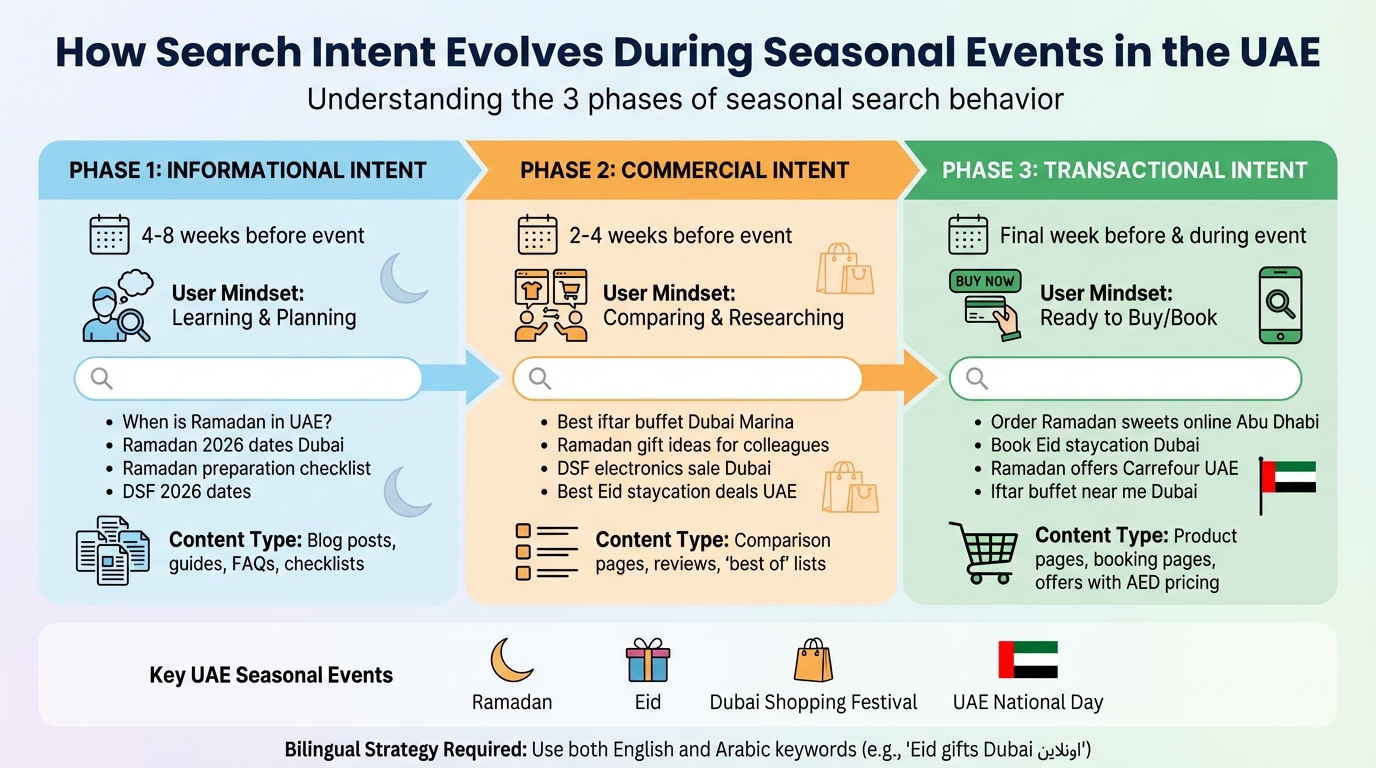
UAE Seasonal Search Intent Evolution: From Informational to Transactional
How Seasonal Events Shape Intent in the UAE
How Intent Changes Throughout a Season
In the UAE, user search intent evolves in clear stages as seasonal events draw closer. Take Ramadan, for example. Around four to five weeks before the holy month begins, searches tend to be more informational, focusing on questions like, "When is Ramadan in UAE?", "Ramadan 2026 dates Dubai", or "Ramadan preparation checklist".
As the event gets closer - about two to three weeks out - people shift towards researching options. Search terms like "healthy Ramadan recipes UAE", "best Ramadan promotions Dubai", and "Ramadan gift ideas for colleagues" become more common, as users start comparing deals and planning purchases.
When Ramadan begins, transactional searches take over. During the final week before Ramadan and the first week of the holy month, people are actively looking for specific products or services, with searches such as "Ramadan offers Carrefour UAE", "iftar buffet near me Dubai", or "order Ramadan sweets online Abu Dhabi". As Eid approaches, the focus shifts again, with searches like "Eid outfit Dubai online", "Eid gift boxes in Dubai", and "Eid staycation deals UAE". On the actual days of Eid, search behaviour becomes hyper-local, with queries like "open malls near me Dubai" or "Eid events today Abu Dhabi".
This phased pattern isn’t limited to Ramadan. Events like the Dubai Shopping Festival (DSF) and UAE National Day follow similar trends. For DSF, early searches focus on dates and general offers, progressing to brand-specific comparisons and ending with direct purchase queries. Around UAE National Day on 2 December, people first search for event details and decorations, followed by bookings for themed experiences and staycations.
Search Behaviour Patterns in the UAE
The UAE’s bilingual and diverse environment adds another layer of complexity to search behaviour. English dominates searches for global brands and tech products, with queries like "Ramadan sale iPhone Dubai" or "DSF deals laptop". Meanwhile, Arabic is more commonly used for culturally rooted topics, such as traditional recipes, family needs, and religious content. Interestingly, some searches blend both languages, like "Eid gifts Dubai اونلاين" or "iftar offers دبي", combining English and Arabic in one query.
This bilingual approach means marketers need to develop parallel keyword strategies for both languages. For example, Arabic terms might dominate recipe searches during Ramadan, while English keywords are more relevant for fashion or electronics. Tools like Google Search Console, with filters for the UAE and language segmentation, can help identify which language works best for specific topics.
Cultural and religious traditions also play a big role in shaping search activity. During Ramadan, fasting and prayer schedules push user activity to late evenings and nights, with search traffic spiking after iftar and suhoor. Gifting traditions around Eid drive searches for items like perfumes, dates, sweets, gold, and luxury products. Modest fashion preferences influence searches such as "modest dresses Dubai" or "abaya Ramadan collection UAE", with intent shifting from inspiration to specific store searches. Family gatherings and hospitality traditions further fuel demand for catering services, restaurant bookings, and home décor, especially on weekends and public holidays.
Search behaviour also varies across different emirates. Dubai sees spikes around events like the Dubai Shopping Festival, New Year’s celebrations, and tourism-related occasions, with searches like "DSF offers Dubai Mall" or "New Year party Dubai Marina". Abu Dhabi users tend to focus on family-friendly experiences and government-related events, with queries like "National Day fireworks Abu Dhabi" or "Yas Island Eid events". Meanwhile, Sharjah and the Northern Emirates show a more budget-conscious trend, with searches such as "cheap Eid gifts Sharjah" or "Ramadan offers Ajman supermarkets". These regional differences highlight the need for tailored keyword strategies.
Tools for Analysing Seasonal Keywords
To track these evolving search patterns, marketers need tools configured specifically for the UAE market. Google Trends is a great starting point for identifying recurring seasonal trends. By setting the region to the UAE and analysing data from the past three to five years, you can pinpoint when interest in Ramadan, Eid, DSF, or National Day peaks. Comparing Arabic and English queries side by side also reveals which language dominates specific topics.
Google Keyword Planner provides detailed volume data when filtered by the UAE. Narrowing results to specific emirates can help uncover local intent. For example, analysing pre-Ramadan, Ramadan, and Eid periods separately shows how search volume shifts week by week, from early informational queries to late-stage transactional ones.
Google Search Console offers site-specific insights. By comparing seasonal periods like Ramadan to non-Ramadan months, you can see which queries and pages gain traction. Filtering by language reveals whether Arabic or English searches are driving traffic. This helps identify intent-specific terms like "buy", "offer", or "near me" that trend during different times of the year.
For real-time insights, Google Autocomplete and People Also Ask are invaluable. Searching for terms like "Ramadan offers" or "Eid gifts Dubai" from a UAE IP address can surface current user needs and long-tail keyword ideas. Combining broader insights from Google Trends and Keyword Planner with detailed data from Search Console creates a comprehensive view of intent shifts, helping businesses time their campaigns effectively.
Building Seasonal Keyword Strategies Based on Intent
Grouping Keywords by Intent
When working with seasonal keywords, it's helpful to categorise them based on search intent: informational, commercial, and transactional. For example, during Ramadan, informational queries like "Ramadan fasting tips UAE" often lead to blog posts or FAQs. Commercial searches, such as "best Ramadan buffet Dubai Marina", are better suited for reviews and curated lists. Meanwhile, transactional searches like "book iftar buffet Dubai" require product pages with clear calls-to-action. The same logic applies to other seasonal topics, like back-to-school campaigns.
Once you've grouped your keywords, adapt these categories to fit the UAE's bilingual audience.
Adapting Keywords for UAE Audiences
To connect with searchers in the UAE, tailoring keywords to local preferences is essential. Given the UAE's bilingual environment, conduct separate keyword research for Arabic and English audiences. Use native speakers or specialised tools to ensure the phrasing feels natural. For instance, عيد هدايا دبي and "Eid gifts Dubai" are both relevant but may attract different users and contexts.
It's also common for users to mix languages in their searches, such as "Eid restaurants Dubai halal" or "ramadan offers دبي". These mixed-language queries often appear in autocomplete suggestions or long-tail searches, so they shouldn't be overlooked. Whenever possible, create parallel Arabic and English landing pages, keeping the structure consistent but tweaking the tone, visuals, and references to suit each audience. Use hreflang tags and a language toggle to make switching seamless for users.
Search Console can help identify which language performs better for specific topics. For example, Arabic tends to dominate searches related to religious and ritual content during Ramadan, while English or mixed-language queries are more common for tourism, luxury shopping, or electronics. Regional differences also play a role: Dubai searches often focus on shopping festivals and tourism, Abu Dhabi leans toward family-friendly activities, while Sharjah and the Northern Emirates feature more budget-conscious searches like "cheap Eid gifts Sharjah" or "Ramadan offers Ajman supermarkets".
Matching Content Types to Intent
To maximise engagement, align your content with the intent behind the keywords.
- Informational intent works best with how-to guides, blogs, checklists, and FAQs that address early-stage questions. Examples include "Ramadan in Dubai: complete guide" or "Back-to-school checklist for UAE parents".
- Commercial intent calls for comparison pages, curated "best of" lists, and buying guides that help users narrow their choices. Pages like "Best family staycations in UAE this Eid" or "Top laptops for UAE students in 2025" fit well here.
- Transactional intent is all about product and category pages featuring AED pricing, stock details, and strong calls-to-action. Adding structured data, such as Product, Offer, or LocalBusiness schema, can further enhance these pages. Internal links should guide users from informational to commercial to transactional pages as their intent becomes more specific.
Timing is also critical. Publish informational content 6–8 weeks before the season, commercial pages 3–4 weeks prior, and transactional pages 2–3 weeks before peak demand.
To simplify this process, Wick's Four Pillar Framework integrates customer insights, behavioural data, and journey mapping. This approach not only optimises strategies but also enables AI-driven personalisation while staying culturally relevant across all touchpoints in the UAE market.
Optimising for Answer Engines and SERP Features
Answer Engine Optimisation vs SEO
While traditional SEO focuses on securing a spot in the top ten search results, Answer Engine Optimisation (AEO) takes a different path. It’s all about structuring content so that tools like Google's AI Overviews, featured snippets, voice assistants, and generative summaries can easily extract and present direct answers to user questions. This becomes especially relevant during seasonal peaks in the UAE. For instance, searches like "what time is iftar in Abu Dhabi today" or "best Eid gift ideas under AED 300" see a sharp rise during Ramadan and Eid.
AEO relies on clear Q&A formats, brief definitions, and structured data, such as FAQ or HowTo schema. Let’s say you’re targeting a query like "What are Eid offers in Dubai 2026?" - your page should start with a concise and direct answer, followed by additional details. This method helps answer engines grasp the context and entities, which is crucial in a bilingual environment like the UAE, where mobile and voice searches dominate.
Using Seasonal SERP Features
AEO lays the groundwork, but seasonal SERP features take it further by offering extra visibility. Different types of search queries trigger specific SERP features, and aligning your content to these can make a big difference. For example:
- Informational queries like "how to plan an iftar menu" often bring up featured snippets or "People Also Ask" boxes.
- Transactional searches such as "buy Eid gifts online UAE" tend to trigger shopping carousels and product-rich results.
- Local queries like "iftar buffet near me Dubai Marina" prompt Google to display map packs and Business Profile panels.
To take advantage of these features, keep your Business Profile up to date with seasonal details like Ramadan timings, photos, and promotions. Use Event schema for activities such as Ramadan tents or National Day brunches, ensuring you include start and end dates in DD/MM/YYYY format, venue details, and accurate postal codes. For product pages, implement Product and Offer schema with priceCurrency: "AED" and specific availability periods. Voice and AI summaries favour natural, conversational phrasing, so aim for queries like "Where can I find last-minute Eid gifts in Dubai after 10 pm?" rather than stuffing keywords unnaturally.
These strategies not only improve visibility but also set the stage for tracking your seasonal campaign performance effectively.
Measuring Seasonal Performance
To gauge how well your seasonal efforts are working, turn to Google Search Console. Filter reports by location (UAE) and key event dates - such as Ramadan, Eid, the Dubai Shopping Festival, and National Day. Keep an eye on metrics like impressions, clicks, average ranking position, and click-through rates for your seasonal keyword clusters. Use the Search Appearance dimension to see how often your pages show up in rich results like snippets and map packs compared to standard listings.
Export data from each seasonal phase to identify which pages are capturing snippets, map packs, or other SERP features. Analyse the types of intent - whether informational, transactional, or local - that generated the most engagement. Comparing year-over-year performance for the same seasonal periods can help confirm whether your optimisation efforts are hitting the mark.
To get a complete picture, combine Search Console data with analytics tools. Track metrics like conversion rates, revenue in AED, and time spent on pages to measure the overall impact of your seasonal strategy. If you have physical locations, check Business Profile Insights for trends in calls, website visits, and direction requests during your campaigns. Together, these insights ensure your seasonal adjustments are timely and effective.
sbb-itb-058f46d
Conclusion: Implementing Intent-Based Seasonal Strategies with Wick
Key Takeaways
Achieving seasonal success in the UAE hinges on aligning your strategies with user intent at every stage of the buyer journey. Start by syncing your campaigns with the UAE's event calendar - key occasions like Ramadan, Eid, Dubai Shopping Festival, National Day, and tourism peaks. Segment your keywords based on intent: informational, commercial, and transactional. For early-stage users, focus on guides and checklists; mid-funnel users need comparisons and reviews; and last-minute shoppers respond best to offer-driven pages with clear AED pricing. Incorporate local elements like city names (Dubai Marina, JLT, Sharjah), Arabic keywords, and themes that resonate with UAE residents and visitors. Launch campaigns well in advance of peak periods to secure rankings, and track performance using tools like Google Search Console and analytics. Analysing year-over-year data will help you refine your strategy for future cycles, creating a more effective approach tailored to the UAE market.
How Wick Supports Seasonal Strategies
Wick takes these insights and applies them through an integrated framework designed to optimise seasonal campaigns. Their Four Pillar Framework ensures seasonal strategies are executed seamlessly across digital platforms:
- Build & Fill: Develops AI-driven content systems and optimised landing pages tailored for UAE audiences.
- Plan & Promote: Utilises SEO, SEM, and Answer Engine Optimisation to capture peak demand through featured snippets, local packs, and shopping results.
- Capture & Store: Tracks behavioural trends and intent patterns using intelligent data systems, helping predict and respond to seasonal demand spikes.
- Tailor & Automate: Personalises and automates campaigns to deliver the right messages to specific segments - whether it's Emirati families preparing for Eid or tourists booking desert safaris. Offers are presented in AED and timed to align with local habits.
Wick’s unified approach ensures every aspect of your digital presence aligns with seasonal intent, providing measurable results. For instance, with UAE clients like Hanro Gulf, Wick coordinated SEO, targeted campaigns, and analytics to drive sustainable growth. Similarly, for Forex UAE, they managed a comprehensive digital strategy with strong SEO execution and detailed performance tracking, delivering actionable insights to guide decision-making. By consolidating website management, content, search, social, and automation into one cohesive strategy, Wick eliminates the inefficiencies of fragmented tools and agencies. This approach not only saves time and reduces costs but also amplifies your impact during critical seasonal periods.
Episode 151 - Optimizing Holiday Marketing for Google Search
FAQs
How can businesses in the UAE plan their content around seasonal events effectively?
To craft impactful content for seasonal events in the UAE, businesses should centre their efforts around prominent occasions like Ramadan, Eid, and UAE National Day. These events hold immense cultural significance, making them ideal opportunities to resonate with local audiences.
By leveraging data-driven insights, businesses can pinpoint the most relevant dates and emerging trends. Tools like AI-powered analytics can help identify optimal times for content release and guide the creation of messages that align with the UAE's cultural values and traditions. Integrating these insights into a well-structured digital strategy can boost audience engagement and visibility, enabling businesses to establish deeper connections with their target market.
How does a bilingual keyword strategy help reach UAE audiences?
In the UAE's linguistically diverse market, a bilingual keyword strategy isn't just a nice-to-have - it's a necessity. By crafting content in both Arabic and English, businesses can connect meaningfully with the country's two primary language groups. This dual-language approach ensures that your message speaks directly to a broader audience, making your brand more relatable and accessible.
Beyond just expanding reach, this strategy also helps businesses align with the region's unique cultural nuances. Tailoring content to both languages demonstrates respect and understanding of local traditions, which fosters trust and strengthens relationships with customers. In a market as dynamic as the UAE, this is a key ingredient for marketing success.
How can businesses use Google Trends to analyse seasonal keyword patterns?
Businesses can use Google Trends to track how search volumes for specific keywords fluctuate over time. This insight helps them pinpoint peak seasons for certain terms and fine-tune their marketing strategies to align with these trends.
Additionally, by studying regional interest patterns, companies can tailor their content to match local seasonal habits. This ensures that their messaging resonates with the audience at the right time, boosting engagement and capitalising on periods of high demand.