

Blog / Intent Mapping for SEO in 2025
Intent Mapping for SEO in 2025
Search engines in 2025 focus on understanding user intent, not just keywords. This shift demands a new approach called intent mapping, which aligns content with what users genuinely need at different stages of their journey. Here's what you need to know:
-
What is Intent Mapping?
It’s about identifying the purpose behind a search query - whether users are seeking information, comparing options, or ready to buy - and creating content that matches their intent. -
Why It Matters:
With 60% of mobile searches ending without clicks (AI summaries provide direct answers), content must be authoritative enough to be cited by these systems. Intent-aligned content improves rankings, engagement, and conversions. -
Types of Search Intent:
- Informational: Users seek answers or knowledge.
- Navigational: They want a specific site or page.
- Commercial: They’re comparing options before deciding.
- Transactional: They’re ready to act (buy, sign up, etc.).
-
How to Succeed:
- Use high-intent keywords and group them by intent.
- Match content formats to user needs (e.g., guides for informational, product pages for transactional).
- Optimise your site structure using a pillar-cluster model to cover topics comprehensively.
-
Future Trends:
AI-driven search, multilingual strategies, and trust signals (E-E-A-T: Experience, Expertise, Authoritativeness, Trustworthiness) are shaping SEO. In the UAE, dual-language content and hyperlocal targeting are especially effective.
Key takeaway: Align your content with user intent to stay relevant, boost conversions, and thrive in an AI-dominated search landscape.
Intent-First Architecture & Internal Linking Tips that Move Rankings (w/Alex Alexakis)
The 4 Types of Search Intent
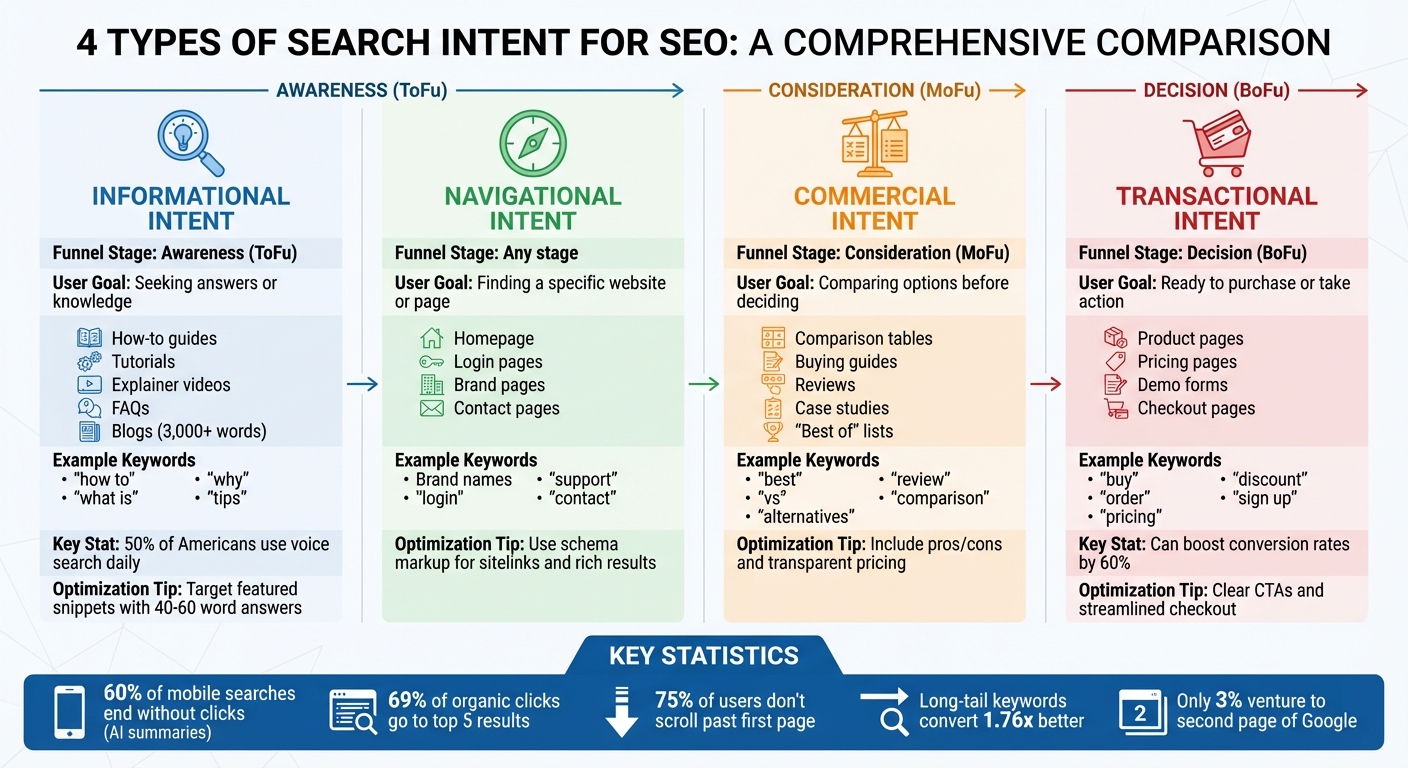
4 Types of Search Intent: Characteristics, Content Formats, and Keywords
Understanding search intent is key to creating content that resonates with what users are looking for. The four main types - Informational, Navigational, Commercial, and Transactional - represent different stages in a user’s journey. By tailoring your content to these intents, you can better meet their needs and improve engagement. Let’s break down each type and how to align your strategy.
Navigational Intent
Navigational intent is all about users who already know where they want to go - they’re searching for a specific website, login page, or brand resource. To capture this traffic, it’s vital to optimise your branded pages so they rank first for your business name. If your homepage or key pages are outranked by directories or review sites, it could be due to a weak site structure or low domain authority. Strengthen your homepage, contact pages, and login portals by including your brand name in title tags, meta descriptions, and H1 headers.
Using schema markup can give you an edge. Structured data helps search engines better understand your site, allowing for rich results like sitelinks. This is especially useful in the UAE, where users often search for specific branches or services within larger organisations. By making navigation easier, you enhance the user experience and retain traffic.
Informational Intent
Informational intent drives the largest share of searches. These are users looking for knowledge, answers, or solutions - queries often start with "how", "what", or "why." This intent aligns with the awareness stage of the buyer’s journey, where users are exploring their options.
Your goal here is to become the go-to resource for answers. Structure your content to address questions clearly and concisely within the first few paragraphs. This increases your chances of appearing in featured snippets or AI-generated summaries. Research shows that longer content - over 3,000 words - tends to attract 3.5 times more backlinks because it covers topics comprehensively.
To address diverse audience needs, use a mix of formats like how-to guides, tutorials, explainer videos, and FAQs. As AI tools evolve, search behaviour is shifting towards longer, conversational queries. For example, users now ask, "how do I optimise my website for voice search in 2025?" instead of just "voice search optimisation". With 50% of Americans using voice search daily, and similar trends growing globally, crafting content that directly answers these natural language queries is essential.
Commercial and Transactional Intent
Commercial and transactional intent occur at the bottom of the funnel, where users are ready to act. While they’re closely related, each serves a distinct purpose and calls for a tailored approach.
Commercial intent reflects the consideration stage. Users are researching and comparing options before making a decision, using queries like "best SEO tools", "marketing agencies in Dubai", or "CRM software comparison." To meet this intent, create content such as comparison tables, buying guides, and reviews. Highlight pros and cons, provide transparent pricing, and offer objective insights to help users make informed decisions.
Transactional intent, on the other hand, signals immediate readiness to act. These users are looking to complete a purchase, sign up for a service, or download something. Searches often include terms like "buy", "order", "pricing", or "discount." For these users, your content should focus on streamlined product pages, clear calls-to-action, and an easy checkout process.
It’s important to align your content format with the user’s intent. For example, if someone searches "buy running shoes online", they expect a product page, not a blog post about choosing running shoes. Similarly, if a user searches for "best running shoes for beginners", they’re likely in the research phase and would benefit from a comparison guide. Misalignment can lead to higher bounce rates and lost opportunities. Google’s Search Quality Evaluator Guidelines highlight this distinction by categorising these as "Do" queries, emphasising the need to match content to user expectations.
When done right, aligning content with these intent types can boost conversion rates by up to 60%. And with only 3% of users venturing to the second page of Google search results, ensuring your content matches intent is critical for staying visible and effective.
How to Build an Intent-First Keyword Research Strategy
Developing a keyword strategy that focuses on intent means prioritising what users aim to achieve over simply chasing high search volumes. In 2025, with many mobile searches ending without a click, it’s time to shift your focus from just gaining impressions to driving actual conversions. This involves a structured approach: identifying keywords that reflect user intent, grouping them based on goals, and validating these choices with real-world data.
Identifying High-Intent Keywords
To start, move beyond raw search volume. The most valuable keywords aren’t necessarily the most popular - they’re the ones that reveal a specific user intent. This approach ties back to the intent mapping framework. Analysing the SERP (Search Engine Results Page) can provide clues: featured snippets and "People Also Ask" boxes suggest informational intent, while shopping ads and product snippets indicate transactional intent. Listicles such as "best" guides often point to commercial investigation.
Keyword modifiers can help you categorise intent more effectively. For example:
- Words like "how", "what", or "tutorial" signal informational intent.
- Terms like "best", "vs", or "review" suggest commercial research.
- Keywords such as "buy", "price", or "coupon" indicate transactional intent.
Take this example: "marketing automation tools Dubai" likely reflects commercial intent, while "buy marketing automation software" is clearly transactional.
It’s also crucial to evaluate click-through potential. A keyword might have 5,000 monthly searches, but if the SERP is packed with ads, AI summaries, and knowledge panels, the actual clicks you can win may be minimal. Tools like Semrush (starting at AED 477.50/month) and Ahrefs (from AED 363.50/month) can help you assess organic CTR potential to uncover real opportunities.
Long-tail keywords often hold more value. They account for around 70% of web traffic and tend to convert 1.76 times better than broad terms because they reflect more specific intent. For example, instead of targeting "SEO", aim for something like "SEO audit checklist for e-commerce sites in UAE." While it’s a lower-volume term, it’s more likely to attract users who are ready to engage.
Clustering Keywords by Intent
Once you’ve identified high-intent keywords, organise them into intent-based clusters. This strategy ensures that each cluster is addressed on a single page, avoiding keyword cannibalisation (where multiple pages compete for the same search goal) and streamlining your content architecture for intent-driven SEO.
The pillar-cluster model is particularly effective here. For instance:
- Create a broad "pillar" page targeting a general term like "content marketing."
- Build related "cluster" pages around specific long-tail variations such as "content marketing strategy for B2B SaaS" or "measuring content marketing ROI."
Linking these cluster pages back to the pillar page helps establish topical authority while meeting deeper user needs.
"We start the keyword mapping process with a content strategy that targets our ideal customer profiles (ICPs) and covers our main content pillars." – Leigh McKenzie, Head of SEO, Backlinko
When clustering, consider the combined search volume of the primary keyword and its related variations. For example, a primary keyword with 500 searches might seem small, but if its cluster includes 15 variations totalling 3,200 searches, it becomes a priority.
Align these clusters with the stages of the buyer’s journey:
- Top of Funnel: Informational intent.
- Middle of Funnel: Commercial intent.
- Bottom of Funnel: Transactional intent.
This ensures your content reflects how users move from awareness to decision-making. Finally, validate your clusters by analysing competitor performance and market data.
Cross-Referencing Competitor and Market Data
Refining your intent-first strategy requires understanding where competitors excel - and where they fall short. Conduct keyword gap analysis to identify queries your competitors rank for but you don’t. These gaps represent immediate opportunities to capture relevant traffic. For instance, if competitors rank for "email marketing automation UAE" and you don’t, it’s worth investigating.
Matching content format to intent is equally important. If the top five results for a keyword are comparison guides, creating a product page won’t cut it - no matter how well it’s optimised.
To understand where competitors dominate, use Share of Voice (SoV) mapping. This analysis can reveal opportunities. For example, competitors may excel in informational content but lag in commercial comparisons, giving you a chance to target users in the consideration phase. Tools like SpyFu (starting at AED 143.20/month) can make this analysis accessible, even on a tighter budget.
Finally, use an Opportunity Score formula to assess the value of a keyword. The formula combines intent, CTR risk, position reach, and value per click. For example, a keyword with 10,000 searches but an 80% CTR risk (due to crowded SERPs) scores lower than a 2,000-search term with clearer click potential and higher commercial value. This highlights the importance of focusing on keywords where you can realistically rank - especially since about 69% of organic clicks go to the top five results.
Optimising Content and Website Structure for Intent
After mapping keywords to user intent, the next step is to align your website structure and content to meet those needs. This isn't just about creating pages - it's about building an interconnected system where every piece of content plays a role in guiding users through their journey. Let's dive into how content formats and on-page elements can directly address user intent.
Creating Content That Matches Intent
The format of your content is just as important as the keywords you target. For instance, a search query like "how to set up email automation" calls for a detailed, step-by-step guide - not a product page. On the other hand, someone searching "buy email automation software UAE" is likely looking for pricing, features, and a clear call-to-action.
To ensure your content aligns with intent, consider the 3 Cs Framework:
- Content Type: Is it a blog, product page, or something else?
- Content Format: Should it be a how-to guide, a comparison list, or a case study?
- Content Angle: What makes your content stand out?
For informational queries, create in-depth guides, FAQs, or tutorials. For commercial intent, focus on comparison articles, case studies, or "best of" lists. Transactional queries require concise product pages with clear pricing, demo forms, or direct calls-to-action.
A mismatch between content format and user intent is one of the biggest reasons content fails. If users don’t find what they expect, they’ll leave immediately. For example, a keyword like "running shoes for beginners" might indicate both a need for educational content and a readiness to purchase. In such cases, prioritise educational content, followed by product recommendations.
Content length also matters. Informational content exceeding 3,000 words often performs better, driving three times more traffic and 3.5 times more backlinks because it answers user questions thoroughly. In contrast, transactional pages should be concise, as buyers prefer quick, actionable information.
On-Page SEO: Signalling Intent
Once your content format aligns with intent, on-page SEO signals help search engines recognise your strategy. Use intent-driven modifiers like "how to", "best", or "buy" in titles and meta descriptions. Schema markup provides additional context - use FAQ schema for informational content, Product schema for transactional pages, and Review schema for commercial comparisons.
For informational queries, optimise for Featured Snippets by providing a clear, 40–60 word answer immediately after a heading. This is especially crucial in 2025, as nearly 60% of mobile searches end without a click due to AI-driven summaries and featured snippets.
Regular audits are essential to catch intent mismatches. For example, if users searching "pricing for CRM software" land on a blog post instead of a pricing page, they’re likely to bounce.
Structuring Your Site for Intent Clusters
A well-organised site structure ensures users can navigate seamlessly from awareness to conversion. Think of your website as a roadmap, guiding visitors step by step. The pillar-cluster model works particularly well: create a broad pillar page targeting a main keyword (e.g., "content marketing") and link it to cluster pages that address specific, long-tail variations (e.g., "content marketing for B2B SaaS in UAE").
Here’s a quick summary of how content can align with intent:
| Intent Type | Funnel Stage | Ideal Content Format | Example Modifiers |
|---|---|---|---|
| Informational | Awareness (ToFu) | Guides, Tutorials, Blogs, FAQs | "how to", "what is", "tips" |
| Commercial | Consideration (MoFu) | Comparison lists, Reviews, Case Studies | "best", "vs", "alternatives" |
| Transactional | Decision (BoFu) | Product pages, Pricing, Demos | "buy", "discount", "pricing" |
| Navigational | Any | Homepage, Login, Brand pages | Brand names, "login", "support" |
Internal linking plays a key role here. Link informational posts to related commercial content and then to transactional pages. This not only improves user experience but also signals topical depth to search engines, reducing the risk of keyword cannibalisation.
Your site navigation should reflect these intent clusters. For example, someone exploring "SEO services" should easily find related topics like "SEO audits" or "technical SEO" without wading through irrelevant pages. A clear, logical structure also enhances crawlability, making it easier for search engines to index your content.
"Search intent alignment is an SEO tactic and a business growth lever. When you match queries to the right content, structure, and offers, you cut wasted effort." – Dennis Hammer, Content Strategist
Lastly, don’t overlook technical factors. With 75% of users not scrolling past the first search page, fast load times and mobile responsiveness are essential for meeting user intent in 2025. Neglecting these can cost you both rankings and conversions.
sbb-itb-058f46d
Measuring and Refining Intent Mapping Strategies
Intent mapping isn’t a one-and-done process - it demands continuous measurement and fine-tuning. Instead of relying on overall traffic metrics, break down the data by intent to get a clearer picture of what’s working.
Setting Intent-Led KPIs
To truly measure success, you need KPIs that align with the goals of each intent type. These metrics should reflect the intent-first approach outlined earlier. For informational content, focus on metrics like dwell time, scroll depth, and sign-ups. For commercial intent, track assisted conversions, the use of comparison tools, and click-through rates to product pages. On transactional pages, measure conversion rates, revenue, and add-to-cart actions. Even navigational queries have value - monitor branded search volume and sitelink click-through rates to assess brand authority.
The key is to move away from vanity metrics and focus on what truly matters. For instance, aligning content with user intent can boost conversion rates by as much as 60% when you measure the right outcomes. To streamline this process, consider creating an intent dashboard. By integrating tools like Google Search Console, Google Analytics 4, and your CRM, you can centralise data and identify which intent segments are driving results - and which need refinement. For example, if your commercial comparison pages attract high traffic but show low assist rates, it might signal issues like unclear calls-to-action or a lack of pricing transparency.
Analysing Performance Metrics
Once your KPIs are in place, dive into the data to uncover actionable insights. Use regex filters in Google Search Console to focus on queries with three or more words, especially those including modifiers like "how", "what", or "why." This approach helps track the performance of informational intent and identifies long-tail queries that drive engagement.
Keep an eye on SERP features. If your page ranks third but isn’t included in a Featured Snippet or People Also Ask box, you could be missing out on valuable traffic. Remember, nearly 69% of organic clicks go to the top five results, so even small changes in SERP visibility can have a significant impact.
Tools like heatmaps and A/B testing provide deeper insights into user behaviour. For example, if users frequently leave a transactional page, a heatmap might show they’re not scrolling down far enough to see pricing details. A/B testing different content formats - like listicles versus how-to guides - can help you determine what resonates more with your audience. Additionally, cross-channel validation can offer clues: if a specific intent cluster performs well in paid search, it’s a sign to prioritise that intent in your organic content strategy.
Iterating Based on Insights
Data is only useful if you act on it. Conduct quarterly SERP checks to ensure your target keywords still align with the dominant user intent. Search engines frequently update their understanding of intent, so your strategy needs to adapt. For instance, a keyword that initially attracted transactional searches might shift over time as users begin looking for troubleshooting guides instead of purchase options.
"User intent impacts the entire algorithm. A poor user experience with your site... at scale it will result in an algorithmic shift that would see your site negatively impacted."
– John Mueller, Senior Search Analyst, Google
Performance data can also help you resolve intent mismatches. For example, if a page ranking for a high-intent keyword has a high bounce rate, it could mean the content doesn’t meet user expectations. Similarly, if multiple pages compete for the same query, you may be dealing with keyword cannibalisation. In such cases, consolidating or differentiating the pages can ensure each serves a distinct user need. By continuously refining your strategy through audits and incremental updates, you’ll keep your approach aligned with both user behaviour and search engine algorithms.
The Future of Intent Mapping in SEO
AI and Intent Mapping Evolution
Search engines have come a long way in understanding user intent, moving far beyond simple keyword matching. By November 2025, Google AI Overviews featured in 60.32% of U.S. queries, while ChatGPT was handling an incredible 2.5 billion daily queries. If current trends hold, ChatGPT could even surpass Google's search volume by 2027. This evolution means that intent mapping now demands a fresh, more nuanced approach.
Instead of focusing solely on keyword volume, the focus has shifted to creating content that thoroughly explores topics through related entities. For instance, informational intent calls for responses that prioritise definitions upfront, while transactional intent benefits from concise, action-driven content that AI systems can easily cite. Gary Illyes from Google highlighted this shift, saying:
"Originality is something we're going to be focusing on this year. That's going to be important".
The stakes are high. In 2024, nearly 60% of searches in the EU and over 58% in the U.S. resulted in "zero-click" outcomes, where AI summaries delivered answers directly on the search results page. To remain visible, businesses need to adopt answer-first formatting - placing clear, concise answers at the top of their content to encourage AI citation. Techniques like Schema Markup can also help signal the content’s purpose directly to AI systems.
These advancements demand that content strategies adapt to address the needs of diverse global audiences.
Catering to Multilingual and Global Audiences
As AI continues to refine its search capabilities, tailoring content to reflect linguistic and cultural subtleties is becoming increasingly important. Intent doesn’t always translate neatly across languages or cultures. In the UAE and the wider GCC region, for example, search behaviour differs significantly between Arabic and English speakers. Even something as simple as word order can shift intent - compare "ingredients for dog food" (likely seeking homemade recipes) with "dog food ingredients" (probably looking for commercial products).
A great case study comes from MedPark Hospital, which implemented a multilingual SEO strategy for medical tourism in 2024–2025. By using proper hreflang attributes, they achieved impressive results: their Thailand-based keyword rankings tripled year-over-year, and English-language pages skyrocketed from almost no rankings to 206,000 U.S. keyword positions, driving over 250,000 organic visits in just one month.
For businesses in the Emirates, hyperlocal intent mapping is a game-changer. Creating landing pages tailored to specific locations, such as Dubai Marina or Yas Island, and incorporating proximity markers like "opposite Mall of the Emirates", can effectively capture intent from both residents and tourists. Offering dual-language content in Arabic and English further increases accessibility and trust, especially as voice search gains traction in the region.
EEAT and Contextual Authority
Incorporating actionable intent strategies is no longer enough - establishing trust has become critical. Google’s Search Quality Guidelines place trust at the heart of E-E-A-T (Experience, Expertise, Authoritativeness, Trustworthiness). Without trust, a page’s E-E-A-T score will suffer, no matter how well it performs in other areas.
The Experience pillar is now more influential than ever, with search engines prioritising content that reflects first-hand knowledge and personal insights over generic, AI-generated material. For businesses in competitive markets like the UAE, this means going the extra mile: showcasing real-world case studies, providing detailed author bios with credentials, and using original imagery that demonstrates direct involvement with the subject. Even transactional pages must now include elements of informational quality and E-E-A-T signals to rank well, especially in sensitive niches like legal or financial services.
To build contextual authority, businesses need to shift their focus from keyword density to topical expertise. Developing content clusters that address complex, long-tail queries can lead to citations, which in turn boost E-E-A-T scores for broader search terms. Structured data plays a key role here, enabling AI search engines to accurately extract and attribute authoritative content. In multilingual regions, maintaining "locale semantics" - such as using regional date formats (DD/MM/YYYY), AED currency symbols, and culturally appropriate language - is essential to preserving E-E-A-T across different languages.
Conclusion: How to Implement Intent Mapping in 2025
Key Takeaways
Intent mapping is more than just an SEO technique - it’s a tool to drive growth by guiding prospects from curiosity to action. When done right, it can deliver impressive results: up to a 60% increase in conversion rates, a 20% rise in customer satisfaction, and a noticeable boost in organic performance. In fact, 92% of SEO professionals consider it essential for ranking, while 75% of users never look beyond the first page of search results. By understanding the four main intent types - Informational, Navigational, Commercial, and Transactional - you can create content that speaks directly to user needs at every stage of their journey. This approach not only reduces wasted effort but also streamlines content planning across your digital channels.
Getting Started with Intent Mapping
To kick things off, conduct a thorough content audit. Look for pages that don’t align with user intent - like a blog post ranking for a "pricing" query but failing to include a clear call to action. Next, sort your keywords by intent and manually analyse search engine results (SERPs) to uncover patterns that search engines reward. Use the 3 Cs Framework - Content Type, Format, and Angle - to evaluate what’s working in top-ranking results. Then, align your content with the five-stage customer journey (Awareness, Consideration, Decision, Retention, and Advocacy), ensuring each stage is supported by the right content formats. For instance, guides might work well during the Awareness stage, while product demos are better suited for the Decision stage.
Set clear, intent-specific KPIs. For example, track bounce rates for informational content and monitor conversion rates for transactional pages. Commit to quarterly SERP audits to stay on top of shifting user behaviours and intent trends. These steps will lay the groundwork for a more effective and adaptive SEO strategy.
Looking Ahead
The SEO world is changing fast. AI-driven search tools and the rise of zero-click results are transforming how people search for and consume information. Eric Siu, CEO of Single Grain, sums it up perfectly:
"Understanding search intent is like having the map before you start the journey".
To stay ahead, businesses need to embrace AI tools that can scale intent analysis, optimise for multimodal searches (voice, visual, and text), and focus on E-E-A-T signals to earn trust from both users and search engines. For companies in the UAE and beyond, the key to staying competitive lies in treating intent mapping as an ongoing process - one that ensures you’re meeting your audience’s needs at every step. At Wick, we’re committed to using data-driven insights to integrate intent mapping into a seamless digital strategy. This approach ensures sustainable growth while keeping your digital ecosystem aligned and effective.
FAQs
What is intent mapping, and how does it help improve SEO rankings in 2025?
Intent mapping is all about aligning the content on your website with the specific intent behind what users are searching for. Are they seeking information, weighing their options, or ready to buy? By identifying these motivations, businesses can craft content that speaks directly to what users need at that moment.
This strategy plays a big role in boosting SEO rankings. How? By making your content more relevant and engaging, it encourages higher click-through rates and keeps users on your site longer - while lowering bounce rates. These are exactly the signals search engines, like Google, look for to determine if your site is meeting user intent. As a result, your site can climb higher in search results. Even in 2025, intent mapping remains a crucial method for staying ahead in the ever-changing digital world.
How can I effectively identify high-intent keywords for SEO?
To spot high-intent keywords, take a close look at search engine results pages (SERPs) for hints like featured snippets, the 'People Also Ask' section, and shopping ads. These features often reflect what users are looking for. Leveraging AI-driven keyword tools can help you discover commercial and transactional terms. Once identified, connect these keywords to the appropriate stages of the buyer's journey. Prioritise terms that are most likely to attract clicks and lead to conversions. Aligning your content with intent-focused keywords not only meets user expectations but also boosts your SEO results.
How can businesses use intent mapping to reach multilingual audiences effectively?
Understanding the intent behind search queries in different languages is key to connecting with a multilingual audience. In the UAE, where a large portion of online users prefer Arabic, yet much of the content is still in English, addressing language preferences can open up significant opportunities.
To begin, segment your audience by language using tools like Google Search Console and analytics platforms. Look for intent signals such as "buy AED 1,250.00 smartwatch" in English versus "كيفية شراء ساعة ذكية" in Arabic. Match these signals with appropriate content types - whether it’s blogs, product pages, or FAQs. While AI-assisted translation can save time, it’s crucial to apply human localisation to ensure accuracy and respect for cultural nuances. This includes using metric measurements, UAE-specific spelling conventions (like "optimise" instead of "optimize"), and culturally relevant phrasing.
A helpful approach is Wick’s Four-Pillar Framework, which involves:
- Defining the intent behind queries
- Creating content that aligns with those intents
- Delivering localised experiences
- Continuously analysing performance to refine strategies
By crafting content that resonates with both English and Arabic speakers, businesses can build stronger connections, enhance user engagement, and achieve meaningful growth in the UAE market.