
Blog / HTTPS vs HTTP: SEO Impact
HTTPS vs HTTP: SEO Impact
HTTPS is a must-have for websites today. It secures data, builds user trust, and boosts search rankings. On the other hand, HTTP is outdated - leaving data unprotected, harming SEO, and misclassifying referral traffic.
Key Takeaways:
- HTTPS encrypts data, safeguarding sensitive information like passwords and payment details.
- Google uses HTTPS as a ranking factor, favouring secure sites since 2014.
- HTTP websites show "Not Secure" warnings in browsers, discouraging users and reducing conversions.
- HTTPS preserves referral data, ensuring accurate analytics, while HTTP loses this data.
- Over 95% of Chrome pages are now HTTPS, reflecting its dominance.
Quick Comparison:
| Feature | HTTP | HTTPS |
|---|---|---|
| Security | No encryption, vulnerable | Encrypted, secure |
| Browser Display | "Not Secure" warning | Padlock icon, "Secure" label |
| SEO Impact | Negative/neutral | Positive ranking signal |
| Analytics | Referral data lost | Referral data preserved |
| Performance | Slower (older protocols) | Faster (supports HTTP/2) |
| Cost | Free | Free to AED 2,570 annually |
For UAE businesses, switching to HTTPS is essential for staying competitive, protecting user data, and improving online visibility. It’s a small investment for long-term gains in trust, rankings, and performance.
HTTP vs HTTPS and Impact on SEO
sbb-itb-058f46d
HTTP: Security Risks and SEO Problems
HTTP, or Hypertext Transfer Protocol, was initially designed to facilitate the transfer of information between web browsers and servers. However, it operates without encryption, meaning sensitive information - like passwords, credit card details, or browsing history - can be intercepted by malicious actors.
Running on port 80, HTTP lacks the encryption layer needed to safeguard data. This makes it a prime target for man-in-the-middle attacks, where attackers can eavesdrop on or alter the data being transmitted. Since July 2018, Google Chrome has taken a firm stance against HTTP, marking all such websites with a bold "Not Secure" warning in the browser's address bar. The root of these issues lies in HTTP's failure to encrypt data.
No Data Encryption
Without the protection of SSL/TLS, HTTP transmits data in plain text. This opens the door for attackers to inject harmful ads, spread malware, or trick users into sharing sensitive information. For businesses in the UAE, this is particularly problematic, as critical web features - like secure payment gateways, geolocation services, and push notifications - require HTTPS to function. The lack of encryption not only compromises security but also negatively impacts user trust and conversion rates.
Lower Search Engine Rankings
Google made HTTPS a ranking factor back in August 2014. By 2020, HTTPS had become the standard for high-ranking pages, with 98% of page-one results in Moz's 10,000-keyword dataset using HTTPS. Even deeper in search results, HTTPS URLs accounted for over 92% of links. Dr. Peter J. Meyers, Marketing Scientist at Moz, emphasised this shift:
If you're not convinced that HTTPS is important when 97-98% of the top ten organic results have it, I'm not sure what's left to say.
Websites still using HTTP lose out on the ranking advantages HTTPS offers. They also miss the performance boosts provided by HTTP/2, which further impacts their visibility. In short, HTTP's outdated structure harms both security and search engine performance.
Missing Referrer Data
HTTP's issues extend beyond security and rankings to traffic analytics. When users click a link from a secure HTTPS site to an HTTP site, browsers strip away the referral information for security reasons. This means analytics tools, like Google Analytics, classify such traffic as 'Direct,' making it impossible to trace the original source. Cyrus Shepard, Founder of Zyppy SEO, explains:
Whenever traffic passes from a secure HTTPS site to a non-secure HTTP site, the referral data gets stripped away. This traffic shows up in your analytics report as 'Direct.' This is a problem because you don't know where the traffic actually comes from.
For businesses in the UAE, this loss of referral data creates significant blind spots, making it difficult to measure the return on investment (ROI) for marketing campaigns. Without accurate data, understanding the effectiveness of marketing efforts becomes a guessing game.
HTTPS: Security Features and SEO Benefits
HTTPS addresses the vulnerabilities of HTTP by offering encryption, data integrity, and authentication. These features not only provide robust security but also contribute to the SEO advantages outlined below.
Data Protection Through Encryption
One of the key strengths of HTTPS is its ability to encrypt all communication between browsers and servers. This ensures that sensitive data, like browsing history or credit card details, remains secure from eavesdropping. Encryption also protects against third parties tampering with data or injecting unauthorised content, such as ads or malware. Additionally, HTTPS ensures that browsers connect to the correct server, reducing the risk of man-in-the-middle attacks. For businesses in the UAE, this level of protection is critical for maintaining trust and enabling secure web functionalities. Beyond user safety, these security measures also align with Google's standards for trusted websites, which can improve search rankings.
Better Search Engine Rankings
HTTPS does more than just secure websites - it plays a direct role in improving SEO performance. Since August 2014, Google has used HTTPS as a ranking signal to promote a safer internet. As Zineb Ait Bahajji and Gary Illyes, Webmaster Trends Analysts at Google, explained:
We've seen positive results, so we're starting to use HTTPS as a ranking signal.
By late 2020, HTTPS URLs dominated search results, making up 98% of page-one organic results in Moz's keyword study. Even for lower-ranked pages (positions 41 to 50), over 92% of URLs used HTTPS. John Mueller, Search Advocate at Google, has also noted that while HTTPS alone won't guarantee a top position, it can act as a tiebreaker when two websites are equal in terms of quality, content, and backlinks. Additionally, HTTPS supports HTTP/2, a modern protocol that enhances page load speeds - a critical ranking factor. HTTPS pages can load in as little as 0.5 seconds, compared to nearly 6 seconds for HTTP pages.
Complete Referrer Data Tracking
Another advantage of HTTPS is its ability to maintain complete referrer data. When traffic moves from an HTTPS site to an HTTP site, browsers strip away referral details for security reasons, causing analytics tools to classify such traffic as "Direct". However, HTTPS-to-HTTPS connections preserve this information, allowing for accurate tracking. For businesses running campaigns in the UAE, this is particularly important. Preserving referrer data ensures precise ROI analysis, eliminates blind spots, and enables more informed, data-driven decisions.
HTTP vs HTTPS: Direct Comparison
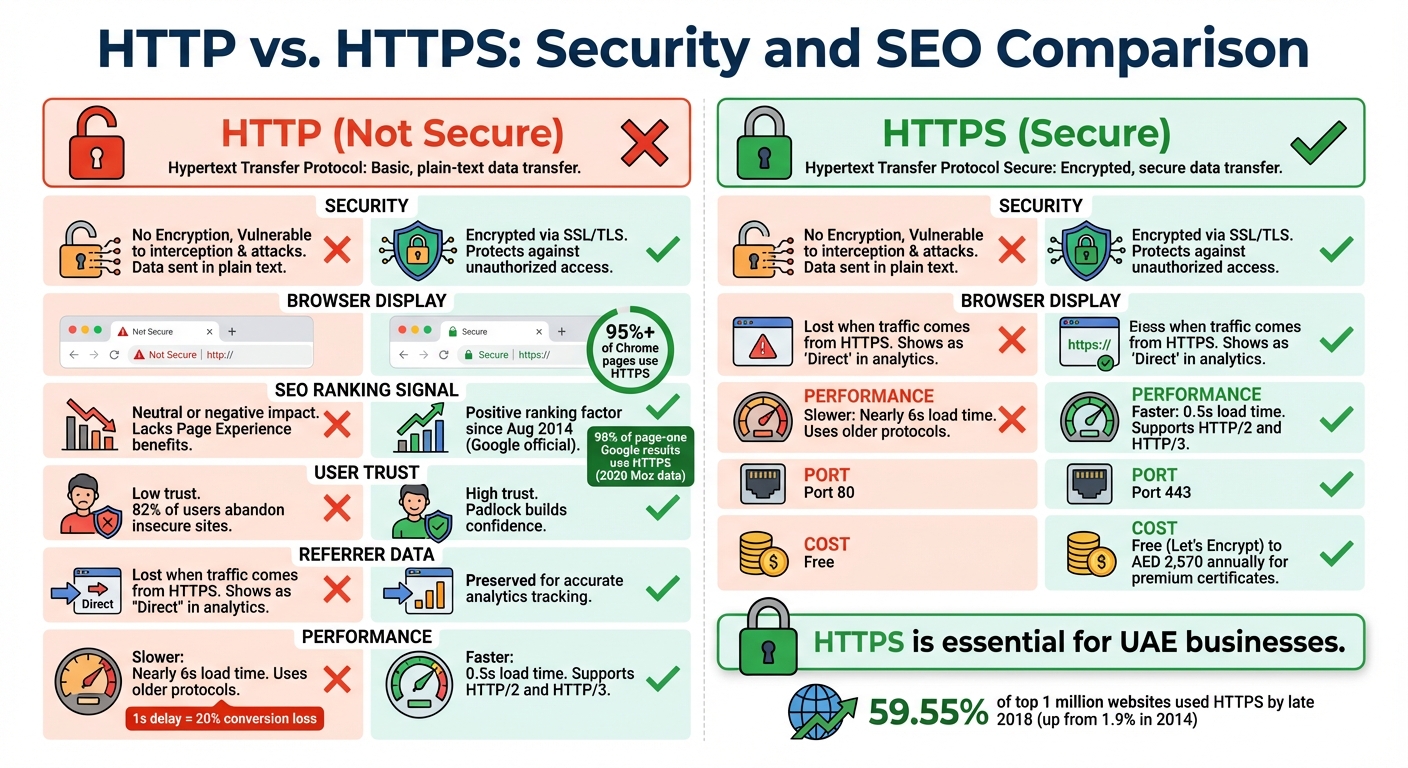
HTTP vs HTTPS Comparison: Security, SEO, and Performance Differences
When it comes to SEO and security, HTTP and HTTPS are worlds apart. While HTTP might seem appealing due to its free setup, it falls short in critical areas like security and SEO performance. HTTPS, on the other hand, offers clear advantages, boosting security, search engine rankings, and even analytics accuracy.
The shift toward HTTPS has been dramatic. Back in 2014, only 1.9% of the top one million websites defaulted to HTTPS. Fast forward to late 2018, and that number skyrocketed to 59.55%. This shift isn’t just about Google's ranking algorithm; it’s also about meeting rising user expectations for secure and trustworthy browsing.
For businesses in the UAE, understanding these differences is key when deciding on website infrastructure. Below is a table that outlines the major distinctions between HTTP and HTTPS:
Comparison Table: HTTP vs HTTPS
| Factor | HTTP | HTTPS |
|---|---|---|
| Security | Data sent in plain text; vulnerable to interception and attacks | Data encrypted via SSL/TLS; protects against unauthorised access |
| Ranking Signal | Neutral or negative; lacks Page Experience benefits | Positive; officially a Google ranking factor since 2014 |
| User Trust | Low; browsers display red "Not Secure" warnings | High; browsers show a padlock icon and "Secure" label |
| Referrer Data | Lost when traffic comes from HTTPS sites (appears as "Direct") | Preserved, allowing for more accurate analytics tracking |
| Performance | Slower; relies on older protocols | Faster; supports modern protocols like HTTP/2 and HTTP/3 for better speeds |
| Port | Uses Port 80 | Uses Port 443 |
| Cost | Free | Ranges from free (e.g., Let's Encrypt) to AED 1,835+ annually for premium certificates |
One area where HTTPS truly stands out is performance. Speed tests have shown that HTTP versions of websites can take nearly six seconds to load, while their HTTPS counterparts load in just 0.5 seconds. And speed matters - a one-second delay can slash conversions by up to 20%.
For UAE businesses aiming to enhance user experience and SEO rankings, HTTPS isn’t just an option - it’s a necessity.
Moving to HTTPS in the UAE
Switching to HTTPS is a smart move for businesses in the UAE. It involves choosing the right SSL certificate, making technical updates, and turning these changes into better search visibility and increased user trust.
SSL Certificate Pricing in AED
One of the first steps in moving to HTTPS is selecting the right SSL certificate for your needs.
SSL certificate prices in the UAE vary widely, from completely free options to those costing over AED 2,500 annually. Many UAE hosting providers include free SSL certificates - such as Let's Encrypt - with their hosting packages. These free certificates provide strong encryption but need to be renewed every 90 days.
For businesses that require extra features like warranties, site seals, or extended validation, paid certificates are available. Domain Validation (DV) certificates, often priced between AED 55 and AED 184 per year, are ideal for smaller websites like blogs or small businesses. Organisation Validation (OV) certificates, typically around AED 367 annually, verify your business details and are suited for corporate sites. For businesses needing the highest level of legitimacy, Extended Validation (EV) certificates cost between AED 363 and AED 2,570 per year. These display your business name directly in the browser, making them perfect for e-commerce, banking, or larger enterprises. If your site manages multiple subdomains, a Wildcard SSL - at about AED 327 annually - can save costs compared to buying separate certificates for each subdomain. Before purchasing a standalone certificate, check if your hosting provider already offers a free SSL option in your hosting plan.
How to Switch from HTTP to HTTPS
Migrating to HTTPS takes careful planning and a step-by-step approach. Start by backing up your website and setting up a staging environment to test changes safely. Next, choose an SSL certificate that matches your business needs - DV for basic sites, OV for added credibility, or EV for high-trust sites.
Once you've obtained your certificate, install it through your hosting control panel (like cPanel). Update your .htaccess file to include a 301 redirect, ensuring all HTTP traffic is directed to HTTPS. You'll also need to update internal links, canonical tags, schema markup, XML sitemaps, and robots.txt. Don’t forget to reconfigure Google Search Console and Analytics to reflect your new HTTPS property. To avoid mixed content issues, use relative URLs (e.g., /img.jpg instead of http://site.com/img.jpg). Finally, audit your site for any remaining HTTP elements and keep an eye on your traffic to catch any indexing problems.
"It's better to run through HTTP than to run through HTTPS with an expired SSL certificate!"
- Adrian Cojocariu, SEO Analyst, CognitiveSEO
These steps not only secure your website but also contribute to its overall performance and trustworthiness.
Return on Investment for HTTPS
Switching to HTTPS delivers more than just security - it directly impacts user behaviour, search rankings, and analytics accuracy. Since Google announced in 2014 that HTTPS is a ranking signal, websites with HTTPS enjoy better visibility. Plus, HTTPS ensures accurate tracking of marketing campaigns by maintaining HTTPS-to-HTTPS connections.
User trust is key to revenue. A staggering 82% of consumers abandon websites marked as insecure. By showing a padlock icon instead of a "Not Secure" warning, HTTPS keeps users on your site. It even helps with page speed - an essential factor for conversions, as every one-second delay can reduce conversions by up to 20%. For UAE businesses serving EU customers, HTTPS also supports compliance with GDPR requirements for secure data handling.
Whether you choose a free certificate or spend a few hundred dirhams annually, the benefits - better search rankings, faster performance, accurate analytics, and increased user trust - make the transition to HTTPS a worthwhile investment.
Conclusion
The decision between HTTP and HTTPS goes beyond technicalities - it's a business-critical choice that influences search engine rankings, user confidence, and, ultimately, revenue. HTTP leaves data vulnerable, triggers security warnings, and loses referral details. On the other hand, HTTPS encrypts data, displays trust indicators like the padlock icon, and ensures referral data remains intact for accurate analytics.
For businesses in the UAE, HTTPS isn’t optional. With Google factoring it into rankings and 82% of users abandoning insecure websites, adopting HTTPS is essential. It often serves as the deciding factor between competing sites, aligning with the broader Page Experience standards that search engines value.
Beyond security, HTTPS also improves site speed through HTTP/2 and safeguards referral data - key factors for e-commerce and customer engagement in today’s digital landscape.
Industry professionals reinforce these points:
"If you're investing in Technical SEO, switching to HTTPS should be one of your first milestones. It's foundational to everything else: structured data, crawlability, page speed, and more." - Louis Pretorius, Technical SEO Consultant, Louis Pretorius Technical SEO UAE
FAQs
How does using HTTPS benefit SEO in the UAE?
Using HTTPS offers clear advantages for SEO in the UAE, particularly by enhancing website security. This added layer of protection ensures user data is encrypted, making it safer from potential threats. In turn, this builds trust with your audience, encouraging them to return to your site.
Moreover, Google uses HTTPS as a ranking signal, giving secure websites an edge in search engine results. For businesses in the UAE's competitive, digital-first landscape, this can be a game-changer. By adopting HTTPS, you not only prioritise user safety but also boost your SEO efforts and establish stronger credibility.
What impact does switching to HTTPS have on SEO and website performance?
Switching to HTTPS boosts your website's security by encrypting data, safeguarding user information, and maintaining data integrity. This step not only strengthens user trust but also aligns with search engines' preferences - platforms like Google favour secure websites in their rankings.
In addition, HTTPS contributes to a better user experience by offering a secure browsing environment. This is particularly important in the UAE, where online trust holds significant value. By implementing HTTPS, your website is more likely to attract and retain visitors while also improving its visibility in search results.
How can I safely migrate my website from HTTP to HTTPS for better SEO?
Migrating your website from HTTP to HTTPS is a crucial step to boost security, build user confidence, and maintain strong SEO performance. Here's how you can make the switch:
- Get an SSL/TLS certificate: Start by obtaining a valid SSL certificate for your domain. This is what enables the encryption needed for HTTPS.
- Install the certificate: Configure the certificate on your web server and double-check that it’s been activated correctly.
- Update your URLs: Ensure all internal links, images, and scripts use HTTPS. This helps prevent mixed content issues, which can break functionality or reduce trust.
- Set up 301 redirects: Redirect all HTTP URLs to their HTTPS counterparts. This step is key for preserving SEO rankings and ensuring users land on the secured version of your site.
- Update sitemaps and robots.txt: Submit an updated sitemap to search engines and make sure all references in robots.txt point to HTTPS.
- Test and monitor: After migration, look out for errors like mixed content or SSL certificate issues. Keep an eye on your site’s performance to ensure everything runs smoothly.
Making this transition carefully helps secure your site, builds trust with users, and keeps your SEO intact.