
Blog / How Predictive Models Improve ROAS
How Predictive Models Improve ROAS
Predictive models are transforming advertising by helping businesses maximise their return on ad spend (ROAS) through data-driven strategies. With advertising costs rising sharply - Meta's CPM up 61% and Google's programmatic display CPMs climbing 75% - these models are a game-changer in high-cost markets like the UAE. Here's how they work:
- Data Analysis: Predictive models analyse historical data (e.g., demographics, behaviours, transactions) to forecast customer actions.
- Advanced Techniques: Methods like look-alike modelling, classification, and uplift modelling identify high-intent users and optimise ad spend.
- Real-Time Adjustments: Smart bidding algorithms distribute budgets effectively, ensuring campaigns meet ROAS goals.
- Seasonal Insights: Models adapt to UAE-specific trends, such as Ramadan and Eid, to predict demand and optimise targeting.
- Creative Evaluation: They assess ad elements - like visuals and copy - to predict which will deliver the best results.
Analytics Advantage: Unlocking the Power of Predictive Analytics
How Predictive Models Improve ROAS
Predictive models take the guesswork out of decision-making by analysing vast amounts of data in real time. They pinpoint profitable opportunities before you spend a single dirham, helping you achieve higher returns while minimising wasted budget.
Automated Bidding and Budget Distribution
Smart Bidding algorithms can process millions of bids per second across campaigns. These systems rely on contextual signals - like device, location, time, browser, and operating system - to predict the likelihood and value of conversions. When trends dip below your target ROAS, the algorithms automatically lower bids, ensuring your budget is spent wisely.
Uplift modelling plays a key role by evaluating whether ad costs are justified by projected revenue. Meanwhile, cross-platform allocation frameworks optimise your budget distribution across platforms like Facebook and Google Ads, funnelling your dirhams into the campaigns that deliver the best performance.
| Business Goal | Smart Bidding Strategy | Predictive Mechanism |
|---|---|---|
| Increase sales/leads | Maximise conversions / Target CPA | Predicts conversion rates using contextual signals |
| Increase profit/ROAS | Maximise conversion value / Target ROAS | Estimates conversion value and probability at auction time |
| Increase awareness | Maximise clicks / Target impression share | Adjusts bids to balance budget and visibility |
These automated systems also enhance audience targeting, creating a seamless approach to improving campaign outcomes.
Better Audience Targeting
Predictive models go beyond basic budget optimisation by refining audience targeting. By analysing millions of behavioural signals, these models identify high-intent users that manual segmentation might overlook.
Uplift modelling pinpoints users who are influenced by ad exposure, helping to focus your efforts on those whose conversions are directly driven by your campaigns. This precision has allowed some campaigns to achieve results while targeting 75% fewer customers compared to traditional methods. Agencies leveraging predictive modelling for audience targeting have reported ROAS increases of up to 208%.
Additionally, these models integrate with attribution systems, enabling algorithms to optimise bids using data-driven attribution. This approach considers the entire customer journey, which is especially useful during key periods like Ramadan and Eid when consumer behaviour shifts significantly.
Predicting Creative Performance
Predictive models also evaluate the effectiveness of your creative assets. By analysing historical campaign data - such as visuals, copy, and messaging - they identify which elements are likely to deliver the highest ROAS. This insight allows you to refresh campaigns before performance declines by focusing on impactful keywords and visuals.
For example, "Key Insights" reports highlight specific text phrases or visual themes that drive strong returns. To ensure the accuracy of these creative models, it’s crucial to include descriptive variables in fields like "Ad Name" or "Ad Body" and to remove outliers from the ROAS column during data preparation. Clean, well-organised data leads to more reliable predictions and better campaign performance.
Steps to Implement Predictive Models
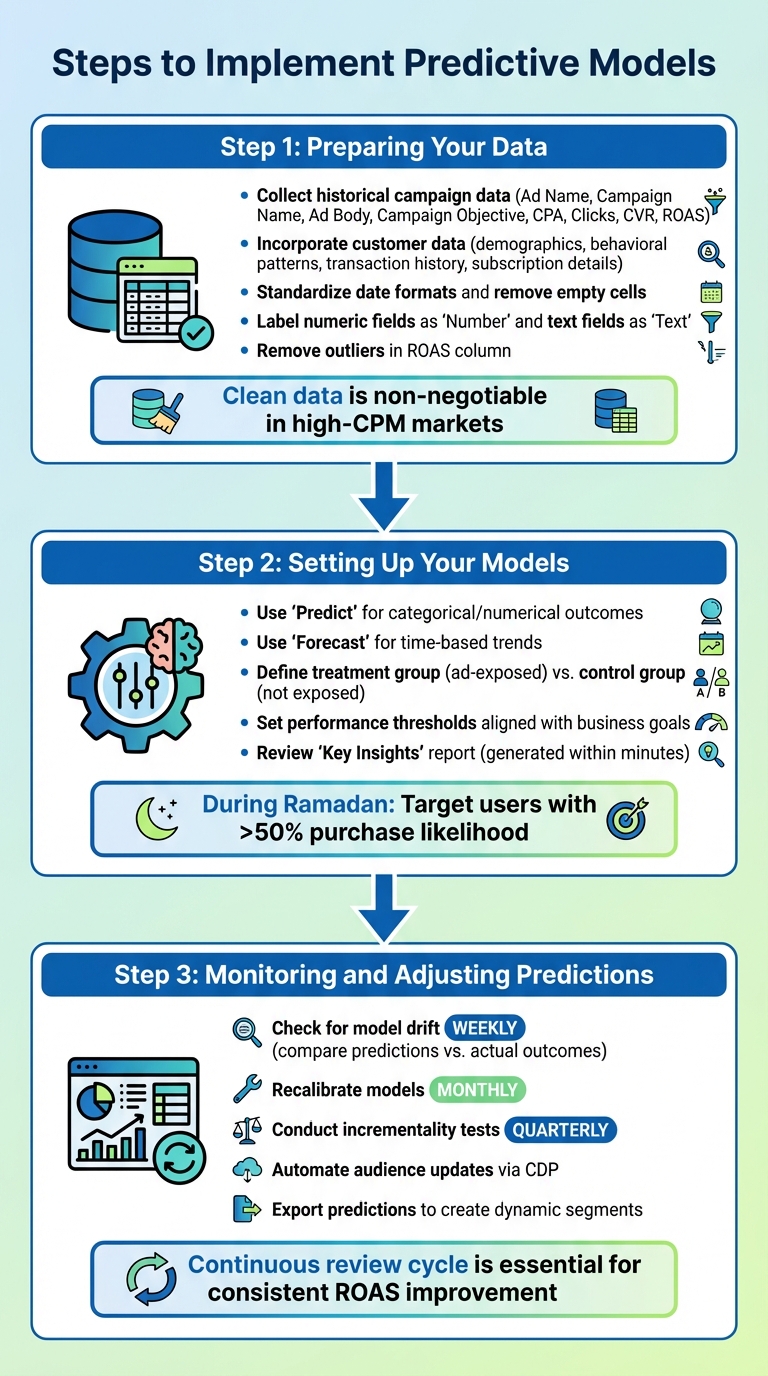
3-Step Process to Implement Predictive Models for ROAS Optimization
Preparing Your Data
The success of predictive models hinges on the quality of your data. Begin by collecting detailed historical campaign data, including key metrics like Ad Name, Campaign Name, Ad Body, Campaign Objective, CPA, Clicks, CVR, and ROAS. To gain a deeper understanding of your audience, incorporate customer data such as demographics, behavioural patterns, transaction history, and subscription details.
Clean data is non-negotiable. Standardise date formats, remove any empty cells, and ensure numeric fields are properly labelled as "Number" while text-based fields are marked as "Text" before importing the dataset. Be particularly cautious of outliers in your ROAS column, as these can distort your results and lead to inaccurate forecasts. In a market where CPMs are on the rise, maintaining clean data is essential for stretching every dirham effectively.
Setting Up Your Models
Once your dataset is well-prepared, the next step is to configure your predictive models. Use "Predict" for determining categorical or numerical outcomes and "Forecast" for analysing time-based trends. For uplift models, define two groups: a "treatment" group (users exposed to your ad) and a "control" group (users not exposed). This setup allows you to measure the actual lift in purchase likelihood.
Align your model's performance thresholds with your business goals. For example, during Ramadan, you might aim to target high-intent users by setting your model to prioritise audience segments with a predicted purchase likelihood above 50%. Once the model generates insights (usually within minutes), review the "Key Insights" report to identify which ad elements contribute most to improving ROAS.
Monitoring and Adjusting Predictions
After your models are live, regular monitoring is crucial to ensure they remain effective. Check for model drift weekly by comparing predictions against actual outcomes - consumer behaviour is always evolving, and your model must adapt to these changes. Recalibrate the models monthly and experiment with new variables, such as different creative approaches or geographic targeting, to refine performance further. Additionally, conduct incrementality tests quarterly to confirm that your predictive segments are genuinely driving revenue growth, rather than simply identifying users who would have converted without ad exposure.
To streamline this process, automate audience updates by exporting predictions into your Customer Data Platform (CDP). This enables the creation of dynamic audience segments that refresh in real time as new data is added. From initial data preparation to ongoing recalibrations, this continuous cycle of review and adjustment is essential for consistently improving ROAS.
sbb-itb-058f46d
Advanced Techniques for Better Predictions
Building on basic strategies, advanced methods can fine-tune prediction accuracy and help you achieve better ROAS.
Accounting for Seasonal Trends
To stay ahead in the UAE market, it's crucial to align your models with the region's unique seasonal patterns. For instance, Ramadan, White Friday, and the Dubai Shopping Festival are prime shopping periods that significantly influence consumer behaviour. Since Ramadan's timing shifts by 10–11 days annually due to the lunar calendar, your model must account for this variability instead of relying on fixed dates.
During Ramadan, online activity spikes after iftar (around 7:30 PM), reflecting a shift in shopping behaviours. Adjust your models to prioritise these evening hours when predicting engagement. For retail campaigns, preparation should start well in advance of key events. For example, Back-to-School search trends in the UAE begin as early as July, even though the peak occurs in late August.
Retailers like Carrefour use predictive analytics to anticipate demand during Ramadan and Eid by analysing purchasing trends, foot traffic, and seasonal habits. Additionally, UAE consumers often show 10–15% higher long-term value compared to other markets, so incorporating geographic weighting into your models is essential. These adjustments ensure your campaigns capture peak moments, directly boosting ROAS.
Combining Multiple Data Sources
Relying solely on campaign history limits your model's potential. Instead, pull data from all advertising platforms (such as Meta, Google, and TikTok), website analytics, and e-commerce tools like Shopify to understand how interactions on one platform influence conversions on another. Supplement this with external signals like search volume trends, auction insights, and competitor activity to go beyond internal data.
"By embracing a multifaceted measurement strategy that integrates AI-powered attribution, MMMs, and incrementality experiments - built on a foundation of first-party data - marketers can confidently navigate the evolving media landscape and drive ROI."
- Kamal Janardhan, Senior Director, Product Management, Analytics, Insights, and Measurement, Google
Marketers leveraging first-party data to enable AI have reported a 30% performance boost compared to those who don't. For example, Saudi Telecom Company (STC) combines customer engagement frequency data with real-time personalised offers delivered via digital ads and SMS to predict and reduce churn. Adding real-time signals - like consumer sentiment, trending Arabic hashtags, or social media activity - enables your models to respond quickly to shifts in behaviour. These layers of data provide a more comprehensive view, allowing you to optimise how credit is assigned across campaigns.
Optimising Attribution Windows
Your attribution window determines which interactions your model considers significant. A 1-day window might work for e-commerce, but longer sales cycles - like real estate or B2B - may require 7+ day windows to capture the full impact of ads. Misaligned windows can lead to blind spots; for example, 73% of advertisers relying on last-click attribution undervalue upper-funnel activities by 23–47%.
During high-intent periods like Ramadan or Eid in the UAE, consumers tend to convert more quickly. Temporarily shortening attribution windows during these times prevents over-crediting older interactions. Use tools like your platform's "Average days to conversion" report to fine-tune window lengths. When setting new bid targets, exclude the most recent 14 days of data to avoid distortions caused by time lags. Businesses that adopt AI-driven attribution models see an average 34% improvement in ROAS compared to those sticking with default settings.
| Attribution Model | Credit Distribution | Best Use Case |
|---|---|---|
| Last-Click | 100% to final touchpoint | Short sales cycles; direct response |
| Time-Decay | More credit to recent interactions | Sales cycles under 30 days |
| Position-Based | 40% to first/last; 20% to middle | Balances awareness and closing |
| Data-Driven | Algorithmic/Machine Learning | Complex journeys with high conversion volume |
When transitioning to a new attribution model or adjusting windows, run both the old and new systems in parallel for 14–30 days. This approach helps validate performance changes and ensures a smooth adjustment for your predictive models. Proper attribution ensures that the refined predictions from earlier techniques translate into smarter budget allocation and, ultimately, better ROAS.
Measuring Predictive Model Performance
Once you've implemented methods to optimise bids and targeting, it's time to determine if your predictive models are actually boosting your return on ad spend (ROAS). Without proper measurement, it's impossible to know if automation is delivering the results you expect.
Checking Prediction Accuracy
Start by comparing your model's predictions to actual campaign outcomes. Many platforms offer accuracy reports that show how often the model's forecasts align with real results. For instance, if your model predicts a 4.5× ROAS and the campaign achieves 4.2×, this suggests the model is performing well.
To further validate predictions, use incrementality testing. Divide your audience into exposed and control groups to see if the conversions were truly driven by your ads or would have occurred naturally. Set confidence thresholds to ensure the model only triggers automated actions when it’s highly certain. For example, you might only scale budgets when predicted ROAS surpasses your break-even point.
Once you've confirmed accuracy, the next step is to analyse how performance varies across different channels.
Evaluating Results by Channel
Different platforms respond differently to predictive optimisation. Measure incremental ROAS lift - the extra revenue generated by predictive models compared to traditional methods - for each channel. For example, in January 2024, LG Ad Solutions teamed up with Akkio to build custom predictive models for ad creatives. By analysing historical data to pinpoint effective visuals and copy, media buyers using the platform reported up to a 208% increase in ROAS. Akkio's "Chat Data Prep" tool played a key role by filtering out outliers and training models to predict outcomes based on specific creative elements like ad text.
Given that 8 out of 10 online purchases involve multiple touchpoints, cross-platform analysis is critical. Compare modelled ROAS (which includes AI-estimated conversions) with direct platform reports to identify discrepancies. For instance, advertisers using enhanced conversions for leads saw an 8% increase in conversions compared to those relying solely on standard offline conversion imports. This type of channel-specific evaluation ensures a more accurate understanding of your predictive model's impact.
Real-Time Performance Tracking
Once accuracy and channel-specific outcomes are assessed, focus on real-time tracking to maintain optimal ROAS. Monitoring campaigns continuously allows you to quickly identify high performers and address underperforming ones. Advanced platforms update predictions throughout the day, factoring in competitor actions and changing market conditions. This real-time adjustment helps you spot "breakout winners" to scale immediately or catch declining performance early.
"Thanks to experiments, you can identify where your modelled predictions differ from actual results, so you can take action and optimise your models for greater accuracy."
- Kamal Janardhan, Senior Director, Product Management, Analytics, Insights, and Measurement, Google
Set clear thresholds for action - for example, 60–70% for "Kill" and 120–140% for "Scale" - to make quick decisions. After increasing a budget based on a prediction, monitor the campaign closely for 72 hours to ensure acquisition costs remain stable. Marketers who leverage first-party customer data for AI tracking report a 30% performance lift compared to those who don’t. Real-time revenue tracking ensures you focus on actual business outcomes, not just proxy metrics like form submissions, translating your predictive models into tangible ROAS improvements.
Conclusion
Every step of your predictive model strategy - from gathering data to fine-tuning - has a direct impact on improving ROAS. Predictive models give UAE businesses the ability to anticipate results and optimise budgets before spending a single dirham. With advertising costs climbing - Meta's cost per thousand impressions up by 61% year-over-year and Google's programmatic display CPMs rising 75% - precision targeting has become more critical than ever.
Switching from reactive to proactive advertising strategies can lead to a 20% to 30% improvement in campaign performance. Real-world examples, such as Carrefour and STC, highlight how this approach has driven similar gains in their campaigns.
"First-party data is probably the most valuable asset a company can have. For people who haven't started building a strategy, do it as soon as possible."
- Marek Lacina, Performance Marketing Director, Invia
Success now hinges on blending AI-driven automation with human strategic guidance. Algorithms can manage real-time bidding and allocate budgets across channels, but your team plays a vital role in maintaining brand consistency and overseeing quality. This combination ensures efficiency while avoiding the pitfalls of over-reliance on algorithms. Prioritise auditing your data collection, adopt server-side tracking, and supply your models with high-quality first-party data to keep them effective.
Whether you're navigating seasonal trends, increasing ad costs, or fierce competition, predictive models provide the tools to maintain strong ROAS well into 2026 and beyond.
FAQs
How can predictive models boost ROAS in competitive markets like the UAE?
Predictive models play a key role in boosting Return on Ad Spend (ROAS) in high-cost markets like the UAE by enabling smarter targeting and more efficient budget use. By leveraging both historical and real-time data, these models can forecast trends such as increased demand during Ramadan or the Dubai Shopping Festival. This allows businesses to allocate their ad budgets in ways that maximise impact.
Through the analysis of audience behaviour, purchasing habits, and local preferences, predictive analytics help fine-tune campaigns to connect with the UAE's diverse audience. The result? Ads that reach the right people at the right time, cutting down on wasted spending and improving conversion rates. Armed with AI-driven insights, brands can adjust bidding strategies, prioritise high-value customer segments, and respond swiftly to seasonal or market shifts, ensuring they stay ahead in a competitive environment while driving better ROAS.
How does first-party data enhance predictive models for better ROAS?
First-party data plays a key role in refining the accuracy of predictive models, which can have a major impact on improving your Return on Ad Spend (ROAS). Unlike third-party data, this type of data is gathered directly from your audience through activities like website visits, social media interactions, or in-store purchases. Because it comes straight from the source, it provides richer and more precise insights into customer behaviour and preferences.
Using first-party data allows marketers to craft campaigns that are highly personalised and targeted. Since this data reflects actual customer interactions, it enables more accurate predictions about how customers will respond to campaigns. This means better budget allocation and sharper targeting. Plus, with increasing privacy regulations and the declining reliability of third-party data, first-party data offers a privacy-friendly and dependable way to maintain - and even improve - your ROAS.
How can businesses in the UAE optimise predictive models for consistent campaign success?
To keep predictive models effective for campaign success, businesses should prioritise frequent updates with high-quality, relevant data. This practice ensures predictions stay aligned with evolving market trends and consumer behaviour. For example, using real-time data can highlight changing audience preferences or seasonal trends, allowing for timely campaign adjustments.
Monitoring key performance indicators (KPIs) like return on ad spend (ROAS), cost per acquisition (CPA), and engagement metrics is equally important. Regularly evaluating these metrics - such as backtesting models against actual outcomes - can help spot inaccuracies or issues like model drift. Automated alerts for mismatches between predictions and actual results can further enable swift corrective measures.
In addition, advanced techniques like multi-touch attribution and dynamic budget adjustments allow campaigns to adapt quickly to market signals, enhancing overall returns. By combining consistent data updates, thorough performance tracking, and strategic refinements, businesses in the UAE can keep their predictive models effective and drive continued growth.