

Blog / How AI Powers Content-Based Recommendations
How AI Powers Content-Based Recommendations
AI-driven recommendation systems simplify decision-making by matching product features to user preferences. Globally, platforms like Amazon and Netflix generate a significant portion of their revenue through these systems - 35% of purchases and 75% of viewing, respectively. In the UAE, where consumer expectations are high, businesses increasingly rely on AI for personalisation.
Content-based filtering (CBF) focuses on item attributes, such as product descriptions or technical details, to deliver tailored suggestions. This approach excels at recommending new items by analysing metadata rather than relying on user reviews. AI enhances CBF by using machine learning, natural language processing (NLP), and large language models (LLMs) to identify patterns and improve accuracy. For example, NLP can extract key features from descriptions, while reinforcement learning updates recommendations in real time.
Businesses like Amazon and Gymshark use these techniques to personalise experiences, improve customer retention, and address challenges like the "cold-start" problem. Metrics such as precision, recall, and cosine similarity help measure recommendation quality. Emerging trends include generative AI and real-time updates, which refine recommendations further by considering factors like local weather or seasonal events, particularly relevant in markets like the UAE.
AI-powered recommendations offer measurable benefits, including increased revenue and improved customer satisfaction, making them essential for thriving in competitive markets.
Content-Based Recommendations - Recommender Systems Part 1
AI Algorithms That Power Content-Based Filtering
Every personalised recommendation you encounter stems from algorithms that transform metadata into actionable insights. These algorithms allow systems to deliver tailored suggestions at scale. Let’s dive into the key techniques that make this possible.
TF-IDF and Cosine Similarity for Analysing Metadata
TF-IDF (Term Frequency-Inverse Document Frequency) turns product descriptions into numerical vectors by assessing the importance of words. For example, a word that appears frequently in a specific product description but rarely across the entire catalogue becomes a strong identifier for that category.
Once these descriptions are vectorised, cosine similarity steps in to measure how closely a user’s preferences align with each product. It does this by comparing the angles between vectors, making it especially useful for handling complex datasets like text.
As Team Thinkstack puts it: "Content-based filtering is a recommender approach that personalises suggestions by modelling both items and users in the same feature space".
A practical example of this comes from Redis in January 2025. They showcased how a dataset of 25,000 IMDB films could be used to recommend movies. By leveraging a pre-trained HuggingFace language model, they generated semantic embedding vectors from film titles, descriptions, and keywords. These embeddings were stored in Redis, and vector similarity searches were used to recommend films like "20,000 Leagues Under the Sea" based on metadata rather than relying solely on genre tags.
Justin Cechmanek from Redis highlights: "The richer the metadata, the easier it is to implement content-based filtering and the better the results".
While vector-based approaches are powerful, additional methods further refine these recommendations.
k-Nearest Neighbours and Neural Networks
Proximity-based methods like k-Nearest Neighbours (k-NN) add another layer of precision. This algorithm identifies similar items by locating the closest "neighbours" in a multi-dimensional feature space. For example, if a user buys a high-quality camera, k-NN calculates the distance between that product and others using metrics like cosine similarity or the Jaccard coefficient.
Neural networks take things a step further by processing unstructured data, such as images, reviews, or product descriptions. Unlike traditional keyword-based systems, neural networks grasp nuanced semantic relationships. This means they can identify similar preferences even when different terminology is used.
These networks also adapt in real-time, updating recommendations based on a user’s ongoing interactions. This dynamic approach ensures that the system evolves alongside user behaviour, offering increasingly accurate suggestions over time.
Industry Applications and Use Cases
The algorithms discussed earlier come to life through various industry applications, showcasing how they reshape product discovery. Content-based filtering, in particular, has delivered notable results across both global giants and niche retailers, changing the way customers find and interact with products.
Amazon's Content-Based Approach
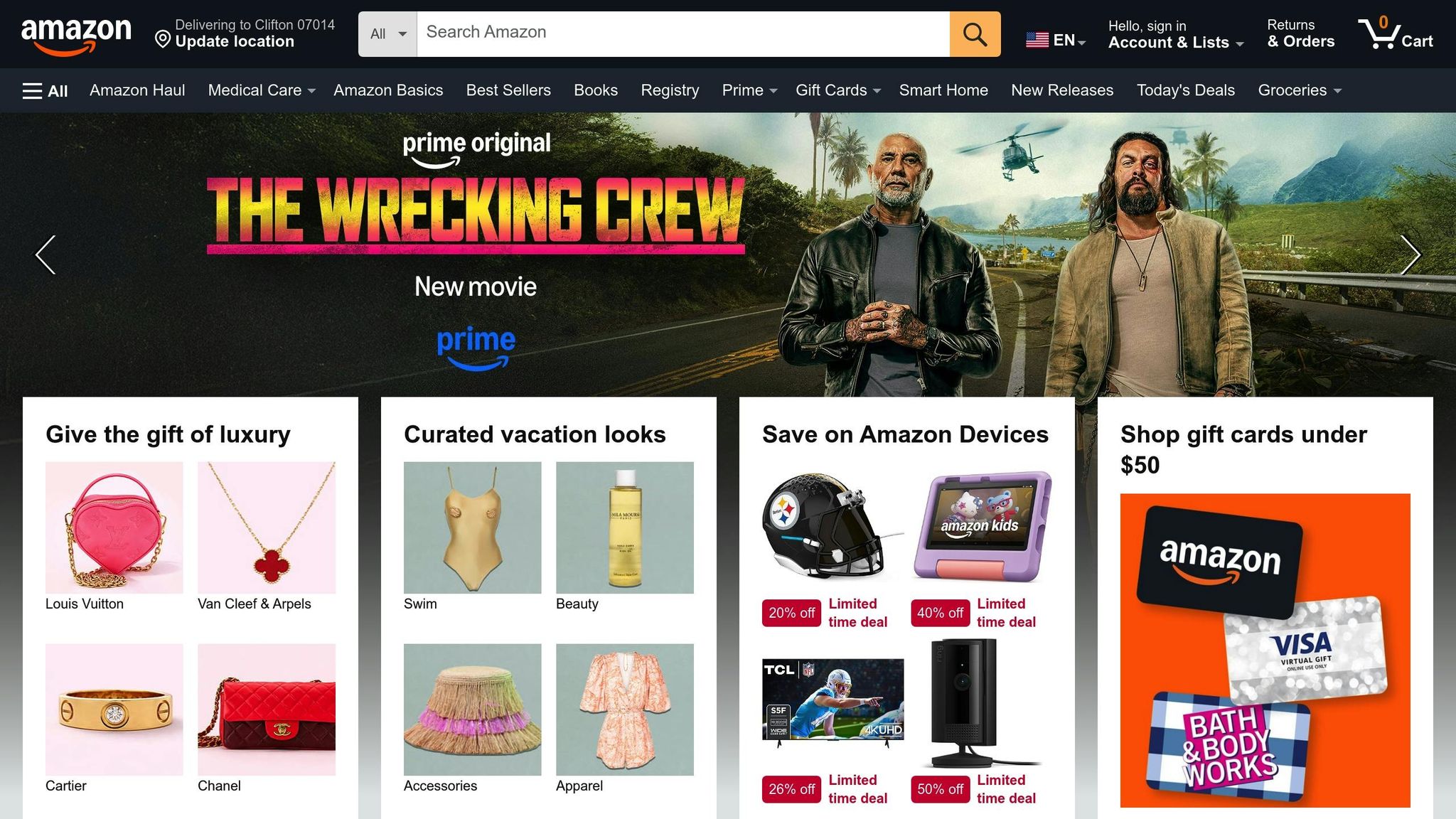
With a staggering catalogue of over 300 million products, Amazon relies heavily on personalised discovery to enhance user experience - it’s not just a feature; it’s a necessity. By analysing item metadata like genre, price, gender, and technical specifications alongside user behaviour (clicks, views, purchases), Amazon can deliver precise and relevant product suggestions.
In September 2024, Amazon took personalisation a step further with generative AI through Amazon Bedrock. Under Mihir Bhanot, Director of Personalisation, the platform introduced dynamic updates to product titles and descriptions. For instance, if a user searches for "gluten-free cereal", the AI adjusts the product description to prioritise the "gluten-free" attribute, even if it originally appeared at the end of the seller’s text.
"If the primary LLM generates a product description that is too generic or fails to highlight key features unique to a specific customer, the evaluator LLM will flag the issue", explains Mihir Bhanot.
Amazon also revamped its carousel titles, replacing generic labels like "Frequently bought together" with engaging, AI-generated themes such as "Morning essentials" or "Rise and shine" to capture user interest. These efforts underscore how AI-driven content-based recommendations can elevate the shopping experience. Similarly, smaller brands are using these methods to cater to their niche audiences effectively.
Examples from Gymshark and Shopcast
Content-based filtering shines in specialised markets where unique attributes are key. For instance, when a customer browses digital cameras, the system zeroes in on technical details - like mirrorless technology, 4K recording capabilities, and sensor size - offering highly specific recommendations rather than generic options.
This precision aligns with consumer expectations: 71% of shoppers want tailored experiences, and 45% are willing to switch brands if those expectations aren’t met. For new products, content-based filtering tackles the "cold-start" problem by focusing on metadata and intrinsic product characteristics, bypassing the need for extensive user interaction data.
Moreover, real-time adaptation ensures recommendations stay relevant as user preferences shift. Whether the focus is on fitness apparel or electronics, this dynamic approach keeps suggestions aligned with evolving customer needs, ensuring a seamless and engaging shopping journey.
sbb-itb-058f46d
Measuring Performance: Metrics and Research Findings
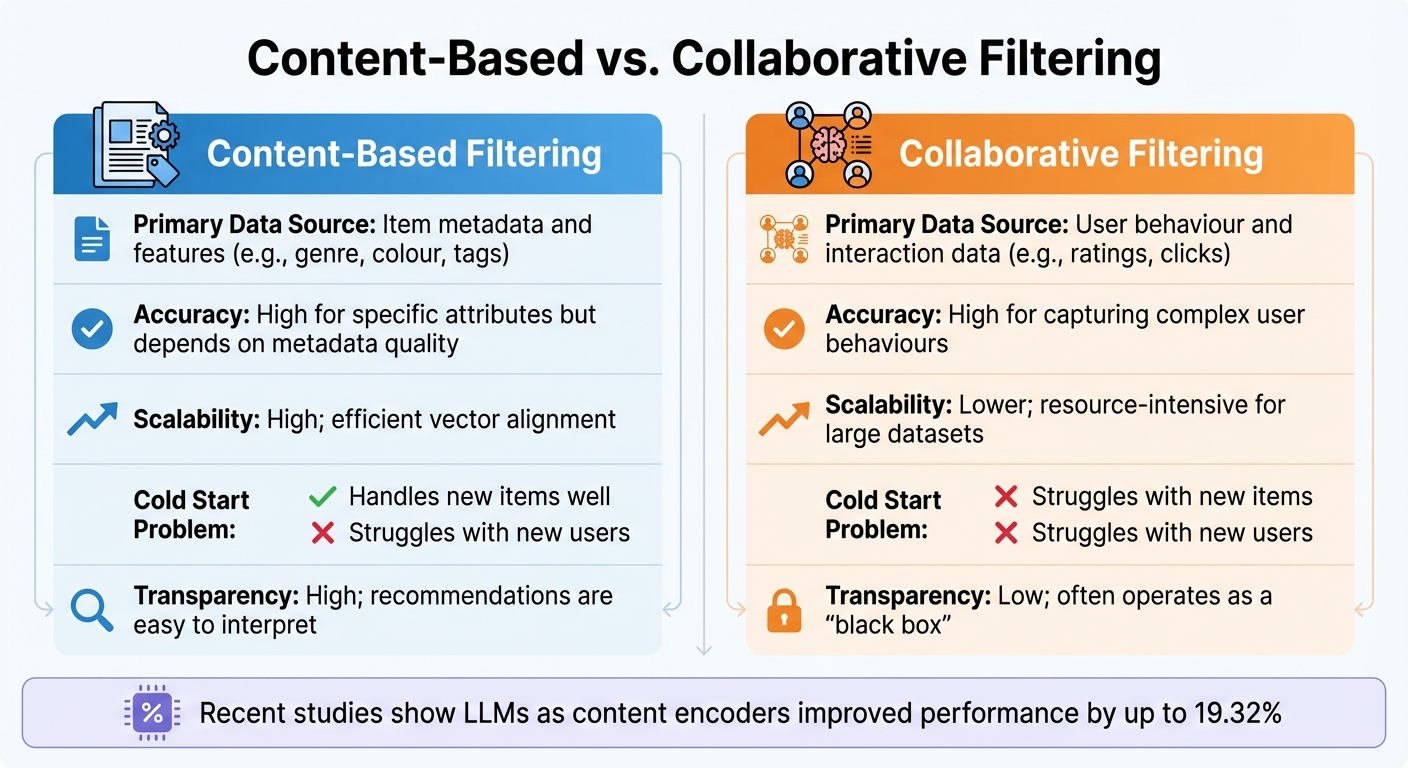
Content-Based vs Collaborative Filtering: Key Differences in AI Recommendation Systems
Evaluating AI algorithms isn't just about creating recommendations - it’s about assessing their quality and improving them over time. Performance metrics are the tools that make this possible.
Precision, Recall, and F1 Scores
Think of recommendations as a classification task: predicting what users will interact with based on an item’s attributes. To measure success, we use:
- Precision: The ratio of relevant recommendations to the total recommendations made.
- Recall: How well the system identifies all relevant items from the catalogue.
- F1 Score: A balance between precision and recall, calculated as their harmonic mean.
To go deeper, vector-based metrics help quantify how well user profiles align with item attributes:
- Cosine Similarity: Measures the angle between two vectors; a score closer to 1 shows higher similarity.
- Euclidean Distance: Calculates the straight-line distance between vectors; smaller distances indicate better matches.
- Dot Product: Combines angle and magnitude, making it especially useful for items with varying popularity.
Transparency also plays a huge role. By explaining recommendations through specific item attributes, users gain trust, and developers can pinpoint whether issues stem from poor metadata or algorithmic flaws.
With these metrics in place, we can better understand how content-based filtering compares to collaborative filtering.
Content-Based vs. Collaborative Filtering
Each recommendation method has strengths and weaknesses, and comparing them highlights their trade-offs.
Content-based filtering shines when it comes to new items, as it relies on metadata rather than user interaction history. This makes it a great solution for the "cold start" problem - at least for products. However, it often struggles with overspecialisation, offering recommendations too similar to what users have already seen, which limits novelty.
| Feature | Content-Based Filtering | Collaborative Filtering |
|---|---|---|
| Primary Data Source | Item metadata and features (e.g., genre, colour, tags) | User behaviour and interaction data (e.g., ratings, clicks) |
| Accuracy | High for specific attributes but depends on metadata quality | High for capturing complex user behaviours |
| Scalability | High; efficient vector alignment | Lower; resource-intensive for large datasets |
| Cold Start Problem | Handles new items well but struggles with new users | Struggles with both new items and new users |
| Transparency | High; recommendations are easy to interpret | Low; often operates as a "black box" |
A recent study found that using Large Language Models as content encoders improved performance by up to 19.32% compared to leading models. These advancements show how AI can enrich item representations, improving recommendation quality while keeping the transparency benefits of content-based systems intact.
Emerging Trends in Content-Based AI
The recommendation landscape is evolving with Generative Recommendation (GeneRec), where AI creates tailored content to meet individual needs dynamically. Moving beyond traditional reliance on passive feedback like clicks, modern systems now empower users to influence recommendations through natural language and multimodal inputs, such as voice commands, images, and videos.
Large Language Models like GPT‑4 have the ability to process unstructured data, uncovering precise user preferences from sources like product reviews, social media, and even song lyrics. This is especially relevant in the UAE, where AI must navigate the region's unique values and diverse consumer preferences in a market expected to grow significantly by late 2025. Moreover, these systems adapt in real-time, incorporating factors like local weather, time of day, and inventory levels to ensure recommendations remain relevant and contextually accurate. These advancements pave the way for more refined generative AI techniques that adjust and improve recommendations on the fly.
Generative AI and Real-Time Adaptation
Real-time adaptation leverages reinforcement learning to instantly update recommendations based on user interactions. This continuous refinement of user profiles addresses challenges like the cold start problem and data sparsity, which are common in fast-changing markets. These real-time updates ensure personalisation remains highly effective.
Context-aware AI takes things further by factoring in elements like local weather, time of day, and even the type of device being used. In the UAE, such technology is also being used to create localised marketing content, including videos and ads that reflect Middle Eastern aesthetics and values. Additionally, it proactively combats customer churn by offering tailored promotions. To ensure safety and compliance, new frameworks are also focusing on fidelity checks to uphold impartiality, authenticity, and adherence to regional regulations.
Wick's AI‑Driven Personalisation Framework
Wick has embraced these trends through its Four Pillar Framework, which incorporates advanced AI strategies. Wick's Tailor & Automate pillar combines marketing automation with AI-driven personalisation, blending content-based filtering with real-time contextual data to create adaptable digital ecosystems.
For businesses in the UAE, this approach offers significant advantages. Wick's multimodal interfaces make it easier for customers to communicate their needs using voice or images. The system also uses triggers like local weather conditions and key seasonal events - such as Ramadan or Black Friday - to deliver timely and relevant recommendations. Wick's strategy includes rigorous fidelity checks to address concerns around bias, privacy, and legal compliance. The result? Revenue increases of 5% to 15%, according to recent data.
Conclusion: The Impact of AI on Recommendation Systems
AI is reshaping how content-based recommendation systems work by using semantic understanding and analysing multimodal data like text, images, and audio. This allows these systems to interpret user intent more effectively and adjust in real time through continuous learning algorithms. These technical advancements are directly tied to measurable business outcomes.
For instance, 71% of shoppers now expect personalised experiences, and 45% are willing to switch brands if those expectations aren't met. A real-world example of AI's impact comes from Microsoft's Global Career Site, which reported a 1.6× boost in job application conversion rates after implementing an OpenAI-powered recommendation engine in February 2025.
The potential for businesses in the UAE is immense. AI-driven recommendation systems can address the region's diverse consumer base by considering factors like local holidays, different Arabic dialects, and seasonal events such as Ramadan. This creates more meaningful and relevant customer experiences. Additionally, with Abu Dhabi aiming to become "AI-native" across all digital government services by 2027, companies adopting these technologies are positioning themselves as leaders in the region's digital economy.
Generative recommendations and conversational interfaces further enhance these systems by providing clear, tailored explanations that foster trust through transparency.
As highlighted in an Artificial Intelligence Review study, "The unique reasoning abilities of LLMs enable them to capture the implied user intent based on the context, which traditional CF models often overlook".
The evidence is clear: AI-powered recommendations not only improve customer experiences but also drive revenue and address previous technical limitations. For businesses ready to embrace these tools, combining advanced algorithms, real-time adaptability, and an understanding of local nuances offers a strong foundation for thriving in competitive markets. These innovations, rooted in both technical precision and cultural awareness, represent the next step in the transformative journey explored in this study.
FAQs
How does AI enhance the precision of content-based recommendations?
AI improves the accuracy of content-based recommendations by examining the specific characteristics of each piece of content and aligning them with individual user preferences. Using machine learning algorithms, AI detects patterns in user behaviour - like browsing habits or previous interactions - to offer tailored suggestions that resonate.
What’s more, these systems get smarter over time. By learning from fresh data, they refine their recommendations, keeping them precise and personalised. This dynamic approach enables businesses to create a smooth and engaging experience for their audiences, strengthening relationships and boosting overall growth.
What are the main challenges of content-based recommendation systems, and how does AI help overcome them?
Content-based recommendation systems come with their own set of challenges. One of the biggest hurdles is the cold-start problem. This happens when there's not enough data about new users or items, making it tricky to offer personalised recommendations. A common way to tackle this is by blending content-based filtering with other methods, such as collaborative filtering, to tap into broader user behaviour patterns.
Another issue is data sparsity, where limited information about items makes it hard to draw meaningful connections. AI-driven techniques, like advanced feature engineering and deep learning, help overcome this by extracting detailed item attributes and improving the accuracy of matches. On top of that, user preferences can evolve over time, and dynamic AI models are designed to keep up by analysing shifting behaviours and trends.
Finally, there's the challenge of diversity and serendipity. Content-based systems can sometimes offer recommendations that are too predictable or narrow. Hybrid approaches step in here, adding variety and helping users discover unexpected yet relevant options. Thanks to advancements in AI, these systems are becoming increasingly refined, delivering more tailored and engaging experiences.
How do AI-driven recommendation systems benefit businesses in the UAE?
AI-powered recommendation systems are transforming how businesses in the UAE connect with their customers, offering tailored experiences that drive engagement and satisfaction. By examining user preferences and behaviour, these systems can suggest products, services, or content that align with individual interests. For example, an e-commerce platform might recommend items based on a customer’s browsing or purchase history, which not only boosts sales but also strengthens customer loyalty.
Beyond personalisation, these systems improve efficiency in operations. They help businesses spot trends, fine-tune inventory management, and target marketing campaigns more effectively. With the recommendation engine market set to grow rapidly in the coming years, UAE businesses have an opportunity to embrace these technologies. Doing so will keep them competitive while supporting the country’s push towards digital transformation, encouraging progress and sustainable development.