
Blog / How 5G Changes Mobile Marketing in GCC
How 5G Changes Mobile Marketing in GCC
5G is transforming mobile marketing in the GCC by enabling faster speeds, ultra-low latency, and massive IoT connectivity. With over 26 million 5G users by early 2024 and a projected 99 million connections by 2030, businesses in the region are leveraging this technology to deliver immersive experiences, real-time personalisation, and high-quality content like 4K videos and AR. Key highlights include:
- Immersive Content: 5G supports seamless delivery of 360° videos, virtual try-ons, and interactive AR/VR experiences.
- Real-Time Engagement: Ultra-low latency enables instant responses for ads, chatbots, and geo-fencing triggers.
- IoT Integration: Smart devices, wearables, and connected vehicles create new marketing touchpoints.
- Data-Driven Personalisation: AI-powered tools analyse user behaviour in milliseconds for tailored campaigns.
With GCC countries leading global 5G adoption, marketers must ensure their tools and strategies are optimised for this advanced network. This includes upgrading infrastructure, enhancing real-time capabilities, and embracing new content formats to stay competitive in a rapidly evolving digital landscape.
Pioneering 5G Advanced Experience Monetization in GCC
sbb-itb-058f46d
Evaluating Your Mobile Marketing for 5G Compatibility
Before diving into 5G-optimised campaigns, it's essential to ask yourself: can your current marketing setup handle the demands of 5G? With the GCC expected to reach 99 million 5G connections by 2030 - accounting for 95% of all mobile connections - this is the perfect time to audit your systems. A thorough evaluation ensures your marketing stack can handle data-heavy content, ultra-low latency, and connectivity with IoT devices, giving you the foundation to make the most of 5G's potential.
Reviewing Your Current Campaigns and Tools
Start by taking a closer look at your Content Delivery Networks (CDNs) and ad servers. Are they equipped to deliver 4K videos, 360° virtual tours, and AR assets without hiccups? With 5G trials showing speeds of up to 10 Gbps, your infrastructure needs to support these high-quality, data-intensive formats. If your systems are still optimised for older networks, you might already be falling behind in a region where legacy networks are being phased out.
Next, test your real-time engagement tools for latency issues. Features like interactive billboards, geo-fencing triggers, and chatbots must operate within the ultra-low latency thresholds that 5G offers. Customers now expect lightning-fast interactions, and your tools should deliver. Also, confirm that your automation systems are compatible with modern 4G/5G devices and VoLTE-enabled hardware, especially as the GCC continues to phase out 3G services.
Don't overlook IoT and edge computing capabilities. Can your platforms handle data from smart home devices, wearables, or connected vehicles? In Saudi Arabia, businesses report an average ROI of just 3.3 years for IoT adoption. Your analytics tools should support edge computing to enable real-time, localised personalisation - an essential feature as the region moves towards 5G-Advanced networks.
Finally, remember that updating your technical infrastructure is only one piece of the puzzle. Your customer touchpoints also need to evolve to fully embrace 5G's capabilities.
Updating Customer Journeys for 5G Interactions
Customer journeys must now be built for real-time, zero-latency experiences. Eliminate any "wait states" - users on 5G expect instant app responses and chatbot interactions. With 80% of mobile data traffic in the GCC predicted to run on 5G networks by 2026, it's time to move beyond static images and embrace formats like high-resolution video and AR. These immersive updates align with the region's shift toward richer, more engaging mobile experiences.
But don't stop at smartphones. Expand your journey maps to include IoT touchpoints like smart home devices, wearables, and connected vehicles. Using Wick's "Capture & Store" pillar, you can redesign journeys to collect and integrate data from these sources, creating a comprehensive view of customer behaviour. This is especially relevant in markets like the UAE and Saudi Arabia, where smartphone penetration exceeds 90%, and mobile shopping is on the rise - 67% of UAE shoppers and 66% of Saudi shoppers now make purchases via mobile devices.
To further refine your strategy, consider implementing network slicing for high-value customer segments. Gamers and remote workers, for example, need specific guarantees for speed and latency - something 5G-Advanced can deliver. With enterprise spending on digital transformation projected to average 9.9% of revenues between 2025 and 2030, investing in infrastructure that supports tailored experiences could give your campaigns a competitive edge over those still relying on outdated networks.
Using 5G for High-Quality Content and Interactive Experiences
With 5G, businesses in the GCC region have a powerful tool to drive engagement and boost ROI. This advanced network technology enables the delivery of high-definition, immersive content like never before. Consider this: 57% of consumers are most excited about higher definition content as a 5G benefit, while 54% are eager for better video streaming quality. With speeds reaching up to 10 Gbps, 5G makes it possible to offer seamless 4K visuals, 360° immersive videos, and high-resolution 3D assets - all without buffering. These capabilities open the door to entirely new content formats and interactive experiences.
Developing AR, VR, and 360° Video Content
5G is transforming how AR and VR are delivered, shifting the heavy processing tasks to the network through cloud-based solutions. This makes immersive experiences accessible on standard 5G-enabled smartphones. The numbers back this up: AR technology is expected to grow at a 39.8% CAGR from 2023 to 2030, and by 2025, 75% of the global population - nearly all smartphone users - are likely to use augmented reality regularly.
Real-world applications are already making waves. In 2024, Ooredoo Kuwait utilised 5G-Advanced mmWave to provide immersive fan experiences at live events, offering real-time stats and interactive AR content without lag. Similarly, du in the UAE introduced AR and VR into virtual classrooms and finance, creating interactive learning spaces and personalised banking solutions. Even retail is embracing this shift - Gucci teamed up with Snapchat to create a 5G-powered AR experience where users could virtually try on shoes and purchase them directly through the app.
The infrastructure behind these innovations is just as critical. Zain KSA and Nokia collaborated to develop 5G Cloud RAN solutions, enabling ultra-low latency AR experiences. With latency reduced to milliseconds, earlier issues like motion sickness in VR are now a thing of the past . Combined with edge computing, this setup allows data processing closer to users, enabling real-time responses for applications like interactive billboards or in-store AR displays . For all these advancements to shine, websites and apps need to adapt to handle 5G traffic effectively.
Preparing Websites and Apps for 5G Traffic
To fully capitalise on 5G, businesses must ensure their websites and apps are ready for the increased bandwidth and reduced latency it offers. Start by reworking app architecture and upgrading back-end systems to support real-time data synchronisation and advanced 5G features. Incorporate APIs that leverage 5G capabilities, compress data for optimised graphics, and maintain efficient coding practices to ensure responsiveness across devices.
Using Wick's "Build & Fill" pillar, businesses can use 5G’s high bandwidth to enrich their digital platforms with features like 4K videos, interactive 3D banners, and 360° virtual tours - all while ensuring the infrastructure can handle the load . However, latency figures, such as 76 ms in Qatar and 75 ms in the UAE, highlight areas for improvement, especially for users roaming across borders, where UAE travellers experienced a 2.3x drop in download speeds compared to their home network.
"5G technology is more than just an upgrade in speed; it's a transformative force for data processing and connectivity." - AdEngage
To ensure apps perform well under high-traffic conditions, test them in environments like shopping malls or live events. With 84% of consumers saying they’re convinced to buy after watching a brand’s video, investing in high-quality multimedia content isn’t just a good idea - it’s essential in today’s mobile-first market.
Setting Up Real-Time Personalisation with AI and Edge Computing
The ultra-low latency of 5G is revolutionising how businesses deliver personalised experiences. With edge computing, data can be processed locally - whether at Dubai Mall or Riyadh Park - allowing AI to react in milliseconds. This rapid processing means AI can analyse customer behaviour and act almost instantly. The financial impact is clear: GCC telecom operators can earn up to AED 21.65 in EBITDA for every AED 3.67 spent on AI-powered marketing personalisation engines.
However, most operators only utilise 30%–50% of their available data. To tap into the full potential of AI, businesses need to adopt a structured approach. Strategy& Middle East outlines a four-layer framework for this: a unified Data Foundation that brings together real-time location and usage data, a Cognitive Marketing Core to predict behaviour, targeted Value Pools for specific use cases like upselling, and seamless Activation across all communication channels. This framework supports a shift towards real-time, data-driven marketing in the GCC.
"Consumers expect real-time and personalised engagement, yet most operators underperform on delivering this due to underutilised data sets, gaps in precision marketing capabilities and operating models that hinder collaboration." - Mahmoud Makki, Partner, Strategy& Middle East
This shift is evident in the region. As of early 2026, 39% of enterprises in the MENA region report advanced use of generative AI. Meanwhile, 22% of 5G users in the UAE are willing to pay 10% more for guaranteed performance on latency-sensitive applications. This reflects a growing expectation for guaranteed performance, especially for activities like live shopping and augmented reality.
Creating Dynamic Ads That Respond to User Behaviour
With enhanced data processing, businesses can now create dynamic advertising systems that adapt in real time. For GCC companies embracing 5G, moving from broad targeting to precise, data-driven interactions is essential. AI-powered ad systems can analyse immediate user actions - such as browsing a product or spending extra time near a store - and adjust the creative, offer, or call-to-action instantly.
The benefits are clear. AI-driven campaigns can double or even triple conversion rates. A great example comes from Panera Bread, which in April 2024 used an AI-powered decision engine to personalise its menu offers. This resulted in over 4,000 unique combinations of offers delivered via email, app, and web, leading to a 5% increase in retention among at-risk customers, a twofold rise in loyalty redemptions and purchase conversions, and over 50 hours saved in manual work.
For GCC businesses, this approach enables hyper-personalisation. Imagine a luxury retailer in Dubai offering tailored product recommendations to two customers standing in the same aisle, based on their browsing history and real-time behaviour. Connected billboards in smart cities can even respond to spoken queries, bridging physical advertising with mobile personalisation.
To achieve this, businesses need to integrate various MarTech systems into a unified platform. By consolidating data from real-time location tracking, usage patterns, and IoT sensors, companies can build a comprehensive customer view. This allows AI to deliver actionable insights instantly, anticipating customer needs before they’re even expressed.
Running Live Shopping and Location-Based Campaigns
Live shopping and location-based campaigns take personalisation a step further, leveraging 5G to create immediate, context-aware experiences. Live shopping, for instance, has redefined how GCC customers interact with brands. Thanks to 5G’s high bandwidth, users can enjoy 4K streaming and interactive video ads, clicking on products during live broadcasts without any buffering - an essential feature for the UAE’s luxury retail sector.
Location-based triggers have also become more precise with 5G. Instead of using simple radius-based targeting, businesses can now employ isoline mapping to define trade areas based on actual travel times, such as a 10-minute drive zone. This precision is particularly useful in the GCC, where factors like extreme summer heat drive people indoors, and mobility patterns are influenced by prayer times and Ramadan schedules.
Real-world examples highlight the potential. Too Good To Go used real-time behavioural data to notify users when "Surprise Bags" of surplus food were available nearby, boosting purchases by 135% and doubling message conversion rates. Similarly, Luxury Escapes dynamically displayed member benefits based on live subscriber status, exceeding its membership signup goal by 42% and achieving a 100% increase in click-through rates in just one month.
For businesses in busy locations like Dubai Mall or The Avenues in Kuwait, the opportunity is immense. By setting up systems that respond to live behavioural signals - such as a user nearing a store or hitting a data usage limit - companies can use in-store sensors and connected infrastructure to send instant, relevant mobile notifications. To meet the demands of generative AI and augmented reality, these systems must also be equipped to handle high data transfer speeds and low latency requirements.
"For GCC telcos, adopting AI-driven marketing is no longer optional – it's a strategic imperative to remain relevant, competitive, and connected to what customers truly want." - Ankit Kushwaha, Principal, Strategy& Middle East
Combining IoT and 5G for Location-Based Marketing
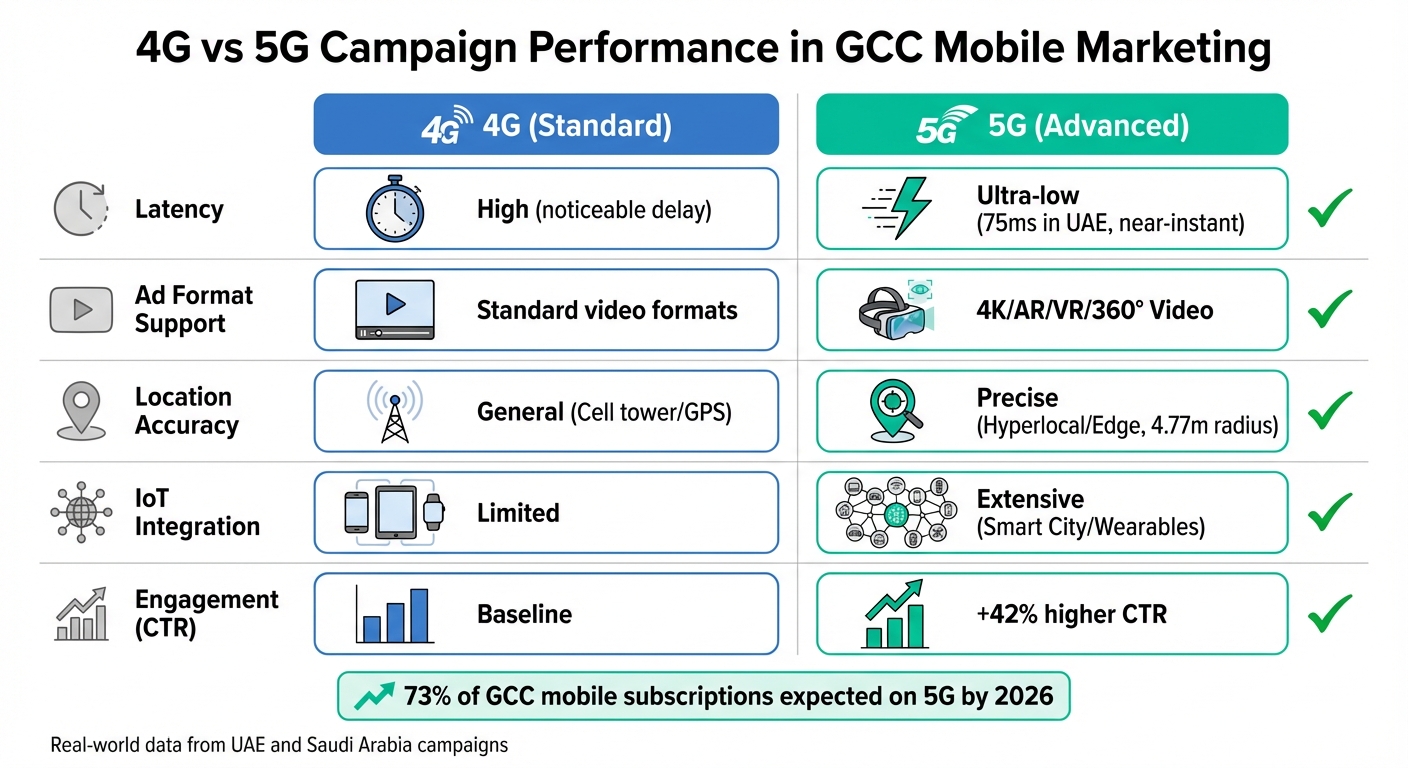
4G vs 5G Mobile Marketing Performance Comparison in GCC
The pairing of 5G and IoT is reshaping how businesses connect with customers in the GCC's rapidly developing smart cities. With 73% of all mobile subscriptions in the region expected to rely on 5G by 2026, the technology is enabling a vast IoT network that powers ultra-localised marketing campaigns. Unlike 4G, which struggles under heavy network traffic, 5G can support thousands of connected devices simultaneously without compromising performance.
In Saudi Arabia, businesses report a 3.3-year ROI on IoT investments, driven by the region's ambitious digital strategies. With digital spending projected to average 9.9% of revenues between 2025 and 2030, cities like Dubai, Riyadh, and Doha are embedding the infrastructure for advanced location-based campaigns into their urban designs. These IoT advancements are setting the stage for marketers to use smart city frameworks to deliver hyper-contextualised campaigns.
"MENA has become a global benchmark for digital transformation. Businesses here are deploying 5G, AI and IoT at a faster pace than many developed markets, fuelled by visionary government strategies." - Jawad Abbassi, Head of MENA, GSMA
Leveraging Smart City Infrastructure for Marketing Triggers
With 5G's enhanced connectivity, smart city infrastructure enables marketers to create real-time, highly tailored triggers that align with advanced personalisation strategies. In Downtown Dubai, for example, connected billboards can respond to voice commands via virtual assistants, delivering customised information directly to nearby mobile devices. Similarly, smart kiosks in areas like Jumeirah Lakes Towers provide interactive services 24/7. Even IoT-enabled parking sensors and public transport systems generate real-time data that marketers can use to send timely, location-relevant messages.
Geo-fencing powered by 5G takes targeting to a new level. Marketers can now focus on dwell time - the duration someone spends at a location - rather than simply tracking their movement. This approach is a stronger indicator of purchase intent. Advanced tools even allow for targeting competitor locations with precision, such as delivering offers to customers within a 4.77-metre radius. A 2025 Ramadan campaign by a GCC retailer demonstrated this potential. Using MEmob+'s AllPings location data and 5G-optimised creative assets, they transformed a single guide into geo-personalised ads and interactive WhatsApp chatbots. The results? A 42% higher click-through rate (CTR) compared to the previous year and a 28% increase in verified in-store visits.
For businesses aligned with initiatives like Saudi Vision 2030 and the UAE's Industry 4.0, the potential extends beyond retail. Platforms like Dubai Pulse centralise data from smart city sensors, allowing marketers to trigger offers when customers enter a specific 500-metre radius - or even a particular aisle in a mall. This level of precision ensures messages are delivered instantly and effectively.
Comparing 4G and 5G Campaign Performance
The leap from 4G to 5G is transformative for location-based marketing. While 4G often struggles with delays between a user's location and message delivery, 5G offers near-instant responsiveness, with median latency as low as 75 ms in the UAE. This speed is crucial for time-sensitive campaigns, such as promoting a lunch deal to people within walking distance of a restaurant.
| Metric | 4G Performance | 5G Performance |
|---|---|---|
| Latency | High (noticeable delay) | Ultra-low (near-instant) |
| Ad Format Support | Standard video formats | 4K/AR/VR/360° Video |
| Location Accuracy | General (Cell tower/GPS) | Precise (Hyperlocal/Edge) |
| IoT Integration | Limited | Extensive (Smart City/Wearables) |
| Engagement (CTR) | Baseline | Significantly higher |
The content possibilities also expand significantly. While 4G campaigns often rely on static images or low-resolution videos to avoid buffering, 5G supports seamless 4K videos, augmented reality (AR) experiences, and 360-degree tours on mobile devices. This opens the door to immersive experiences like virtual try-ons or interactive product demos triggered by proximity to a store.
"As increasing numbers of devices are plugged into 5G networks, enhanced connectivity and higher speeds will generate an enormous wealth of data. This will lead to new insights and functionalities through AI-powered analytics." - Essam Alshiha, CEO, Saudi Business Machines
For businesses aiming to take advantage of these advancements, the focus should be on creating high-resolution, engaging content that leverages 5G's capabilities. Integrating with smart city touchpoints allows campaigns to respond to real-time contexts, creating timely and relevant customer experiences. The shift from 4G to 5G isn't just about faster speeds - it's about reimagining how location data, IoT, and marketing work together to deliver impactful results.
Tracking and Improving 5G Campaign Performance
The rise of 5G has reshaped how businesses in the GCC evaluate marketing efforts. Traditional metrics like clicks and impressions no longer cut it for campaigns featuring AR product try-ons, 360° videos, or real-time location-based triggers. In the UAE and Saudi Arabia, advertisers are shifting towards outcome-based pricing models such as Cost Per Install (CPI), Cost Per Action (CPA), and Cost Per Lead (CPL). These metrics tie marketing budgets directly to measurable business outcomes, making it easier to justify expenditures and demonstrate ROI to stakeholders.
Metrics like Return on Ad Spend (ROAS) and Lifetime Value (LTV) are now central to evaluating campaigns, as they reveal long-term business impact. For immersive content, tracking interaction depth - how users interact with virtual product placements or gamified ads - has become essential. Tools like AppsFlyer, Adjust, and Kochava help businesses monitor real-time attribution and analyse cohorts, ensuring that only genuine value-driving channels are prioritised while filtering out fraudulent activities like bot installs or click flooding.
Key Metrics for 5G Marketing Campaigns
Using the right metrics is crucial for gauging the success of 5G campaigns. For immersive experiences, interaction depth measures user engagement, such as rotating a 3D product or navigating a virtual showroom. Session duration indicates whether high-bandwidth experiences hold user attention or lead to drop-offs. In location-based campaigns, hyper-local responsiveness - the time between a geo-fencing trigger and message delivery - directly influences conversion rates, with even slight delays impacting outcomes.
Metrics like ROAS (revenue generated per dirham spent) and LTV (long-term customer value) are critical for assessing the profitability of campaigns. Additionally, targeting smaller, micro-cohorts of a few hundred users can boost conversion rates by 2–3x. AI-powered tools for prospecting and dynamic pricing have further increased conversion rates by up to 15% for regional operators. Fraud detection remains a cornerstone of campaign success, with pre-install filtering, post-install validation, and partner scoring ensuring that budgets are used effectively.
"Marketing can no longer be seen as only a creative or brand-building function – it has to be a growth engine. Executives want conversion rates, not just narratives." - Wassim Derbi, Head of Strategic Marketing and Brand Communication, Hyundai UAE and Genesis UAE
Optimising Campaigns with Wick's Four Pillar Framework
To maximise campaign performance, Wick's Four Pillar Framework offers a structured approach:
- Data Foundation: This pillar focuses on creating a unified, 360-degree view of the customer by integrating real-time location data, usage patterns, and behavioural insights. Such a foundation is key for hyper-personalised targeting.
- Cognitive Core: By leveraging AI and advanced analytics, businesses can identify high-value customers before they convert. Predictive modelling and automated budget allocation help optimise spending. For instance, GCC telecom operators have seen returns of up to AED 21.67 in EBITDA for every AED 3.67 invested in AI-driven personalisation engines over five years.
- Value Pools: This pillar focuses on creating targeted use cases. For example, one GCC operator reduced expected customer churn by 40% to 60% by offering proactive resolutions after network outages.
- Activation: Ensuring the right message reaches the right audience at the right time, this pillar relies on marketing automation and personalisation strategies. It aligns with the GCC's "agility over perfection" mindset, where businesses test multiple campaign iterations simultaneously and refine them based on real-time performance.
Conclusion: Preparing Your Mobile Marketing for 5G
The move to 5G in the GCC is more than just faster internet - it's about reimagining how businesses connect with their audiences. With 73% of all mobile subscriptions in the region expected to use 5G by 2026, businesses need to act now. Companies sticking to static images and broad audience segments risk losing out to those embracing immersive AR, real-time engagement, and hyper-personalised experiences.
The GCC’s leadership in digital innovation is a double-edged sword. On one hand, it creates immense opportunities; on the other, it raises consumer expectations for instant, tailored interactions. The tools to meet these demands - like 4K video, 360-degree virtual tours, location-based triggers, and AI-driven micro-cohort targeting - are already available. However, success depends on investing in strong creative assets and a solid data infrastructure. This shift also calls for redefining mobile marketing success metrics, moving beyond clicks and impressions.
In a 5G-driven environment, traditional metrics won’t cut it. Instead, focus on interaction depth, session duration, and hyper-local responsiveness to gauge how effectively users engage with immersive content. Saudi Arabia is already seeing results from strategic 5G adoption, proving its potential as a game-changer. Think of 5G as a bridge that connects customer journeys seamlessly across devices.
To fully leverage the power of 5G, align your efforts with a structured approach. Wick’s Four Pillar Framework provides a clear path: from building a unified data foundation to scaling AI-driven personalisation. This framework can help you strategically utilise 5G to drive measurable growth. With enterprise spending on digital transformation averaging 9.9% of total revenues in the GCC, businesses are already investing in the future. As digital transformation accelerates, make sure your mobile marketing strategy is ready to seize the opportunities 5G offers.
FAQs
How can businesses in the GCC optimise their marketing tools for 5G technology?
To make the most of 5G technology, businesses in the GCC need to upgrade their digital infrastructure to keep up with its faster speeds, ultra-low latency, and improved connectivity. This means being ready to support high-resolution content like 4K videos, augmented reality (AR), and interactive experiences, which are now more accessible thanks to 5G's broader bandwidth.
In addition, using AI-driven personalisation and data analytics can create seamless, real-time, and customised cross-channel experiences for consumers. It's also important to adopt platforms that are designed to improve mobile app performance and fully leverage 5G capabilities. This ensures smoother user engagement and faster interactions across devices.
By aligning their marketing tools with the possibilities of 5G, companies can strengthen customer engagement and achieve better returns on investment in the fast-changing GCC market.
How does 5G enhance immersive content in mobile marketing?
5G technology is reshaping mobile marketing by offering faster speeds and ultra-low latency, which open the door to immersive, real-time experiences. This means businesses can now integrate AR (Augmented Reality) and VR (Virtual Reality) into their campaigns, creating highly interactive and engaging content that grabs attention like never before.
On top of that, 5G supports high-resolution formats such as 4K video, enabling brands to deliver visually striking, data-rich content directly to users' devices. These advancements make it easier for businesses in the UAE to reach larger audiences and keep them engaged, resulting in more impactful marketing campaigns.
How does 5G enhance the impact of location-based marketing campaigns?
5G takes location-based marketing to a whole new level by offering faster and more precise geolocation data. This means businesses can connect with their audience in ways that feel personal and timely, delivering messages and promotions tailored to where people are at any given moment.
With this advanced connectivity, marketers can share highly relevant content exactly when and where it matters most. Whether it’s a special offer as someone walks into a mall or a notification about nearby events, 5G ensures these interactions happen seamlessly. The added benefit? Enhanced analytics that allow businesses in the UAE to make smarter decisions, like choosing the best locations for their stores or fine-tuning strategies to get the most out of their marketing budgets.