

Blog / Checklist for Evaluating AI in Martech
Checklist for Evaluating AI in Martech
AI in martech can boost results - but only if you choose the right tools. Many businesses in the UAE face challenges like high customer acquisition costs, multilingual audiences, and seasonal trends. Yet, only 10% of marketers feel confident in their AI use. This guide provides a 7-step checklist to help you evaluate AI tools effectively:
- Define Business Goals: Set measurable targets like reducing costs by 20% or increasing conversions by 15%. Align AI applications with specific objectives such as customer acquisition, retention, or seasonal campaigns.
- Assess Features & Performance: Look beyond flashy claims. Check scalability, transparency, and measurable outcomes through pilots and A/B tests.
- Ensure Integration: Verify compatibility with tools like HubSpot or Salesforce, and test data syncing across systems in both Arabic and English.
- Prioritize Security: Ensure compliance with UAE laws like PDPL, encryption standards, and regional data residency options.
- Evaluate Support & Costs: Confirm vendor support during GST hours, assess pricing based on AED, and clarify add-on costs.
- Test User Experience: Ensure the platform is user-friendly, allows manual overrides, and provides real-time reporting.
- Monitor & Scale: Regularly review AI performance, update models, and expand successful initiatives gradually.
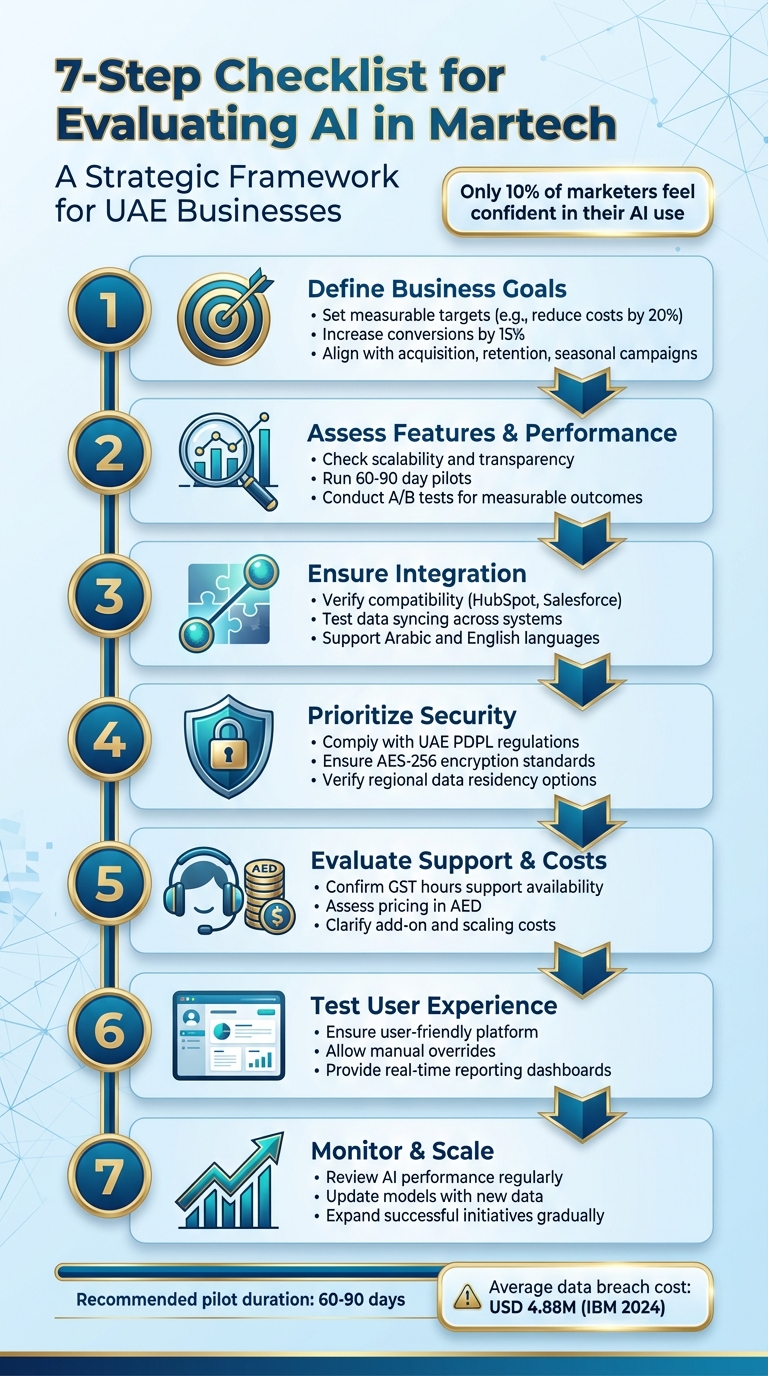
7-Step Checklist for Evaluating AI in Martech Tools
A Guide to AI Marketing Tool Selection
1. Identify Your Business Goals and AI Applications
Before diving into AI-powered martech tools, it’s crucial to define what success looks like for your business. Avoid setting vague goals, as they can lead to wasted resources. Instead, focus on measurable outcomes. For example, aim to reduce your cost per acquisition by 20%, boost email conversion rates by 15%, or increase your average order value by AED 50 within six months.
In the UAE, businesses often focus on customer acquisition in competitive industries, generating high-value leads for B2B services, and retaining customers in subscription-based models. For instance, an e-commerce retailer in Dubai could increase repeat purchases by using AI-driven product recommendations in both Arabic and English. Similarly, a real estate developer might rely on predictive lead scoring to prioritise high-intent enquiries. Once you’ve defined success, the next step is to set clear marketing objectives.
Mapping these objectives to specific AI applications is essential. For customer acquisition, tools like predictive audiences and automated bidding are effective. To drive conversions, dynamic content and intelligent A/B testing can make a difference. For retention, consider churn prediction models and personalised lifecycle journeys. For example, a hospitality group in the UAE might use AI to optimise media spending across search, social, and programmatic channels during peak tourism seasons, increasing direct bookings while reducing reliance on online travel agencies.
1.1 Set Clear Marketing Objectives
Start by translating broader business goals - like revenue growth or market share - into specific, actionable KPIs that AI can directly influence. For instance, a revenue growth target could be broken down into metrics such as qualified leads per month, average order value, or channel-specific conversion rates. AI’s role could then be evaluated based on its impact on predictive lead scoring, dynamic pricing, or on-site personalisation.
In the UAE, it’s important to consider seasonal trends like Ramadan, Eid, the Dubai Shopping Festival, and other key tourism periods. During these times, real-time optimisation and predictive demand modelling can deliver exceptional results. Set realistic benchmarks for AI performance, such as a 15–20% increase in lead-to-customer conversions or a 10–30% rise in email engagement rates.
1.2 Select Priority Applications
Focus on AI applications that offer the greatest potential impact. Assess each use case based on expected revenue gains, cost savings, data availability (like AED transaction records and engagement logs), system requirements, and how easily your team can adapt to the changes.
Some "quick wins" include automated creative optimisation, subject line testing, and audience expansion. These initiatives often leverage existing data from ad platforms or email tools. On the other hand, more complex applications - like dynamic pricing or full-funnel marketing mix modelling - can deliver larger benefits but typically require stronger analytics infrastructure and governance. These should be planned as medium-term priorities within a six- to twelve-month timeline.
For UAE businesses, it’s essential to tailor AI applications for a multilingual, mobile-first audience. Companies like Wick can assist in turning your objectives into measurable KPIs while aligning AI capabilities with a broader digital strategy, including SEO, content marketing, and automation efforts.
2. Review AI Features and Performance
After aligning your business objectives with AI applications, the next step is to determine if the tool can truly meet your needs. This means digging deeper than flashy marketing claims to assess the platform's technical capabilities, transparency, and results. For businesses in the UAE, where operations span diverse languages, currencies, and channels, this evaluation becomes even more critical.
Make sure the AI platform can handle growth seamlessly, scaling from thousands to millions of profiles without requiring major reconfigurations. Ask for performance benchmarks, such as maximum contacts, events per second, and API limits, to ensure the system can manage increased demand without slowing down or losing reliability. For instance, if your current user base is 50,000 profiles but you're aiming for 5 million across GCC markets within two years, request evidence of the platform's performance during peak times like Ramadan, Eid, or the Dubai Shopping Festival, when traffic and transactions surge.
Transparency is essential - marketers need to understand how and why the AI makes decisions. Look for tools with explainability features and audit trails that detail what the AI did, when it acted, and the data and parameters it used. Frameworks like SHAP or LIME can provide insights into which factors influenced decisions, such as browsing behaviour, past spending in AED, or engagement with seasonal promotions. This is especially important when justifying targeting strategies to finance, legal, or compliance teams, or when working in regulated industries like banking or healthcare.
To measure the AI tool's impact, establish baseline metrics before deployment. These could include your current conversion rate, cost per acquisition in AED, email engagement rates, or revenue per visitor. Run a 60–90 day pilot with A/B testing, comparing results from your existing approach to those driven by AI optimisation. Monitor metrics like conversion rate improvements, reduced costs per lead, higher revenue per email, and operational efficiencies like faster campaign execution or better deliverability. For example, if your email conversion rate is currently 2.5%, a well-implemented AI tool should show measurable gains - perhaps reaching 3.0% or more - within the trial period.
Ask vendors for detailed information about the models powering their features, such as predictive scoring, recommendation engines, or bid optimisation. Clarify how often these models are retrained - whether in real-time, daily, or weekly - and request case studies from similar businesses. For UAE companies managing multilingual audiences, ensure the AI performs well with mixed Arabic-English content and verify if language impacts its accuracy. Firms like Wick, which handle over 1 million first-party data points, can assist in creating testing frameworks tailored to local market needs and help interpret explainability outputs effectively.
2.1 Growth Capacity and Flexibility
Beyond transparency, evaluate the platform's ability to scale and adapt to shifting demands. Request data on how many campaigns it can process daily, events it handles per second, and the maximum audience size it supports. Confirm whether the platform offers auto-scaling during peak periods and whether this impacts latency or costs. For budget planning in AED, ask for pricing models based on contacts, events, or impressions, so you can estimate costs as your database grows.
Flexibility is equally important. The platform should support multiple functions - segmentation, prediction, content generation, and journey orchestration - without requiring additional tools or extensive customisation. Prioritise systems with no-code or low-code configurations, enabling your marketing team to adjust audience rules, test variations, and launch campaigns independently. Ensure the platform accommodates local data fields like Emirate, preferred language, and local holidays, and confirm these adjustments won't incur extra fees. Check if the vendor's roadmap includes emerging UAE-specific channels, such as WhatsApp Business or Arabic-focused social platforms.
2.2 Transparency and Explainability
Transparency builds trust. Look for tools that explain AI decisions through frameworks like SHAP or LIME. These should offer clear documentation on what data feeds the models, how often retraining happens, and how bias is tested. Features like "why this recommendation" tooltips, feature importance panels, and reason codes should be accessible in a user-friendly interface so non-technical teams can understand AI-driven decisions. Robust audit trails are critical for regulatory compliance and internal reviews, capturing what the AI did, when, and why. In sensitive industries or when targeting specific groups, ensure the platform allows manual overrides if AI decisions don't align with your brand values. As MarTech.org highlights, auditability should reveal not just decisions but also the data and timing behind them.
2.3 Performance Metrics
Evaluate the tool's success based on measurable outcomes, such as improved conversion rates or better customer targeting. Align these metrics with your initial goals to ensure a clear return on investment. Conduct a time-limited pilot with a control group to track improvements in engagement, revenue, and other key metrics.
Monitor both business and operational performance indicators:
- Business metrics: conversion rates, revenue per visitor, cost per acquisition in AED.
- Operational metrics: latency, failure rates, and data freshness.
According to MMA Global, marketing AI tools should be reassessed regularly to ensure their effectiveness doesn't decline over time. Models that aren't retrained or adjusted can lose their edge, so it's wise to evaluate tools at least twice a year. Use criteria like impact, adoption, integration, and investment to decide whether to scale, optimise, or replace your AI platform.
3. Check Integration with Your Current Martech Stack
An AI tool, no matter how advanced, can become a burden if it doesn't integrate well with your existing systems. Start by listing all the core platforms your business relies on - whether that’s HubSpot, Salesforce, Microsoft Dynamics 365, Zoho CRM, Adobe Marketing Cloud, or Oracle. Then, ensure the tool offers certified connectors and regional hosting options that align with UAE data-residency standards.
Integration goes beyond just having an "API available." It’s crucial to test how the tool performs in real-world scenarios. Walk through the entire customer journey - from a web form submission to CRM lead creation, marketing automation workflows, and final reporting. Follow test contacts through each step to confirm that campaign IDs, consent flags, custom fields, and tags sync correctly across platforms without causing duplicates or workflow issues. If your business operates in both Arabic and English, make sure the AI can handle mixed-language data, respects right-to-left text formatting, and processes timestamps in Gulf Standard Time (GST) to keep campaigns and reports in sync.
3.1 Compatibility with Current Tools
When evaluating vendors, request a live demonstration of the AI tool integrating with systems similar to yours, such as a CRM and a marketing automation platform. Watch how the vendor creates a contact, triggers an AI-driven action (like sending a personalised email or updating an audience score), and displays the results in a reporting dashboard. Check for API limitations and how errors are managed. Additionally, ask for examples of past implementations in the GCC or MENA region, particularly those involving Arabic language support, multi-currency handling (especially AED), regional domains, and privacy considerations. This will give you a clearer picture of the challenges and timelines you might face.
3.2 Data Synchronisation
Once compatibility is confirmed, focus on ensuring smooth data flow between systems. Data fields like unique identifiers, location, language, and currency (in AED) should sync accurately across platforms. Define a "source of truth" system for customer identity and configure the AI tool to ensure it doesn’t overwrite critical fields in your CRM or CDP during enrichment or predictions.
Understand how the vendor handles data updates. Do they use webhooks or streaming for real-time updates (usually within seconds to a few minutes), or scheduled batch jobs (e.g., every 15 minutes, hourly, or nightly)? Real-time syncing is essential for triggered campaigns, onsite personalisation, and fraud detection, while batch syncing may work for daily reporting or large historical data imports. Test the syncing process by updating a contact or event in one system and timing how long it takes to reflect in the AI tool and your CRM. Repeat these tests throughout the day to ensure consistency.
Before feeding data into AI models, conduct a thorough data audit. Remove duplicates, fix invalid emails and phone numbers, standardise location fields (e.g., Dubai, Abu Dhabi, and Sharjah), and convert all currency values to AED where necessary.
3.3 Long-Term Viability
Ask vendors for a 12–24 month integration roadmap that outlines planned updates, backward compatibility, and UAE-specific localisation features. Find out how often connectors are updated when major platforms like Salesforce, HubSpot, Meta, or Google change their APIs, and how much notice is provided to UAE customers before any deprecations. Vendors that actively participate in ecosystem marketplaces, hold certifications like ISO, and collaborate with GCC-focused agencies or consultancies (e.g., Wick) often demonstrate a stronger commitment to long-term support in the region.
Look for features that align with UAE requirements, such as support for right-to-left scripts, Arabic content generation and analysis, and the ability to handle AED alongside other currencies. Review case studies or examples of other UAE or GCC customers, and confirm the vendor provides regional support in GST hours. Also, check if they have local partners or account managers familiar with UAE regulations and cultural norms. Ensure the tool can accommodate UAE-specific needs like DD/MM/YYYY date formats, local weekend schedules, and public holidays such as Ramadan, Eid, and UAE National Day.
sbb-itb-058f46d
4. Verify Data Security, Privacy, and Compliance
Once your AI tool is integrated, the next step is ensuring it aligns with UAE data protection laws and international privacy standards. This is crucial to safeguard your brand reputation and maintain customer trust. Data breaches can be incredibly costly - IBM's 2024 report highlights an average loss of USD 4.88 million per breach, with even higher stakes in heavily regulated industries like finance and healthcare. Given that the UAE ranks among the top 10 countries targeted by cyberattacks in the MEA region, implementing robust security measures for cloud-based AI tools is non-negotiable.
4.1 UAE Regulatory Compliance
After integration, focus on verifying compliance with UAE data protection regulations. Ensure the vendor has mapped their data processing practices to UAE Federal Decree-Law No. 45 of 2021 (PDPL) and its Executive Regulations (Cabinet Decision No. 32 of 2022). If your business operates within a free zone, check compliance with the DIFC Data Protection Law No. 5 of 2020 or the ADGM Data Protection Regulations 2021, both of which are closely aligned with GDPR. Request key documentation, such as the vendor's Record of Processing Activities, data protection impact assessments, and their approach to managing data subject rights like access, correction, deletion, and objection to profiling.
Additionally, ask for the vendor's data processing agreement and transfer impact assessments, especially if customer data from the UAE is processed in regions such as the EU or US. For organisations handling sensitive financial or healthcare data, confirm adherence to sector-specific regulations from entities like the Central Bank of the UAE or healthcare authorities. If your operations span multiple jurisdictions, such as the UAE mainland, DIFC, and the EU, using GDPR-compliant tools can help streamline compliance across PDPL, DIFC, ADGM, and EU regulations.
4.2 Data Protection Measures
Scrutinise the vendor's technical safeguards to ensure they meet stringent security standards. The AI tool should include:
- Encryption in transit (TLS 1.2 or higher) and at rest (AES-256 or equivalent)
- Options for customer- or vendor-managed encryption keys
- Data residency within the UAE or GCC, with clearly defined primary and backup data centres
Ask the vendor where your data is stored and backed up. Do they offer UAE or GCC data residency options? Are backup locations consistent with production data regions? Confirm their safeguards for cross-border data transfers, such as standard contractual clauses.
Ensure the vendor employs role-based access controls, SSO/SAML, MFA, admin audit logs, and duty segregation. Request documentation for security certifications like ISO/IEC 27001, ISO 27701, or SOC 2 Type II, and inquire about their penetration testing and vulnerability management processes. Understand their backup and disaster recovery plans - how frequently are backups performed, and what are the recovery time objective (RTO) and recovery point objective (RPO) targets? Also, check how quickly they can restore systems without data loss that might disrupt campaigns or AI models.
4.3 Ethical AI Practices
Beyond legal and technical compliance, ethical AI practices are key to ensuring responsible use of the tool. Confirm that the vendor has measures in place to detect and address bias in areas like segmentation, ad targeting, and lead scoring. Ask about their testing methodologies and how often these are conducted. Evaluate the level of explainability and user control offered - can you understand why a recommendation was made, adjust parameters, override automated actions, or roll back changes if necessary?
Investigate how the vendor manages AI errors and hallucinations, particularly for critical functions such as automated campaigns or personalised pricing. Is there a human review process in place? How are users notified of significant model updates?. Ensure the vendor has a clear AI ethics policy that outlines prohibited uses, addresses sensitive attributes, and includes safeguards against manipulative or discriminatory practices.
It's also wise to include AI-specific clauses in contracts, covering areas like data usage permissions, rights to export data and models, and notification requirements for major model updates. For businesses working with consultancies like Wick, which specialise in creating unified digital ecosystems and AI-driven personalisation, standardising data protection and AI governance requirements across all tools - such as web platforms, CRM systems, marketing automation, and analytics - ensures compliance with PDPL and other regulations. By embedding these ethical AI practices into your broader business strategy, you can achieve consistent and compliant performance across all operations.
5. Assess Vendor Support and Costs
Once you've confirmed your tool's compliance and security, it's time to dive into vendor support and pricing structures. This step is all about ensuring their support model and costs align with your resources and growth plans. Vendors offer a range of implementation options. For teams with strong internal marketing and technical expertise, self-serve models might suffice. However, these can delay results if the documentation is sparse or the integration process is tricky. On the other hand, vendor-managed or partner-led implementations can speed things up significantly. These approaches often include certified professionals who handle data mapping, workflow design, and AI model setup - essential tasks when integrating CRMs, CDPs, or automation platforms. Just like technical performance, reliable vendor support and transparent pricing are key to long-term success.
5.1 Implementation Support
Ask for a detailed implementation plan that includes phases, milestones, and go-live dates. Request examples of project timelines from similar clients to ensure the sales pitch matches actual deployment experiences. Be clear on what the standard onboarding package covers - like training hours, delivery methods (live or on-demand), and language options - and what might incur extra charges as professional services. For UAE-based organisations, confirm that vendor support is available during Gulf Standard Time (GST) hours. Ideally, they should offer 24/7 or robust regional business hours coverage through email, in-app chat, phone, and ticketing systems. If you're in sectors like government, banking, or managing multiple brands, verify the availability of Arabic-speaking support and regional partners. Companies like Wick specialise in offering tailored regional support, blending global AI tools with local expertise to guide implementation, technical strategy, and training for region-specific needs.
5.2 Growth Capacity and Licensing Models
Look beyond the initial setup to understand how the platform handles growth and its licensing terms. Pay attention to limits on active users, API calls, event processing, and data storage, especially as they vary across pricing tiers. Ensure the platform can manage multi-brand, multi-region, and multi-currency campaigns while delivering consistent performance. Request case studies that showcase successful scaling, from small pilot projects to large-scale deployments, including details like contact database sizes and campaign volumes. Understand the pricing model - whether it's based on users/seats, accounts or database size, specific features (like AI content or predictive scoring), or usage metrics such as impressions or API calls. When calculating total costs in AED, factor in subscription fees, implementation and professional services, data overage charges, premium support, integrations, and optional add-ons. Ask for multi-year pricing scenarios tied to growth forecasts, such as list size or automation volume over 24–36 months. Also, clarify terms like automatic price increases, contract minimums, or early termination fees.
5.3 Training and Onboarding
Check if the vendor offers a mix of live and on-demand training options. These might include instructor-led workshops, recorded sessions, searchable knowledge bases, and tailored learning paths for marketers, analysts, and administrators. Leading vendors often provide step-by-step guides, use-case playbooks, and templates for common AI applications like lead scoring, content creation, and customer journey mapping. Look for certification programs, sandbox exercises, and Q&A sessions during the first 60–90 days. UAE teams, especially those with distributed operations across regions like KSA, India, and Europe, benefit from asynchronous training resources that minimise disruptions. For teams with limited martech expertise, consider partner-led implementations through firms like Wick. They offer ongoing support, performance tracking, and actionable insights to ensure sustained growth. Lastly, appoint an internal product owner for the platform - typically from marketing operations - who will coordinate with the vendor's customer success team. Also, involve an IT lead for data and APIs, a data analyst to validate AI outputs, and marketing stakeholders to define use cases and success metrics.
6. Test User Experience and Control
Once integration and compliance are sorted, the next step is ensuring your team can effectively interact with and manage the AI tool. Even the most advanced AI systems fall short if users struggle to control or override them. Interestingly, only 10% of marketers feel they're using AI to its full potential. For teams in the UAE, juggling campaigns across various emirates, languages, and customer demographics, a user-friendly interface and clear control options are key to achieving success.
6.1 User Interface
A good interface should make everything straightforward - whether it’s launching campaigns, filtering audiences, or reviewing reports, it should all require minimal clicks. Look for features like intuitive menus, readable fonts, and visually clear charts with high contrast. The platform must also cater to different roles, offering tailored views for marketers, analysts, and leadership. No-code or low-code workflows are a bonus, enabling team members without technical expertise to create prompts, automations, or customer journeys without relying on IT.
To test efficiency, time how long it takes a UAE marketer to set up a campaign. Running a short proof-of-concept trial over 1–2 weeks with a cross-functional team (marketing, CRM, analytics, and compliance) can also help. Usage analytics from the trial should show widespread adoption across the team, rather than just a few power users relying on the system. These checks ensure that the interface not only performs well technically but also supports practical, everyday marketing tasks.
6.2 Customisation and Control
AI tools must allow marketers to configure rules that align with specific schedules, like Gulf weekends or Ramadan campaigns. You should be able to set optimisation goals - whether it’s revenue per session, lead quality, or cost per acquisition - and adjust them as needed. Manual overrides are critical for situations where automated actions might conflict with brand values or regulations.
Features like sliders to control experimentation levels, personalisation depth, or audience exclusions help keep AI as a tool to enhance, not replace, human judgement. The system should log all AI recommendations with clear explanations and allow manual adjustments when necessary. For example, thresholds can be set to flag actions like excessive discounting or risky targeting, triggering manual reviews. If AI performance dips or anomalies arise, the system should fall back to pre-set rules-based strategies. Additionally, the tool should explain its decisions - why it chose a specific audience, channel, or creative - by highlighting factors like recent purchases, engagement history, location, or device type.
6.3 Reporting and Monitoring
The platform should deliver near real-time dashboards that track critical metrics such as open rates, click rates, conversions, revenue in AED, cost per lead, and ROAS. It’s important that these dashboards clearly differentiate between AI-driven optimisation and baseline performance. Teams should also be able to drill down by audience or channel to identify where AI is adding the most value.
Custom alerts for anomalies - like sudden conversion drops, unexpected spikes in opt-outs, or budget overages - are essential for quick responses. Dashboards that lack outcome-focused metrics are a warning sign, so insist on tools that prove AI’s impact. Controlled tests, like A/B or holdout experiments, are excellent ways to compare metrics like conversion rates, average order value, or cost per acquisition between AI-managed processes and traditional methods.
Establish a regular review schedule, whether weekly or monthly, where teams from different functions come together to assess performance dashboards, error logs, and risk indicators. This includes checking for bias in audience targeting or unexpected patterns. Governance rules should also be in place for modifying AI settings, with audit trails to ensure accountability. For businesses partnering with firms like Wick, monitoring can be integrated into a broader data and AI governance framework. This ensures that your martech AI stays aligned with UAE regulations and long-term growth objectives.
7. Next Steps
It’s time to put your plans into action. Start by identifying 2–4 AI-enabled tools that fit your marketing goals and meet UAE compliance standards. From there, design a 60–90 day proof-of-concept focusing on specific use cases like lead scoring or email personalisation. Don’t forget to map out the necessary integrations with your CRM, analytics, and automation platforms to ensure a smooth implementation.
Once you’ve completed your evaluation, run a pilot programme. Compare AI-assisted campaigns with your current methods using measurable KPIs to track performance. Schedule weekly reviews to spot any anomalies early and address potential risks. Make sure all stakeholders are on the same page, and assign a dedicated team member to oversee the entire process.
Plan your rollout in three stages. In the first three months, audit your marketing stack and conduct small-scale pilots. Between months three and six, replace tools that aren’t delivering, strengthen critical integrations, and establish AI governance measures like access controls, approval workflows, and bias checks. From six to twelve months, scale up successful initiatives across all channels. Invest in advanced analytics and attribution tools, and only expand AI into new areas once you’ve proven its stability and value. This phased approach ensures steady progress in performance, integration, and compliance.
Don’t overlook the importance of training. Schedule sessions to help your team understand how to configure models, interpret results, and step in when human judgment is needed. Clearly define roles - who approves AI-generated content, who monitors dashboards, and who handles incident responses. Establish a monthly review schedule to track ROI, update models as data trends evolve, and ensure your AI tools remain aligned with UAE regulations and your long-term business objectives.
For businesses in the UAE looking to speed up implementation, consider partnering with a consultancy like Wick. They can help translate your goals into actionable AI use cases, design a robust martech framework, and integrate websites, SEO, content, automation, analytics, and AI-driven personalisation into a unified digital strategy. Whether you choose to build capabilities in-house or work with external experts, the focus should be on moving from a simple checklist to a comprehensive strategic roadmap - complete with clear metrics, strong governance, and a commitment to ongoing improvement.
FAQs
How can I make sure AI tools meet my business goals effectively?
To make sure AI tools effectively support your business goals, start by identifying what you want to achieve. Whether it’s boosting customer engagement, streamlining processes, or gaining deeper insights from data, having clear objectives is key. Next, assess tools based on how well they integrate with your current systems, their ability to scale as your business grows, and how well they cater to the specific needs of the UAE market.
At Wick, we specialise in crafting customised, AI-powered marketing strategies that drive sustainable growth. By delivering personalised solutions tailored to your business needs, we help make AI a powerful addition to your digital marketing efforts.
What should businesses in the UAE consider when integrating AI into their marketing tools?
When incorporating AI into marketing tools in the UAE, businesses need to pay attention to a few critical elements to ensure success:
- Compatibility: Make sure the AI solution integrates smoothly with your current digital systems and marketing platforms, avoiding disruptions or inefficiencies.
- Local compliance: Stay aligned with UAE data privacy laws and standards. This not only ensures legal compliance but also builds trust with your audience.
- Scalability: Opt for tools that can expand alongside your business, managing larger datasets and growing user demands effectively.
- Cultural relevance: Customise AI-driven personalisation to align with the UAE's diverse cultural landscape, ensuring your messaging connects with local audiences.
By focusing on these factors, businesses can build a cohesive, effective digital marketing framework tailored to the UAE's unique market dynamics, paving the way for sustainable growth.
How can I assess if an AI system's decisions are transparent and easy to understand?
To assess how transparent and clear an AI system's decisions are, see if it offers straightforward explanations about how its outcomes are reached. Features like decision pathways, key factors that influence results, and visual aids can help make the process more understandable.
It's also important that the system provides detailed documentation of its reasoning process, ensuring it supports interpretability. This approach can be a strong foundation for building reliable, data-informed marketing strategies.