

Blog / Data Insights for GCC Marketing Frameworks
Data Insights for GCC Marketing Frameworks
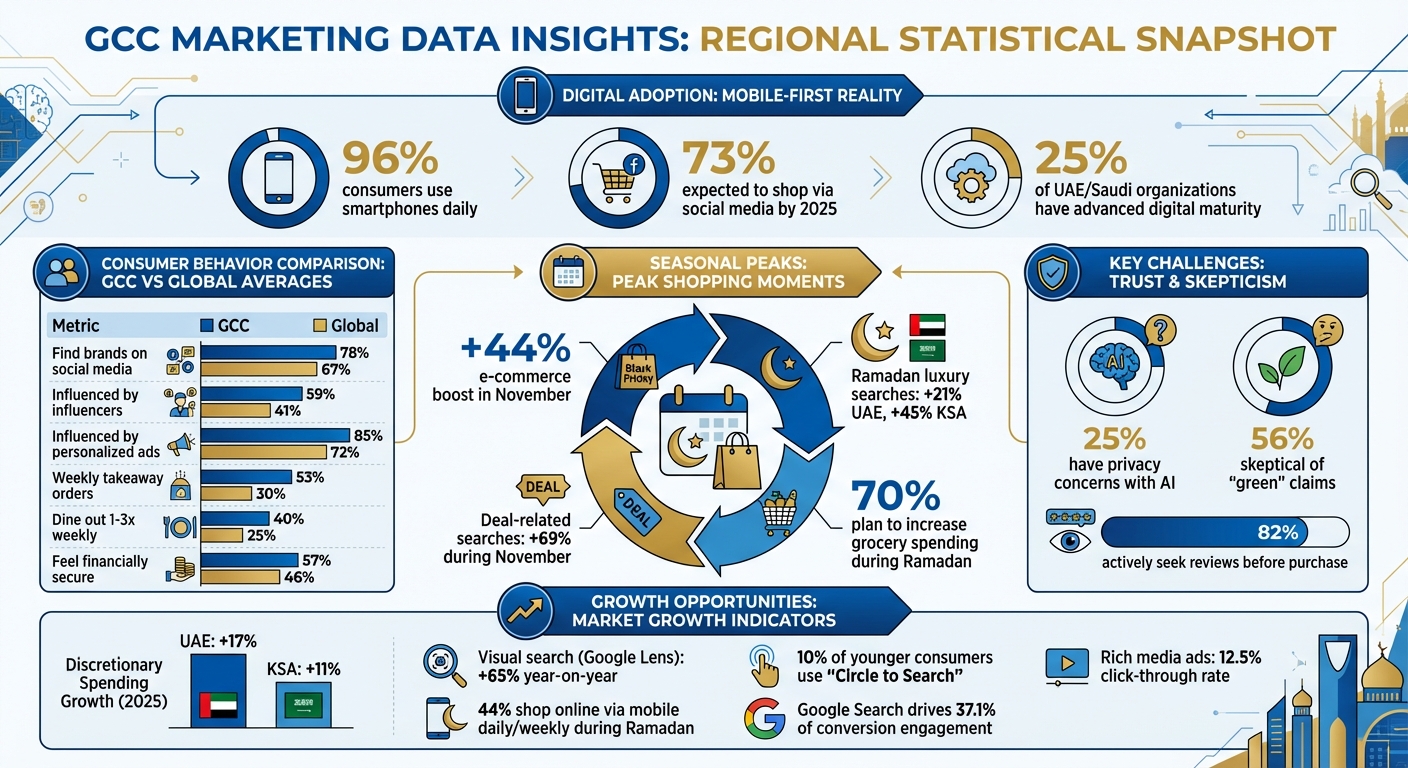
The GCC region's marketing landscape is shifting towards a mobile-first, AI-driven approach. With 96% of consumers using smartphones daily and 73% expected to shop via social media by 2025, businesses must adapt to emerging trends like AI tools, visual search, and social commerce. However, only 25% of organisations in the UAE and Saudi Arabia have achieved advanced digital maturity, highlighting a gap in leveraging these opportunities.
Key takeaways:
- Consumer behaviour: Influencers sway 59% of GCC shoppers, and 78% discover brands on social media, surpassing global averages.
- Seasonal spikes: Events like Ramadan, Eid, and Black Friday drive spending surges, with November sales boosting e-commerce by 44%.
- Challenges: Privacy concerns affect 25% of AI users, and 56% are sceptical of "green" claims.
- Opportunities: Government initiatives and increasing discretionary spending (+17% UAE, +11% KSA in 2025) fuel growth.
To succeed, brands need unified frameworks that integrate data across touchpoints, prioritise Arabic-first content, and align with local habits and peak shopping periods. Mobile optimisation, influencer-led campaigns, and advanced tools like Google Lens and Generative AI are essential for engaging GCC audiences effectively.
GCC Marketing Statistics: Consumer Behavior and Digital Trends 2025
GCC Ecommerce 2026 | How Retailers Can Win Q4 2025 ft Adriano Silva VTEX | Let’s Talk Ecommerce EP 1

Consumer Behavior Trends in GCC Marketing
Consumer habits across the GCC are not just reshaping how people discover brands digitally but also influencing seasonal buying patterns, creating opportunities for marketers to craft unified strategies tailored to the region.
Social Commerce and Creator-Led Discovery
Social media platforms have become the go-to for discovering new brands in the GCC. A striking 78% of consumers in the region find new brands through social media, compared to the global average of 67%. In the UAE and Saudi Arabia, 73% of consumers have made purchases directly through social channels. Platforms like Instagram, TikTok, and Snapchat dominate this space, with influencer-driven videos generating over 30% engagement during the initial awareness phase.
The role of influencers is particularly powerful in the GCC. 59% of consumers in the region are swayed by influencers when making purchasing decisions, significantly higher than the global figure of 41%. This trust extends to personalised advertising, where 85% of GCC consumers are influenced by tailored social media ads, compared to 72% globally. However, this trust comes with a caveat - 82% of consumers actively seek reviews to verify a brand before finalising their purchase.
Aditya Aima, Managing Director of Growth Markets at AnyMind Group, highlights: "Brands that harness culturally authentic storytelling with data-driven creativity will unlock new frontiers of engagement and growth in this highly dynamic market".
Video advertisements perform best during evening and late-night hours, reflecting the region's unique lifestyle, where 53% of consumers order takeaway at least once a week, nearly double the global average of 30%. These daily habits set the stage for the significant seasonal shifts that occur during Ramadan.
Consumer Behavior During Ramadan
Ramadan brings noticeable changes to consumer behavior in the GCC, building on existing digital and social trends. As Eid approaches, search interest for luxury apparel spikes - 21% in the UAE and 45% in Saudi Arabia. Spending during this time focuses heavily on specific categories like fashion, beauty, and groceries, with 70% of respondents in the region planning to increase grocery spending during the season's peak.
Mobile commerce surges during Ramadan, with 44% of consumers shopping online via their phones daily or weekly. Social commerce also sees a boost, as brands align their strategies with shifting spending priorities and media habits. Night-time engagement intensifies, mirroring lifestyle changes where dining out and ordering takeaway become more common after iftar.
For marketers, timing is everything. Campaigns targeted at the end of Ramadan - especially those featuring luxury and high-end apparel - can capture a significant surge in spending. In Saudi Arabia, this uptick often coincides with post-payday periods, amplifying the impact. Additionally, cross-border shopping grows during Ramadan, with one-sixth of all transactions in the UAE and Saudi Arabia involving international sellers.
Sustainability, Health, and Premium Products
Consumers in the GCC present an interesting mix of cost-consciousness and a willingness to spend on luxury. While 49% cite the cost of living as a major concern, 50% still plan to increase their spending on luxury items, far exceeding the global average of 32%. This duality extends to health and wellness, with 60% aiming to consume more fresh produce and 72% open to using smart wearables for health monitoring.
Norma Taki, Deals Partner and Consumer Markets Leader at PwC Middle East, observes: "Consumers in the Middle East are redefining what they expect from the food industry. Health, convenience and trust now top the menu".
When it comes to sustainability, messaging needs to be carefully tailored. While 51% of consumers check nutrition labels and prefer sustainable packaging, 56% remain sceptical of brands' "green" claims. Health benefits and product quality resonate more with consumers than environmental messaging alone when promoting locally made products. Social media plays a crucial role in spreading awareness about sustainability, as 72% of consumers in the GCC learn about corporate climate initiatives through these platforms.
Interestingly, the region also has a higher adoption rate of prescription weight-loss drugs at 9%, compared to much lower global figures. Meanwhile, the non-usage of healthcare technology in the GCC is only 12%, far below the global average of 30%.
| Consumer Behaviour | GCC/Regional | Global Average |
|---|---|---|
| Financially Secure | 57% | 46% |
| Dine Out 1-3x Weekly | 40% | 25% |
| Influencer Persuasion | 59% | 41% |
| Weekly Takeaway Orders | 53% | 30% |
Data Sources and Metrics for GCC Marketing
Main Data Sources for GCC Markets
To truly understand consumer behaviour in the GCC, marketers need to pull insights from a variety of data sources. Google Search data is invaluable for uncovering what people are actively searching for, such as "near me" queries and emerging e-commerce trends. Meanwhile, Visa spend data gives a clear picture of actual discretionary spending patterns. Social media platforms like Meta, TikTok, LinkedIn, and Snapchat provide detailed metrics on ad reach, audience demographics, and engagement, all tailored to the region's unique characteristics. Additionally, platforms such as AnyTag and AnyX offer first-party insights into influencer campaigns, mobile marketing, and e-commerce performance.
Large-scale consumer surveys conducted by firms like Deloitte and GWI deliver a broader understanding of lifestyle habits, device preferences, and adoption of new technologies. On the infrastructure side, GSMA Intelligence and Ookla provide critical metrics on mobile penetration and internet speeds. For instance, in the UAE, the median mobile download speed hit 441.89 Mbps in early 2025, representing a 50.7% year-on-year increase.
Together, these diverse data sources form the foundation for the metrics that measure marketing success across the GCC.
Key Metrics for Marketing Performance
Several metrics are central to evaluating marketing effectiveness in the GCC. The conversion rate, which tracks the percentage of leads turning into customers, is a direct indicator of how well the sales funnel is performing. Similarly, Customer Acquisition Cost (CAC) helps businesses monitor how much they are spending per customer on a quarterly basis. Another critical metric is Customer Lifetime Value (CLV), which estimates the total revenue a business can expect from a single customer, guiding resource allocation to high-value audiences.
In this region, "peakiness" has become a key metric, highlighting spikes in search and spending during major events like Ramadan or Black Friday. For example, during the November Black Friday period, e-commerce sales in the UAE and Saudi Arabia jump 44% above the monthly average. Search engines play a significant role here, with Google Search driving 37.1% of conversion engagement, while rich media interstitial ads boast click-through rates of 12.5%, far outperforming static banners.
For luxury goods, however, physical retail remains dominant, with 92% of UAE luxury retail spend and 97% in Saudi Arabia happening in-store.
Basel Hijazi, Product Lead at Google MENA, advises: "Marketers should keep 'super peaks' in mind. This is when major peaks collide, for example Ramadan and Black Friday in 2033, likely leading to surges in consumer activity".
Data Source Comparison
Understanding the strengths and limitations of different data sources is crucial for crafting effective GCC marketing strategies. Here's a breakdown:
| Data Source | Benefits | Limitations | Best Application in GCC |
|---|---|---|---|
| Search Data (Google) | Reveals consumer intent. | Does not track offline or social app purchases. | Spotting discovery trends and "near me" searches. |
| Spend Data (Visa) | Reflects actual spending behaviour. | Lacks detailed demographic context of buyers. | Analysing sales events and peak shopping periods. |
| Social Media Analytics | Offers engagement and discovery data. | May include duplicate or inauthentic accounts. | Optimising influencer marketing and social commerce. |
| Consumer Surveys | Explains motivations and captures sentiment. | Self-reported data can sometimes be biased. | Tracking long-term shifts in consumer priorities. |
This mix of data sources and metrics allows marketers to navigate the unique dynamics of the GCC market effectively.
sbb-itb-058f46d
Adapting Global Marketing Frameworks for the GCC
Cultural Factors and Targeting Methods
Marketing strategies designed for Western markets often fall short in the GCC due to the region's distinct cultural and social dynamics. Key moments like Ramadan and Eid Al Fitr, Back-to-School season, November sales (commonly referred to as Black Friday), Saudi National Holidays, Eid Al Adha, and the End-of-Year festivities demand a sharp focus on these "peak moments." These events require marketers to allocate resources effectively during these high-impact periods.
Content localisation is crucial in the GCC, where Arabic-first messaging and culturally relevant storytelling resonate far better than repurposed global content. Collaborating with local influencers who understand the nuances of the region allows brands to create campaigns that appeal to both Emirati nationals and the large expatriate population. For instance, during Ramadan, consumers increasingly expect brands to demonstrate transparency in charitable initiatives, making accountability in donations a key component of successful campaigns.
"Marketers should keep 'super peaks' in mind. This is when major peaks collide, for example Ramadan and Black Friday in 2033, likely leading to surges in consumer activity", says Basel Hijazi, Product Lead at Google MENA.
Timing is everything in the GCC. Ad schedules should align with local habits, such as the late-night and evening spikes in video consumption during Ramadan. In Saudi Arabia, monthly paydays drive spending surges, making it essential to time campaigns around these dates. Beyond offering discounts, messaging during these peak periods should emphasise themes like "celebration" and "connection", helping brands stand out in a crowded marketplace. For example, during November's Black Friday season, deal-related search interest jumps by 69%, underscoring the importance of aligning campaigns with these pivotal moments.
By addressing these cultural factors, marketers can lay the foundation for a mobile-first approach that shapes the consumer journey in the GCC.
Mobile-First and Digital Journey Optimisation
The GCC's consumer landscape is defined by its overwhelming reliance on mobile devices, making it essential to optimise digital journeys from discovery to conversion. Social platforms like Instagram, TikTok, and Snapchat dominate the discovery phase, with influencer videos driving over 30% engagement at this stage.
Emerging tools like visual and AI-driven search are transforming how consumers begin their shopping journeys. Google Lens, for instance, has seen a 65% year-on-year rise in usage, with one in five searches reflecting commercial intent. Younger consumers are increasingly turning to visual search tools like "Circle to Search", which now account for over 10% of shopping journeys. To capture this audience, marketing frameworks must integrate visual search optimisation alongside traditional SEO.
"GCC – a melting pot of cultures has digitally native consumers that drive its digital transformation while navigating the complex web of social, entertainment and commerce touchpoints daily", explains Aditya Aima, Managing Director of Growth Markets at AnyMind Group.
Rich media formats perform exceptionally well in the region. Interstitial ads, for example, achieve click-through rates as high as 12.5%, far surpassing static banners. In-game advertising also captures the attention of 43% of surveyed users in the GCC. Messaging platforms like WhatsApp have become vital for conversions, making it imperative to incorporate these channels into the customer journey rather than treating them as secondary options.
Interestingly, while digital engagement is high, luxury retail in the region remains heavily tied to physical stores, with 92% of UAE and 97% of Saudi luxury purchases still occurring offline. This highlights the need for digital campaigns to focus on discovery and engagement while ensuring a smooth transition to in-store experiences.
Framework Adaptation Comparison
| Feature | Standard Global Framework | GCC-Adapted Framework |
|---|---|---|
| Primary Channels | Search, Email, Facebook | TikTok, Instagram, Snapchat, WhatsApp |
| Content Language | English-first / Translated | Arabic-first / Culturally relevant |
| Peak Timing | Christmas, Black Friday | Ramadan, Eid, Saudi National Day, Paydays |
| Discovery Method | Algorithm-based Search | Influencer-led / Social Discovery |
| Purchase Journey | Web-based E-commerce | Mobile-first / Social Commerce / In-store Luxury |
| Search Method | Text-based SEO | Visual Search (Google Lens) & AI-driven Discovery |
This table underscores why translating global campaigns is rarely effective in the GCC. The region's distinct consumer habits, cultural calendar, and digital preferences demand marketing frameworks tailored specifically to its unique ecosystem.
Using Data Insights with Wick's Four Pillar Framework
Build & Fill: Digital Presence for GCC Trends
Developing a digital presence that resonates with GCC audiences goes beyond simple translation - it calls for Arabic-first content tailored for mobile-first users. With app engagement in the region being 1.6× higher, it’s crucial to focus on mobile-friendly digital experiences. Websites and apps must function seamlessly on mobile devices, as this is the backbone of long-term engagement in the GCC.
It’s also important to align your content with the region's growing interest in health and wellness. For example, 88% of regional consumers are more likely to use healthcare apps or wearables, opening doors for brands to incorporate wellness-focused messaging. Companies like UAE-based Right Bite and Saudi Arabia-based Calo have already embraced this trend by offering digital meal planning tools that sync with health-tracking apps, delivering personalised nutrition plans based on user activity. This approach also taps into the 45% of GCC consumers willing to pay more for food that supports environmental health.
Another key element is influencer-led content, which remains a powerful tool for discovery. Partnering with local creators who understand the region’s cultural nuances allows brands to deliver authentic and engaging narratives. Platforms like Instagram, TikTok, and Snapchat dominate in the region and are essential to a strong Build & Fill strategy. These efforts create the foundation for effective promotional campaigns that can be strategically launched at the right time.
Plan & Promote: Using Seasonal and Behavioural Data
The Plan & Promote phase of Wick’s Four Pillar Framework focuses on leveraging seasonal and behavioural data for precise campaign timing. In the GCC, six major "peak moments" drive consumer activity: Ramadan and Eid Al Fitr, Back-to-School, November sales (Black Friday), Saudi National Holidays, Eid Al Adha, and End-of-Year celebrations. These periods often see significant spikes in spending, such as a 44% increase in e-commerce sales during November sales.
Timing is everything. For instance, video ads run during Ramadan in the evening or late at night achieve the highest click-through rates. In Saudi Arabia, monthly paydays also create spending surges, making it a smart move to align promotions with these dates. Brands should also prepare for "super peaks", when major events overlap, such as Ramadan and Black Friday in 2033.
While social platforms dominate discovery, Google Search still accounts for 37.1% of conversion engagement. Additionally, rich media interstitial ads have shown click-through rates as high as 12.5%. For brands targeting physical retail - where a staggering 92% of UAE and 97% of Saudi luxury purchases occur - optimising for "near me" searches is essential to drive in-store visits.
Tailor & Automate: Personalisation for GCC Audiences
The final pillar focuses on personalised automation, a critical factor for the 71% of GCC consumers who expect tailored experiences. With 58% of respondents in the UAE and KSA already using Generative AI tools, the region is clearly ready for tech-forward solutions. Brands can use GenAI to offer personalised meal plans, fitness routines, and product recommendations that integrate with wearable devices.
Take Foodics, a UAE-based platform, as an example. They use data analytics to help restaurants identify best-selling items and optimise menus according to real-time consumer preferences. This kind of automation is especially valuable during peak shopping seasons, such as Black Friday in November, when deal-related search interest increases by 69%.
Visual search is also gaining traction. Tools like Google Lens have seen a 65% year-on-year growth, with one in five searches having a commercial intent. Additionally, over 10% of younger consumers now start their searches using "Circle to Search". This makes visual optimisation just as important as traditional SEO. Automation should also incorporate regional calendars to ensure content and offers align seamlessly with religious holidays, national celebrations, and major shopping events.
"Companies that thrive will be those that meet people where they are – with affordable, nutritious, tech‐savvy and locally rooted solutions that fit modern lifestyles and values", says Norma Taki, Deals Partner and Consumer Markets Leader at PwC Middle East.
Transparency is equally important, particularly when it comes to sustainability claims. With 56% of GCC consumers sceptical about companies overstating their "green" credentials, brands must back their messaging with measurable data. A great example is the US$680 million joint venture between US-based Plenty and the UAE's Mawarid, which aims to produce 2 million kg of strawberries annually through indoor farming. This initiative not only meets the demand for locally grown premium produce but also highlights the importance of measurable outcomes.
Conclusion
Marketing in the GCC demands a nuanced understanding of its digitally diverse and dynamic landscape. While platforms like Instagram and TikTok are key for brand discovery, Google Search still plays a major role, driving 37.1% of conversion engagement. The data paints a picture of consumers who are both cost-conscious and indulgent - highlighted by growing concerns over expenses alongside frequent takeaway orders. This duality calls for strategies that capture both everyday habits and the seasonal spikes that define the region.
The six peak moments - spanning from Ramadan to November sales - are critical opportunities for brands. These events can drive spending increases of more than 40%. Looking ahead, "super peaks", such as the overlap of Ramadan and Black Friday in 2033, promise even greater challenges and rewards for marketers.
With 96% of consumers using smartphones daily, a 65% year-on-year rise in visual search, and 58% engaging with generative AI tools, it’s clear that a mobile-first, tech-driven approach is essential. However, trust remains a hurdle, as 56% of consumers remain sceptical about sustainability claims. Striking a balance between innovation and credibility is key.
Wick’s Four Pillar Framework offers a roadmap for navigating this complex market. By aligning digital presence (Build & Fill), strategic timing (Plan & Promote), and advanced automation (Tailor & Automate), brands can stay ahead of trends. Whether it’s optimising campaigns for late-night Ramadan browsing or incorporating wellness features to tap into the growing popularity of healthcare apps, this approach ensures relevance and impact.
The message is clear: the GCC is a unique market that demands dedicated, data-driven strategies. The opportunities are immense, and success will belong to those who approach the region with insight and precision.
FAQs
How can businesses in the GCC region leverage AI to enhance their marketing strategies?
Businesses across the GCC can unlock new opportunities by incorporating AI-driven personalisation and automation into their marketing strategies. With advanced tools like generative AI, companies can analyse real-time consumer behaviour to offer highly relevant product recommendations, fine-tune pricing in AED (e.g., د.إ 1,250), and craft Arabic-language content that respects local customs and traditions. Acknowledging key holidays and cultural nuances can deepen connections with audiences in the UAE.
To make the most of AI's potential, businesses should prioritise impactful use cases such as predictive media buying, customer retention strategies, and AI-powered content creation. Establishing clear measurement frameworks and monitoring key metrics like conversion rates and revenue growth in AED ensures these initiatives deliver tangible results.
Wick’s Four-Pillar Framework presents a structured approach to creating a seamless digital ecosystem. It integrates marketing automation, data analytics, and AI personalisation, all designed to align with the preferences and expectations of GCC consumers. By tailoring AI strategies to local culture and privacy standards, businesses can drive growth while providing engaging and effortless customer experiences.
What cultural aspects should be considered when localising marketing content for the GCC region?
When crafting marketing content for the GCC region, understanding language, religious values, and cultural traditions is key. Arabic is often the language of choice, and your messaging should honour Islamic customs, family-oriented values, and the unique national identities of the region. Content that reflects these priorities tends to strike a chord with local audiences.
The way people consume digital content here is another important consideration. In the UAE and across the GCC, mobile usage dominates, with a strong preference for video content and personalised experiences powered by AI. Social media trends also highlight the popularity of local influencers who communicate in Arabic and authentically embody Gulf lifestyles. Including these elements in your approach can help ensure your brand feels relevant and engaging.
Additionally, incorporating advanced tools like AI technologies and social commerce into your marketing strategy - while respecting privacy and cultural norms - can strengthen trust and create meaningful connections with GCC audiences.
How does Ramadan influence consumer behaviour in the GCC region?
Ramadan brings a noticeable shift in consumer behaviour across the GCC, with spending habits undergoing significant changes. During this sacred month, overall spending increases by about 53%, as 75% of shoppers delay their purchases to take advantage of Ramadan-specific discounts. E-commerce also experiences a remarkable boost, with online sales climbing by 65%. A large portion of this surge comes from the growing demand for food delivery services after iftar, highlighting the preference for convenience during fasting hours.
For brands, this means adapting marketing strategies to align with these seasonal trends. Consumers tend to focus on price, followed by quality and promotional offers, while many turn to social media for inspiration and deals. Content consumption also rises, especially for Ramadan-themed shows, making digital and TV platforms prime spots for targeted advertising during peak viewing hours.
Wick can assist brands in navigating these shifts by using advanced analytics and marketing automation to customise offers, fine-tune campaigns, and ensure messaging resonates with the region's cultural and economic values. For example, displaying prices in AED 1,000 and using the dd/MM/yyyy date format ensures a seamless and locally relevant experience for audiences in the UAE.