
Blog / Customer Journey KPIs for GCC Businesses
Customer Journey KPIs for GCC Businesses
85% of unhappy customers in the GCC don’t share feedback - they leave silently or complain on social media. This makes tracking customer journey KPIs vital for businesses in the region. Without real-time insights, issues go unnoticed until it's too late, causing revenue losses and reduced customer retention.
Key takeaways for GCC businesses:
- Data silos hurt customer experience: Disconnected tools across marketing, IT, and support lead to frustration for 87% of customers.
- Surface metrics fail: Metrics like NPS and CSAT don't link directly to revenue or retention.
- Personalisation vs. privacy: 80% of GCC customers expect tailored experiences, but 55% value data protection equally.
- Cross-channel coordination is lacking: 79% of customers expect consistent service, but fragmented systems lead to delays and missed opportunities.
Solutions:
- Unify data with a Customer Data Platform (CDP): GCC companies see a 20–30% rise in engagement and 15–25% higher conversions with connected data systems.
- Focus on revenue-driven KPIs: Metrics like CLV, churn reduction, and AOV directly impact profits.
- Implement ethical personalisation: Use first-party data and transparent practices to build trust.
- Coordinate actions across channels: Real-time insights ensure consistent, timely responses across platforms.
With internet penetration at 99% in the UAE and smartphone usage at 97%, customer expectations are high. Businesses that act on predictive insights can boost revenue by 5–15% and reduce churn by 2–4%. The future belongs to brands that predict, personalise, and act in real time.
Main Problems in Tracking Customer Journey KPIs
Disconnected Data Across Channels
In the GCC, businesses aren't short on data - they're short on connected data. Different teams like marketing, IT, and customer support often operate in silos, using separate platforms that don’t talk to each other. This lack of integration creates a fragmented view of the customer, making it nearly impossible to achieve a unified understanding of their journey.
The statistics paint a clear picture: 87% of consumers feel frustrated when they have to repeat their information across channels, 56% frequently re-explain their situation to different representatives, and 55% feel like they’re dealing with isolated departments instead of one cohesive company. This disjointed data environment not only frustrates customers but also limits a business's ability to respond effectively, often leading to an overemphasis on shallow metrics.
Focus on Surface-Level Metrics
Many GCC companies lean heavily on metrics like Net Promoter Score (NPS) and Customer Satisfaction (CSAT), but these numbers rarely connect to tangible outcomes like revenue, retention, or profitability. Such metrics don’t capture the nuances of real-time customer behaviour. Leveraging AI in digital marketing can help bridge this gap by processing behavioral data instantly. The issue becomes even more glaring when you consider that 85% of unhappy customers in the GCC don’t bother filling out surveys - they simply delete the app or cancel their subscription.
Without assigning monetary values to customer actions, businesses struggle to identify which channels are actually profitable. For instance, if a qualified lead is worth AED 100 because one in ten converts into a AED 1,000 customer, this insight could guide resource allocation. Without such clarity, companies are left in the dark, unable to link their KPIs to financial performance.
Balancing Personalisation with Data Ethics
Consumers in the GCC have high expectations when it comes to personalisation. 80% expect businesses to understand their unique needs, and 66% want consistently tailored offers. At the same time, 55% say a brand’s ability to protect their personal data influences their trust. This creates a tricky balancing act: collecting enough data to personalise experiences without compromising transparency or ethical practices.
The stakes are high. A single negative interaction can push 52% of customers to switch to a competitor. Meanwhile, poor privacy practices can damage trust almost as much as an actual data breach. However, businesses that strike the right balance often see significant rewards, with revenue increases of 1.5X to 2.9X.
Poor Cross-Channel Coordination
Even when businesses have the right data, turning insights into action is a persistent challenge. Customers may receive irrelevant offers, like a promotion for a product they’ve already purchased, or face redundant outreach from multiple departments about the same issue. This lack of coordination is a problem, especially when 79% of customers expect consistent interactions across all departments.
In the UAE, where smartphone penetration is at a staggering 97%, customers frequently switch between platforms. This rapid movement exacerbates the cost of delays in acting on insights. When valuable data takes weeks - or even months - to translate into action, businesses lose opportunities and risk alienating their customer base. The result? Frustrated customers and missed chances to build loyalty.
sbb-itb-058f46d
Solutions for GCC KPI Tracking Challenges
Building Connected Customer Data Systems
Fragmented data can be a major hurdle, but the solution isn’t collecting more - it’s connecting what you already have. A Customer Data Platform (CDP) acts as a central hub, bringing together information from websites, mobile apps, CRMs, social media, and even offline sources into a single, unified customer profile. This integration allows businesses to take cohesive and effective actions.
In the UAE, businesses implementing a CDP often see a 20–30% boost in campaign engagement and a 15–25% rise in conversion rates within just six months. The setup, which includes tasks like data mapping and profile unification, typically takes 6–10 weeks. Shifting from traditional surveys to predictive systems that analyse live data can enable personalised actions, increasing revenue by 5–15% and reducing annual churn by 2–4 percentage points through proactive customer retention efforts.
To demonstrate quick results, try a 90-day pilot targeting a critical customer journey, such as onboarding or prepaid recharge. Ensure compliance with local regulations, including UAE data protection standards and, where applicable, SAMA and NCA guidelines. Most importantly, focus on delivering real-time insights to agents and digital channels. Weekly dashboards are no longer enough - connected data should drive immediate, meaningful actions.
Shifting to Revenue-Focused KPIs
Connecting data is just one part of the equation; the other is focusing on KPIs that directly impact revenue. GCC businesses should prioritise financial metrics such as Customer Lifetime Value (CLV), Customer Retention Rate, Average Order Value (AOV), and Customer Acquisition Cost (CAC).
Breaking revenue down by customer type or product category can reveal which segments are growing and which need attention. In the UAE, tracking Customer Retention Rate is especially critical, as it provides insight into long-term revenue stability and service quality.
Moreover, businesses should measure success beyond cost savings. For example, instead of celebrating a 10% reduction in operational expenses, ask if your analytics initiative improved cross-sell rates or reduced churn. As Shemanti Ghosh from Inductus GCC says:
"What gets measured gets mastered".
Automated, real-time dashboards are key, enabling businesses to adjust strategies quickly while balancing value against costs for maximum impact.
Implementing Ethical Personalisation Practices
Personalisation is important to GCC consumers, but so is transparency. The key is to create a value-exchange model, where customers understand what they gain in return for sharing their data - whether it’s curated storefronts, exclusive offers, or faster service.
Focus on first-party data collected through loyalty programmes, email opt-ins, and direct interactions rather than relying on third-party sources. Companies using first-party data for marketing often see revenue gains of 1.5X to 2.9X. For example, during Ramadan 2022, Maggi (Nestlé) used an AI-driven strategy to engage consumers through website registrations, resulting in a 66% increase in registrations and a 118% rise in click-through rates.
To maintain ethical standards, adopt human-in-the-loop reviews to ensure AI recommendations align with fairness and integrity. Conduct regular data audits to evaluate accessibility, relevance, timeliness, reliability, and sample size. Embedding digital ethics into your KPIs is essential, as trust has become a measurable asset in the GCC market. When personalisation is done ethically and synchronised across channels, it strengthens the overall customer journey.
Coordinating Customer Journeys Across Channels
Once data is unified and personalisation is ethically implemented, the next step is seamless cross-channel coordination. Data’s value lies in how it informs actions. With 97% smartphone penetration in the UAE, customers switch between platforms quickly, and any delay in response can result in missed opportunities. The solution lies in unified ecosystems that connect signal capture (listening) with automated actions - like instant refunds or alerts - in real time.
Track metrics like engagement scores across touchpoints and monitor conversion rates after launching cross-channel workflows. Tools like behaviour trackers and customer data platforms ensure that when a customer interacts with your brand on WhatsApp, the context is immediately available to your email team or service agents.
Platforms such as the Etisalat Smart Messaging Platform help unify communication across SMS, email, and in-app notifications while offering detailed KPI analytics for each channel. As Etisalat UAE explains:
"The customer experience is enhanced when you engage them proactively but that requires that you need the right data and how you capture that data".
Measuring Your Customer Journey Performance - Keith Kmett of Medallia
How Wick's Four Pillar Framework Solves GCC KPI Challenges
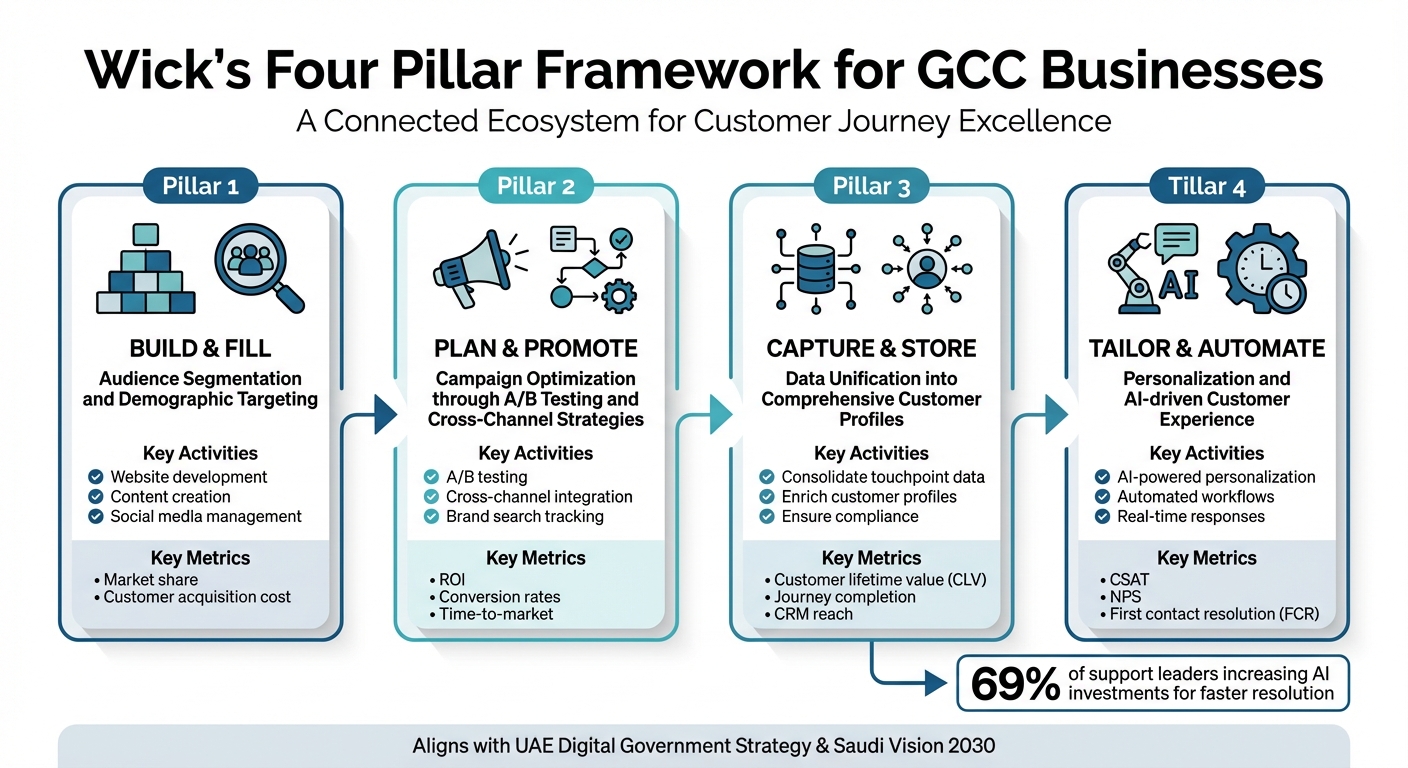
Wick's Four Pillar Framework for Customer Journey KPI Tracking
Understanding Wick's Four Pillar Framework
Wick's Four Pillar Framework is designed to tackle the core challenges GCC businesses face in tracking customer journey KPIs. It creates a seamless digital ecosystem where every stage of the customer journey is interconnected, ensuring data flows smoothly and insights are actionable. Each pillar focuses on a specific aspect of the journey, helping businesses achieve clarity and efficiency in their strategies.
Build & Fill lays the groundwork with website development, content creation, and social media management. This pillar zeroes in on audience segmentation and reaching the right demographic. For GCC businesses, this might mean crafting messages that resonate with Emirati millennials who are highly tech-savvy or appealing to traditional Saudi families with culturally relevant content. Metrics like market share and customer acquisition cost are key here, ensuring the strategy aligns with diverse audience expectations.
Plan & Promote sharpens campaign performance through A/B testing and integrated cross-channel strategies. This pillar tracks ROI, conversion rates, and time-to-market, offering businesses a clear picture of their campaign effectiveness. It also measures brand searches during the consideration phase, providing insight into commercial intent - a critical factor in the GCC market.
Capture & Store takes data from all customer touchpoints and consolidates it into detailed customer profiles. This pillar not only organises data but enriches it with insights from multiple interactions. It supports metrics such as customer lifetime value and journey completion while adhering to the region's strict data compliance standards.
Tailor & Automate leverages AI to deliver personalised customer experiences while monitoring metrics like CSAT, NPS, and first contact resolution (FCR). With 69% of support leaders planning to increase AI investments for faster problem resolution, this pillar ensures automation enhances efficiency without losing the human element. By integrating data across channels, it helps identify and address specific CX challenges, bridging gaps in customer experience understanding.
| Pillar | Core Function | Key Metrics Supported |
|---|---|---|
| Build & Fill | Audience segmentation and demographic targeting | Market share, customer acquisition cost |
| Plan & Promote | Campaign optimisation through A/B testing and cross-channel strategies | ROI, conversion rates, time-to-market |
| Capture & Store | Data unification into comprehensive customer profiles | Customer lifetime value, journey completion |
| Tailor & Automate | Personalisation and AI-driven customer experience | CSAT, NPS, first contact resolution (FCR) |
Aligning KPIs with GCC Business Objectives
The framework addresses common challenges like fragmented data and superficial metrics by aligning KPIs with the broader objectives of GCC businesses. By using these pillars, companies can move beyond outdated metrics and focus on strategies that directly contribute to revenue growth and customer retention. This shift is critical, particularly as 40–50% of GCC centres still operate with a primary focus on cost reduction, while only 10–20% adopt advanced technologies to drive innovation.
By integrating marketing, sales, and customer service, the framework ensures that KPIs represent the entire customer journey. Andrea Hubbert, a PR Strategist and Copywriter, emphasises this collaborative approach:
"It's crucial to involve different departments - marketing, sales, customer service - because the customer journey touches on all these areas. It's a team sport!"
The Capture & Store pillar focuses on metrics like Strategic Value and CRM Reach, aligning data insights with enterprise goals and revenue growth. Meanwhile, the Tailor & Automate pillar measures automation depth and repeat purchase rates, enhancing operational efficiency and building long-term customer loyalty.
For GCC businesses navigating initiatives like Saudi Arabia's Vision 2030 or the UAE's Digital Government Strategy, this framework embeds customer experience (CX) and data ethics into its core. By tying every KPI - from initial awareness to long-term retention - directly to financial goals and regional compliance, it ensures businesses are not just meeting, but exceeding, both market and regulatory expectations.
Conclusion
GCC businesses can't afford to overlook the importance of customer journey KPIs. With internet penetration in the UAE reaching an astounding 99% and 85% of dissatisfied GCC customers leaving without offering feedback, the margin for error is practically non-existent. The transition from relying on reactive surveys to leveraging real-time predictive insights isn't just an upgrade - it's a necessity in a market where consumers demand personalised interactions at every stage.
The numbers paint a clear picture: 72% of high-performing UAE companies monitor Customer Lifetime Value (CLV), compared to just 41% of underperformers. This stark difference highlights the importance of adopting a cohesive KPI strategy that goes deeper than surface-level metrics like page views. Revenue-driven KPIs - such as CLV, predictive churn rates, and first contact resolution - create a direct link between customer experiences and financial outcomes. For instance, 80% of UAE organisations now track revenue as a key service metric, a significant increase from 51% in 2018.
These statistics underline the urgency of predicting and acting on customer behaviours. As Synergy Consulting aptly puts it:
"GCC companies that predict, personalise, and pre-empt will own the next decade. Those that react will watch customers swipe away."
Wick's Four Pillar Framework tackles these challenges by unifying customer data across all touchpoints, from initial awareness to long-term retention. This framework doesn't just track interactions; it transforms them into actionable insights that align with regional compliance requirements. The results are tangible: a 5–15% boost in revenue and a reduction in annual churn by 2–4 percentage points.
FAQs
Which customer journey KPIs should GCC businesses prioritise to link CX to revenue?
GCC businesses need to prioritise customer satisfaction, loyalty, and retention metrics, while also leveraging real-time predictive analytics. These key performance indicators (KPIs) are essential for linking customer experience (CX) directly to revenue. By focusing on these areas, businesses can tackle challenges in monitoring and improving the customer journey effectively.
How can we unify customer data across web, app, CRM, and support without creating new silos?
To bring all your customer data together without creating silos, consider using a Customer Data Platform (CDP). A CDP gathers data from various sources - websites, mobile apps, CRMs, and support systems - and organises it into a single, centralised location.
To make this work smoothly, ensure integration through APIs, follow robust data governance rules, and standardise data formats. Using centralised cloud platforms with real-time syncing ensures the data stays accurate and up-to-date. This approach allows for better insights, more tailored marketing strategies, and enhanced customer experiences - key factors for thriving in fast-paced markets like the UAE.
How can we personalise in the UAE while staying ethical and compliant with data privacy rules?
To tailor customer experiences ethically in the UAE, it's crucial to align with the UAE Data Protection Law. Start by ensuring clear transparency, obtaining explicit consent, and always respecting individuals' rights. Adopt a privacy-first approach by collecting only the data you truly need, safeguarding it with robust measures, and giving customers control over their own information.
Techniques like anonymising data and using secure storage solutions not only help build trust but also ensure compliance with regulations. This way, you can create personalised experiences that are both effective and fully compliant with legal requirements.