

Blog / Customer Journey Automation for SMBs: Tools Guide
Customer Journey Automation for SMBs: Tools Guide
Small businesses in the UAE face unique challenges, from managing WhatsApp inquiries to processing orders while staying competitive. Automation tools simplify these tasks, ensuring timely follow-ups and guiding customers through their journey - from discovering your business to becoming loyal buyers. For UAE SMBs, automation boosts efficiency, saves costs, and improves customer experiences across platforms like WhatsApp, email, and social media.
Key Takeaways:
- Why it matters: Over 70% of online shopping carts are abandoned, but automation can recover lost revenue with follow-ups.
- Top tools: Platforms like Zoho CRM (from AED 80/month) and HubSpot (free plan available) offer tailored solutions for UAE businesses, including Arabic support and WhatsApp integration.
- Benefits: Save up to 25 hours/week, improve conversion rates by 53%, and maintain 24/7 availability without additional staff.
- Local focus: Use tools compliant with UAE data laws, integrate with payment gateways like PayTabs, and support bilingual customer communication.
Pro tip: Start small - automate one workflow, such as abandoned cart reminders, and measure results before scaling up.
How To Set Up Marketing Automation Tools For Small Business #FLTS
sbb-itb-058f46d
Automation Tools for SMBs
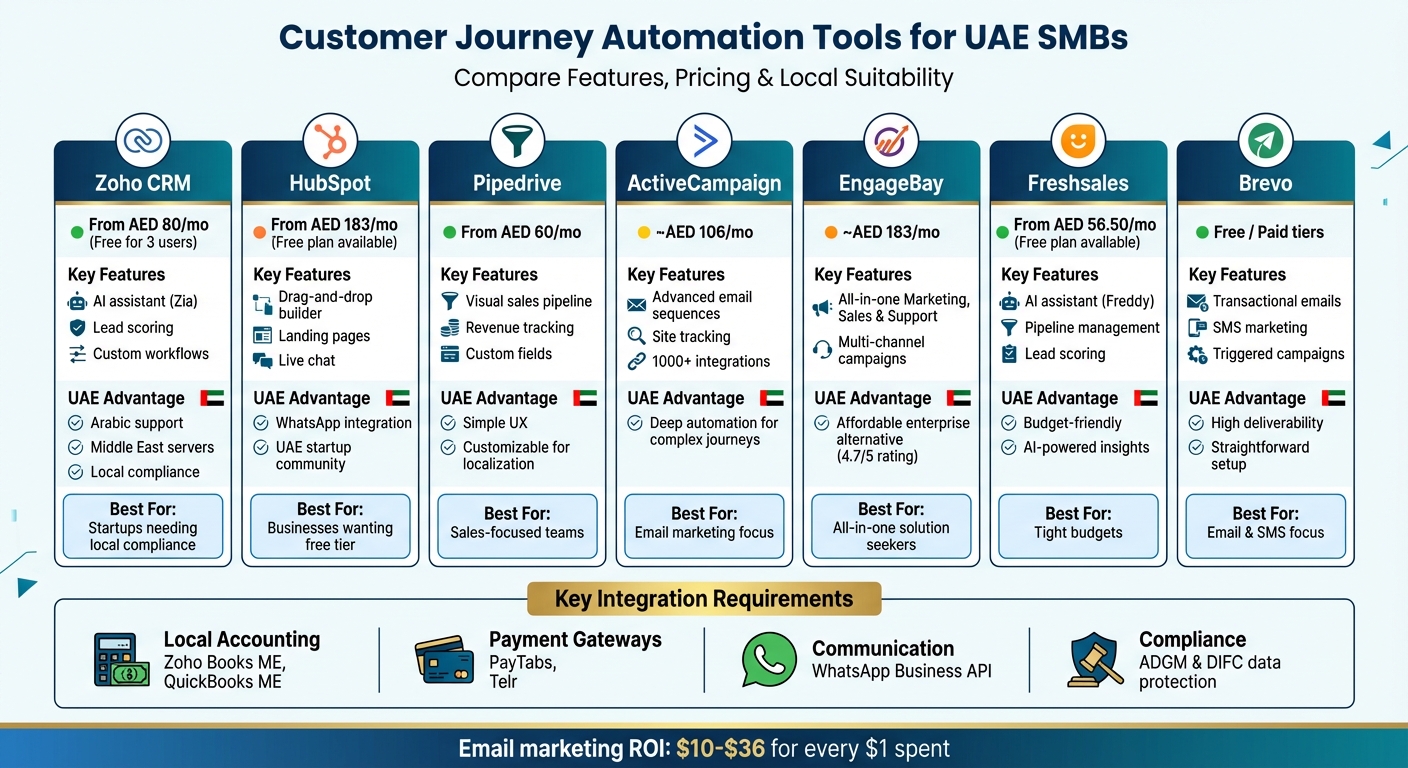
Customer Journey Automation Tools Comparison for UAE SMBs
Key Automation Tools Overview
For UAE-based small and medium businesses (SMBs), selecting the right automation tool involves weighing costs, integration capabilities, and essential features. Thankfully, several platforms are designed for small teams, offering robust solutions without breaking the bank.
Zoho CRM is a standout choice for UAE businesses. It offers a free tier for up to three users, with paid plans starting at AED 80 per user/month. Key features include AI-driven lead scoring through Zia, workflow automation, and Arabic language support. With servers located in the Middle East, it ensures better performance and compliance with local data residency laws. For startups just starting out, Zoho provides an affordable and reliable entry point.
HubSpot CRM is another popular option, with a free-forever plan supporting up to 1,000 contacts and 2,000 branded emails per month. Paid plans start at AED 183/month, adding features like a drag-and-drop workflow builder, landing pages, and live chat. Many UAE startups find HubSpot's free plan an ideal starting place.
Pipedrive offers a simple and intuitive sales pipeline starting at AED 60 per user/month. For businesses focused on email marketing and customer tracking, ActiveCampaign starts at approximately AED 106/month and provides advanced email sequences, site tracking, and over 1,000 integrations used by thousands of small businesses worldwide. EngageBay, priced at around AED 183 per user/month, combines marketing, sales, and customer support in one platform and boasts a high user rating of 4.7/5 across 900+ reviews on G2. For those on a tight budget, Freshsales starts at AED 56.50 per user/month, with a free plan available, offering AI-powered lead scoring and pipeline management. Brevo is another affordable option, providing free transactional emails and SMS marketing, with paid tiers for added features.
For UAE SMBs, integration is just as critical as pricing. Your CRM should seamlessly connect with local accounting software like Zoho Books ME or QuickBooks ME, payment gateways such as PayTabs and Telr, and support WhatsApp Business API. Platforms with Middle East server regions not only improve connection speeds but also help ensure compliance with ADGM and DIFC data protection regulations.
"It's time to stop juggling and start scaling - automated systems are the secret weapon for UAE small businesses looking to grow faster, with less stress." - Louis Pretorius, Brand Marketing & Creative Consultant
Below is a comparison table to help you evaluate the best tool for your business needs.
Tool Comparison Table
| Tool | Pricing (AED) | Key SMB Features | Automation Capabilities | UAE Suitability |
|---|---|---|---|---|
| Zoho CRM | From AED 80/mo (Free for 3 users) | Lead scoring, AI assistant (Zia), Custom workflows | Advanced workflow automation, AI predictions | Arabic support, Middle East servers, local compliance |
| HubSpot | From AED 183/mo (Free plan available) | Drag-and-drop builder, Landing pages, Live chat | Email sequences, Workflow triggers | WhatsApp integration, UAE startup community |
| Pipedrive | From AED 60/mo | Visual sales pipeline, Revenue tracking, Custom fields | Basic automation, Email sync | Simple UX, customisable for localisation |
| EngageBay | ~AED 183/mo | All-in-one Marketing, Sales, and Support suite | Multi-channel campaigns, Lead nurturing | Affordable enterprise alternative (4.7/5 rating) |
| ActiveCampaign | ~AED 106/mo | Advanced email sequences, Site tracking, CRM | Deep automation, 1000+ integrations | High automation depth for complex journeys |
| Freshsales | From AED 56.50/mo (Free plan available) | AI assistant (Freddy), Pipeline management | Automated lead scoring, Workflow builder | Budget-friendly, AI-powered insights |
| Brevo | Free / Paid tiers | Transactional emails, SMS marketing | Simple automation, Triggered campaigns | High deliverability, straightforward setup |
Before deciding on a platform, test its local integration capabilities and ensure that Arabic language support extends to customer-facing communications, not just the interface. With email marketing delivering returns of $10 to $36 for every $1 spent, the right automation tool can quickly become a valuable asset for businesses tailored to the UAE market's specific needs.
Wick's Four Pillar Framework for SMB Automation
Tailor & Automate: Wick's SMB Approach
Wick's Tailor & Automate pillar is designed to tackle the specific automation challenges faced by small and medium-sized businesses (SMBs) in the UAE. By focusing on locally relevant multi-channel engagement and streamlined data management, Wick ensures that automation workflows align with the needs of UAE businesses. High-impact communication channels like WhatsApp, SMS, and RCS are prioritised to connect with local customers effectively.
A key component of this approach is the Customer Data Platform (CDP), which brings together customer behaviour and transaction data into a single source. This unified data layer not only eliminates the need for multiple databases (covering email, web tracking, and messaging platforms) but also allows SMBs to personalise their communication at scale. Tools like visual journey mapping help identify problem areas, such as abandoned shopping carts or unresolved customer queries, which can then be addressed through automated workflows.
With no-code visual builders, even small teams can create automation triggers, set conditions, and define follow-up actions. For example, a WhatsApp message can be automatically sent an hour after a cart is abandoned, encouraging customers to complete their purchase. Behaviour-based logic can also be implemented, such as sending a follow-up message if the customer doesn't engage with the initial communication, ensuring no potential lead is overlooked.
"Octopus turned our marketing into a conversion engine - automated, precise, and impactful." - Amina Calderon, Growth Manager
Wick's platform integrates seamlessly with local systems like Zoho Books ME for accounting, PayTabs and Telr for payment processing, and major CRM platforms. This connectivity enables SMBs to automate lead capture from website forms, lead magnets, and communication tools, ensuring that follow-ups happen instantly without manual effort.
Advanced Plan Features for SMBs
Wick's Advanced Plan builds on the Tailor & Automate foundation, offering additional tools to help SMBs scale their operations. While the basic plan addresses essential automation needs, the Advanced Plan introduces AI-driven solutions and enhanced multi-channel capabilities for businesses looking to grow further.
One standout feature is AI-powered lead scoring, which ranks prospects based on their readiness to buy. This allows sales teams to focus their efforts on high-priority leads, a crucial advantage for SMBs with smaller teams. In fact, 71% of employees believe generative AI can significantly reduce manual tasks, freeing up time for strategic decision-making.
The plan also includes multi-channel orchestration, enabling businesses to maintain a consistent brand voice across platforms like WhatsApp, SMS, Email, Messenger, and Instagram. Unlike tools that operate in silos, Wick's framework ensures messages are tailored to each platform's format and timing while delivering a unified customer experience. For instance, if a customer clicks a link in an email but doesn't make a purchase, they can receive a follow-up WhatsApp message with an interactive button, simplifying the buying process.
Performance tracking is another key feature, allowing SMBs to monitor metrics like click-through rates, conversion rates, and customer retention in real time. Businesses can use this data to run A/B tests on content, timing, and triggers, fine-tuning their workflows for better results. Wick also supports hyper-personalisation, creating advanced workflows that adapt to individual customer behaviours. For example, a customer browsing high-value products repeatedly might be added to a VIP nurture sequence offering exclusive deals.
Integration with the WhatsApp Business API through official Business Solution Providers (BSPs) ensures reliable, high-volume communication. This is especially important in the UAE, where personalised content can increase customer engagement and boost conversion rates by up to 40%. Additionally, Wick operates within ADGM and DIFC data protection guidelines by using Middle East-based cloud servers, ensuring both faster performance and compliance with local regulations.
Customising Workflows for UAE SMBs
How to Build Automation Workflows
Start by mapping the entire customer journey - from initial awareness to long-term retention. Pinpoint areas where customers tend to drop off, such as abandoned carts or unanswered enquiries. These are the pain points where automation can make a real difference. Lay out each touchpoint visually and define triggers for actions like link clicks, time spent on a page, or even exit intent.
For UAE businesses, WhatsApp integration is a must. With 79.6% of social media users in the UAE active on WhatsApp, it’s a channel with unparalleled engagement. Set up automated welcome messages to respond instantly when leads come in through website forms or social media platforms.
Synchronise your messaging across multiple channels to ensure consistency. Connect email, SMS, WhatsApp, and social media lead forms into one cohesive workflow. For example, if a customer clicks a link in an email but doesn’t complete their purchase, trigger a follow-up message on WhatsApp. Include interactive buttons to make the buying process smoother. Tailor these workflows to align with UAE-specific standards and cultural preferences.
| Workflow Stage | UAE-Specific Automation Action | Recommended Channel |
|---|---|---|
| Awareness | Deliver lead magnets via WhatsApp/Email | WhatsApp, Social Media |
| Consideration | Share automated FAQs and product/property photos | WhatsApp Business API |
| Decision | Send abandoned cart reminders with AED pricing | WhatsApp, SMS |
| Purchase | Provide in-chat payment links and order confirmations | WhatsApp Catalogue |
| Retention | Collect post-purchase feedback and offer loyalty rewards | Email, WhatsApp |
Localising Automation for UAE Markets
Adapting to local standards not only builds trust but also enhances the customer experience. Ensure all data formats comply with regional norms: use DD/MM/YYYY for dates, AED for pricing, and metric units for measurements. For payments, integrate local gateways like PayTabs or Telr. Additionally, connect with tools like Zoho Books ME for accounting and opt for platforms using Middle East-based cloud servers. This approach improves connection speeds and ensures compliance with ADGM and DIFC data protection regulations.
Support both Arabic and English to cater to the UAE’s linguistically diverse audience. Segment your customers based on language preference, location (e.g., Dubai vs. Abu Dhabi), and purchase behaviour. This segmentation allows you to send highly relevant broadcast campaigns.
Timing is everything. Adjust your automation workflows to reflect local events like Ramadan, when shopping habits and working hours change. Schedule campaigns and follow-ups to align with these shifts, ensuring messages land when customers are most likely to engage. Personalised content during such periods can increase purchase rates by as much as 40%.
Implementation Best Practices
Onboarding and Testing Workflows
When introducing automation, start small and test thoroughly. Instead of rolling out automation across every department at once, begin with a pilot programme. Focus on a single department or a specific customer segment. This phased approach helps minimise disruptions and allows you to identify and fix potential issues early on. By optimising one area at a time, you can gradually expand automation with confidence.
Try A/B testing during onboarding. For example, automate one half of a campaign - like welcome emails or abandoned cart reminders - while managing the other half manually. Then, compare metrics such as engagement rates, conversions, and customer feedback between the two groups. This process ensures that automation is genuinely adding value before you commit to scaling it up. For instance, test automated WhatsApp follow-ups against manual ones to determine which approach resonates better with UAE-based customers.
To streamline the process, visually map your workflows. This makes it easier to spot and fix potential issues, such as payment gateway errors with platforms like PayTabs or Telr. Additionally, ensure compliance with UAE data protection laws, including ADGM and DIFC regulations, by testing how your workflows handle customer data storage and processing.
Invest in building in-house expertise. Conduct training sessions to familiarise your team with the automation tools, and create detailed documentation for each workflow. This equips your team to troubleshoot common problems and adapt workflows based on customer feedback.
Once your workflows are running smoothly and thoroughly tested, shift your focus to tracking performance and optimising for better results.
Measuring and Improving ROI
After validating workflows, it’s essential to assess their impact on both revenue and operational efficiency. Keep an eye on key metrics like AED revenue growth, conversion rates from Marketing Qualified Leads (MQLs) to paying customers, and customer retention rates. These figures reveal whether automation is driving results or simply adding unnecessary complexity.
For example, Beijing Tong Ren Tang in the UAE saw a 93% rise in revenue and over 300% growth in monthly MQLs by restructuring their marketing and sales processes with automation. Similarly, Bafco achieved a 45% increase in lead-to-customer conversion rates through tailored automation solutions. These successes stem from a combination of precise measurement and continuous improvement.
Don’t just measure revenue - track efficiency gains too. Calculate how much time your team saves on repetitive tasks like assembling emails, entering data, or scheduling follow-ups. Automation can cut operational costs by 20–30% and reduce quality control inspection expenses by half. Compare your cost per lead before and after automation to quantify the savings.
Monitor engagement across all channels, with a special focus on WhatsApp, which reaches 79.6% of UAE social media users. Analyse reply rates, message open rates, and click-through rates on interactive buttons. Be alert to signs of disengagement, such as customers unsubscribing or ignoring messages, as these indicate areas where workflows may need fine-tuning. Even a modest 5% increase in customer retention through automation can boost profits by 25–95%.
Set SMART goals to keep your efforts focused. For instance, aim to "increase lead generation by 25% within six months" or "reduce response times to under two hours." Review these metrics monthly and adjust workflows based on the data. Also, include compliance in your ROI calculations - non-compliance with data regulations can cost 2.65 times more than implementing proper measures.
Conclusion and Key Takeaways
For SMBs in the UAE, customer journey automation isn't just a luxury - it's becoming a necessity. With 65% of UAE consumers expecting fast, proactive communication, automation allows small teams to deliver the kind of service that rivals much larger enterprises, all without stretching their budgets thin.
The financial benefits speak for themselves. Maintaining a 24/7 human support team can cost anywhere from AED 33,000 to AED 55,000 per month. In contrast, deploying a conversational AI agent ranges between AED 1,800 and AED 9,200. But it’s not just about cutting costs - automation also boosts revenue. Take TKD Lingerie, for example: by using personalised WhatsApp broadcasts and omnichannel automation, they achieved an impressive 40X return on their ad spend.
"It's not just about saving time - it's about creating a system that works for you 24/7."
– Louis Pretorius, CRM & Sales Automation Consultant
To make automation work for your business, start small but think strategically. Focus on one impactful workflow - such as recovering abandoned carts, following up with leads instantly, or confirming appointments via WhatsApp. Test thoroughly, track metrics like conversion rates and response times, and scale once you see results. Make sure to choose tools that integrate well with platforms popular in the region and adhere to local data regulations.
FAQs
How can customer journey automation benefit SMBs in the UAE?
Customer journey automation offers a practical way for SMBs in the UAE to streamline their operations, save valuable time, and enhance customer engagement. By automating tasks such as email scheduling, lead scoring, and follow-ups, businesses can shift their focus towards growth without the need to expand their workforce. This approach also enables more personalised interactions, tailored to local preferences. For instance, businesses can address specific behaviours like cart abandonment during Ramadan or price comparisons in AED, ensuring communication remains timely, relevant, and culturally aligned.
On top of that, automation provides real-time data insights, allowing businesses to monitor key performance metrics like email open rates and revenue. This data empowers smarter decision-making and helps maximise ROI. With features like audience segmentation and AI-powered recommendations, companies can deliver tailored content in either Arabic or English, all while adhering to local data privacy laws. By integrating websites, social media platforms, CRM systems, and analytics into a unified strategy, businesses can create a seamless digital ecosystem that fosters trust, builds loyalty, and supports sustainable growth over the long term.
How can automation tools help UAE SMBs streamline their operations while meeting local needs?
Automation tools like Zoho CRM and HubSpot are tailored to meet the specific needs of UAE-based small and medium businesses (SMBs).
Zoho CRM provides an affordable and flexible solution, featuring tools like lead scoring, workflow automation, and omnichannel communication. It supports both Arabic and English, displays prices in AED (د.إ), and complies with local data protection standards, ensuring data is securely stored in UAE-approved centres. With its mobile app, sales teams working in cities like Dubai, Abu Dhabi, and Sharjah can easily stay updated on the go.
Meanwhile, HubSpot excels in inbound automation, offering advanced workflows for email, social media, and chatbots. Its localisation features include Arabic templates, Ramadan-specific scheduling, and integration with UAE payment gateways and ERP systems. The platform also customises analytics to display revenue in AED and adheres to local compliance requirements, delivering actionable insights for business leaders.
Both tools enable UAE SMBs to streamline operations while respecting cultural and regulatory requirements, making it easier to deliver personalised customer experiences without unnecessary complications.
Why is integrating WhatsApp important for SMBs in the UAE?
WhatsApp plays a key role in communication for SMBs across the UAE, being the most popular social platform in the region - used by over 79.6% of social media users. By integrating WhatsApp into a customer journey automation system, businesses can streamline operations like automating responses, sending transactional updates, abandoned cart alerts, and running personalised marketing campaigns - all without needing manual input.
For SMBs in the UAE, integrating WhatsApp effectively means addressing local preferences. This includes offering both Arabic and English language options, displaying prices in AED, and considering culturally relevant factors like Ramadan timings. A consultancy like Wick can assist in setting up this integration, ensuring features like lead scoring, segmentation, and analytics are seamlessly incorporated. This not only improves the customer experience but also drives measurable business growth, helping SMBs stay competitive in the UAE's dynamic market.