
Blog / How Cross-Channel Messaging Builds Customer Trust
How Cross-Channel Messaging Builds Customer Trust
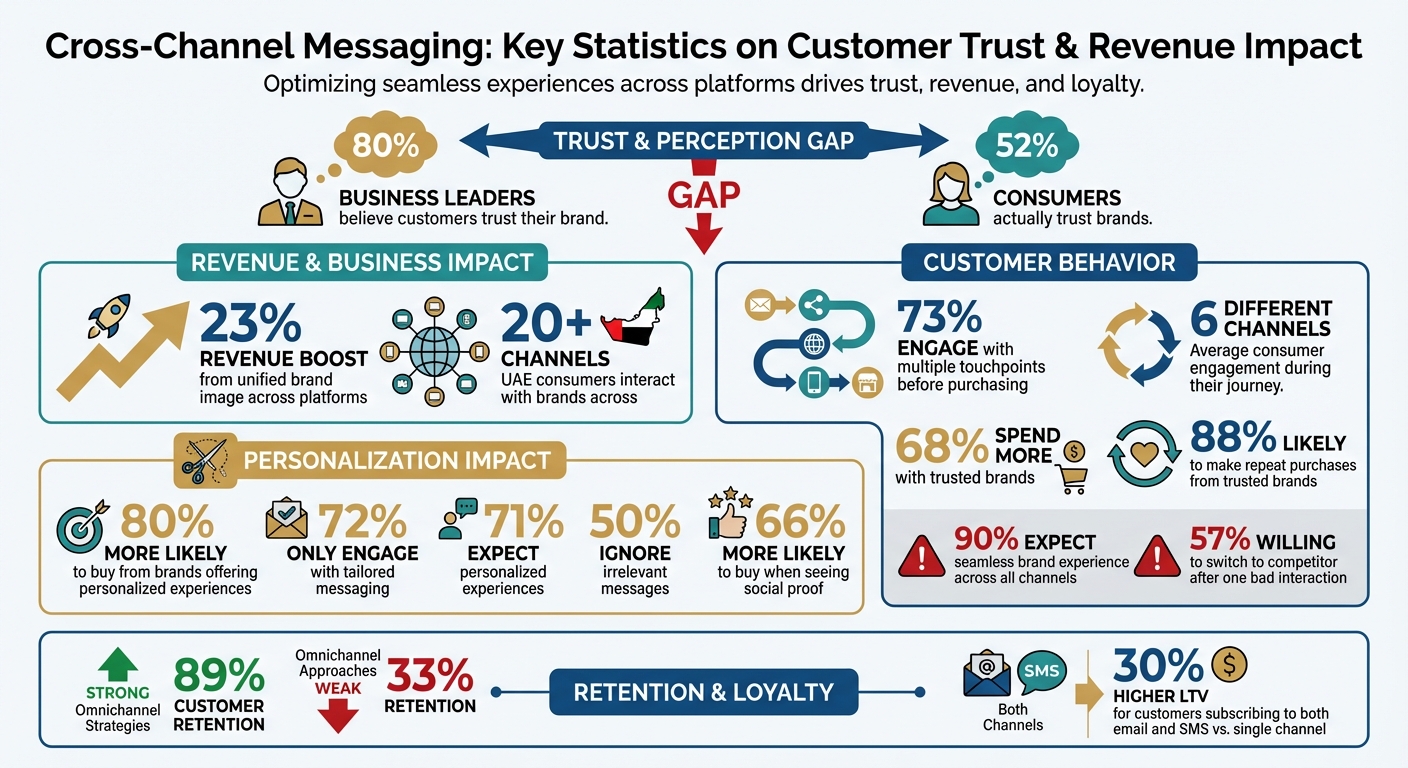
Consistent cross-channel messaging is key to gaining customer trust. Research shows that businesses with a unified brand image across platforms can boost revenue by 23%. Yet, only 52% of consumers trust brands, compared to 80% of business leaders who believe otherwise. In the UAE, where consumers interact with brands across 20+ channels, this gap can result in lost opportunities.
Here’s why this matters and how to fix it:
- Trust Drives Sales: 68% of customers spend more with trusted brands, and 88% are likely to make repeat purchases.
- Cross-Channel Messaging Defined: Unlike multichannel marketing, this approach integrates platforms for a seamless customer journey.
- Customer Journey Mapping: Identify touchpoints (e.g., Instagram, WhatsApp, in-store) to maintain consistent communication from awareness to retention.
- Unified Data: Use tools like CDPs to merge customer data, enabling precise and consistent messaging.
- Personalisation: Tailor messages to each customer while maintaining a consistent brand voice.
For UAE businesses, aligning messaging across platforms while respecting local preferences (e.g., Arabic/English content, Ramadan campaigns) is critical. Brands that integrate cross-channel strategies can better connect with their audience, retain customers, and outperform competitors.
Cross-Channel Messaging Statistics: Trust, Revenue & Customer Behavior Data
Mastering Cross-Channel Marketing For A Seamless Customer Journey
sbb-itb-058f46d
Mapping the Customer Journey Across Channels
Before delivering consistent messaging, it’s crucial to identify every point where customers interact with your brand. On average, customers engage with a brand through six different channels during their journey. By mapping these touchpoints, you can see the full customer experience - from the first Instagram ad they encounter to the follow-up WhatsApp message after a purchase.
Today’s customer journey isn’t a straight line. It’s fluid and can jump across platforms and devices. For instance, someone might discover your brand on TikTok, explore your products on your website, reach out with questions through WhatsApp, visit your physical store, and then complete the purchase via your mobile app - all in just a few days. Each interaction is an opportunity to build trust through consistent messaging - or risk losing it with mixed signals.
Steps to Identify Key Touchpoints
To map the customer journey, break it down into stages: Awareness, Consideration, Decision, Purchase, Post-purchase, and Retention. For each stage, list all possible interaction points, including direct channels like your website and app, as well as indirect ones like online reviews and social media discussions.
Take Panera Bread as an example. They utilised Twilio Programmable Messaging to streamline communications across their website and mobile app. Under the leadership of Raj Anbalagan, SVP of Digital Technology and Innovation, they introduced SMS integration at over 2,000 locations, making the order-to-pickup process seamless. This initiative helped digital channels contribute to 49% of total sales during that period.
Effective mapping requires input from multiple teams. Marketing teams bring insights into digital touchpoints, sales identifies key conversion moments, customer service highlights common support interactions, and IT ensures the technical infrastructure supports the strategy. This collaboration ensures no critical customer moment is overlooked, paving the way for consistent messaging.
By mapping these interactions, you create the foundation to integrate fragmented data into a unified customer view.
Integrating Data for a Single Customer View
Once touchpoints are mapped, the next step is to unify customer data. This ensures precise and consistent messaging across all channels. Without integration, scattered data from CRM, e-commerce, and analytics systems can result in an incomplete customer picture, making consistent communication difficult.
A Customer Data Platform (CDP) or an integrated CRM can bring together data from web, mobile, and offline sources into one comprehensive customer profile. For example, if a customer browses products on their mobile device, the system can follow up with a personalised email referencing the exact items they viewed.
The benefits of a unified customer view are clear. Businesses with strong omnichannel strategies retain 89% of their customers, compared to just 33% for those with weaker approaches. Additionally, 90% of consumers expect a seamless brand experience across all channels, and 57% are willing to switch to a competitor after a single bad interaction. In the UAE’s competitive market, integrating data to deliver consistent messaging is key to fostering loyalty and standing out.
Creating Consistent and Personalised Messaging
Once you've established a unified view of your customers, the next step is to craft messaging that is both consistent and personalised. Why does this matter? Because 80% of consumers are more likely to buy from brands that offer personalised experiences, and 72% say they only engage with tailored messaging.
The trick lies in balancing two key elements: your brand voice and your brand tone. Your brand voice is the constant - it reflects your brand's personality, whether that's "helpful and straightforward" or "bold and forward-thinking." Your tone, on the other hand, adjusts based on context. For example, an urgent push notification about a flash sale will naturally sound different from a detailed email introducing a new service. Yet, both should feel like they come from the same brand. As PushEngage puts it, "Real consistency is about maintaining your core brand personality whilst adapting to each channel's unique context and audience expectations".
Armed with a strong data foundation, you can ensure your brand's voice stays intact while tailoring messages to individual preferences.
Personalisation Without Losing Brand Consistency
To pull this off, create clear guidelines that define fixed elements, like your logo and core values, while allowing flexibility in tone depending on the channel. For instance, emails can be conversational and detailed, while SMS messages should be short and direct - both still clearly reflecting your brand.
A great example comes from KFC Spain. Back in December 2025, they faced criticism over their fries. Instead of ignoring the feedback, they identified affected customers and sent personalised compensation offers across multiple channels - email, in-app messages, and push notifications. Each message carried the same apologetic tone, but the format was tailored to fit the channel. The results? A 95% email open rate, a 679% increase in app downloads, and a 20× spike in daily orders on launch day. This shows how consistent yet personalised messaging builds trust and drives results.
Modern tools can make this process even smoother. AI-powered validation systems, for example, can scan your content to ensure it aligns with your brand's tone, voice, and visual style before it goes live. Additionally, modular content systems allow you to create templates with dynamic fields, enabling personalised messages while keeping everything on-brand.
Once you've mastered consistent personalisation, the next step is to segment your audience for even more effective communication.
Adapting Messaging for Different Customer Segments
Every customer is at a different stage in their journey, and your messaging should reflect that. New subscribers might need warm, educational messages introducing your brand's value. Returning customers? They’ll appreciate personalised product recommendations based on their past purchases. And for loyal customers, exclusive offers or behind-the-scenes content can reinforce their connection to your brand.
One proven way to segment your audience is through eRFM modelling, which groups customers by Engagement, Recency, Frequency, and Monetary value. For instance:
- First-time buyers could receive a discount code along with helpful tips to get started.
- Frequent shoppers might get early access to new products or VIP perks.
Both messages will stay true to your brand voice, but their tone and content will adapt to the customer’s stage in the journey.
The impact of personalisation is hard to ignore. Shoppers spend an average of 38% more when their experience is tailored. Plus, 66% of customers are more likely to buy when they see social proof, like reviews or testimonials. In a diverse market like the UAE, tailoring messaging to account for language preferences, shopping habits, or local tastes can further strengthen engagement - all while keeping your brand instantly recognisable.
Implementing Wick's Four Pillar Framework for Cross-Channel Integration
Wick's Four Pillar Framework provides a structured approach to ensure consistent messaging across all your digital touchpoints. This method helps unify your marketing efforts, creating a seamless system that connects every aspect of your brand's communication.
Overview of the Four Pillar Framework
Wick's framework breaks cross-channel integration into four key pillars:
Build & Fill lays the groundwork for your digital presence. Start by creating a centralised website that serves as your digital hub, producing content that resonates with your audience, and maintaining an active social media presence. With 71% of customers expecting personalised experiences and 50% ignoring irrelevant messages, conducting a full audit of your visuals and messaging is crucial. This ensures your brand guidelines are clear and consistent across all platforms.
Plan & Promote focuses on keeping your messaging uniform while reaching the right audience. This includes strategies like SEO, paid ads, and influencer collaborations, all aimed at reinforcing your brand identity. By mapping the customer journey, you can identify critical touchpoints across both online and offline channels, then select the most effective communication methods for your audience.
Capture & Store is all about data integration. Use tools like a Customer Data Platform (CDP) or CRM to consolidate fragmented data into a single, unified view of your customers. This 360-degree perspective connects interactions, sales data, and social media activity, enabling more personalised communication.
Tailor & Automate ties everything together with AI-driven personalisation and automation. AI tools can validate content against brand guidelines before publishing, while automation handles tasks like cart abandonment reminders or location-based offers. This ensures your customers receive timely, relevant messages without manual effort.
By following this method, businesses can streamline their marketing efforts and achieve measurable results, as explored in the next section.
Benefits for UAE Businesses
For businesses in the UAE, this framework offers unique advantages. The region's multilingual and diverse market requires messaging that respects cultural nuances while maintaining brand consistency. Wick's approach allows you to create content for both Arabic and English-speaking audiences, adapt to local shopping habits during key periods like Ramadan, and deliver offers tailored to regional preferences - all without diluting your brand identity.
The framework's adaptability is another key benefit. Whether you're a startup in Dubai or a large enterprise operating across the Emirates, the system grows with your business. AI-driven insights help decode customer behaviours specific to the UAE market, while automation reduces repetitive tasks, allowing your team to focus on strategic goals.
Choosing the Right Plan for Your Business
Wick offers three tailored plans to suit varying business needs:
| Plan | Best For | Core Features | Approach |
|---|---|---|---|
| Basic | Small businesses building their presence | Website creation, basic SEO, content production, social media management | Foundational tools to establish your cross-channel strategy |
| Advanced | Mid-sized businesses looking to expand | Advanced SEO, paid ads, influencer marketing, data analytics, journey mapping | Growth-oriented solutions with robust data integration |
| Enterprise | Large organisations needing full transformation | Full framework implementation, AI personalisation, CDP setup, strategic consulting | Comprehensive integration with advanced automation |
Each plan is custom-priced to fit your specific goals. Whether you're just starting out or looking for a complete digital transformation, there’s a plan designed to match your needs.
Measuring Success and Improving Cross-Channel Messaging
To ensure your cross-channel marketing efforts build trust rather than add to the noise, tracking the right metrics is essential. Start with key financial indicators like Customer Acquisition Cost (CAC) and Customer Lifetime Value (LTV). A strong LTV:CAC ratio of 3:1 or higher means that every customer generates three times the amount it costs to acquire them. This is particularly important for businesses in the UAE during high-traffic times, such as Ramadan.
Another critical metric is the Cross-Channel Engagement Rate, which focuses on combined interactions - likes, shares, clicks - across all platforms. This provides a clearer picture of how well your messaging resonates as a whole, rather than assessing each platform in isolation. With 73% of customers engaging with multiple touchpoints before making a purchase, analysing the "Path to Conversion" can help identify which sequences of interactions are most effective. From there, you can pinpoint areas where friction might be eroding trust along the customer journey.
Key Metrics to Monitor
Metrics that highlight friction points are vital for understanding and improving the customer experience. For instance, Time to Conversion shows how long it takes for a customer to move from their first interaction to making a purchase. Similarly, Active List Growth measures the number of engaged subscribers across multiple channels, rather than focusing solely on a single email list. Research shows that customers subscribing to both email and SMS programmes tend to have a 30% higher Lifetime Value compared to those using only one channel. For UAE businesses catering to both Arabic and English-speaking audiences, this is an especially useful insight.
Channel-specific metrics are equally important. Keep an eye on email open rates (a healthy range is 20–25%), click-through rates, and website bounce rates to identify technical issues early on. Regularly audit automated flows like cart abandonment emails and browse-triggered messages. For example, if your website traffic doubles but your automated messages remain unchanged, it could signal a technical problem that undermines customer trust.
Beyond these individual metrics, using attribution models can provide a deeper understanding of how different channels work together to build trust.
Using Attribution Models for Insights
Attribution models allow you to see which channels contribute to building trust throughout the customer journey. Multi-touch attribution goes beyond the outdated "last-click" approach by showing how various channels interact. For example, in 2024, H&R Block used Amazon Marketing Cloud to analyse customer journeys across Prime Video, Twitch, and display ads. They found that adding online video to display ads resulted in a 47% increase in conversion rates, while their full-funnel strategy achieved a 144% higher conversion rate compared to display-only campaigns.
"Cross-channel attribution helps reveal hidden influencers by showing how seemingly minor touchpoints contribute to conversions that might otherwise be credited solely to the last interaction." - Amazon Ads
Different attribution models suit different needs. Position-Based models are ideal for businesses with longer sales cycles, emphasising both discovery and conversion phases. On the other hand, Time-Decay models prioritise recent interactions, making them more effective during short-term promotions. For instance, Hanes discovered that customers exposed to both display and search ads converted at twice the rate of those seeing only search ads, generating AED 28.5 million in attributed sales.
To refine your strategy further, combine attribution insights with A/B testing. Experiment with timing, frequency, and content, and measure the results against your own historical data rather than generic industry benchmarks. This is especially relevant in the UAE, where cultural events and multilingual preferences play a significant role in shaping customer behaviour. Additionally, breaking down metrics by geography and demographics can reveal whether certain Emirates or customer groups prefer SMS over social media, enabling you to fine-tune your channel mix.
Conclusion: Building Customer Trust with Cross-Channel Messaging
Earning customer trust hinges on consistent, personalised communication across every interaction. When your brand delivers a steady and unified message - whether on social media, via email, or through SMS - it builds a sense of reliability that directly impacts purchasing behaviour. For instance, 88% of customers are more likely to make repeat purchases, and 68% tend to spend more when they trust a brand's messaging consistency.
In the UAE, businesses have a unique opportunity to capitalise on a diverse market by adopting a unified yet flexible approach. With customers interacting across an average of 20 different channels, brands that cater to individual preferences - such as offering content in both Arabic and English or letting customers choose between SMS and email communications - demonstrate both cultural awareness and operational efficiency. Striking this balance between a cohesive brand identity and tailored delivery sets memorable brands apart from the rest.
To succeed, businesses must employ a data-driven strategy that quantifies trust in actionable ways. Metrics like Customer Lifetime Value and Cross-Channel Engagement Rate, combined with multi-touch attribution models, provide valuable insights into the effectiveness of different touchpoints. However, a trust gap persists: while 80% of business leaders believe their customers trust their brand, only 52% of consumers feel the same. Bridging this gap requires a commitment to honest evaluation and ongoing improvement.
As highlighted earlier, a unified cross-channel strategy not only builds trust but also delivers measurable benefits. Wick's Four Pillar Framework offers a clear roadmap for integrating cross-channel efforts in the UAE, from creating consistent digital assets to unifying customer data and automating personalised responses. Whether you're a small business taking your first steps or a large organisation pursuing a full-scale digital transformation, the key lies in maintaining consistency in visual identity, messaging tone, and overall experience across every platform.
FAQs
What’s the difference between cross-channel and multichannel messaging?
The key distinction is in how the platforms work together. Multichannel messaging operates across various platforms independently, letting customers choose their preferred way to interact. However, it doesn't guarantee a consistent experience across those channels. On the other hand, cross-channel messaging creates a unified experience by coordinating messages across platforms like email, social media, and mobile apps. This synchronised approach ensures consistency and delivers targeted communication, leveraging data from all channels to build trust and connection.
How do I start mapping my customer journey across UAE channels?
Start by figuring out where your customers spend the most time - whether that's social media, mobile apps, or physical stores. Once you've pinpointed these key areas, make sure your messaging stays consistent across all of them. Use data to get a deeper understanding of your customers' behaviours and preferences, combining these insights to create a unified picture of who they are.
Take it a step further by automating and personalising your interactions with tools like marketing automation. This not only saves time but also makes your communication feel more relevant to each customer. Finally, keep improving your approach by closely monitoring engagement, tracking conversions, and listening to customer feedback. These steps will help you earn trust and build long-lasting loyalty.
Which metrics best prove cross-channel messaging is building trust?
Metrics that show how trust is built through cross-channel messaging include consistency and transparency as perceived by the audience. When messaging aligns seamlessly across platforms, it often results in stronger customer loyalty, more engagement, and higher spending. For instance, when brands maintain cohesive messaging, they frequently see tangible benefits like increased customer consumption and better campaign performance.