
Blog / Cross-Channel Marketing: Best Practices For 2025
Cross-Channel Marketing: Best Practices For 2025
Cross-channel marketing ensures your customers enjoy a smooth, connected experience across platforms like websites, apps, WhatsApp, and physical stores. By 2025, UAE businesses can no longer ignore its importance. Here's why and how to implement it effectively:
- Why It Matters: Mobile commerce now drives 60% of global e-commerce sales, and UAE consumers expect consistent interactions across channels. Yet, only 25% feel brands meet these expectations.
- Key Benefits: Brands using cross-channel strategies see up to 9.5% revenue growth, 89% better customer retention, and higher engagement when using AI and first-party data.
- Actionable Steps:
- Use mobile app retargeting with deep links to recover abandoned carts.
- Add Connected TV (CTV) to your strategy for better reach and conversions.
- Implement a Customer Data Platform (CDP) to centralize data and ensure consistent messaging.
- Focus on unified messaging to avoid over-messaging and build trust.
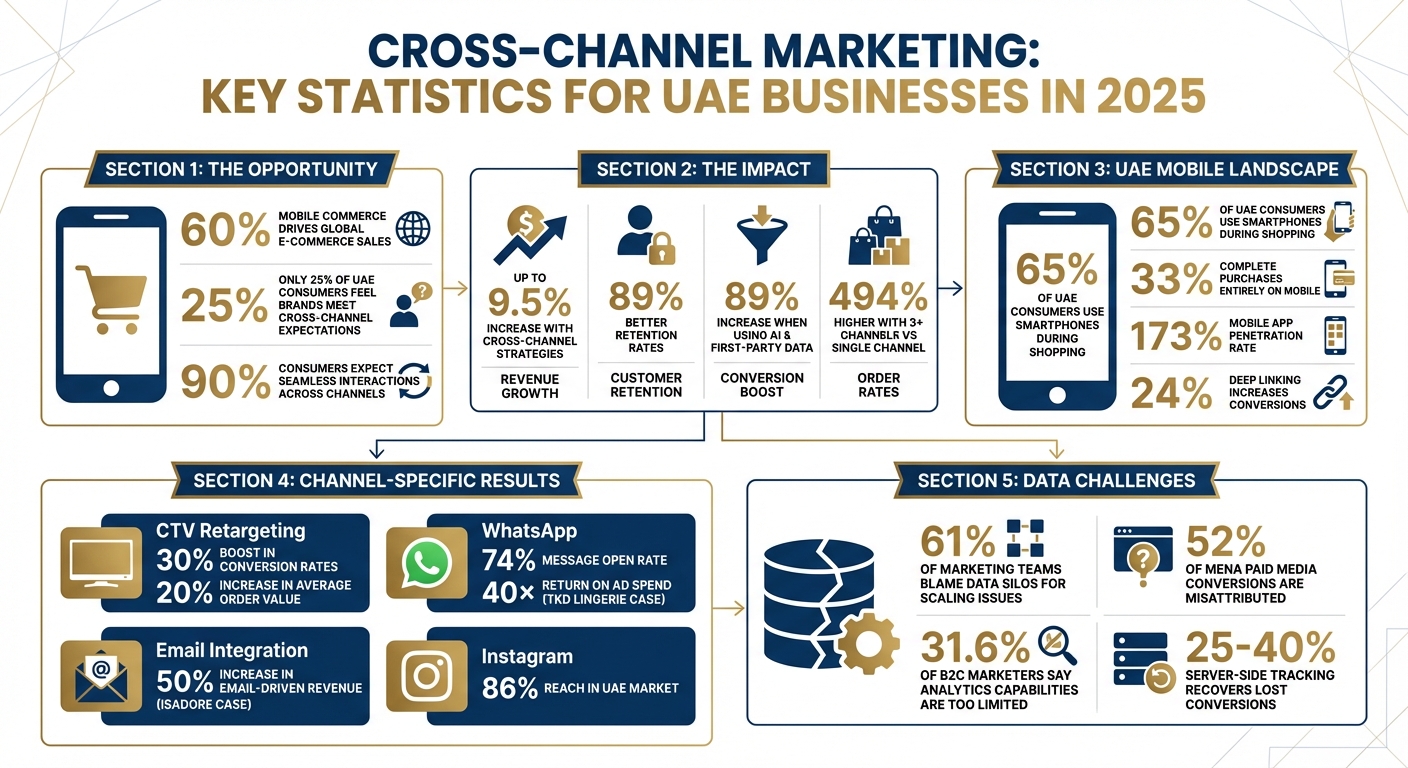
Cross-Channel Marketing Statistics and Impact for UAE Businesses 2025
Mastering Cross-Channel Marketing For A Seamless Customer Journey
sbb-itb-058f46d
Best Practices for Cross-Channel Marketing
Building on the idea of unified messaging, these strategies are shaping effective cross-channel marketing in 2025.
Invest in Mobile App Retargeting
In the UAE, where 65% of consumers use smartphones during their shopping journey and over 33% complete purchases entirely on mobile, app retargeting has become a must. Predictive analytics plays a crucial role here, helping brands identify users at risk of disengaging. For instance, patterns like reduced session frequency or shorter browsing times can signal when to launch re-engagement campaigns.
Streamlining the user journey with deep linking can make a big difference. If you send a retargeting email or SMS, direct users to the exact product page or cart they abandoned instead of the app's homepage. This simple adjustment can increase conversions by up to 24%. For example, Anigma Technologies, a UAE-based gaming PC retailer, used an omnichannel tool in 2026 to connect interactions across Instagram, Facebook, and WhatsApp. By automating abandoned cart responses, they recovered 70% of cancelled orders and grew their customer base by 25%.
Adding Connected TV (CTV) strategies to your retargeting plan can also expand your reach across multiple devices.
Leverage Connected TV (CTV) Retargeting
CTV is quickly becoming a popular tool in the UAE, offering a way to complement mobile and web marketing efforts. The key is to maintain consistent messaging across all screens. For example, if a customer browses your app but doesn’t make a purchase, you could serve them a CTV ad at home featuring a special offer - like free shipping or a discount code. This approach has been shown to boost conversion rates by 30% and increase average order value by 20%.
What sets CTV apart is its ability to merge traditional and digital media. Start with compelling storytelling on CTV to grab attention, then follow up with targeted mobile in-app ads to drive specific actions. To avoid overwhelming your audience, deploy frequency capping across platforms, especially when targeting households.
Align Messaging Across All Channels
Unified messaging is essential to maintaining customer trust. Inconsistent communication can confuse customers and weaken your brand. In the UAE’s diverse market, this means creating brand guidelines that ensure consistency in tone, visuals, and messaging across every platform - from WhatsApp to Instagram to physical stores. With 90% of consumers expecting seamless interactions across channels, this is more important than ever.
A centralised CRM or Customer Data Platform (CDP) can help maintain this consistency. It ensures that conversations started on WhatsApp retain their context when they shift to email or an in-store interaction. For example, TKD Lingerie, a UAE-based retailer, used WhatsApp Broadcast via an omnichannel platform to send personalised promotions in 2026. This approach achieved a 74% message open rate and a 40× return on ad spend.
To cater to the UAE’s diverse audience, consider using multilingual strategies and emirate-specific landing pages. Breaking down silos between marketing, sales, and customer service teams is also crucial to ensure everyone communicates the same message.
| Channel | UAE Usage/Reach | Best Practice for Consistency |
|---|---|---|
| High Trust/Dominant | Use for real-time support and personalised broadcasts | |
| 86% Reach | Focus on high-quality visuals and influencer alignment | |
| Google Search | 95% Market Share | Use multilingual keywords (English/Arabic) |
| Mobile Apps | 173% Penetration | Use deep links and predictive retargeting |
| CTV | Growing | Reinforce messaging from mobile/web interactions |
Using Data for Cross-Channel Success
Data is the backbone of any successful cross-channel marketing strategy. Without it, even the most well-planned campaigns can fall apart. In fact, 61% of marketing teams blame data silos for their inability to scale campaigns. In the UAE's competitive digital space, this disconnect can translate into lost revenue. The key? Treat data as the starting point for every decision - not just an afterthought.
Centralise Data for Better Insights
A Customer Data Platform (CDP) acts as a central hub, gathering and unifying first-party data from various sources like POS systems, eCommerce platforms, mobile apps, WhatsApp, and social media. When data is scattered across silos, the result is inconsistent messaging that customers notice. A unified data hub, however, ensures personalisation and consistency across channels.
One of the most powerful features of a CDP is identity resolution - combining emails, phone numbers, and device IDs into a single, comprehensive customer profile. For UAE businesses, this could mean connecting a customer's Instagram activity to their in-store purchases or WhatsApp queries. Companies in the MENA region that centralise their data report a 20–30% increase in repeat purchases and a 25% reduction in operational inefficiencies.
"The personalisation, segmentation, and automation of your messaging can only ever be as good as the data that's flowing into your marketing platforms." - Chad S. White, Head of Research, Oracle Digital Experience Agency
With third-party cookies becoming obsolete, owning your data infrastructure is no longer optional. Start by conducting a data audit to pinpoint where your information is trapped, whether in ERPs, spreadsheets, or disconnected apps. Then, adopt an API-first CDP that integrates seamlessly with tools like Salesforce, HubSpot, or Shopify. Centralising your data enables instant performance tracking and better decision-making.
Use Real-Time Dashboards and Analytics
Relying on monthly reports to make decisions is a thing of the past. Real-time dashboards offer instant insights into key metrics like ROI and conversion rates, allowing marketers to quickly allocate budgets to high-performing channels and pause underperforming ones. This kind of agility is crucial, especially when 31.6% of B2C marketers say their analytics capabilities are too limited to be effective.
Take the example of Isadore, a premium cycling apparel brand. In July 2025, they integrated their email campaigns with real-time website behavioural data. By linking browsing patterns with engagement metrics, they tailored product recommendations, resulting in a 50% increase in email-driven revenue and a 29% reduction in product returns.
Modern analytics go beyond describing past actions - they predict customer needs using AI. Brands that combine predictive AI with first- and third-party data report an 89% increase in conversions. Instead of focusing on channel-specific KPIs like open rates, marketers should shift to broader metrics like Customer Lifetime Value (CLV).
For UAE businesses, this means tracking how a WhatsApp conversation leads to an in-store purchase or how a CTV ad boosts mobile app engagement. 31% of marketers cite "integrated marketing technology" as the top factor for cross-channel success. Unified dashboards are no longer a luxury - they're essential for precise attribution and smarter strategies.
Optimise Campaigns with Attribution Modelling
Attribution remains one of the biggest challenges in cross-channel marketing. In the MENA region, 52% of paid media conversions are misattributed, with traditional models often under-crediting Meta by 35% and over-crediting Google Search by 28%.
Multi-touch attribution offers a solution by tracking the entire customer journey rather than just the last click. This is especially crucial in the UAE, where 67% of MENA users start shopping on mobile but complete their purchase on desktop. Without proper attribution, the mobile touchpoints that initiated the sale might go unnoticed.
Regional behaviours add another layer of complexity. For instance, 73% of MENA eCommerce brands use WhatsApp for sales, yet 90% fail to track it properly in their attribution models. Additionally, 68% of UAE eCommerce orders are Cash-on-Delivery (COD), creating a gap between online activity and offline revenue. To address this, businesses should integrate offline delivery confirmation data into ad platforms like Meta and Google, ensuring ROI calculations reflect actual revenue rather than just intent.
"After auditing 150+ MENA accounts, we found the average business misattributes 52% of their paid media conversions." - Ahmed Maher, Marketing and Growth Leader
For high-spend brands (over AED 183,500/month), incrementality-based attribution using controlled experiments provides the most accurate measurement of a channel's true impact. For businesses with high Average Order Value (above AED 735), Enhanced Data-Driven Attribution (DDA) combines first-party data, AI, and server-side tracking to create detailed customer journey maps that bypass privacy restrictions. By implementing server-side tracking with tools like Google Tag Manager, businesses can recover 25–40% of conversions typically lost to ad blockers and iOS restrictions.
Creative Optimization for Cross-Channel Campaigns
Strong, cohesive creatives are the backbone of any successful campaign. A staggering 87% of consumers express frustration when they encounter inconsistent messaging across a brand’s channels. In the UAE, a market known for its visual sophistication, maintaining a unified brand identity is even more critical.
A/B Testing for Channel-Specific Creatives
Personalised A/B testing, powered by customer data like location, past interactions, and lifetime value, helps identify the best-performing content for specific audience segments. When comparing results across channels such as email and SMS, use the Effective Conversion Rate (ECR) method to measure conversions against the total initial target audience. For platforms like WhatsApp and SMS, where "opens" aren’t typically tracked, hyperlink shorteners can provide detailed click tracking and facilitate A/B testing. Personalised CTAs have been shown to increase conversions by over 200%.
Timing is everything. Features like Smart Send Time allow you to schedule messages based on local UAE time zones and user activity, ensuring your audience receives them when they’re most engaged. For mobile campaigns, using UAE area codes builds trust and familiarity, which can significantly improve conversion rates. When exploring new channels like TikTok or Connected TV (CTV), assess their "halo effect" - for instance, whether increasing video ad spend boosts conversions on branded search.
"I fundamentally think that if you're going to be sending emails and SMS, they have to know what each other are doing." - Jonathan Guez, CTO, Sunrise Brands
These tailored tests and insights enable fine-tuning of platform-specific creatives.
Tailor Visuals and Messaging for Each Platform
While maintaining a unified messaging strategy, it’s important to adapt content to fit the strengths of each platform. Emails excel at rich storytelling, SMS is ideal for short, urgent updates, WhatsApp encourages interactive conversations, and social media thrives on visually engaging, platform-specific content. Businesses that adopt integrated marketing strategies report 91% higher customer retention rates.
A centralised messaging framework is essential for consistency. Define a core value proposition, use standardised terminology, and maintain a centralised library of brand assets to ensure colours, fonts, and imagery remain consistent across all platforms.
AI tools are increasingly being used to create optimised copy, visuals, and offers tailored to each channel’s requirements. These tools analyse historical data to determine the most effective channel for each customer, delivering content where they’re most likely to convert. To avoid overwhelming your audience, use flow filters to skip redundant messages if a customer has already engaged on another channel.
| Channel | Primary Content Role | Best Practice for Tailoring |
|---|---|---|
| Rich Storytelling | Ideal for long narratives, newsletters, and visuals | |
| SMS/Text | Urgent/Time-Sensitive | Keep it short, direct, and action-oriented |
| Two-Way Conversation | Focus on interactive and personal engagement | |
| Social Media | Awareness/Retargeting | Use platform-specific visuals tailored to user intent |
| Mobile App | VIP Engagement | Push notifications for exclusive offers and rewards |
Optimising Content for UAE Audiences
To truly engage UAE audiences, content must reflect the region’s diversity and expectations. With expatriates making up approximately 88% of the population, it’s important to create content in English while also incorporating Arabic, Hindi, and Urdu where relevant.
UAE consumers expect premium visuals and polished production. High-quality video content in the UAE generates 4.2 times more engagement than global averages, and brand visuals featuring local landmarks receive 3.1 times more comments. Investing in top-tier photography and video production is non-negotiable, as the UAE’s affluent audience has little patience for anything less than exceptional.
A great example of this is Anigma Technologies, a UAE-based gaming PC retailer. By implementing an omnichannel tool to centralise communications across Instagram, Facebook, and WhatsApp, the company recovered 70% of cancelled orders and grew its customer base by 25% in early 2026. This success highlights the impact of high-quality, locally tailored visuals and messaging on customer retention.
"We always go the extra mile for our customers and having the ability to personalise communications is super important. I'd recommend SleekFlow to other businesses, as it has given us the full picture across our retail channels." - Kate Kikano, Founder, TKD Lingerie
To further localise your strategy, align campaigns with the UAE’s religious calendar. For example, create specialised Ramadan campaigns that focus on relevant themes and timing. Tailor content to specific business districts and free zones, as audiences in Dubai, Abu Dhabi, and Sharjah often respond differently to targeted messaging. Always ensure your creative assets respect local values and traditions, while aligning with the UAE’s forward-looking and aspirational identity.
Implementing Wick's Four Pillar Framework
Cross-channel marketing in the UAE thrives on a connected digital ecosystem where every interaction strengthens the customer journey. Wick's Four Pillar Framework offers a structured approach to eliminate silos and ensure seamless channel integration. With nearly 73% of marketers recognising cross-channel interactions as having a "major" impact on conversions, this approach is essential for businesses across Dubai, Abu Dhabi, and beyond. It builds on the unified messaging strategy, providing UAE businesses with a roadmap for success.
One major challenge this framework tackles is the organisational gap in cross-channel marketing - only 5% of marketers believe their organisations are equipped to deliver effective campaigns. By centralising data, aligning messages, and automating personalisation, the Four Pillar Framework addresses these gaps. Multi-channel campaigns using three or more channels achieve a 494% higher order rate than single-channel efforts, while robust omnichannel strategies boost customer retention by 89%.
Overview of the Four Pillar Framework
This framework ensures that every digital touchpoint contributes to a cohesive brand experience.
Build & Fill focuses on creating a solid digital foundation, starting with mobile-first website development and high-quality content. In the UAE, where consumers engage with brands on a variety of platforms, this pillar ensures a professional, bilingual (Arabic and English), and culturally relevant online presence. Bilingual web design can increase engagement by up to 40%.
Plan & Promote enhances visibility through strategic SEO, Answer Engine Optimisation (AEO), and targeted advertising across PPC and social platforms. With digital ad spending in the UAE expected to grow by nearly 15% by 2025, this pillar ensures your brand appears where your audience is looking - whether through traditional Google searches or AI-powered platforms like ChatGPT and SGE.
Capture & Store centralises customer data using analytics tools and CRM systems, creating a single source of truth. This eliminates the frustration of 87% of consumers who dislike repeating information across channels. Customer Data Platforms (CDPs) serve as the central hub, connecting data from email, social media, and in-store interactions to build comprehensive customer profiles.
Tailor & Automate uses AI-driven personalisation and marketing automation to deliver the right message at the right time. For 52.6% of marketers, hyper-personalisation is a key challenge. This pillar enables brands to anticipate customer needs and deliver tailored messages, increasing conversion rates by up to 24%.
Each pillar addresses specific challenges faced by UAE businesses in today’s fast-paced digital environment.
Benefits for UAE Businesses
The Four Pillar Framework is tailored to the UAE's unique market dynamics. With mobile commerce predicted to account for 60% of global e-commerce sales by 2025, surpassing AED 9.2 trillion, and 71% of buyers relying on social media for purchasing decisions, UAE businesses need a strategy that connects fragmented touchpoints into a unified customer journey.
Using first-party data, a core focus of the Capture & Store pillar, can lead to 2.9× revenue growth and 1.5× cost savings. In a market where 90% of consumers expect consistent interactions across all brand touchpoints, this framework ensures seamless data exchange, creating a cohesive customer experience.
Cultural localisation is another key benefit. Arabic-first campaigns, especially those tailored to events like Ramadan, achieve engagement rates up to 40% higher than English-only campaigns. By combining bilingual content (Build & Fill), culturally relevant advertising (Plan & Promote), and personalised automation (Tailor & Automate), businesses can build trust and drive measurable results.
Comparison Table: Pillars, Services, and Benefits
| Pillar Name | Key Services | Benefits for UAE Businesses | Wick Plan Suitability |
|---|---|---|---|
| Build & Fill | Bilingual Web Design, Mobile Optimisation, Content Localisation | Higher engagement (up to 40%) and cultural relevance | Basic |
| Plan & Promote | SEO/AEO, Voice Search, Lead-Based Ads, Social Commerce | Greater visibility in AI-driven and voice search | Advanced |
| Capture & Store | CDP Integration, CRM Sync, First-Party Data Strategy | 360-degree customer view; eliminates data silos | Advanced |
| Tailor & Automate | AI Personalisation, Predictive Analytics, Chatbots | 24% higher conversion rates and improved loyalty | Enterprise |
Conclusion: Key Takeaways for Cross-Channel Marketing
Recap of Best Practices
Cross-channel marketing in 2025 is all about creating harmony between platforms, not just having a presence on multiple channels. Research shows that multi-channel campaigns deliver far better results than single-channel efforts. Centralising customer data in tools like a CDP or B2C CRM can help eliminate silos and establish a unified source of truth.
Consistency is key. Whether someone in Dubai is scrolling through Instagram, receiving a message on WhatsApp, or stepping into a store, the experience should feel connected. Unified messaging across platforms significantly boosts engagement. Add to this AI-driven personalisation, mobile-first designs, CTV retargeting, and content tailored to the UAE's diverse audience, and you have a powerful strategy.
The Role of Wick in Cross-Channel Marketing
Wick’s Four Pillar Framework simplifies the complexities of cross-channel marketing. This structured approach - Build & Fill, Plan & Promote, Capture & Store, and Tailor & Automate - removes guesswork and ensures every channel works in sync. By centralising data and automating personalisation, this framework delivers a seamless customer journey, leading to 2.9× revenue growth through first-party data.
For businesses in the UAE, dealing with bilingual audiences, the rise of mobile commerce, and high consumer expectations, this framework provides clarity. Whether you're a retailer in Dubai introducing BOPIS (Buy Online, Pick Up In-Store) or a brand in Abu Dhabi expanding into social commerce, this approach brings fragmented touchpoints together, creating a unified experience that drives tangible results.
Final Thoughts on 2025 Trends
A unified strategy is critical for staying ahead of the curve. By 2025, an estimated 90% of businesses will prioritise omnichannel marketing as their main growth strategy. This includes shifting from third-party cookies to first-party data, leveraging WhatsApp as a trusted marketing channel in MENA, and using AI for hyper-personalisation. UAE businesses that embrace "phygital" (physical + digital) experiences, conversational marketing, and multi-touch attribution stand to gain from the 38% increase in spending generated by personalised experiences.
The challenge now is determining how quickly cross-channel marketing can become a core part of your growth strategy. The future belongs to those who can integrate diverse channels into one seamless, customer-focused experience.
FAQs
What’s the difference between cross-channel and omnichannel marketing?
Cross-channel marketing involves using multiple platforms to share a consistent message, ensuring customer data flows across channels to maintain alignment. Omnichannel marketing, on the other hand, takes this a step further by delivering a fully integrated and seamless experience across every touchpoint, keeping the entire customer journey in focus. The difference lies in how deeply the channels are connected and how much attention is given to creating a unified customer experience.
How do I start unified messaging without over-messaging customers?
To build an effective approach, start with a clear strategy that ensures consistent and personalised communication across all channels. Avoid overwhelming your audience by carefully managing the frequency of your messages. Break down data silos by using integrated marketing tools that help synchronise your messaging efforts.
Identify key customer touchpoints and use data-driven insights combined with automation to customise your messages. Always focus on delivering meaningful content rather than simply increasing output. Regular testing and fine-tuning of your messaging flows are essential to keep your communication relevant and ensure a smooth experience for your audience without overloading them.
Which metrics best prove cross-channel ROI in the UAE?
When evaluating cross-channel ROI in the UAE, there are a few essential metrics to focus on. These include:
- Return on Ad Spend (ROAS): This measures the revenue generated for every dirham spent on advertising, giving a clear picture of how efficiently your ad budget is being utilised.
- Customer Acquisition Cost (CAC): This tracks how much it costs to acquire a new customer, helping businesses assess the efficiency of their marketing efforts.
- Click-Through Rate (CTR): A key indicator of how engaging your ads are, CTR shows the percentage of people who click on your ad after seeing it.
- Customer Lifetime Value (LTV): By estimating the total revenue a customer is expected to bring over their entire relationship with your business, this metric helps in understanding long-term profitability.
These metrics are crucial for monitoring performance across various devices and platforms, ensuring you gain accurate insights into the success of your campaigns.