

Blog / Cross-Border Data Compliance: UAE Regulations
Cross-Border Data Compliance: UAE Regulations
Cross-border data compliance in the UAE revolves around adhering to federal laws, free zone regulations, and sector-specific requirements for transferring personal data internationally. The UAE's Personal Data Protection Law (PDPL), effective since 2022, applies to all entities processing UAE residents’ data, regardless of location. Non-compliance risks fines between AED 50,000 and AED 5 million, business suspensions, or criminal charges.
Key points to know:
- Federal Law: The PDPL governs data processing and transfers, with oversight by the UAE Data Office. It mandates breach notifications, Data Protection Impact Assessments (DPIAs), and appointing Data Protection Officers (DPOs) for high-risk activities.
- Free Zones: The DIFC and ADGM have their own frameworks aligned with global standards like the GDPR, requiring compliance with local and federal laws.
- Transfer Mechanisms: Data can be transferred using adequacy decisions, Standard Contractual Clauses (SCCs), Binding Corporate Rules (BCRs), or explicit consent. Sector-specific rules often require local data storage.
- Sector Regulations: Banking and healthcare data have strict localisation mandates, with limited exceptions for cross-border transfers.
Understanding and complying with these frameworks is essential for businesses to avoid penalties and ensure smooth operations.
Tsaaro X Paramount | UAE Data Protection Law: Regulations & Compliance | #webinar #compliance
The UAE Data Protection Framework
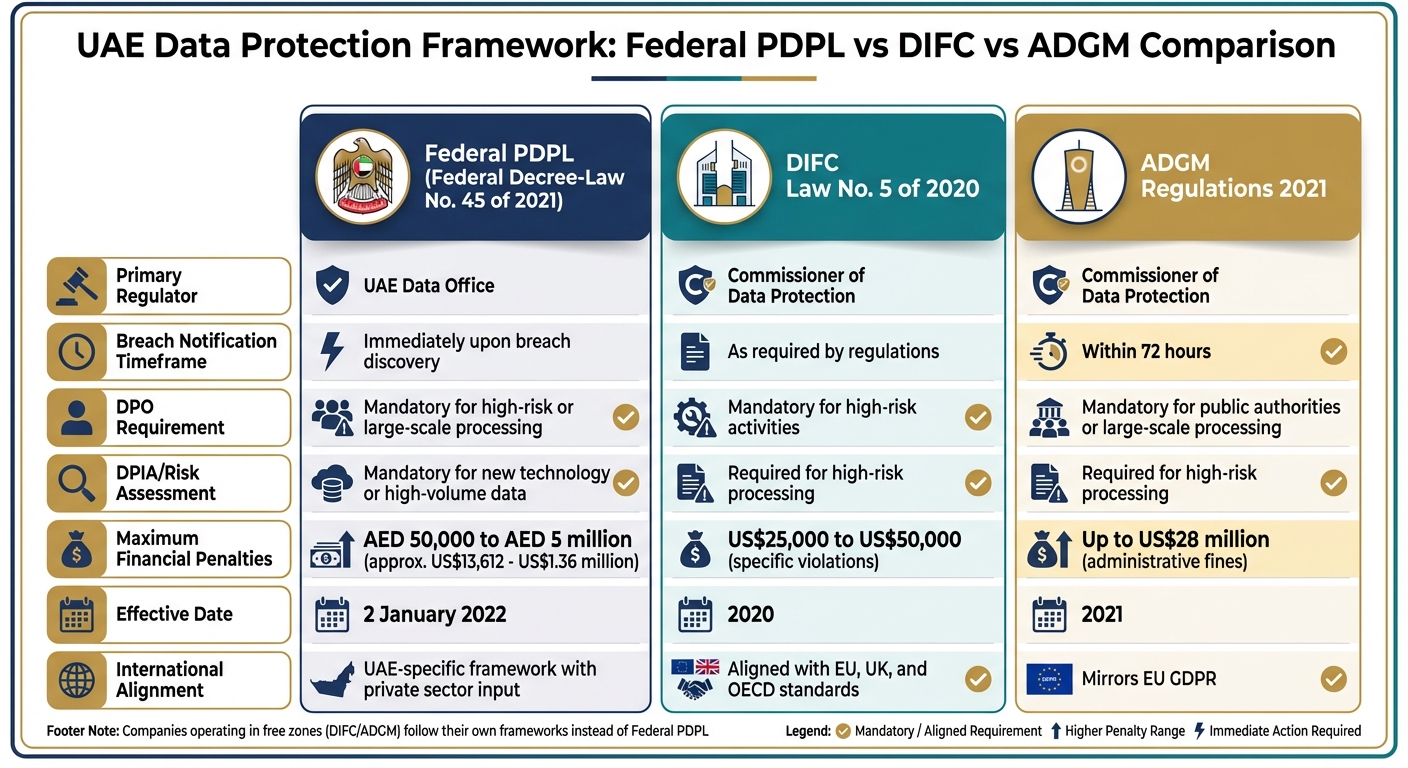
UAE Data Protection Framework Comparison: Federal PDPL vs DIFC vs ADGM
The UAE has developed a multi-layered approach to data protection, addressing the challenges of cross-border compliance and providing distinct regulatory frameworks. This system consists of federal law and separate legal structures for the DIFC and ADGM. Companies operating in free zones adhere to their own data protection rules instead of the federal law, creating a diverse yet comprehensive regulatory landscape.
Federal Decree-Law No. 45 of 2021 (PDPL)
The Personal Data Protection Law (PDPL), which took effect on 2 January 2022, is the UAE's first federal law shaped with input from the private sector. It applies to any controller or processor managing the personal data of UAE residents, regardless of their location. However, the PDPL excludes sector-specific data, which remains under separate regulations. Oversight and enforcement fall to the UAE Data Office, established under Federal Decree-Law No. 44 of 2021. This office is tasked with setting policies, monitoring compliance, and handling complaints.
Under the PDPL, controllers must inform the UAE Data Office of any data breaches, while processors are required to notify their respective controllers promptly. The law also mandates the appointment of a Data Protection Officer (DPO) for high-risk processing activities and requires detailed record-keeping of personal data handling, including cross-border transfers. Free zone entities follow their own specialised data protection frameworks, tailored to their operational needs.
DIFC Data Protection Law No. 5 of 2020
The DIFC operates under its own data protection framework, established by Law No. 5 of 2020 and overseen by the Commissioner of Data Protection. This framework is aligned with international standards, including those of the EU, UK, and OECD.
Entities in the DIFC must submit a data protection notification upon incorporation and whenever significant changes occur. A DPO must be appointed for high-risk processing activities, and Data Protection Impact Assessments are required for such cases. In 2023, the DIFC updated its regulations to address personal data processing through artificial intelligence systems, reflecting its effort to stay aligned with technological progress.
ADGM Data Protection Regulations 2021
The ADGM offers a similar yet distinct framework, administered by its Commissioner of Data Protection. Its regulations mirror the EU's GDPR while introducing unique compliance measures. For instance, controllers in the ADGM must report data breaches to the Commissioner within 72 hours - providing a more specific timeline compared to the federal law.
ADGM regulations also impose a Data Protection Fee for controllers and require secure deletion of data after retention periods. Companies must maintain policies for handling special categories of data and appoint DPOs for high-risk processing activities, ensuring a strong focus on accountability.
| Feature | Federal PDPL | DIFC Law | ADGM Regulations |
|---|---|---|---|
| Primary Regulator | UAE Data Office | Commissioner of Data Protection | Commissioner of Data Protection |
| Notification Timeframe | Upon breach | As required by regulations | Within 72 hours |
| DPO Requirement | For high-risk or large-scale processing | For high-risk activities | For public authorities or large-scale processing |
| Maximum Fines | AED 50,000 to AED 5 million | Not specified | Up to $28 million |
Legal Methods for Cross-Border Data Transfers
Transferring data across borders in compliance with the UAE's Personal Data Protection Law (PDPL) and free zone regulations requires a clear legal foundation. These frameworks provide multiple pathways tailored to meet diverse business requirements.
Adequacy Decisions and Approved Jurisdictions
One of the simplest ways to transfer data across borders is by sending it to countries deemed "adequate" by UAE regulators. According to Article 22 of the PDPL, the UAE Data Office evaluates whether a country provides sufficient protection based on its laws, regulatory oversight, and respect for individual rights. Similarly, free zone regulators maintain their own lists of approved jurisdictions. For instance, the DIFC Commissioner recognises over 40 jurisdictions, including the EU/EEA countries, the UK, Singapore, Canada, and South Korea.
The DIFC's approach to adequacy extends beyond individual countries. It also acknowledges regional and international mechanisms, such as transfers to the Abu Dhabi Global Market (ADGM), Qatar Financial Centre (QFC), and frameworks like the Global Cross-Border Privacy Rules (CBPR). This alignment within the GCC region facilitates smoother data transfers while maintaining high protection standards. The DIFC Commissioner applies global best practices in these assessments, using tools like the Adequacy Assessment Questionnaire to evaluate third-country applicants.
"The Commissioner of Data Protection applies adequacy standards based largely on prevailing international best practices and extensive practical application and methodology development."
- DIFC Commissioner of Data Protection
To ensure compliance, organisations must perform due diligence, often using tools like the DIFC's Ethical Data Management Risk Index (EDMRI+), to confirm that the receiving entity adheres to required standards. When adequacy decisions are not applicable, contractual safeguards become the preferred solution.
Standard Contractual Clauses (SCCs) and Binding Corporate Rules (BCRs)
In cases where adequacy is not established, contractual mechanisms like Standard Contractual Clauses (SCCs) and Binding Corporate Rules (BCRs) offer reliable alternatives. SCCs are widely used and consist of pre-approved terms that bind both the data exporter and importer to uphold protections equivalent to UAE standards. The DIFC provides its own "DIFC SCCs", which are adapted from EU model clauses and the UK International Data Transfer Agreement, ensuring compatibility on a global scale.
BCRs, on the other hand, are tailored for multinational corporations that frequently transfer data within their own group. These internal policies require regulatory approval and, while more complex to set up than SCCs, are ideal for ongoing intra-group transfers.
| Feature | Standard Contractual Clauses (SCCs) | Binding Corporate Rules (BCRs) |
|---|---|---|
| Scope | Specific to a contract between two parties (exporter and importer) | Covers all entities within a corporate group |
| Ease of Use | High – standard templates are readily available (e.g., DIFC SCCs) | Lower – requires detailed policy creation and regulatory approval |
| Best For | One-time transfers or third-party vendor agreements | Frequent intra-group transfers for multinational organisations |
Organisations must notify the DIFC Commissioner when transferring data to jurisdictions without adequacy decisions. Failure to comply can lead to penalties of up to AED 92,000. Additionally, businesses should maintain comprehensive records of all cross-border transfers, including the chosen mechanism and the security measures in place.
Explicit Consent and Other Exemptions
Article 23 of the PDPL allows cross-border data transfers based on explicit consent, with some limited exemptions for specific scenarios, such as contractual obligations, public interest, legal claims, or vital interests.
"The law prohibits the processing of personal data without the consent of its owner, except for some cases in which the processing is necessary to protect a public interest or to carry out any of the legal procedures and rights."
- UAE Government Portal
However, these exemptions are narrowly defined and should not be relied upon routinely. Additional sector-specific rules can further complicate cross-border transfers. For instance, the UAE Central Bank mandates that customer and transaction data remain within the country, while Federal Law No. 2 of 2019 prohibits the external storage or transfer of health information without ministerial approval. Organisations must carefully evaluate whether their data is subject to such localisation requirements before opting for consent or other exemptions.
Data Localization Requirements by Sector
The UAE's data protection framework generally permits cross-border data transfers under certain conditions. However, specific industries are required to store data within the country. These sector-specific rules play a key role in shaping compliance strategies.
Banking and Financial Services
Licensed Financial Institutions (LFIs) are required to store all consumer and transaction data within the UAE, as mandated by the Central Bank of the UAE (CBUAE). This applies regardless of whether third-party services or cloud solutions are used. It's worth noting that the UAE's Personal Data Protection Law (PDPL) does not cover personal banking data, as this is regulated separately by the CBUAE.
Financial institutions must also keep a secure backup of their data at a separate local site for at least five years after a business relationship ends or a casual transaction is completed. When outsourcing, banks must maintain ownership of the data and ensure customer rights are protected. If an outsourcing provider subcontracts tasks involving confidential data, the bank remains accountable for ensuring that all UAE legal and regulatory requirements are met.
To safeguard data shared externally, encryption is mandatory. Additionally, the Board of an LFI must assign a senior manager to oversee the Data Management and Protection function, with this individual reporting directly to Senior Management. In the event of a major personal data breach, LFIs must notify the Central Bank immediately and inform affected customers without delay if the breach risks their financial or personal security.
Healthcare and Medical Data
Federal Law No. 2 of 2019, also known as the "Health Data Law", governs healthcare ICT in the UAE, including free zones. This law establishes a general prohibition on transferring patient health data outside the UAE. The PDPL also excludes personal health data from its scope if this data is already regulated under specialised laws like the Health Data Law.
There are variations at the emirate level; for instance, some authorities place restrictions on cloud usage unless specific exceptions are met. In Dubai Healthcare City (DHCC), health data is regulated under its own Health Data Protection Regulation No. 7 of 2013.
Ministerial Resolution 51 of 2021 outlines ten exceptions for cross-border health data transfers. These include scenarios such as scientific research (requiring anonymisation and encryption), insurance claims (requiring written consent and anonymisation), overseas treatment (requiring patient approval), pharmacovigilance (requiring written consent, encryption, and local storage), and telemedicine (requiring time-limited physician access and written consent). In most cases, businesses must ensure a copy of the health data remains stored within the UAE.
Balancing Localization and Cross-Border Transfers
The localization requirements in sectors like banking, healthcare, and payment services create challenges for cross-border data transfers. This highlights the importance of adopting segmented data strategies. A hybrid data architecture can address these needs by storing regulated data - such as banking, health, and sensitive IoT information - in local data centres while leveraging international cloud services for non-regulated data. Proper partitioning of these data categories is essential to ensure compliance.
For financial data transfers, businesses should proactively seek approval from the UAE Central Bank and secure explicit customer consent. Techniques like anonymisation or pseudonymisation can process data in a way that it no longer identifies specific individuals, potentially exempting it from certain transfer restrictions. When health data is transferred under an exemption, businesses are legally required to follow the "highest safety standards", including mandatory encryption and anonymisation.
| Sector | Primary Regulation | Localization Requirement |
|---|---|---|
| Banking | Central Bank Consumer Protection Standards | Customer and transaction data must be stored in the UAE |
| Healthcare | Federal Law No. 2 of 2019 (Healthcare ICT Law) | Electronic health data must be stored in the UAE |
| Payment Services | Retail Payment Services and Card Schemes Regulation | Personal and payment data must be stored in the UAE |
| IoT | IoT Regulatory Policy | Secret/Sensitive/Confidential data must be stored in the UAE |
sbb-itb-058f46d
Compliance Requirements for UAE Businesses
The UAE Data Protection Framework lays out a clear roadmap for businesses to follow in order to maintain compliance. A key focus is ensuring adherence to the Personal Data Protection Law (PDPL), particularly when it comes to cross-border data transfers.
Data Protection Impact Assessments (DPIAs)
Article 21 of the PDPL requires businesses to conduct a Data Protection Impact Assessment (DPIA) before processing personal data with modern technologies that could pose significant risks to privacy and confidentiality. This is particularly relevant when dealing with:
- Large volumes of data
- Systematic evaluations of sensitive information
- Profiling or automated decision-making processes
The DPIA must outline the scope, purpose, and nature of the processing activities, along with any associated risks. For cross-border data transfers to regions without an adequacy decision, businesses may need to implement additional safeguards beyond Standard Contractual Clauses (SCCs) or Binding Corporate Rules (BCRs).
To streamline compliance, companies should map their data flows to identify which data requires localisation and which can be transferred internationally. Engaging the Data Protection Officer (DPO) early in the planning stages of new processing activities is vital. All findings must be meticulously documented in a record of personal data processing, including details on cross-border data movements and security measures. This record should be readily available for review by the UAE Data Office if requested.
Appointing a skilled DPO is a critical step in managing high-risk data processing activities effectively.
Data Protection Officer (DPO) Requirements
Under Article 10 of the PDPL, appointing a Data Protection Officer (DPO) is mandatory for businesses handling high-risk processing, such as large-scale data operations or sensitive data analysis through profiling or automated technologies. The DPO can be an internal employee or an external expert and must have expertise in data protection regulations. Regardless of their location, the DPO's contact information must be registered with the UAE Data Bureau, and their independence must be safeguarded.
The DPO's responsibilities include:
- Ensuring the quality of data processing practices
- Addressing inquiries and complaints from data subjects
- Providing technical guidance on risk assessments
- Monitoring compliance with the PDPL
To fulfil their role, the DPO must have access to sufficient resources and maintain open communication with data subjects.
Breach Notification and Penalty Structures
The PDPL enforces stringent requirements for breach notifications. Controllers must immediately notify the UAE Data Office upon discovering a breach that compromises personal data security. This is stricter than the 72-hour notification window seen in many global regulations. As outlined in Federal Decree-Law No. 45 of 2021:
"The Controller shall, immediately upon becoming aware of any infringement or breach of the Personal Data of the Data Subject that would prejudice the privacy, confidentiality and security of such data, report such infringement or breach and the results of the investigation to the Office."
Non-compliance with the PDPL can result in financial penalties ranging from AED 50,000 (around US$13,612) to AED 5 million (around US$1.36 million). In specific jurisdictions:
- DIFC: Fines for failing to appoint a DPO range from US$25,000 to US$50,000.
- ADGM: Administrative fines can reach up to US$28 million for violations.
| Requirement | UAE Federal (PDPL) | DIFC (Law No. 5) | ADGM (Regulations 2021) |
|---|---|---|---|
| DPO Appointment | Mandatory for high-risk or large-scale sensitive data | Mandatory for high-risk activities or public authorities | Mandatory for public authorities or large-scale monitoring |
| DPIA/Risk Assessment | Mandatory for new tech or high-volume data | Required for high-risk processing | Required for high-risk processing |
| Max Financial Penalty | AED 5 Million | US$25,000 – US$50,000 (specific violations) | US$28 Million (general administrative fine) |
It’s crucial for businesses to establish internal protocols to detect and investigate breaches promptly. The UAE Data Office may offer exemptions for establishments that process limited volumes of data.
Regional Alignment and Cross-Border Efficiency
The UAE collaborates closely with neighbouring GCC countries to harmonise data protection standards, making it easier and less costly for businesses to operate across multiple jurisdictions. This cooperative effort builds on existing compliance mechanisms, aiming to create a unified approach to data protection across borders.
Mutual Adequacy Recognition in the GCC
The UAE’s financial free zones - the Dubai International Financial Centre (DIFC) and Abu Dhabi Global Market (ADGM) - are at the forefront of establishing mutual adequacy agreements with the Qatar Financial Centre (QFC). The DIFC has officially recognised both ADGM and QFC as having 'adequate' data protection frameworks, allowing personal data to move freely between these financial hubs without the need for additional safeguards like Standard Contractual Clauses (SCCs).
To support this, GCC nations are adopting consistent standards for cross-border data transfers and interoperable contractual safeguards. The IIC MENA chapter is actively working to promote this harmonisation across all six GCC states. Vladislav Klimov, Cloud Security and Compliance Lead at SAP (EMEA South), explains:
"A GCC-wide framework, or at least mutual recognition of adequacy, would streamline compliance for companies operating across borders, reduce the duplication of effort and present the bloc as a unified digital market."
The UAE's Federal Decree-Law No. 45 of 2021 (PDPL) permits international data transfers when bilateral or multilateral agreements on personal data protection are in place. Until a formal GCC-wide adequacy framework is finalised, businesses can use SCCs or Binding Corporate Rules (BCRs) to ensure lawful data transfers between GCC jurisdictions.
Streamlining Compliance Across DIFC, ADGM, and QFC
Both DIFC and ADGM have aligned their data protection laws with the EU’s GDPR, enabling businesses to implement a unified privacy programme across these hubs. Thanks to mutual adequacy agreements, companies can maintain consistent compliance processes across these financial centres.
In December 2022, the DIFC Commissioner of Data Protection and the UK Minister of State for Media, Data and Digital Infrastructure issued a joint statement creating a 'Data Bridge' between the UK and DIFC. This agreement facilitates trusted data sharing between the two regions. Notably, DIFC stands out as the only jurisdiction in the GCC or Middle East to be identified by the UK as one of six priority partners for a 'Data Bridge'.
For businesses operating in these financial hubs, the shared core requirements between DIFC and ADGM simplify compliance efforts. Companies can conduct thorough data mapping to understand where their data is stored and use mutual adequacy agreements to streamline data transfers without duplicating documentation.
To further assist businesses, DIFC offers tools like the Ethical Data Management Risk Index (EDMRI+), which evaluates the compliance environment of importing entities in jurisdictions that lack adequacy recognition. Additionally, the use of standardised SCCs - based on EU and UK models - helps reduce administrative burdens for multinational companies managing cross-border data flows.
Conclusion
Summary of Compliance Best Practices
Navigating data compliance in the UAE requires understanding the specific framework in play: the Federal PDPL for the mainland, DIFC Law No. 5 of 2020, or ADGM Regulations 2021.
Start by mapping your data flows. Identify where data is collected, stored, and transferred to determine the appropriate mechanisms, such as Standard Contractual Clauses (SCCs) or Binding Corporate Rules (BCRs). Check for any sector-specific rules around local data storage. Keep your Records of Processing Activities (ROPA) updated as per Article 7. This should include details like processing purposes, data categories, and transfer methods. Don’t overlook mandatory registrations and associated fees - they are a key part of staying compliant.
Use risk assessment tools to gauge compliance levels and identify gaps. Strengthen your technical safeguards with measures like encryption, pseudonymisation, and strict access controls to protect data during storage and transmission. These steps not only ensure compliance but also prepare businesses to adapt as regulatory requirements evolve.
The Future of Data Compliance in the UAE
The UAE’s data protection framework is poised for further refinement. The UAE Data Office is already working on enhancing technical standards under the PDPL. Sudhanshu Singh from Middle East Briefing highlights the country’s ambitions:
"The PDPL signals the UAE's ambition to be a credible and competitive hub for global digital services... aligning the UAE with international best practices while maintaining a sovereign legal identity".
The push for international data sharing is gaining momentum, with initiatives like the DIFC’s collaboration with the UK paving the way for trusted cross-border data exchanges. Interestingly, 73% of consumers now say that data privacy strongly affects their purchasing decisions. This shift makes compliance not just a legal necessity but a competitive edge. Businesses that adopt these practices today will be well-positioned to thrive in the evolving regulatory landscape.
FAQs
What are the penalties for failing to comply with the UAE’s Personal Data Protection Law (PDPL)?
Non-compliance with the UAE's Personal Data Protection Law (PDPL) can lead to administrative fines, as specified under the law's 'Fines and Remedies' section. The UAE Data Office determines these fines, which can vary based on how serious the violation is.
To steer clear of penalties, organisations must prioritise full compliance with the PDPL. This means adopting strong data protection practices and keeping up with the latest regulatory updates.
What are the key differences between DIFC, ADGM, and the UAE's federal data protection law?
The DIFC and ADGM have established their own independent data protection frameworks, tailored specifically for entities operating within their respective financial free zones. The DIFC Data Protection Law 2020 emphasises areas like adequacy assessments and standard contractual clauses, with oversight provided by a dedicated Commissioner. Similarly, the ADGM Data Protection Regulations 2021 govern data protection within the ADGM free zone.
On the other hand, the UAE's Federal Decree-Law No. 45 of 2021 (Personal Data Protection Law) extends across the entire nation, encompassing all organisations operating in the UAE. This law enforces consent-based data processing and prescribes rules for cross-border data transfers, ensuring a consistent and unified data protection framework across all emirates, outside the specific jurisdictions of DIFC and ADGM.
What are the options for businesses to transfer personal data across borders in the UAE?
Businesses in the UAE have several options for transferring personal data internationally, ensuring they stay within the bounds of local regulations. These mechanisms include:
- Adequacy decisions: Transferring data to countries with laws that align with UAE data protection standards.
- Contractual safeguards: Using DIFC-approved Standard Contractual Clauses or other legally recognised agreements to ensure compliance.
- Internal policies: Establishing and adhering to strong internal data protection policies that meet UAE requirements.
- Specific derogations: Relying on exceptions like obtaining explicit consent from individuals or making transfers necessary for public interest purposes.
To avoid penalties, businesses must carefully evaluate their specific circumstances and ensure their practices align with UAE data protection laws.