

Blog / How to Build a Content Lifecycle Framework
How to Build a Content Lifecycle Framework
A content lifecycle framework is a structured process that guides content from planning and creation to distribution, optimisation, and archiving. It helps businesses stay organised, reduce inefficiencies, and improve ROI by focusing on data-driven strategies and streamlined workflows.
Key takeaways:
- Why it matters: Most businesses waste up to 70% of their content due to poor management, while optimising the lifecycle can boost ROI by 300%–400%.
- Steps to success: Define goals aligned with your business strategy, map out content types, and continuously update and repurpose high-performing assets.
- Tools and roles: Use project management platforms, SEO tools, and DAM systems to centralise processes. Assign clear roles for strategists, writers, editors, and analysts.
- UAE focus: For markets like Dubai and Abu Dhabi, bilingual content and localised strategies can improve performance by up to 40%.
Content Strategy A Framework You Can Use Right Away
Set Your Objectives and Scope
Before diving into your content framework, take a step back and define what success means for your business. Is it about attracting new customers, keeping existing ones, or establishing your brand as an authority? Research shows that marketers with a documented content strategy are 313% more likely to report success, yet many businesses still skip this crucial step.
Match Framework Goals to Business Strategy
Your content goals should tie directly to measurable business outcomes, not just surface-level metrics. While likes and shares might feel rewarding, they don’t necessarily show how your content impacts revenue. Dennis Hammer, Content Strategist at Siteimprove, puts it plainly:
"Your leadership doesn't care about traffic or engagement or Facebook comments. Those metrics, which may be meaningful to you, don't mean much in terms of the business' performance".
Instead, align your content objectives with the different stages of the marketing funnel:
- Awareness: Focus on educational content that attracts visitors and addresses their needs through SEO-driven efforts.
- Consideration: Build trust with lead-nurturing content like guides or webinars.
- Decision: Create content that encourages conversions, such as product demos or testimonials.
- Retention: Reduce churn and encourage upselling with helpful resources and exclusive insights.
Set SMART goals - Specific, Measurable, Achievable, Relevant, and Time-bound. For instance, aim for something like, "Boost lead generation by 15% within three months." Use tools like Keyword Opposition to Benefit (KOB) analysis to prioritise topics that can drive quicker results. A targeted strategy that emphasises quality over sheer quantity is key.
Additionally, establish 3–5 core content pillars - themes that align your brand’s strengths with audience interests and business goals. These pillars help maintain consistency across all platforms and prevent aimless content creation. It’s worth noting that 90% of consumers expect brands to provide meaningful content.
Identify Your Content Types and Audiences
Once your goals are clear, categorise your content based on what your audience needs and what your business is trying to achieve. For example:
- Long-form articles can strengthen your SEO presence.
- Videos are great for driving engagement on platforms like Instagram or TikTok.
- Case studies can help convert leads into customers.
- Trend reports can elevate brand awareness.
But here’s the catch: 60% of content created ends up as useless clutter. To avoid this, focus on understanding your audience. Start with pain point research - use surveys or CRM data to uncover their challenges and create content that addresses those issues. Dive into website and social media analytics to see which topics resonate most, and use social listening tools to track real-time conversations about your brand or industry.
Also, consider where your audience spends their time. For example, if they’re active on LinkedIn, focus on professional insights rather than casual Instagram posts. Localising your content for specific markets, like Dubai or Abu Dhabi, can deliver a 40% boost in performance. A content gap analysis, comparing competitor activities and FAQs, can help you identify topics you might be missing.
Finally, strike a balance between evergreen content (which stays relevant over time) and trending pieces (which capture short-term interest). By clearly defining your content types and understanding your audience, you’ll be ready to map out the stages of your content lifecycle effectively.
Build the Content Lifecycle Stages
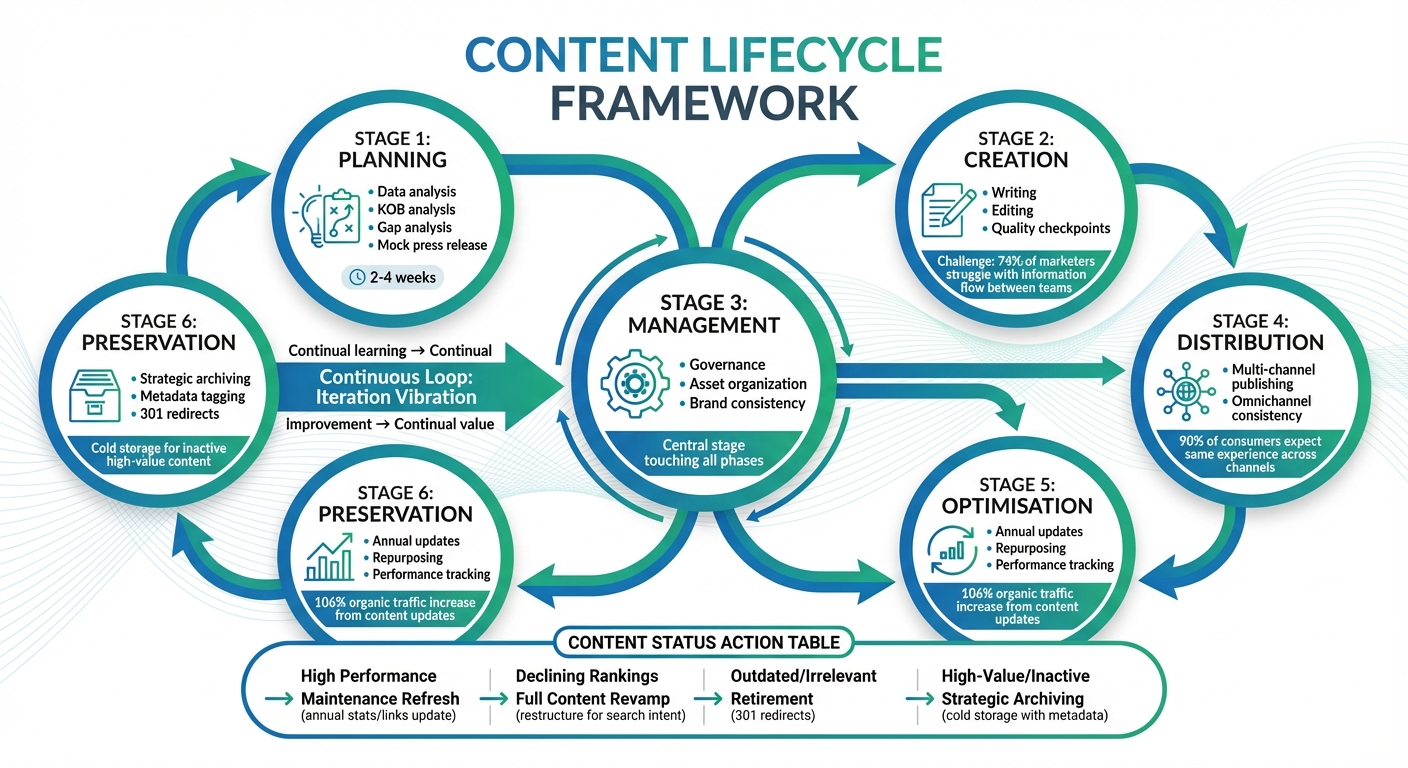
6-Stage Content Lifecycle Framework: From Planning to Preservation
Once goals are set and strategies aligned, the next step is to put your content lifecycle framework into action. Think of the content lifecycle as a continuous loop where every stage feeds into the next, creating a seamless flow that supports ongoing improvements.
This framework generally includes six key stages: Planning, Creation, Management, Distribution, Optimisation, and Preservation. The "Manage" stage is central, touching every other phase by implementing governance, organising assets in a unified system, and ensuring brand consistency throughout the process. As one content strategist puts it:
"A lifecycle affirms the reality that digital delivery should never be linear. It needs to be an ongoing loop that lets us build in impact as we go - continual learning, continual improvement, and continual value for users and the business".
When you refine content based on performance data, those insights should guide your next planning phase. This creates what some call an "iteration vibration" - a rhythm of constant refinement that keeps your content relevant and impactful.
Planning and Content Ideation
Start with data. Use analytics to uncover what your audience is actively searching for, rather than relying on assumptions. AI tools can simplify this process by analysing search intent, audience behaviours, and emerging trends. For UAE audiences, consider local preferences like bilingual content (Arabic/English) and right-to-left (RTL) layouts to better connect with your readers.
Use KOB (Keyword Opportunity and Business Value) analysis to prioritise topics with the highest potential. A gap analysis can also reveal areas where competitors are excelling, giving you the chance to address those gaps. Leverage proprietary tools to process keyword data and identify emerging trends that align with your core content themes.
A helpful planning trick? Write a mock press release for your content project before creating anything. This forces clarity and focus from the start. Keep the ideation phase short - 2 to 4 weeks - to maintain momentum. Define one clear success metric per outcome to keep the entire process on track.
Communication is often a sticking point, with 58% of marketers citing it as their biggest challenge in content management. Establish clear roles and responsibilities early to avoid delays. For businesses in the UAE, factor in compliance requirements, like UAE Federal Decree-Law No. 45 of 2021 on personal data collection, during the planning stage.
Creation, Approval, and Publishing
To maintain quality, set checkpoints at every handoff - whether it's between writers, editors, or publishers. This is especially important, as 74% of content marketers struggle with keeping information flowing smoothly between teams.
A hybrid workflow is often the best approach. Track both high-level stages and individual tasks to ensure nothing slips through the cracks. Tools like Digital Asset Management (DAM) and Product Information Management (PIM) can centralise your content assets, speeding up the process from creation to publication.
During the approval stage, keep strategic oversight separate from day-to-day execution. This ensures that long-term goals remain aligned while the daily workflow stays efficient. Once content is published, it enters a phase of active refinement and repurposing. Make sure you're distributing content across the platforms your audience frequents. Consistency is key - 90% of consumers expect the same experience across all channels. Omnichannel shoppers, for instance, spend 4% more in-store and 10% more online than single-channel shoppers.
Optimisation, Repurposing, and Archiving
Update high-performing content at least once a year. Use "low-scope" updates to refresh statistics, fix broken links, and tweak meta-tags for content that's already performing well. For underperforming pieces, opt for a "full revamp" - this could mean restructuring for better search intent or adding more depth.
A great example of this is Purple's content strategy. By focusing on revamping existing content rather than creating new material, they managed to boost traffic significantly while keeping their content library lean.
When repurposing, maximise your best-performing content by transforming it into different formats. For instance, turn an eBook into a blog series, an infographic, a webinar, or social media posts. This approach allows you to reach diverse audience segments with less effort than creating entirely new content. AI tools can assist by summarising key points and suggesting the best formats for each platform.
| Content Status | Recommended Action | Best Practice |
|---|---|---|
| High Performance | Maintenance Refresh | Update stats, fix links, and refresh meta-tags annually |
| Declining Rankings | Full Content Revamp | Restructure for search intent and expand depth |
| Outdated/Irrelevant | Retirement | Use 301 redirects to avoid 404 errors and maintain SEO |
| High-Value/Inactive | Strategic Archiving | Move to cold storage and tag with metadata for future use |
When archiving, think long-term. As Courtney Roe, former Director of Content Strategy at Acquia, explains:
"Archive, or cold storage, preserves inactive content at a cost often lower than active storage. Moving files to an archive also keeps your content repository clutter-free, ensures that only current content is used, and keeps inactive content safe until it's needed".
Archiving doesn’t mean the end for content. Tag archived pieces with metadata like expiry dates, rights ownership, and original sources to avoid legal risks. Before deleting anything, use a "usage manager" tool to check where the content is linked on your site. And when retiring content, always implement 301 redirects to maintain SEO value.
sbb-itb-058f46d
Set Up Roles, Tools, and Processes
To run a smooth content operation, you need the right people, tools, and workflows in place. Assigning clear roles, using effective platforms, and documenting processes are the backbone of a successful content lifecycle.
Define Team Roles and Responsibilities
When everyone knows their role, tasks move faster, and confusion is avoided. Here's how to structure your team:
- A Content Strategist focuses on the big picture - strategy, keyword research, and aligning topics with business goals.
-
The Content Manager handles the day-to-day, breaking down plans into tasks and ensuring deadlines are met. As Andreea Macoveiciuc from School of Content explains:
"Just like you have an office manager or administrator who oversees the daily operations... you need a content manager who oversees the full content lifecycle".
- Content Writers bring ideas to life, creating content based on briefs, while Editors polish it for clarity, style, and SEO.
- Subject Matter Experts (SMEs) provide technical accuracy, and SEO Specialists focus on traffic potential and optimisation.
- Distribution Specialists (social media and email marketers) promote content, and Analysts track performance and user insights.
In larger organisations, strategists and managers often work centrally, while writers and marketers operate within local teams. To avoid bottlenecks, audit your current setup and use tools like RACI charts to map responsibilities and dependencies.
Once roles are clear, the next step is equipping your team with the right tools.
Choose the Right Tools and Platforms
Tools are essential for streamlining workflows and eliminating manual delays. Some key options include:
- Project management tools like Asana, Monday.com, Trello, and ClickUp to visualise workflows, track tasks, and assign responsibilities.
- Content Management Systems (CMS) such as HubSpot Content Hub to centralise publishing and content management.
- SEO tools like Semrush SEO Writing Assistant to ensure content is optimised and ranks well.
- Digital Asset Management (DAM) solutions to organise images, videos, and documents. A centralised DAM can improve team performance, as noted by 80% of marketers.
Automation and AI are also making a big impact. In 2024, 45% of B2B marketers using generative AI reported more efficient workflows. For businesses in the UAE, tools that support bilingual content and right-to-left (RTL) layouts for Arabic are especially important. Conduct a technology audit to eliminate overlapping tools, which can occur as businesses grow.
An example of an integrated approach is Wick's Four Pillar Framework, which combines website development, SEO, content creation, and marketing automation into one system. This reduces the need for juggling multiple platforms.
With tools in place, it's time to establish workflows that keep everything running smoothly.
Create Clear Workflows and Governance
Workflows guide content from idea to publication, while governance ensures everything stays consistent and on-brand. Though 72% of marketers struggle with strategic content management, those with organised processes are 397% more likely to succeed.
There are different workflow styles to consider:
- Task-based workflows focus on completing specific steps in sequence.
- Status-based workflows track the current stage of a project (e.g., "In Review").
- A hybrid approach combines both for detailed and high-level tracking.
Document your workflow in stages: Pre-production (ideation and briefing), Production (creation and editing), and Post-production (distribution and analytics). Include checkpoints at every stage to ensure quality, and use standardised briefs to clarify goals and keywords before work begins.
Governance includes maintaining brand voice, style guides, and quality standards across all channels. An editorial board can oversee the entire content ecosystem, including compliance with UAE-specific regulations like Federal Decree-Law No. 45 of 2021 on personal data collection.
Tim Walters from The Content Advisory highlights the importance of strategy:
"Strategy is key to success and that resources should never constrain strategic thinking".
Despite its importance, only 42% of marketers have documented strategies for treating content as a business asset. By documenting your workflows and governance now, you set yourself up for better organisation and long-term success.
Monitor, Evaluate, and Improve the Framework
Keep refining your framework to stay aligned with shifting business objectives.
Key Metrics for Measuring Success
To measure success effectively, track metrics across three main areas:
- Awareness and Engagement: Monitor unique pageviews, visitors, impressions, time on page, bounce rates, scroll depth, and social shares. These metrics help assess visibility and how users interact with your content.
- Conversions and Leads: Focus on gated downloads, e-newsletter sign-ups, demo requests, and conversion rates to evaluate business impact.
- SEO Health: Keep an eye on organic clicks, click-through rates (CTR), and keyword rankings, especially for Top 3 and Page 1 positions. For context, Google’s first position averages a 27.6% CTR, while the third position sees about 11%. Core Web Vitals like LCP, INP, and CLS are also crucial - just a three-second delay in page load time can increase bounce rates by 32%.
Additionally, measure ROI through metrics like revenue generated, customer lifetime value (CLV), and cost per lead. Compare the returns from refreshing old content versus creating new material - updating existing content can boost organic traffic by 106%.
However, many marketers struggle with data-driven strategies. A survey revealed that 39% lack a data-focused approach, and 47% say their tools fall short in reporting content performance. Michelle Jackson, Chief Strategy Officer at BackPocket Agency, highlights the issue:
"Without those things in place, it's easy to get lost in an overwhelming sea of content metrics".
To combat this, set clear benchmarks by comparing 28-day rolling averages against 90-day and year-over-year data. This helps separate seasonal trends from structural declines like "content decay". Automate alerts for significant drops in clicks (≥30%), CTR (≥25%), or keyword ranking declines of two or more positions. Conduct monthly performance reviews and quarterly audits to identify content that needs refreshing, merging, or archiving.
Use Feedback and Insights
Use both performance metrics and audience feedback to guide improvements. Identify high-performing channels and adjust distribution strategies to maximise their effectiveness. Tools can help pinpoint "evergreen" content that needs periodic updates to maintain relevance and rankings.
Establish feedback loops within your team and with stakeholders to evaluate the framework’s effectiveness. A Customer Data Platform (CDP) can centralise customer data, offering a comprehensive view of behaviour and enabling AI-driven trend analysis.
Prioritise updates using Keyword Opposition to Benefit (KOB) analysis. Focus on high-performing content showing signs of decline or underperforming pieces with strong conversion potential. Employ content scoring systems to ensure assets meet brand standards in voice, terminology, and quality.
A real-world example comes from Purple, a mattress brand. By prioritising major updates for outdated content and shifting to lighter maintenance updates, they achieved significant traffic growth, outperforming competitors who saw flat or declining results.
Scale the Framework for Growth
Scaling your framework while maintaining quality requires a thoughtful approach. Implement a Content Operations (Content Ops) framework to manage multiple content types efficiently. A headless CMS can help by separating content creation from its presentation, making it easier to optimise for various channels.
Centralise your resources with a Digital Asset Management (DAM) system, ensuring all assets remain organised and accessible. For larger organisations, split responsibilities between central teams (strategy and management) and local teams (writing and localisation) to maintain relevance in different markets. An independent editorial board can oversee the entire content ecosystem, including technology and schedules.
As your library grows, shift focus from creating new content to maintaining existing high-value assets. Lightly refresh 5–10 posts monthly to achieve higher ROI with similar effort to creating one new post. Standardise processes with clear brand guidelines, templates, and checkpoints to ensure quality as your team expands.
Sabrina Lui, Executive Director & Digital and Creative Agency Lead at KPMG, emphasises the long-term benefits:
"Establishing a content framework aligned to your buyer's journey takes time... But once you do it, you can be more nimble and adjust to changes in audience and business needs".
For businesses in the UAE aiming to scale content operations, Wick's Four Pillar Framework offers an integrated solution. It combines website development, SEO, content creation, and marketing automation to support growth while addressing bilingual content needs and regional market dynamics.
Conclusion
Creating a content lifecycle framework can completely reshape how your business handles digital assets. It starts with aligning your goals to your overall business strategy and flows through structured stages - planning, creation, optimisation, and archiving. This cycle forms a continuous loop that supports efficient and sustainable operations. To make it work, you need clear roles, well-defined workflows, strong governance, and, most importantly, a data-driven approach to track performance and guide decisions.
Here’s a surprising reality: while 82% of businesses rely on content marketing as a core strategy, only 28% of enterprise marketers report achieving effective results. A staggering 60% of content turns into clutter. However, refreshing existing content can increase organic traffic by 106% and boost ROI by 300%–400%.
As Tim Walters from The Content Advisory puts it:
"Strategy is key to success and resources should never constrain strategic thinking"
This underscores the importance of treating content as a dynamic asset that evolves over time, rather than a one-off effort. A flexible strategy that adapts to changing market needs is essential for ongoing success.
For businesses in the UAE, where bilingual content and unique market dynamics play a significant role, Wick's Four Pillar Framework offers a tailored approach. It integrates key digital marketing elements - like website development, SEO, data analytics, and AI-driven personalisation - into a unified lifecycle strategy. Solutions such as Digital Asset Management (DAM) and workflow automation help tackle regional challenges while maximising the value of your content investments.
Switching to a "maintenance mode" - where you focus on updating high-performing content instead of constantly creating new material - ensures sustainable operations. With strong governance and data-led decision-making, this framework provides the foundation for long-term digital success. By adopting this approach, businesses can turn their digital assets into consistent, measurable growth.
FAQs
How does a content lifecycle framework boost ROI for my business?
A carefully structured content lifecycle framework can play a key role in boosting your business's ROI. How? By ensuring that every piece of content is thoughtfully planned, created, and managed to deliver the best possible results. This approach prioritises efficiency and scalability, extending the lifespan of your content. As a result, you can reduce the need for constant new production, saving valuable time and resources.
Beyond that, such a framework brings consistency to how content is handled - from brainstorming ideas and production to distribution, performance analysis, and updates. This keeps your content fresh, engaging, and in sync with your business objectives. The outcome? Better performance, improved engagement, and a path to steady growth.
What are the key tools needed to efficiently manage a content lifecycle?
To effectively handle a content lifecycle, businesses need tools that simplify creation, organisation, and oversight. Content Management Systems (CMS) play a key role by centralising storage, managing user access, and maintaining version control. These systems help keep content structured and easy to access.
Beyond CMS, lifecycle management platforms are essential for tracking, categorising, and securely disposing of content, which is especially important for meeting regulatory requirements. For more specific tasks, tools like contract lifecycle management (CLM) platforms are ideal for managing legal agreements, while certificate lifecycle management solutions handle digital certifications with precision.
Modern AI-powered and cloud-based tools take it a step further by offering scalability and automation, enabling businesses to monitor processes in real time and boost efficiency. When these tools are integrated into a unified system, they help businesses streamline content management, meet compliance standards, and support long-term growth.
How can I align my content strategy with my business goals?
To make your content strategy work hand-in-hand with your business goals, you need to start with clarity. Define why you're creating content, who your audience is, and how your content ties back to your objectives. This kind of clarity ensures that every piece of content has a purpose and contributes to your business's growth.
Build a process you can rely on - a repeatable framework that includes key elements like content goals, audience insights, workflows for creation, distribution channels, and performance tracking. With this in place, you'll maintain consistency and be able to scale your efforts without losing focus.
Managing content across its entire lifecycle - planning, creation, distribution, and optimisation - helps you get the most out of it. This structured approach not only saves time but also ensures your content delivers results that matter to your business.