
Blog / 5 Steps to Build AI-Powered Content Pipelines
5 Steps to Build AI-Powered Content Pipelines
AI-powered content pipelines can help you produce high-quality visuals faster while reducing manual effort. This approach is especially valuable in the UAE, where businesses need to cater to a multilingual audience and adapt to local preferences. By combining automation with human oversight, companies can scale their output without compromising quality.
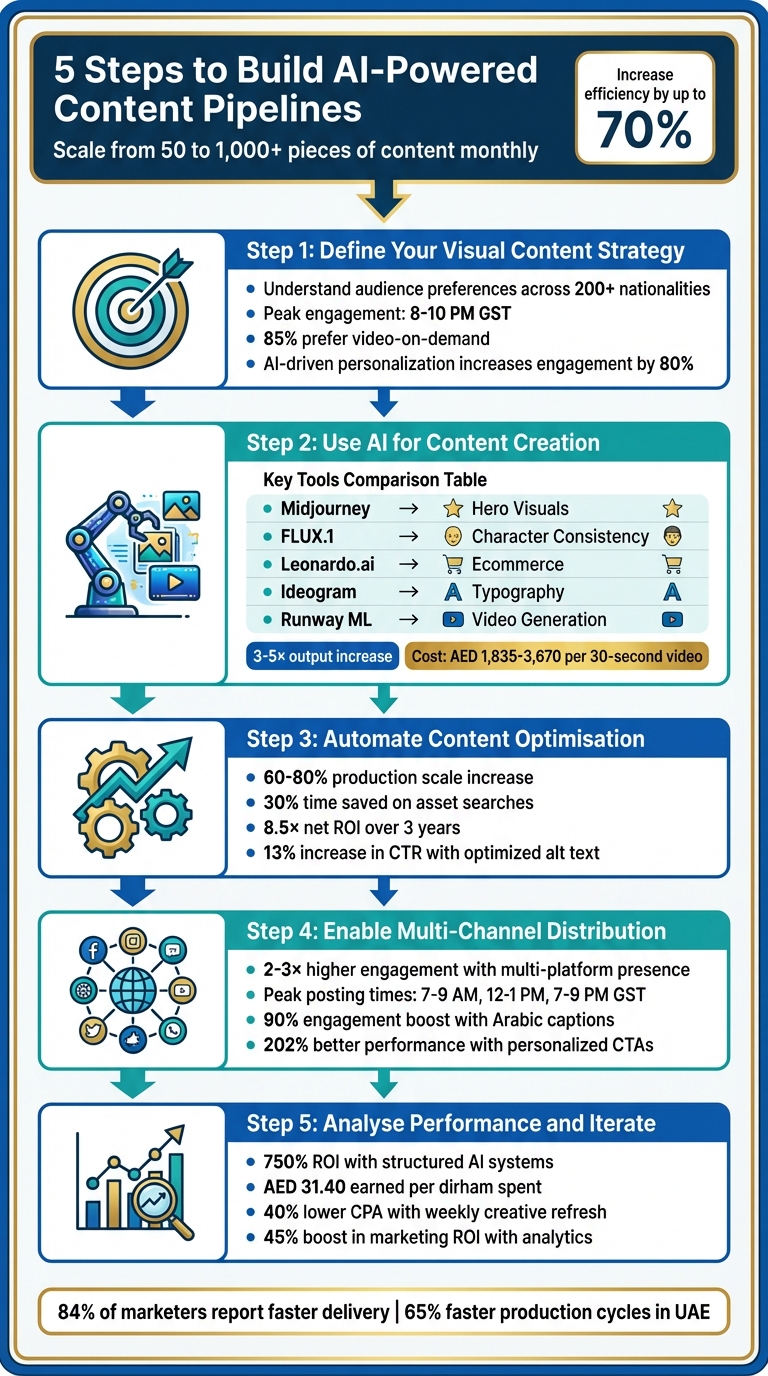
Here’s a quick breakdown of the five steps covered in the article:
- Define Your Visual Content Strategy: Identify your audience, set measurable goals, and plan content around key UAE events like Ramadan or the Dubai Shopping Festival.
- Use AI for Content Creation: Leverage tools like Midjourney, Runway ML, and Leonardo.ai to create videos, images, and text tailored to UAE preferences.
- Automate Content Optimisation: Use AI to handle repetitive tasks like editing, resizing, and SEO, ensuring consistency and performance.
- Enable Multi-Channel Distribution: Automate posting across platforms like Instagram, TikTok, and LinkedIn, and personalise content for different audience segments.
- Analyse Performance and Iterate: Track metrics like engagement rates and ROI to refine your pipeline and improve results.
AI pipelines can increase efficiency by up to 70%, helping businesses in the UAE scale from 50 to 1,000+ pieces of content monthly without additional staff. By combining automation with localised strategies, companies can stay competitive and deliver content that resonates with their audience.
5 Steps to Build AI-Powered Content Pipelines for UAE Businesses
The Latest AI-Powered Content Creation Workflow for Business (Speed Challenge!)
Step 1: Define Your Visual Content Strategy
Before diving into an AI-powered content pipeline, it’s crucial to define your target audience and objectives. This ensures your visuals resonate in the UAE's vibrant and competitive digital landscape.
Understand Audience Preferences
With a population representing over 200 nationalities and spending more than three hours daily on platforms like Instagram and TikTok, UAE audiences demand diverse and tailored content strategies. AI-powered social listening tools can track online conversations across forums and social media to identify trending topics and specific concerns within Dubai and the Emirates. Sentiment analysis can further reveal subtle cultural distinctions across demographics, helping your visuals align with local values.
Timing is also key. Peak engagement in the UAE typically occurs between 8 and 10 PM GST. AI tools can automate audience segmentation - differentiating between Emirati families, European expats, and other groups - and predict the best times to post. This is critical, especially when 85% of viewers in the UAE prefer video-on-demand, and 44% of Gen Z no longer watch live TV.
Incorporating consented first-party data from online and offline sources allows you to create detailed audience personas. These personas reveal genuine interests and preferences, which are further refined through predictive analytics. This approach not only helps anticipate market trends but also identifies content gaps before competitors can. Brands in Dubai using AI tools have reported engagement rates three times higher than average, while AI-driven personalisation can increase engagement by up to 80%.
Once you have a clear understanding of your audience, it’s time to set measurable content goals.
Set Clear Content Goals
Using audience insights as a foundation, establish specific and measurable goals that align with local market behaviours and timings. Avoid generic objectives. Instead, focus on outcomes tied to your business metrics. For example, aim to increase organic click-through rates from 2.5% to 4.8% or improve content-led conversions from 1.2% to 3.5% - results that reflect documented improvements with AI-augmented strategies in the UAE.
Your goals should also reflect the UAE’s unique calendar. Plan campaigns around key events like Ramadan, Eid, and the Dubai Shopping Festival, when consumer intent and search behaviours shift significantly. Incorporate geo-specific keywords like "Dubai Marina" or "Business Bay" to match local search patterns. For visual content, set format-specific objectives: short-form videos (15–60 seconds for TikTok and Reels), authentic real-life imagery (preferred by 61.5% of GCC consumers over animations), and bilingual content in Arabic and English.
"Stop thinking of AI as an autopilot and start treating it as your strategic co-pilot, a tool that augments your team's creativity with unparalleled data-driven precision." – GO Digital
Align your goals with the right visual formats and keywords. For lead generation, use high-intent terms like "book" or "best". If brand awareness is your focus, prioritise storytelling-driven visuals, as stories deliver the strongest emotional impact (51.1%) compared to characters or photos alone. By setting clear goals, every piece of AI-generated content will serve a well-defined purpose.
Step 2: Use AI for Content Creation
Once your strategy is ready, it’s time to create visual assets that resonate with audiences in the UAE. Instead of relying on basic "text-to-video" methods, professionals recommend an "ingredients-to-video" approach. This technique pre-generates detailed assets, ensuring consistency and quality in the final output.
Here’s why this matters: Quality is what separates successful campaigns from those that harm a brand’s reputation. For instance, in January 2026, PJ Ace launched an AI-generated ad featuring David Beckham using this approach. The result? A staggering 233 million views within just three days - proof that controlled AI workflows can deliver at scale.
"AI is not a magic button. Anyone can prompt a model, but only those who can direct and control the tool get a production-grade result." – Ilya Zmienko, Founder, Svyazi Creative Agency
Using AI tools can increase output by 3–5×, leveraging the brain’s ability to process visuals quickly. However, this level of quality doesn’t come cheap. Producing a polished 30-second AI video can cost between AED 1,835 and AED 3,670 in computational resources alone, due to the numerous iterations required for refinement. This makes selecting the right tools - and customising them for local preferences - essential.
Choose AI Content Creation Tools
The right AI tools balance artistic quality, precision, and scalability. Here’s a breakdown of some popular options:
- Midjourney: Perfect for creating high-quality hero visuals and campaign imagery.
- FLUX.1: Known for maintaining character consistency and adhering to prompts, ideal for storytelling with recurring characters or products.
- Leonardo.ai: Great for ecommerce, offering presets for product shots and batch processing.
- Ideogram: Delivers reliable text rendering for social media graphics and posters.
- Runway ML: Excels in video creation, ensuring smooth transitions and real-time editing.
| Tool | Best For | Key Strength |
|---|---|---|
| Midjourney | Hero Visuals | High-quality aesthetics and composition |
| FLUX.1 | Character Consistency | Detailed and precise prompt adherence |
| Leonardo.ai | Ecommerce | Batch generation and product presets |
| Ideogram | Typography | Clear and readable text in images |
| Runway ML | Video Generation | Smooth editing and temporal consistency |
For seamless integration with analytics frameworks like Wick’s, choose tools that support REST APIs or SDKs. This allows tracking of performance metrics such as prompt text, seed values, and model versions, creating a feedback loop to refine future content.
Technical prompting is crucial for achieving high-quality results. Use precise instructions, including camera settings, fixed seeds, and brand assets to maintain a consistent look and feel. Automate batch processing through CSV inputs to scale production efficiently.
Ensure a quality check by reviewing AI-generated frames with storyboard tools. Any issues, such as artefacts, can be corrected using inpainting methods.
Once the technical aspects are sorted, focus on tailoring the content to align with UAE-specific preferences.
Customise Content for the UAE Market
To connect with audiences in the UAE, visuals must reflect the region’s cultural and linguistic diversity. Generic visuals won’t make an impact. Start with bilingual integration: ensure your content supports both English and Arabic, including right-to-left (RTL) text orientation and localised expressions. Tools like Skywork's LongCat-Image are helpful for multilingual text rendering, though final touches might require platforms like Canva or Adobe Photoshop.
Follow the UAE Design System principles for visuals: they should be "Memorable" (realistic), "Human" (featuring relatable people), and "Future-forward" (progressive and optimistic). This means incorporating local attire, gestures, and settings while avoiding any elements that could be culturally inappropriate. For instance, prompts should specify "modest business attire" or "traditional Emirati dress" when depicting people. Use negative prompts to exclude unwanted features like "distorted logos" or "culturally insensitive attire".
Contextual adaptation is also key. Props, settings, and colours should align with regional tastes. The UAE market appreciates "modern luxury" aesthetics - think sleek skylines like Dubai Marina, contemporary interiors, and premium finishes. Use structured prompts like: Subject + Setting + Style + Details. For example, "Professional Emirati businessman, Dubai Business Bay office, cinematic photorealism, natural lighting, 85mm f/1.4".
When adding text to visuals, ensure readability by applying a 30% black colour overlay on semi-busy backgrounds, increasing to 60% for brighter or more cluttered images. Use the "Rule of Thirds" for hero images and keep the focal point prominent, covering about 50% of the foreground. Avoid over-editing or using heavy filters - natural lighting and balanced colours work best.
For video content aimed at the GCC, AI-powered "lip-sync" technology can match mouth movements to Arabic audio, including specific dialects. Given that over 80% of social media videos are watched without sound, captions and strong visual storytelling are critical for engagement. Use WebP image formats for better compression without sacrificing quality - these save up to 30% more space compared to JPEGs.
"Speed without quality won't build trust. We pair AI efficiency with human creativity so every blog, script, and video is meaningful [and] culturally relevant." – Titan Digital UAE
AI-assisted workflows can speed up production by 2–5×. However, the UAE Design System advises using CGI and AI imagery sparingly, favouring real photography for authenticity. When AI is necessary, a hybrid workflow combining AI-generated drafts with human review ensures cultural relevance, tone, and brand alignment. Brands adopting this approach have seen engagement increase by up to 80% through personalised content. By tailoring AI outputs to the UAE audience, you can create assets that meet both strategic objectives and local expectations, all while maintaining scalability and quality.
Step 3: Automate Content Optimisation Processes
Once visuals are tailored for the UAE market, the next hurdle is maintaining quality and consistency, especially when scaling up production. Handling hundreds of visuals each month makes manual editing and SEO impractical. This is where AI-powered automation steps in, streamlining repetitive tasks while ensuring every asset aligns with brand guidelines and performs well in search results.
Modern AI tools can verify details like colour codes, logo placement, and typography. Automated brand guideline generators create frameworks that prevent "style drift" across campaigns, ensuring a consistent brand image. Research shows that consistent branding can directly boost revenue, and businesses using these tools often recover their investment within six months.
The trend is moving toward orchestration layers that manage the entire content lifecycle. AI now handles tasks like resizing visuals, applying templates, and generating alt text automatically. Human-in-the-loop systems allow editors to review and fine-tune AI outputs before publication, striking a balance between speed and quality.
"True transformation comes from orchestration: intelligent systems that operate across the full pipeline." – TVTechnology
This approach is particularly effective for the UAE market, where content must balance modern aesthetics with local sensitivities. AI-powered vision APIs, for instance, can flag visuals that don’t align with local standards, while automated metadata ensures bilingual content - Arabic and English - is formatted correctly. With these tools, production can scale by 60–80% without compromising brand integrity.
AI-Powered Editing and Quality Checks
AI tools are now capable of handling tasks that previously required hours of manual effort. These include image refinement, auto-cutting video scenes, and syncing visuals to voiceovers or music. Creative teams report saving up to 30% of their time on asset searches and revisions.
AI is also adept at enforcing brand guidelines. By training AI systems on style guides, they can automatically flag non-compliant elements, such as incorrect colours or logos placed too close to edges. Locking parameters like colour codes, typography, and spacing ensures that every output meets your standards.
For the UAE market, precision is key. Instead of vague prompts like "blue background", specify details such as "background colour #0047AB with a Dubai skyline silhouette and a 60% opacity overlay." This level of detail helps maintain the modern luxury aesthetic preferred in the region while respecting local norms.
Vision APIs like Google Cloud Vision and AWS Rekognition offer real-time quality control by identifying labels, objects, and SafeSearch categories to ensure assets comply with local regulations. Optical Character Recognition (OCR) further ensures on-image text is readable for both users and search engines.
A multi-stage approval process can enhance quality. First, approve written content, then review visual assets separately. Digital Asset Management (DAM) systems integrated with AI tools ensure all team members access up-to-date, approved assets, preventing outdated visuals from slipping through.
| Dimension | Manual Process | AI-Assisted Workflow | AI-Orchestrated Automation |
|---|---|---|---|
| Speed | Slow | Faster | Fastest |
| Consistency | Variable | Improved | High |
| Human Oversight | High | Moderate | Moderate (with audits) |
| Scalability | Limited | Good | Excellent |
| Cost per Piece | High | Lower | Lowest at scale |
Adopting AI-driven workflows can deliver up to an 8.5× net ROI over three years. By April 2025, 74.2% of newly created web pages included AI-generated elements, showing that automation is now the norm.
"The future of brand design is a partnership between human creativity and AI's efficiency - one that, when done right, will allow brands to thrive in the evolving digital landscape." – Eddie Bridgewater, Bluetext
Improve SEO for Visual Content
Beyond design consistency, making visuals discoverable is equally important. AI-powered SEO tools can optimise visual assets to rank higher in search results, which is especially critical in the UAE, where bilingual content and cultural relevance play a major role.
Start with automated alt text generation. Use image-to-text AI models like BLIP to create descriptive captions at scale, then refine them with language models to ensure they sound natural and align with your brand tone. Tools like Screaming Frog can identify images missing alt text, allowing you to batch-process them through an AI workflow. Brands that implemented well-crafted alt text and ImageObject schema saw a 13% increase in click-through rates from answer panes.
File names also matter. Replace generic names like IMG_1234.jpg with descriptive, keyword-rich ones, such as luxury-dubai-resort-interior.webp. This helps search engines better understand your images. For web use, opt for the WebP format for superior compression without quality loss, while SVG remains the best choice for icons and vectors.
Structured data using Schema.org ImageObject helps AI models identify unique entities within images and match them with relevant search queries. Modern AI systems can map text to related keywords with 98% accuracy.
AI Vision Testing is another critical step. Tools like Google Cloud Vision API let you see images as search engines do, focusing on information density and clarity rather than aesthetics. This ensures visuals comply with local standards and avoid regulatory issues.
The results speak for themselves. In October 2023, Nantasket Beach Resort implemented a three-step visual optimisation strategy, including centralising assets via a DAM and tagging entities with schema. This led to a 72% increase in image-rich results and a 5% boost in overall impressions, with 70% of images on SERPs originating from their domain. Similarly, a Massachusetts resort saw an 871% increase in image appearances in search results after adopting AI-driven content governance in 2024.
For the UAE, localisation is essential. Ensure AI-generated metadata - file names, alt text, and captions - reflects regional search habits and terminology. AI lip-sync technology can also match Arabic audio and dialects accurately. Strong captions and visual storytelling remain key to engaging audiences.
To improve page load times, use lazy loading (loading="lazy"), which is a crucial ranking factor. A DAM system with real-time scoring for asset quality and SEO readiness ensures every visual meets technical and cultural standards before publication.
With the rise of multisearch - where users combine images with text queries - optimising both visuals and their surrounding copy is becoming increasingly important. In May 2025, Google Lens traffic surged to 10 million visits, up from just 1 million two years earlier. Over 70% of pages cited in AI search results were updated within the last year.
sbb-itb-058f46d
Step 4: Enable Multi-Channel Distribution and Personalisation
After optimising your content automatically, the next step is ensuring it reaches the right audience at the right moment. The challenge lies in managing multiple platforms like Instagram, LinkedIn, TikTok, and YouTube simultaneously. Doing this manually is tough, especially at scale. This is where AI-powered tools come into play, automating scheduling, adapting content for different formats, and personalising messaging tailored to the UAE market.
The results speak for themselves. Brands maintaining a steady presence across platforms report engagement rates 2–3× higher than those focusing on just one channel. Yet, 73% of marketers say their biggest struggle is posting consistently. AI simplifies this by handling repetitive tasks like resizing visuals, rewriting captions, and choosing the best posting times. This frees up human teams to focus on what they do best - strategy and creativity - while ensuring content is delivered effectively across platforms.
Automate Multi-Channel Scheduling
AI tools like DesignerBox, Postly, and ContentStudio make multi-channel management easier by offering unified dashboards for platforms such as Instagram, YouTube, LinkedIn, and TikTok. Instead of uploading content separately to each platform, you can upload it once, and the AI adjusts it for each channel. For instance, a single video can be formatted as a vertical Reel for Instagram, a horizontal upload for YouTube, and a square post for LinkedIn - all without manual effort.
AI also analyses engagement trends to schedule posts during peak activity times - often 7–9 AM, 12–1 PM, and 7–9 PM GST - ensuring your content gets maximum visibility. Many of these tools automate bulk uploads and cross-platform posting, saving you from daily manual updates. With just two hours a week, you can schedule 10–15 posts and maintain a consistent presence in the UAE market.
Beyond scheduling, AI tools can rewrite content to suit different platforms. For example, LinkedIn posts might be more formal and detailed, while TikTok content is punchier and visually engaging. Calls-to-action are also adapted - like "Save this post" for Instagram or "Link in comments" for LinkedIn.
"The brands and teams that succeed are not the ones creating twice as much. They are the ones making what they have already created go twice as far." – Ross Simmonds, Founder, Distribution.ai
For UAE-based campaigns, accuracy in time zones is crucial. Ensure your scheduling tools are set to GST to avoid missing peak engagement times. Automated checks also help verify that visuals meet platform requirements, such as correct aspect ratios and resolutions, before publishing. Tools like Distribution AI can even break down a single long-form asset - like a podcast or YouTube video - into multiple platform-ready posts.
| Feature | Native Scheduling (Free) | AI Third-Party Schedulers (Paid) |
|---|---|---|
| Dashboard | Manages one platform at a time | Unified view for all platforms |
| Batch Upload | Not supported | Handles 10–20+ posts at once |
| Timing | Requires manual selection | AI-driven peak times |
| Media Handling | Manual resizing needed | Auto-resizing and format validation |
| Repurposing | Manual process | AI-powered asset generation |
Third-party AI schedulers typically cost between AED 70 and AED 290 per month, offering features like bulk uploads and smart timing. Many tools, such as Distribution AI (15-day trial), DesignerBox (7-day trial), and PostEverywhere, offer free trials with no credit card required. While free native tools like Meta Business Suite or TikTok Studio are available, they only support single-platform management and lack a unified calendar view.
Use AI for Personalised Content Delivery
Once your distribution is automated, the next step is personalising content to connect with specific audience segments. In the UAE, this could mean tailoring posts for Emirati families, European expats in Dubai, or visiting tourists. AI can assess first-party data to adjust visuals, messaging, and formats based on user behaviour, increasing engagement.
For example, in February 2025, a Dubai restaurant used AI to add Arabic captions to its social media videos. The result? A 90% boost in engagement compared to its previous English-only posts. This highlights the importance of bilingual strategies in the UAE, where tools like ChatGPT-4 and Jasper can assist with Arabic localisation.
Event-specific personalisation is another effective approach. AI can help brands prepare content for key occasions like Ramadan, UAE National Day, or the Dubai Shopping Festival. By scheduling themed visuals in advance, brands can stay relevant and top-of-mind. AI chatbots, such as those powered by the WhatsApp Business API, can also provide instant, tailored responses to FAQs, like store locations in Dubai or Abu Dhabi.
AI-driven creative tools make personalisation even easier by resizing and reformatting visuals for different platforms, all while maintaining brand consistency. For example, TikTok posts should grab attention immediately, while LinkedIn content benefits from longer, more thoughtful text.
Visuals can also be adapted to resonate with Middle Eastern preferences. AI tools can incorporate elements like Dubai skylines or traditional patterns, but human oversight is essential to ensure accuracy and cultural appropriateness.
Between March and May 2025, the Averi Team used an AI-powered "content machine" to publish 100 pieces of content in just 60 days, resulting in a 340% increase in organic traffic and a 220% rise in newsletter signups. AI-driven strategies can boost engagement by 40%, and personalised calls-to-action perform 202% better than generic ones.
"AI doesn't just predict what to send. It predicts what converts." – Alex, Field Notes from Alex
For UAE campaigns, tracking performance is key. Use UTM parameters (e.g., ?utm_source=instagram&utm_medium=social) to monitor which channels drive the most traffic and conversions. First-hour engagement metrics, like likes and comments, can also help you evaluate whether your AI-driven posting times are effective.
Sentiment analysis is another valuable tool. By analysing how audiences respond, you can ensure your brand voice aligns with local expectations. While automation saves time, it’s important to balance it with human oversight to maintain authenticity and cultural sensitivity.
In the UAE, 65% of consumers prefer personalised content, and brands in Dubai see 3× higher engagement when using AI-driven social strategies. Combining automated scheduling with personalisation allows brands to maintain a consistent, locally relevant presence across platforms - without the burden of daily manual work.
Step 5: Analyse Performance and Iterate
Once your content pipeline is up and running, the real work begins - tracking performance and refining strategies based on actual results. Without proper measurement, you're essentially making educated guesses. AI-powered analytics tools can process data quickly, offering real-time insights into how your audience responds to different formats like video, audio, and text. These insights can help you improve workflows, reduce costs, and scale production effectively.
With the phasing out of third-party cookies, 74% of marketers have shifted their focus to first-party data collection. This means relying on direct engagement metrics - likes, comments, shares, and watch time - rather than external tracking. Brands with structured analytics systems have reported a 45% boost in marketing ROI compared to those without. By segmenting performance data, you can fine-tune your strategies and optimise your entire content process.
Monitor Key Performance Metrics
When analysing performance, focus on metrics that matter. Instead of total likes, pay attention to engagement rates, click-through rates (CTR), and ROI. AI tools can automatically identify key visual attributes and flag content that performs exceptionally well or poorly. For videos, track the "Hook Rate" (how many viewers stick around for the first three seconds) and the "Hold Rate" (how many watch until the end). AI-driven anomaly detection can highlight what works, saving you time compared to manual reviews.
Predictive analytics takes this a step further, forecasting viral potential and suggesting optimal posting times based on historical data. For campaigns in the UAE, consider scheduling posts during peak hours - 7–9 AM, 12–1 PM, and 7–9 PM GST - for maximum visibility. Multi-touch attribution can also help track how your visual content performs across platforms.
By 2025, 53% of marketers will prioritise social media and website engagement as their main performance metrics. Unified dashboards that integrate with CRMs allow you to measure conversion-driven metrics more effectively. Companies using AI for customer targeting have seen conversion rates jump by 40% and average order values increase by 35%.
"80% of CMOs have reported that AI has improved productivity, with 30% of CMOs prioritising insight generation, and 27% prioritising predictive analytics." – Sanjay Vachani, Senior Director of Product Marketing, Adobe
To measure AI-generated content's effectiveness, tag it consistently in your CMS (e.g., label it "AI-assisted"). This allows you to compare its performance against manually created assets. Keep an eye out for "sleeping giants" - content with high retention but low CTR - that may only need a new thumbnail or title to perform better.
For UAE-specific campaigns, use UTM parameters (e.g., ?utm_source=instagram&utm_medium=social) to track which platforms drive the most traffic and conversions. First-hour engagement metrics, such as likes, comments, and shares, can reveal whether your AI-driven posting times are hitting the mark. Sentiment analysis tools can also ensure your brand voice resonates with local audiences, especially when balancing English and Arabic content.
| Platform | Typical Engagement Rate | Best-Performing Format | Algorithm Priority |
|---|---|---|---|
| 1–3% | Educational/Professional | Relevance + Time-on-page | |
| 1–5% | Reels and Stories | Watch time + Shares | |
| TikTok | 5–15% | Trending sounds + Humour | Completion rate + Shares |
| YouTube | 2–8% | Long-form education | Watch time + Session time |
| Twitter/X | 0.5–3% | News/Breaking info | Retweets + Replies |
2026 Platform Performance Benchmarks
Refine and Scale Content Pipelines
Armed with performance data, you can refine your workflows for better results. Track production metrics like the time it takes to move from brief to publication and the frequency of editorial revisions to spot inefficiencies. For instance, if your team spends 30% of their time searching for assets or coordinating edits, it's time to automate more of the process.
A helpful approach is the Three-Layer Framework, which evaluates pipelines based on three criteria:
- Technical Fidelity: Ensuring the output is error-free.
- Operational Efficiency: Measuring time and cost savings.
- Commercial Impact: Analysing conversions and ROI.
For technical quality, monitor metrics like "Prompt Adherence" (how well AI follows instructions) and "Artifact Rate" (frequency of glitches or errors). If too much time is spent fixing AI drafts, adjust your prompts or brand guidelines. Operational efficiency can be measured using "Creative Velocity" - the number of content experiments produced weekly. The formula is:
(Number of New Concepts) × (Variations per Concept) / (Production Hours).
Top-performing brands in 2025 are achieving a time-to-market of under six hours for trend-based video content using AI pipelines. In the UAE, this speed is crucial for leveraging events like Ramadan, the Dubai Shopping Festival, or UAE National Day.
On the commercial side, focus on "Velocity-Adjusted ROAS", a metric combining ad spend returns with the speed of testing creative concepts. Brands refreshing creative weekly with AI report up to 40% lower CPAs (Cost Per Acquisition) compared to monthly refreshes. Keep an eye on CTR trends; if CTR drops while frequency rises, it’s time for an AI-driven refresh.
Consider these examples:
- Wyndly, a telehealth platform, scaled its content production from 40 to 200 articles per month using AI, resulting in a 5× output increase and 20× organic traffic growth.
- Averi AI launched the "Don't Feed the Algorithm" newsletter using AI for ideation and first drafts, achieving a 47% open rate and 3,400 subscribers in just eight weeks.
"The point is not to create 'AI content.' It is to create better content, at higher velocity, with less grunt work." – Montana Thomas, Quick Sprout
To maintain quality and pace, implement automated quality checks for fact accuracy, brand voice compliance, and SEO health before human review. AI tools can also handle bulk tasks like drafting alt text, captions, and metadata to ensure your visuals are search-engine-friendly. Remember, content that isn't updated quarterly is three times more likely to lose search visibility compared to refreshed pages.
Organisations using structured AI systems report a 750% ROI, earning AED 31.40 for every dirham spent. Media teams adopting AI workflows have seen an 8.5× net ROI over three years. By continuously optimising and automating, you can keep your content pipeline efficient, scalable, and aligned with audience expectations.
Conclusion
AI-powered content pipelines can completely transform production workflows, removing bottlenecks and dramatically increasing output. Imagine scaling from 50 to over 1,000 pieces of content each month - without inflating budgets or adding headcount. By defining a clear strategy, leveraging AI tools, automating optimisation, enabling multi-channel distribution, and consistently analysing performance, businesses can adopt this streamlined approach. Shifting from isolated content projects to an assembly line model delivers measurable, impactful results.
The numbers speak for themselves. Companies using structured AI systems report a staggering 750% ROI, earning AED 31.40 for every dirham invested. Additionally, 84% of marketers report faster delivery of quality content, with production cycles becoming up to 65% faster in dynamic markets like Dubai and Abu Dhabi. This ability to consistently produce high-quality content creates a strong competitive edge.
"True transformation comes from orchestration: intelligent systems that operate across the full pipeline." – TVTechnology
For businesses in the UAE, catering to a bilingual, mobile-first audience of over 200 nationalities, speed and cultural relevance are essential. AI takes care of the repetitive tasks - like research, drafting, and technical editing - freeing up human experts to focus on strategy, storytelling, and aligning content with local values and regulations. This hybrid approach ensures automation enhances, rather than diminishes, authenticity.
Wick offers tailored AI-powered content solutions designed specifically for the UAE market. Wick uses its Four Pillar Framework - covering website development, SEO, content creation, social media management, marketing automation, and AI-driven personalisation - to help businesses create cohesive digital ecosystems. Whether you're an SME looking to scale or an enterprise aiming to streamline workflows, Wick provides the expertise to turn AI pipelines into a strategic advantage, driving sustainable growth.
FAQs
How can AI help personalise content for a multilingual audience in the UAE?
AI has the potential to reshape how content is personalised for a multilingual audience in the UAE, ensuring it aligns with both linguistic and cultural expectations. It’s not just about translating words; it’s about adapting content to reflect local expressions, cultural subtleties, and preferences in widely spoken languages like Arabic and English. This approach helps create messages that genuinely connect with the UAE's diverse population.
By automating localisation processes, AI significantly cuts down the time and effort needed to craft high-quality, customised content. It can recommend changes in text, visuals, and calls-to-action that fit regional customs and behaviours, ensuring that brand messaging remains consistent and relatable. In the UAE’s mobile-first, multilingual landscape, AI-driven personalisation enables brands to deliver engaging, platform-specific stories while staying true to their identity and respecting cultural nuances.
What are the top AI tools for creating visuals that resonate with UAE audiences?
To design visuals that resonate with UAE audiences, it's essential to use tools that cater specifically to the region's preferences. One such platform is Create with Shams. This AI-powered tool generates high-quality visuals that align with the UAE's cultural and aesthetic values. By using advanced technologies like computer vision, it creates professional-grade content that works seamlessly across digital platforms.
Another excellent choice is Rawa, which focuses on crafting AI-generated visuals and voice content tailored to Middle Eastern audiences. With its emphasis on cultural alignment and regional nuances, Rawa ensures the content feels relevant and authentic to the UAE market. These tools are perfect for businesses aiming to incorporate local heritage, contemporary design styles, and the distinctive identity of the region into their visuals.
How can AI help scale content production while ensuring quality?
AI streamlines content production by automating tasks such as transcription, translation, SEO optimisation, and content repurposing. By handling these repetitive processes, AI frees up teams to concentrate on more creative and strategic projects. This not only speeds up the production cycle but also allows businesses to efficiently distribute content across various platforms.
To ensure quality remains intact, AI-driven workflows incorporate structured processes that include built-in quality checks and human oversight. This approach helps maintain consistency with the brand's voice and standards, preventing issues like bland or mismatched content. By blending automation with human expertise, organisations can create scalable, high-quality content that resonates with their audience.